
 100% FREE ACCESS
8th Standard CBSE Syllabus & Materials
8th Standard CBSE
CBSE 8th Social Science Theme D - Factors of Production - New Model Questions Papers Study Material - QB365 Set A
NEW8th Standard CBSE
CBSE 8th Social Science Theme C - Universal Franchise and India's Electoral System - New Model Questions Papers Study Material - QB365 Set A
NEW8th Standard CBSE
CBSE 8th Social Science Theme B - The Rise of the Marathas - New Model Questions Papers Study Material - QB365 Set A
NEW8th Standard CBSE
CBSE 8th Social Science Theme B - Reshaping India's Political Map - New Model Questions Papers Study Material - QB365 Set A
NEW8th Standard CBSE
CBSE 8th Social Science Theme A - Natural Resources and Their Use - New Model Questions Papers Study Material - QB365 Set A
NEW8th Standard CBSE
CBSE 8th Science Keeping Time with Skies - New Model Questions Papers Study Material - QB365 Set A

Published on: 24/09/2019
Combustion and Flame
Download CBSE Class 8th Standard CBSE Science question papers, sample papers, important questions, and previous year solved papers in PDF format. Get free study materials, NCERT solutions, and exam preparation resources for Class 8th Standard CBSE Science
Questions + Answers key
Take MCQ Science Test
1.
Uneducated and careless people are not aware of saving fossils, such as, coal and petroleum. Discuss some points how you can make them aware regarding this.
2.
How does a match stick burn? Explain its process.
3.
Explain briefly different types of combustion.
4.
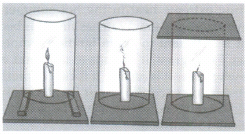
Write an experiment to show that air is necessary for burning of a candle.
5.
Give the name of two energy sources that you would consider to be exhaustible. Give reasons for your choices.
6.
A matchstick does not catch fire on its own. But when it is rubbed, it starts burning. Why?
7.
Why a matchstick can burn a splinter of wood directly but cannot burn a log of wood directly? How can we burn a log of wood?
8.
What should be done to control fire due to oil?
9.
You are provided with three watch glasses containing milk, petrol and mustard oil respectively. Suppose you bring a burning candle near these materials one by one, which material(s) will catch fire instantly and why?
10.
Abida and Ramesh were doing an experiment in which water was to be heated in a beaker. Abida kept the beaker near the wick in the yellow part of the candle flame. Ramesh kept the beaker in the outermost part of the flame. Whose water will get heated in a shorter time?
11.
Can the process of rusting be called combustion? Discuss.
12.
Explain how CO2 is able to control fires.
13.
Name the unit in which the calorific value of a fuel is expressed.
14.
Give reasons.
(a) Water is not used to control fires involving electrical equipments.
(b) LPG is a better domestic fuel than wood.
(c) Paper by itself catches fire easily, whereas a piece of paper wrapped around an aluminium pipe does not.
15.
Compare LPG and wood as fuels.
1.
All fossil fuels are in limited quantity. Thus we need a very judicious use of these fuels. For this, we must find out some alternative sources of energy as solar energy, water energy, geothermal energy etc. We must ask them to reduce unnecessary use of vehicles e.g., if four people are going from one place to single destination, they should use only one vehicle rather than more than one.
2.
These days the head of the match sticks contains only antimony trisulphide and potassium chlorate. The rubbing surface has powdered glass and a little red phosphorus. When the match stick is struck against the rubbing surface i.e., some red phosphorus, this immediately reacts with potassium chlorate on the match stick head to produce enough heat to ignite antimony trisulphide and start combustion.
3.
Types of combustion: It is of three types:
(i) Rapid combustion: When gases burn rapidly to produce heat and light, it is called rapid combustion.
(ii) Spontaneous combustion: When material suddenly bursts into flame, without the application of any apparent cause, it is called spontaneous combustion.
(iii) Explosion: When combustion takes place with sudden release of heat, sound, light and gas with a bang it is called explosion.
4.
To show that air is necessary for burning a candle.
Experiment:
(i) Fix a lighted candle on a table.
(ii) Put a glass chimney over the candle in such a way that air can enter the chimney. We find that candle burns freely.
(iii) Now, fix a glass chimney in a way that no air enters in the glass.
(iv) The flame flickers and produces smoke.
(v) The flame finally goes off because the air is not available. It is already used by the candle to burn
So, this concludes that air is necessary for burning a candle.
5.
(i) The name of two energy sources that we would consider to be exhaustible are coal and petroleum.
(ii) They will be exhaustible when continuously extracted. Moreover, the formation of these fuels under the earth takes a longer period of time.
6.
A matchstick does not catch fire on its own at room temperature because the ignition temperature of matchstick is much higher than the room temperature. The matchstick starts burning on rubbing it on the rough side provided on the matchbox. It is because the heat produced by friction heats the chemical at the head of the matchstick to its ignition temperature and makes it burn.
7.
A matchstick can burn a splinter of wood directly because it has low ignition temperature, whereas a matchstick cannot burn a log of wood directly as it has high ignition temperature. In order to burn a log of wood, a small fire is first started by burning straw (or dry grass), or paper by a matchstick, then the log of wood is placed over this fire. This fire heats the log of wood to its ignition temperature due to which it starts burning.
8.
If fire is due to oil, then water is not suitable fire extinguisher because it is heavier than oil and settles down below the oil. In such cases, sand or soil should be used.
They cut off the supply of air to the fire. Thus, fire can be controlled.
9.
The watch glass containing petrol will catch 'lire Instantly because its ignition temperature is very low. Also petrol is an inflammable substance, i.e. it can easily catch fire with a flame.
10.
The water heated by Ramesh will get heated in a shorter time because he kept his beaker near the hottest (non-luminous) zone of the flame.
11.
The process of rusting cannot be called combustion because in this process, no heat and light is produced. Due to this reason, iron is not considered as combustible substance.
12.
Carbon dioxide (CO2) is the best fire extinguisher. Being heavier than oxygen, it covers the fire like a blanket. Since, the contact between the fuel and oxygen is cut-off, the fire is controlled. It also brings down the temperature of the fuel. That is why, it is an excellent fire extinguisher.
13.
Calorific value of a fuel is expressed in kilojoule per kilogram (kJ/kg).
14.
(a) Water is not used to control fires involving electrical equipments because water is a good conductor of electricity. So, it can easily conduct electric current and causes danger of electric shocks.
(b) LPG is a better domestic fuel than wood because LPG has more calorific value and produces no pollution. While wood produces smoke and causes more pollution.
(c) It is because the ignition temperature of paper is less, so it catches fire easily. It does not catch fire, when wrapped around aluminium pipe because aluminium absorbs the heat by conduction, so paper does not attain its ignition temperature
15.
Difference between LPG and wood are as follows:
| LPG | Wood |
| It is a gaseous fuel | It is a solid fuel. |
| It does not produce smoke | It produces smoke. |
| It is easily stored in cylinders. | It requires more space to store. |
| It does not cause any pollution. | It causes more pollution |
| Its calorific value is high i.e. 55000 kJ/kg | Its calorific value is less, i.e. 17000-22000 kJ/kg. |

8th Standard CBSE Syllabus & Materials
8th Standard CBSE
CBSE 8th Science Particulate Nature of Matter - New Model Questions Papers Study Material - QB365 Set A
NEW8th Standard CBSE
CBSE 8th Science Pressure, Winds, Stroms and Cyclones - New Model Questions Papers Study Material - QB365 Set A
NEW8th Standard CBSE
CBSE 8th Mathematics Quadrilaterals - New Model Questions Papers Study Material - QB365 Set A
NEW8th Standard CBSE
CBSE 8th Mathematics A story of Numbers - New Model Questions Papers Study Material - QB365 Set A



CBSE 8th Standard CBSE Subjects
CBSE Standards




