
 100% FREE ACCESS
8th Standard CBSE Syllabus & Materials
8th Standard CBSE
CBSE 8th Social Science Theme D - Factors of Production - New Model Questions Papers Study Material - QB365 Set A
NEW8th Standard CBSE
CBSE 8th Social Science Theme C - Universal Franchise and India's Electoral System - New Model Questions Papers Study Material - QB365 Set A
NEW8th Standard CBSE
CBSE 8th Social Science Theme B - The Rise of the Marathas - New Model Questions Papers Study Material - QB365 Set A
NEW8th Standard CBSE
CBSE 8th Social Science Theme B - Reshaping India's Political Map - New Model Questions Papers Study Material - QB365 Set A
NEW8th Standard CBSE
CBSE 8th Social Science Theme A - Natural Resources and Their Use - New Model Questions Papers Study Material - QB365 Set A
NEW8th Standard CBSE
CBSE 8th Science Keeping Time with Skies - New Model Questions Papers Study Material - QB365 Set A

Published on: 16/08/2019
Force and Pressure
Download CBSE Class 8th Standard CBSE Science question papers, sample papers, important questions, and previous year solved papers in PDF format. Get free study materials, NCERT solutions, and exam preparation resources for Class 8th Standard CBSE Science
Questions + Answers key
Take MCQ Science Test
1.
Determine the pressure when a force of 200 N acts on area 20 m2
2.
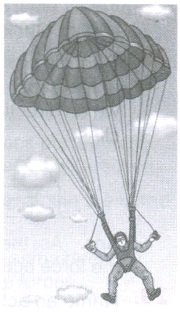
Figure shows a man with a parachute. Name the force which is responsible for his downward motion. Will he come down with the same speed without the parachute?
3.
Name the forces acting on a plastic bucket containing water held above ground level in your hand. Discuss, why the forces acting on the bucket do not bring a change in its state of motion.
4.
Give two examples each of situations in which you push or pull to change the state of motion of objects.
5.
Draper and rubber sucker work on the principle of ____________ pressure.
6.
An archer stretches her bow while taking aim at the target. She then releases the arrow, which begins to move towards the target. Based on this information, fill up the gaps in the following statements using the following terms:
( muscular, contact, non-contact, gravity, friction, shape, attraction )
While the arrow moves towards its target, the forces acting on it are due to _________ and that due to __________ of air.
7.
An archer stretches her bow while taking aim at the target. She then releases the arrow, which begins to move towards the target. Based on this information, fill up the gaps in the following statements using the following terms:
( muscular, contact, non-contact, gravity, friction, shape, attraction )
The force applied by the archer to stretch the bow is an example of __________ force.
8.
To move a loaded trolley, we have to __________ it.
9.
To draw water from a well, we have to _______ the rope.
10.
Name an activity which does not involve any pushing force.
11.
Fruits detached from a tree fall down due to the force of gravity. We know that a force arises due to interaction between two objects. Name the objects interacting in this case.
12.
A girl is pushing a box towards East direction. In which direction should her friend push the box so that it moves faster in the same direction?
13.
A ball of dough is rolled into a flat chapati. Name the force exerted to change the shape of the dough.
14.
What are contact and non-contact forces? Explain briefly with suitable examples.
15.
Amit and Sumit were good friends. They both went to gym center for exercise. As, the coach of gym told them to complete 10 dips each. So, Amit started doing it by stretching the palms on the floor while Sumit opted to do the same job on pair of rods at some height from floor.
(a) Amit got less pain while Sumit got more pain on his palm. Why?
(b) Mention the idea used by Amit here.
16.
Observe the vessels A, B, C and D as shown in figure carefully.
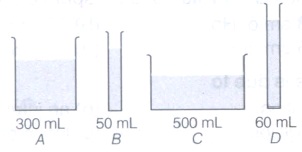
Volume of water taken in each vessel is as shown. Arrange them in the order of decreasing pressure at the base of each vessel. Explain.
17.
Briefly explain the concept of variation of atmospheric pressure.
18.
Some mustard oil is kept in the beaker. It will exert pressure
upward
downward
sideways
in all the directions
19.
Force is due to
motion
an interaction
collision
None of these
20.
Which one of the following forces is a contact force?
Force of gravity
Force of friction
Magnetic force
Electrostatic force
21.
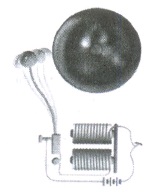
In the circuit shown in figure, when the circuit is completed, the hammer strikes the gong. Which of the following force is responsible for the movement of hammer?
Gravitational force alone
Electrostatic force alone
Magnetic force alone
Frictional force alone
22.
State of motion is described by
position of rest
position of motion
Both (a) and (b)
None of these
23.
Liquids and gases do not exert pressure on the walls of the container.
24.
In 'tug of war' when both the teams apply equal pulling force then net force is maximum.
25.
If two forces act in opposite directions, then net force is the difference between the two forces.
26.
Muscular force and frictional force are the examples of non-contact forces.
27.
Only the earth exerts gravitational force.
28.
Contact force
29.
Liquids
30.
Atmospheric pressure
31.
Force
32.
Pressure
1.
Pressure = \(\frac{Force}{Area}\)
Given, F = 200 N
For area, A = 20m2
\(p=\frac{200}{20}=10\) N/m2 or 10Pa
2.
The name of force responsible for the downward motion of the parachute is force of gravity. No, because the air friction will become less.
3.
The forces acting on a plastic bucket are gravitational force and muscular force. These forces not bring a change in its state of motion because being equal and opposite in magnitude, the effect of net force on bucket becomes zero.
4.
The two examples are as follows:
(i) We push the door to open it.
(ii) We pull a drawer to open it.
5.
()
atmospheric
6.
()
gravity, friction
7.
()
muscular
8.
()
push
9.
()
pull
10.
When a person swims freestyle, he is pulling himself forward in the water.
11.
The interacting objects in this case are: earth and fruit. Earth applies force of gravity on fruit towards its centre. So, fruit fells down.
12.
Her friend should push the box towards East direction, so that it will start moving more fast towards East because the magnitude of force increases.
13.
The shape of dough is changed due to muscular force applied by the hand.
14.
Forces can be of two types:
(i) Contact forces.
(ii) Non-contact forces.
(i) Contact forces : The forces that come into play when two objects come in contact with each other.
(a) Muscular force: The force which is exerted due to action of muscles is known as the muscular force. e.g., running, bending, walking etc.
(b) Frictional Force: The force responsible for changing the state of motion of an object. Equal and opposite forces are being exerted on an object when its surface comes in contact with other surface. e.g., a car or scooter comes to rest.
(ii) Non-contact forces: The forces that can be exerted from a distance without establishing a contact are called the non-contact forces.
(a) Magnetic forces : Force exerted by a magnet on another magnet or magnetic substances like iron is called magnetic force. e.g., Car sticking to an electromagnet.
(b) Electrostatic force : Force exerted by a charged body on another charged body or uncharged body is called electrostatic force. e.g., If we rub a comb with hair and bring it near some small bits of paper it attracts the bits of paper towards itself. This is electrostatic force.
(c) Force of gravity : The earth pulls every object towards its centre. The force exerted by the earth is called the force of gravity.
15.
(a) Sumit applied more pressure on his palm by baring the maximum load of his body on small area of palm while Amit applied less pressure on his palm by baring the same load on larger area of palm.
(b) Amit have the presence of mind and he thought of an excellent idea about pressure on the body part.
16.
Pressure at depth due to liquid column depends upon
(i) gravitational acceleration (g)
(ii) density of liquid
(iii) height of liquid.
And in this case, g and density are same, so only thing that can change pressure is height. So, the order of pressure exerted by the fluid A, B,C and D at the base is given by Po > Pa > PA > PC
17.
As, we know that the atmospheric pressure exerted by the air on the object below it. This pressure vary from place to place and from time to time due to variation in temperature. Even, the density of air decreases with the increase in temperature. So, as a result, the atmospheric pressure also decreases. The atmospheric pressure at a place is because of the weight of air above it. So, if we go higher above the earth surface, the atmospheric pressure decreases, thus at mountain top the pressure is less. The atmospheric pressure at sea level is considered as standard pressure.
18.
(d)
in all the directions
19.
(b)
an interaction
20.
(b)
Force of friction
21.
(c)
Magnetic force alone
22.
(c)
Both (a) and (b)
23.
(b)
24.
(b)
25.
(a)
26.
(b)
27.
(b)
28.
()
Muscular force
29.
()
Exert same pressure at equal depth
30.
()
76 mm of Hg
31.
()
Push or pull
32.
()
Force on unit area

8th Standard CBSE Syllabus & Materials
8th Standard CBSE
CBSE 8th Science Particulate Nature of Matter - New Model Questions Papers Study Material - QB365 Set A
NEW8th Standard CBSE
CBSE 8th Science Pressure, Winds, Stroms and Cyclones - New Model Questions Papers Study Material - QB365 Set A
NEW8th Standard CBSE
CBSE 8th Mathematics Quadrilaterals - New Model Questions Papers Study Material - QB365 Set A
NEW8th Standard CBSE
CBSE 8th Mathematics A story of Numbers - New Model Questions Papers Study Material - QB365 Set A



CBSE 8th Standard CBSE Subjects
CBSE Standards




