
 100% FREE ACCESS
8th Standard CBSE Syllabus & Materials
8th Standard CBSE
CBSE 8th Social Science Theme D - Factors of Production - New Model Questions Papers Study Material - QB365 Set A
NEW8th Standard CBSE
CBSE 8th Social Science Theme C - Universal Franchise and India's Electoral System - New Model Questions Papers Study Material - QB365 Set A
NEW8th Standard CBSE
CBSE 8th Social Science Theme B - The Rise of the Marathas - New Model Questions Papers Study Material - QB365 Set A
NEW8th Standard CBSE
CBSE 8th Social Science Theme B - Reshaping India's Political Map - New Model Questions Papers Study Material - QB365 Set A
NEW8th Standard CBSE
CBSE 8th Social Science Theme A - Natural Resources and Their Use - New Model Questions Papers Study Material - QB365 Set A
NEW8th Standard CBSE
CBSE 8th Science Keeping Time with Skies - New Model Questions Papers Study Material - QB365 Set A

Published on: 20/09/2019
Microorganisms Friend and Foe
Download CBSE Class 8th Standard CBSE Science question papers, sample papers, important questions, and previous year solved papers in PDF format. Get free study materials, NCERT solutions, and exam preparation resources for Class 8th Standard CBSE Science
Questions + Answers key
Take MCQ Science Test
1.
Shikha while teaching her sister about microbes explained that microbes are useful to humans. Hearing this, her sister Sneha got confused as she knew that her Uncle was suffering from TB caused by microbes. She asked this to Shikha. Shikha appreciated Sneha was asking this question and explained her.
(i) What are microbes?
(ii) How are microbes helpful to humans?
(iii) Mention two diseases other than TB caused by microbes.
(iv) Identify the values shown by Sneha.
2.
How do vaccines work?
3.
Explain the various shapes of bacteria.
4.
Draw structure of virus and amoeba.
5.
Why are salt and edible oils also called preservatives? Name two chemicals that are used as common preservatives.
6.
Boojho wants to know what is pasteurization.
7.
Give some points to show that bacteria have beneficial effects.
8.
Yeast is very useful for baking industry. Elucidate the role of yeast.
9.
Classify the following into friendly and harmful microorganisms. Yeast, malarial parasite, Lactobacillus, bread mould, Rhizobium, Bacillus anthracis.
10.
What will happen to 'pooris' and 'unused kneaded flour' if they are left in the open for a day or two?
11.
Microorganisms survive under adverse conditions. How?
12.
Write a short paragraph on the harmful effects of microorganisms.
13.
Write 10 lines on the usefulness of microorganisms in our lives.
14.
What are the major groups of microorganisms?
1.
(i) Organisms that cannot be seen with eyes alone or with naked eyes are called microbes.
(ii) Microbes are useful to humans in many ways:
They help in the production of curd, cheese, in cleaning the environment etc.
(iii) Diseases caused by microbes are polio, malaria etc.
(iv) Sneha is attentive, responsive and curious.
2.
The body produce antibodies when a disease carrying microbe enters in it. The body also retains memory of this encounter to fight the microbe if it enters again. A vaccine consists of dead or weakened microbes which when introduced in a healthy body, produce suitable antibodies to fight and kill themselves. These antibodies remain in the body to protect it from disease causing microbes thus develop immunity.
3.
The bacteria are classified into three types on the basis of their shape:
(a) Rod shaped (Bacillus) :
Example: Lactobacillus

(b) Round shaped (Coccus) :
Example: Streptococcus

(c) Spiral shaped
Example: Treponema

4.
Virus:
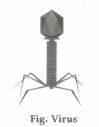
Amoeba:
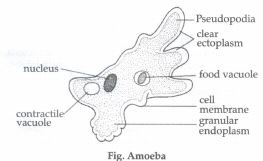
5.
Salt and edible oils are the common chemicals generally used to check the growth of microorganism. Sodium benzoate and metabisulphate are common preservatives.
6.
The milk is heated to 70°C for 15 seconds and then suddenly chilled and stored. By doing so, it prevents the growth of microbes. This process was discovered by Louis Pasteur. It is called Pasteurization.
7.
Beneficial effects of bacteria are as follows :
(i) They give us various milk products like curd and cheese
(ii) They cause immune enhancement and prevents intestinal disorders
(iii) They decompose organic matter to give nutrients to plants.
8.
Yeast plays an important role in baking industry. It reproduces rapidly and produces CO2 during respiration. Bubbles of the gas fill the dough and increase its volume, making the products such as bread, cake and fluffy.
9.
| Friendly | Harmful |
| yeast | Malarial parasite |
| lactobacillus | Bread mould |
| Rhizobium | Bacillus anthracis |
10.
The 'unused kneaded flour' if left in warm conditions, gets infected by microbes which cause fermentation and spoils the flour. The pooris would remains in relatively good condition because these were deep fried in heated oil that kills microbes.
11.
Microorganisms survive under adverse conditions by forming a hard and protective covering called cyst around them. On return of favourable conditions, the cyst wall breaks and microorganisms resume their life cycles.
12.
Microorganisms are harmful for human beings in many ways. They cause diseases in humans, plants and animals, e.g.
(i) In humans, bacteria cause diseases such as cholera, typhoid, tuberculosis, etc.
(ii) In cattle, the foot and mouth disease is caused by a virus.
(iii) Also several microbes cause diseases in plants, e.g. tikka disease, late blight of potato. Some microbes grow on food and secrete toxic substances which make the food poisonous.
13.
Microorganisms are useful for the humans and plants in following ways:
(i) They are used in preparation of food items such as breads.
(ii) Bacteria are used in the conversion of milk into curd.
(iii) They are used for the large scale production of alcohol, wine, and acetic acid.
(iv) A number of medicines such as antibiotics are being produced from bacteria and fungi.
(v) They are used to check microbial infections in animals.
(vi) Vaccines are made by dead or weakened microbes.
(vii) Some bacteria and blue-green algae increase the soil fertility by fixing atmospheric nitrogen.
(viii) They decompose the dead organic wastes of plants and animals.
(ix) They are used in cleaning up of the environment.
(x) Certain microbes are also used in the biological treatment of sewage and industrial effluents.
14.
Microorganisms are divided into four major groups which are as follows:
(i) Bacteria These are single-celled organisms which are harmful, as they cause disease and some of them may be useful as in. vaccines.
(ii) Fungi These are non-green plants which consume their food from the dead organic matter.
(iii) Protozoa These are unicellular animals which causes diseases like malaria and dysentery.
(iv) Algae These are photoautotrophic organisms, that may be unicellular or multicellular. They play important role in medicines, agriculture, industry and as food. Some microbiologists also classify viruses as microorganisms, but other consider these as non-living. They are those microbes which reproduce only inside the cells of host organisms. They cause diseases like cold, polio, AIDS, etc.

8th Standard CBSE Syllabus & Materials
8th Standard CBSE
CBSE 8th Science Particulate Nature of Matter - New Model Questions Papers Study Material - QB365 Set A
NEW8th Standard CBSE
CBSE 8th Science Pressure, Winds, Stroms and Cyclones - New Model Questions Papers Study Material - QB365 Set A
NEW8th Standard CBSE
CBSE 8th Mathematics Quadrilaterals - New Model Questions Papers Study Material - QB365 Set A
NEW8th Standard CBSE
CBSE 8th Mathematics A story of Numbers - New Model Questions Papers Study Material - QB365 Set A



CBSE 8th Standard CBSE Subjects
CBSE Standards




