
 100% FREE ACCESS
8th Standard CBSE Syllabus & Materials
8th Standard CBSE
CBSE 8th Social Science Theme D - Factors of Production - New Model Questions Papers Study Material - QB365 Set A
NEW8th Standard CBSE
CBSE 8th Social Science Theme C - Universal Franchise and India's Electoral System - New Model Questions Papers Study Material - QB365 Set A
NEW8th Standard CBSE
CBSE 8th Social Science Theme B - The Rise of the Marathas - New Model Questions Papers Study Material - QB365 Set A
NEW8th Standard CBSE
CBSE 8th Social Science Theme B - Reshaping India's Political Map - New Model Questions Papers Study Material - QB365 Set A
NEW8th Standard CBSE
CBSE 8th Social Science Theme A - Natural Resources and Their Use - New Model Questions Papers Study Material - QB365 Set A
NEW8th Standard CBSE
CBSE 8th Science Keeping Time with Skies - New Model Questions Papers Study Material - QB365 Set A

Published on: 03/10/2019
Reaching the Age of Adolescence
Download CBSE Class 8th Standard CBSE Science question papers, sample papers, important questions, and previous year solved papers in PDF format. Get free study materials, NCERT solutions, and exam preparation resources for Class 8th Standard CBSE Science
Questions + Answers key
Take MCQ Science Test
1.
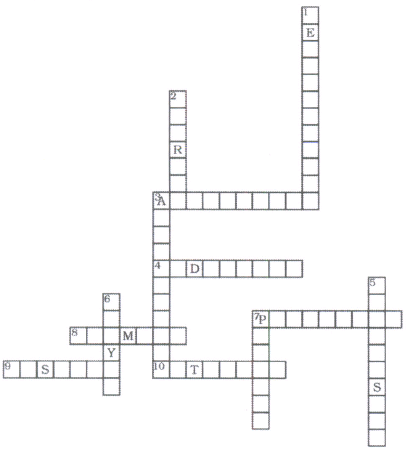
Word game : Use the clues to work out the words.
Across:
(3) Protruding voice box in boys
(4) Glands without ducts
(7) Endocrine gland attached to brain
(8) Secretion of endocrine glands
(9) Pancreatic hormone
(10) Female hormone
Down:
(1) Male hormone
(2) Secretes thyroxine
(3) Teenage
(5) Hormone reaches here through blood stream
(6) Voice box
(7) Changes at adolescence constitute
2.
It is believed that height of a child depends upon the genes inherited from parents. However, it is often seen that tall parents may have short children and vice-versa. Are these factors other than genes that can cause these variations?
3.
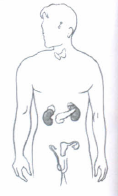
In figure, mark the position of the endocrine glands which release the hormones that
(a) control the release of sex hormones.
(b) are responsible for the secondary sexual characters in boys.
(c) prevent diabetes.
(d) maintain the correct salt balance in the blood.
4.
During adolescence, the body of boys and girls undergoes certain changes. Given below are few of those changes
(a) Broad shoulders
(b) Wider chests
(c) Wider region below waist
(d) Development of muscles
(e) Development of mammary glands
(f) Growth of facial hair
(g) Acne and pimples on face
(h) Development of sex organs
(i) High-pitched voice
(j) Growth of pubic hair
Categorise these changes into those that occur in boys and those that occur in girls and fill in the table given below.
Body changes during adolescence
| Boy | Girl |
|---|---|
5.
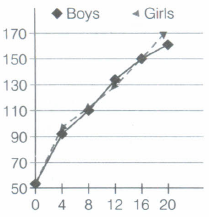
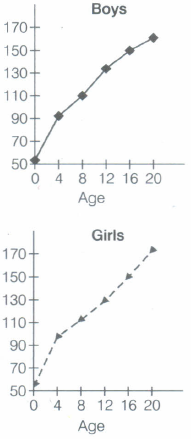
The table below shows the data on likely heights of boys and girls as they grow in age. Draw graphs showing height and age for both boys and girls on the same graph paper. What conclusions can be drawn from these graphs?
| Age (Years) | Height (cm) | |
| Boy | Girl | |
| 0 | 53 | 53 |
| 4 | 96 | 92 |
| 8 | 114 | 110 |
| 12 | 129 | 133 |
| 16 | 150 | 150 |
| 20 | 173 | 165 |
6.
Write notes on—
(a) Adam’s apple.
(b) Secondary sexual characters.
(c) Sex determination in the unborn baby.
1.
(1) Testosterone
(2) Thyroid
(3) Adam's apple, Adolescence
(4) Endocrine
(5) Target sites
(6) Larynx
(7) Pituitary, Puberty
(8) Hormone
(9) Insulin
(10) Estrogen.
2.
Height of a child depends upon the genes inherited from parents. However, there are some other factors also that can affect height. These factors include balanced diet, hormones, exercise, diseases. Balanced diet is essential for the adolescents as it helps the bones, muscles and other parts of the body to get adequate nourishment for growth.
Similarly, lack of hormones as growth hormones may lead to dwarfism. Regular exercise is also essential for proper development lack of disease is a priority for proper growth that is related to other factors listed above. Thus, height depends on combination of various factors.
3.
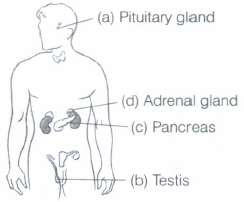
(a) Pituitary gland It releases hormones that control the release of sex hormones, i.e. testosterone in males and oestrogen in females.
(b) Testis It releases testosterone which is responsible for the secondary sexual character in boys.
(c) Pancreas It releases insulin which prevents diabetes.
(d) Adrenal gland It releases aldosterone that maintains the correct salt balance in the blood
4.
Body changes during adolescence are given below
| Boy | Girl |
|---|---|
| Broad shoulders | Wider region below waist |
| Wider chests | Development of mammary glands |
| Development of muscles | Acne and pimples on face |
| Growth of facial hair | Development of sex organs |
| Acne and pimples on face | High-pitched voice |
| Development of sex organs | Growth of pubic hair |
| Growth of pubic hair |
5.
We conclude that initially, girls grow faster than boys but by about 18 years of age, both reach at their maximum height. The rate of growth in height varies in different individuals.
6.
(a) Adam's apple The protruding part of the growing voice box is called Adam's apple in males. In boys, voice box (larynx) develops larger than girls and this protruding part is seen as bulge in the neck area.
(b) Secondary sexual characters The physical features that help to distinguish the males from the females are called secondary sexual characters. These characters develop at the time of puberty. The secondary sexual characteristics in humans are given below:
In males,
(i) Growth of pubic hair, beard and moustaches.
(ii) Hair on chest and underarms.
In females,
(i) Enlargement of breasts.
(ii) Appearance of pubic hair, hair under arms.
(c) Sex determination of the unborn baby Sex of the unborn baby is determined by the sex chromosomes, i.e. X and Y. A female has two X-chromosomes, while a male have one X and one Y-chromosome.
So in females, the gamete, i.e. egg have only one X-chromosome but in males, the sperm, i.e. male gamete may have an X-chromosome or V-chromosome. If the egg fertilises with sperm containing X-chromosome, the zygote will develop into a female (XX) and if the egg fertilises with sperm containing V-chromosome, the zygote will develop into a male (XY).

8th Standard CBSE Syllabus & Materials
8th Standard CBSE
CBSE 8th Science Particulate Nature of Matter - New Model Questions Papers Study Material - QB365 Set A
NEW8th Standard CBSE
CBSE 8th Science Pressure, Winds, Stroms and Cyclones - New Model Questions Papers Study Material - QB365 Set A
NEW8th Standard CBSE
CBSE 8th Mathematics Quadrilaterals - New Model Questions Papers Study Material - QB365 Set A
NEW8th Standard CBSE
CBSE 8th Mathematics A story of Numbers - New Model Questions Papers Study Material - QB365 Set A



CBSE 8th Standard CBSE Subjects
CBSE Standards




