
 100% FREE ACCESS
8th Standard CBSE Syllabus & Materials
8th Standard CBSE
CBSE 8th Social Science Theme D - Factors of Production - New Model Questions Papers Study Material - QB365 Set A
NEW8th Standard CBSE
CBSE 8th Social Science Theme C - Universal Franchise and India's Electoral System - New Model Questions Papers Study Material - QB365 Set A
NEW8th Standard CBSE
CBSE 8th Social Science Theme B - The Rise of the Marathas - New Model Questions Papers Study Material - QB365 Set A
NEW8th Standard CBSE
CBSE 8th Social Science Theme B - Reshaping India's Political Map - New Model Questions Papers Study Material - QB365 Set A
NEW8th Standard CBSE
CBSE 8th Social Science Theme A - Natural Resources and Their Use - New Model Questions Papers Study Material - QB365 Set A
NEW8th Standard CBSE
CBSE 8th Science Keeping Time with Skies - New Model Questions Papers Study Material - QB365 Set A

Published on: 03/10/2019
Reproduction in Animals
Download CBSE Class 8th Standard CBSE Science question papers, sample papers, important questions, and previous year solved papers in PDF format. Get free study materials, NCERT solutions, and exam preparation resources for Class 8th Standard CBSE Science
Questions + Answers key
Take MCQ Science Test
1.
What are clones? What are the various steps of this process? Explain with examples.
2.
Explain the process of reproduction in human beings with suitable diagrams.
3.
(a) Give the term used for the fusion of gametes.
(b) Name the type of fertilisation in humans
(c) Where does it mainly occur?
(d) Fertilisation in humans takes place'ln female. How?
4.
Observe the following figures.
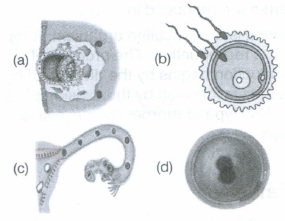
(i) Identify the stages (a) to (d) in figure during development of human baby.
(ii) Arrange the stages in correct sequence of development.
(iii) Explain the development that takes place in anyone stage.
5.
How can we say that fish exhibits external fertilisation?
6.
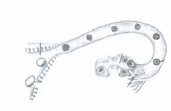
After observing figure above, answer the following.
(a) Read the following statements and label them in the figure.
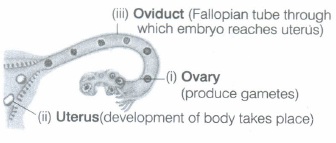
(i) The part which produces female gametes.
(ii) The part where development of the baby takes place.
(iii) The part through which the developing embryo passes to reach the uterus.
(b) Explain the future development of the embryo that would take place after it gets embedded in the uterus.
1.
Cloning is the production of an exact copy of a cell any other living part, or a complete organism. Ian Wilmut and his colleagues at the Roslin Institute, Edinburgh, Scotland successfully cloned a sheep named Dolly.
Following steps were involved in cloning:
(i) A cell was collected from the mammary gland of a female sheep.
(ii)An egg was obtained from a Scottish blackface and its nucleus was removed.
(iii)The nucleus from the mammary gland cellof Dorset sheep was introduced in the egg.
(iv)This egg was then implanted in the uterus.
2.
Reproduction in human beings: In humans, internal reproduction takes place. There are two sexes in human beings - male & female. Male reproductive parts include a pair of testes, two sperm ducts and a penis. The testes produce the sperms. The female reproductive organs are a pair of ovaries, oviduct and the uterus
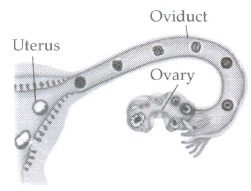
The ovary produces female gametes called ova. Fusion of the egg and the sperm is called fertilization. This results in the formation of a fertilized egg or zygote. Zygote begins to develop into an embryo. The zygote repeatedly gives rise to a ball of cells. The cells then begin to form groups and organs of the body which form embryo. The stage of the embryo in which all the body parts can be identified is called foetus. When the development of the foetus is complete, the mother gives birth to the baby.
3.
(a) Fertilisation is the term used for the fusion of a male gamete (sperm) and a female gamete (ovum or egg) to form a zygote during sexual reproduction.
(b) Internal fertilisation takes place in humans.
(c) Fertilisation mainly occurs in the Fallopian tube.
4.
(i) The figures showing stages during development of embryo are identified as
(a) Embedding of the embryo in the uterus (implantation).
(b) Fertilisation (fusion of egg and sperm).
(c) Zygote formation and development of an embryo from the zygote.
(d) Zygote (showing fusion of gametes) single celled.
(ii) The above stages in sequence are
(b) Fertilisation ⟶ (d) Zygote formation ⟶
(c) Development of embryo ⟶
(a) Implantation of embryo in uterus.
(iii) The embryo after being implanted in uterus, continues to develop and divide and differentiate into body parts. This stage of embryo where body parts are distinct and identified is called foetus. After complete development of foetus, mother gives birth to baby.
5.
Female fish lay eggs in water while male fish release their sperms in water. Sperms swim and reach the eggs of fish, randomly due to water currents.
When a sperm comes in contact with the viable egg, nuclei of both the cell fuses to form a zygote. This process of fertilisation takes place in water outside the female body, hence fertilisation is external in fishes.
6.
(a) The parts in the figure are labelled below:
(b) The embryo continues to develop after it gets embedded in the uterus. It divides and differentiates into three germ layers which give rise to different body parts such as hands, legs, head, eyes, ears, etc. This stage where all the body parts are distinct and easily identified in developing embryo is called foetus. After completion of development of foetus, mother gives birth to baby.

8th Standard CBSE Syllabus & Materials
8th Standard CBSE
CBSE 8th Science Particulate Nature of Matter - New Model Questions Papers Study Material - QB365 Set A
NEW8th Standard CBSE
CBSE 8th Science Pressure, Winds, Stroms and Cyclones - New Model Questions Papers Study Material - QB365 Set A
NEW8th Standard CBSE
CBSE 8th Mathematics Quadrilaterals - New Model Questions Papers Study Material - QB365 Set A
NEW8th Standard CBSE
CBSE 8th Mathematics A story of Numbers - New Model Questions Papers Study Material - QB365 Set A



CBSE 8th Standard CBSE Subjects
CBSE Standards




