
 100% FREE ACCESS
8th Standard CBSE Syllabus & Materials
8th Standard CBSE
CBSE 8th Social Science Theme D - Factors of Production - New Model Questions Papers Study Material - QB365 Set A
NEW8th Standard CBSE
CBSE 8th Social Science Theme C - Universal Franchise and India's Electoral System - New Model Questions Papers Study Material - QB365 Set A
NEW8th Standard CBSE
CBSE 8th Social Science Theme B - The Rise of the Marathas - New Model Questions Papers Study Material - QB365 Set A
NEW8th Standard CBSE
CBSE 8th Social Science Theme B - Reshaping India's Political Map - New Model Questions Papers Study Material - QB365 Set A
NEW8th Standard CBSE
CBSE 8th Social Science Theme A - Natural Resources and Their Use - New Model Questions Papers Study Material - QB365 Set A
NEW8th Standard CBSE
CBSE 8th Science Keeping Time with Skies - New Model Questions Papers Study Material - QB365 Set A

Published on: 18/09/2018
Model Question II
Download CBSE Class 8th Standard CBSE Social Science question papers, sample papers, important questions, and previous year solved papers in PDF format. Get free study materials, NCERT solutions, and exam preparation resources for Class 8th Standard CBSE Social Science
Questions + Answers key
Take MCQ Social Science Test
1.
What do you know about the public water supply in Porto Alegre?
2.
Briefly describe the religious beliefs of Adivasis.
3.
What provisions are made to protect the interests of minorities?
4.
How would you recognise the presence of a poisonous gas in the air? What precautions would you take to protect yourself and your family against its harmful effects?
5.
Why is cotton textile industry mainly situated in Gujarat and Maharashtra?
6.
Explain the favourable factors for the location of steel plant at Jamshedpur.
7.
Find out: Do you think the minimum wage for a construction worker is adequate, low or high?
8.
What metals are important in present-day India? Why? Where do they come from? Are there Adivasi populations there?
9.
Explain at least three different reasons why groups .may be marginalised.
10.
What kinds of cloth had a large market in Europe?
11.
Agarias, a community living in central India was specialised in:
Wearing
Iron smelting
Mine working
Dyeing cloth
12.
When did the government amend the 'Child Labour Prevention Act'?
December, 2001
January, 2004
October, 2006
July, 2007
13.
What is the literacy rate of Muslims in India (2001)?
90 per cent
76 per cent
69 per cent
59 per cent
14.
A ghetto is an area/locality populated by
poor people
members of a particular community
malnourished people
displaced people
15.
Where is Porto Alegre situated?
Bolivia
Portugal
Brazil
Spain
16.
The raw material of textile industry is/are
cotton only
silk only
fibres
None of these
17.
Industrial disaster occurred in Bhopal on
3rd December, 1974
3rd December, 1980
3rd December, 1983
3rd December, 1984
18.
TISCO was started in the year ______ at Sakchi.
1907
1980
1807
1957
19.
Right to Education is guaranteed for all children aged between
5-15 years
6-14 years
6- 2 years
5-10 years
20.
In the 1850s, Britain came to be known as the _____________
textile hub
most industrialised nation
workshop of the world
devil's workshop
21.
Bengaluru has some important public sector industries and research institutions. Find out the full forms of the organizations listed below:
22.
Who are Scheduled Castes? Discuss constitutional provisions for safeguarding the interests of SCs and STs.
23.
What simple Do-s and Don't-s can you list in case of a biological disaster?
24.
How has the government fared in its responsibility to enforce safety laws?
25.
Should private companies be allowed to take over the task of water supply?
26.
Look at the given picture and answer the following questions.
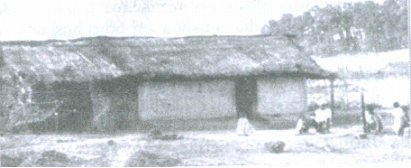
(i) Name the community, who was lived in this village?
(ii) In which century a series of famines devastated the dry tracts of India.
27.
Name some of the communities in different parts of India famous for weaving
28.
Name the two crafts and industries of India during British rule
29.
What are minimum wages?
30.
How can laws ensure that markets work in a manner that is fair?
31.
What causes man-made disasters?
32.
Find out how potassium Iodate tablets can be used to counter exposure to radioactivity.
33.
Write a short note on Calico Act
34.
What measures can be taken to reduce the risks of industrial accidents?
35.
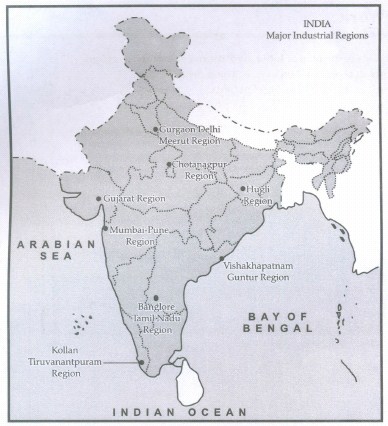
Mention the major industrial regions of India and show them on the outline map of India.
1.
Proto Alegre is a city in Brazil. The water supply condition in this city is excellent. The average price of water is very low, so it is easily accessible by all The poor people are charged half the basic rate. The profits is used to improve the water supply.
2.
(i) They often are involved in the worship of ancestors, village and natural spirits, associated with and residing in various sites in the landscape -' mountain-spirits', 'river-spirits', 'animal-spirits', etc.
(ii) The village spirits are often worshipped at specific sacred groves within the village boundary, while the ancestral ones are usually worshipped at home.
(iii) Adivasis have always been influenced by different surrounding religions like Shakta, Buddhist, Vaishnav, Bhakti and Christianity.
3.
(i) No citizen shall be denied admission into any educational institution maintained by the state or receiving aid out of state funds on grounds of religion, race, sex, caste, language, etc.
(ii) Any section of the citizens residing in the territory of India or any part thereof, having a distinct language, script or culture of its own, shall have the right to conserve the same.
4.
Poisonous gases are colorless and odorless, but their presence can be recognised through which we can save ourselves and our family too. These are now:
(i) The first symptoms of a possible chemical leakage are irritation, burning, and redness in the nostrils and eyes, followed by nausea, dizziness, and disorientation. Pungent or bitter-sweet smells indicate the presence of a gas in the air.
(ii) That panic induced fleeing during a gas leakage is harmful. Stay calm in the same place, put a wet cloth on your face and breath through it. Most gases will dissolve in water.
(iii) Lying down close to the ground may help since most hazardous gases are lighter than air and will tend to rise upwards.
5.
The main reasons why cotton textile industry is situated in Gujarat and Maharashtra are:
i) The climate of these states is moist
ii) The black soil of these states is best suited for cultivation of cotton.
iii) They have better means of transport and are linked with other parts of the country with soil and rounds.
6.
Iron and steel industry is located at Jamshedpur due to the following factors:
(i) Manganese is obtained from Keonjhar district of Odisha.
(ii) Well-developed network of transport is available.
(iii) Kolkata provides port facilities.
(iv) Cheap and skilled labour is available from the nearby states.
7.
It is barely adequate
8.
Metals like iron and aluminium are important in present-day India.
They are required for building infrastructure including roads, bridges, rail-lines, aeroplanes ete. They come from the mines of iron ore and " aluminium ore under forest lands. Yes, there are Adivasi populations inhabiting those places.
9.
Groups may be marginalised because of the following reasons:
(i) Different spoken languages
(ii) Different customs and religions
(iii) Low social status
10.
From the 1680s onwards, cotton and silk textiles had a large market in Europe. Such textiles made in India were popular because of their excellent quality, fine craftsmanship and low price. Among various varieties sold in the European markets, chintz, cossaes (or khassa), bandanna and jamdani were the most well-known.
11.
(b)
Iron smelting
12.
(c)
October, 2006
13.
(d)
59 per cent
14.
(b)
members of a particular community
15.
(c)
Brazil
16.
(c)
fibres
17.
(d)
3rd December, 1984
18.
(a)
1907
19.
(b)
6-14 years
20.
(c)
workshop of the world
21.
1. BEL: Bharat Electronics Limited
2. BHEL: Bharat Heavy Electricals Limited
3. HAL: Hindustan Aeronautics Limited
4. NAL: National Aerospace Laboratories
5. DRDO: Defense Research Development Organization
6. ISRO: Indian Space Research Organization
7. ITI: Indian Telephone Industries Limited
8. IISc: Indian Institute of Science
9. NCBS: National Centre for Biological Sciences
10. UAS: University of Agricultural Sciences.
22.
(i) People who were formerly treated as untouchables in the society are called Scheduled Castes.
(ii) The chief provisions for uplifting and safeguarding the interests of the SCs and STs are the following:
(a) Article 46 of the Constitution provides, "The care, the educational and economic interests of the weaker sections of the people and in particular of the SCs and the STs, shall protect them from social injustice and all form of exploitation".
(b) Article 17 declares, "Untouchability is abolished and its practice in any form is forbidden. It enforces that any disability arising out of the untouchability shall be an offence punishable with law."
(c) According to article 275, "There shall be a pay out of the consolidated fund of India as grants- in-aid of the revenues of states. Such capital and recurring sums as may be undertaken by the state, with the approval of the government for the purpose of raising the level of administration of the scheduled areas therein to that of the administration of the rest of that state."
(d) The Preamble to the Constitution of India, the Fundamental Rights and the Directive Principles of the State Policy also contain several provisions for safeguarding interests of the SCs and STs.
Implementation of the Constitution provisions :
To implement the above Constitution provisions, several steps have been taken for the welfare and upliftment of the weaker sections of the society. These include:
(i) Jobs in the government are reserved for the Scheduled Castes and Scheduled Tribes.
(ii) Seats are reserved for SCs and STs in educational institutions.
(iii) Some constituencies of Lok Sabha and the State Assemblies are reserved for the SC and ST candidates. In such constituencies, only a SC or ST
candidate can contest the elections.
(iv) Provisions have been made for various competitive examinations to improve the representation of SCs and STsin various services.
(v) Book banks have been provided to SC and ST students aspiring for Engineering and medical courses.
(vi) Scholarship and grants for higher education from abroad are also given.
(vii) Hostel facility for SC and ST girls studying in schools, colleges and universities have been given. Most of the above provisions are common to both, the SC and ST people.
(viii) Vocational Training Programmes have been started in tribal areas by opening educational institutions for the promotion of female literacy in these areas.
23.
Do's in the event of biological disasters:
(i) Follow regular hygienic methods as before eve!}' principal meal wash your hands with antibiotic soap.
(ii) Before cooking always wash vegetables properly. Follow active immunization.
(iii) If sickness occurs, immediately contact health authorities without any delay. In case of mosquitoes use nets or repellants at night.
Don'ts in the event of biological disasters:
(i) Do not panic and be calm.
(ii) Do not allow waste material to gather in or around your locality.
(iii) Do not allow stagnant water accumulated around you.
(iv) Do not eat stale food items.
24.
The government is responsible for making and implementing sound safety laws in the country for the protection of its citizens and upholding the Fundamental Right to Life. However, the Bhopal gas tragedy was a tragic proof of government's failure in fulfilling this responsibility. First, the safety laws were lax in India. Second, even these weak safety laws were not fully enforced.
The government officials refused to recognise the Bhopal plant as hazardous and allowed it to come up in a populated locality. Despite objections, the government insisted that clean technologies and safer procedures were notJUs an option because the state needed jobs and investment. The government thus failed in its responsibility to protect the interests of the people and seriously compromised on their safety.
25.
If private companies are given the responsibility of providing public facilities such as water, they will charge more. In such a situation, only some people will be able to afford to buy water. Thus, even though some private companies are providing the facility of water, this facility is not available to all at an affordable rate. If we go by the rule that people will get as much as they can pay for, then many people will be deprived of the opportunity to live a decent life. The government not private companies should work towards making available public facilities for all and guarantee the Right to Life.
26.
(i) Agarias - a community of iron smelters were lived in this village.
(ii) In the late 19th century a series of famines devastated the dry tracts of India.
27.
The famous communities for weaving were the 'tanti" weavers of Bengal, the "julahas" or "monin" weavers of north India, "Sale" and "Kaikollar " and devangs" of south India.
28.
Textiles and iron and steel.
29.
Wages means all payment capable of being articulated in terms of money, and are payable to a person employed in respect of his employment or for work done in such employment. Minimum Wages are the wages which would be sufficient to cover the bare minimum needs of the worker and his family. Each country sets its own minimum wage laws and regulations.
30.
Because of the followings laws ensure that markets work in a manner that is fair:
(i) The businessmen should not sale adulterated articles or things of low quality. Shopkeepers should not keep expired products.)
(ii) Shopkeepers should use proper ISI mark, balance, weights or measurements and charge prices less than MRP fixed by the producers.
31.
Man-made disasters are caused by human actions including major accidents, deliberate or inadvertent actions of individuals or groups.
32.
Potassium iodate can be used to protect the thyroid against the accumulation of radioactive iodine. It does this by saturating the body with a stable source of iodine prior to this exposure.
33.
(i) When the Portuguese first came to India in search of spices, they landed in Calicut on the Kerala coast in South - West India.
(ii) The cotton textiles which they took back to Europe, along with the spices, came to be called as "calico" (derived from Calicut), and subsequently, calico became the general name for all cotton textiles.
(iii) By the early 18th century, worried by the popularity of Indian textiles, wool and silk makers in England began protesting against the import of Indian cotton textiles.
(iv) In 1720, the British government enacted a legislation banning the use of printed cotton textiles chintz - in England. This Act was known as the CalicoAct
34.
The following measures can be taken to reduce the risks of industrial accidents:
(i) Densely populated residential areas should be situated far away from the industrial areas.
(ii) People staying in the vicinity of industries should be aware of the way of storage of toxins or hazardous substances and their possible effects, in case if an accident occurs.
(iii) Fire warning and fighting system should be improved.
(iv) Storage capacity of toxic substances should be limited.
35.
India has eight industrial regions and they are:
(i) Mumbai-Pune Region: It extends from Thane to Pune and the adjoining districts of Nasik and Sholapur.
(ii) Hugli Region: It extends from Bansbaria in the north to Birlanagar in the south.
(iii) Bangalore- Tamil Nadu Region: It extends from Banglore to all parts of Tamil Nadu except Villupuram.
(iv) Gujarat Region: It lies between Ahmedabad and Vadodara in the south to Jamnagar in the west.
(v) Chhotanagpur Region: It extends over Jharkhand, northern Odisha and western West Bengal.
(vi) Vishakhapatnam-Guntur Region: It extends from Vishakhapatnam district to Kurnool and Prakasam district in the south.
(vii) Gurgaon-Delhi-Merrut Region: It includes Gurgaon, Delhi, Shahadara, Faridabad, Ghaziabad, Meerut, Modinagar, Ambala, Agra and Mathura.
(viii) Kollam- Thiruvananthapuram Region: It is spread over Thiruvananthapuram, Kollam, Alwaye, Ernakulam, and Alappuzha districts.

8th Standard CBSE Syllabus & Materials
8th Standard CBSE
CBSE 8th Science Particulate Nature of Matter - New Model Questions Papers Study Material - QB365 Set A
NEW8th Standard CBSE
CBSE 8th Science Pressure, Winds, Stroms and Cyclones - New Model Questions Papers Study Material - QB365 Set A
NEW8th Standard CBSE
CBSE 8th Mathematics Quadrilaterals - New Model Questions Papers Study Material - QB365 Set A
NEW8th Standard CBSE
CBSE 8th Mathematics A story of Numbers - New Model Questions Papers Study Material - QB365 Set A



CBSE 8th Standard CBSE Subjects
CBSE Standards




