
 100% FREE ACCESS
8th Standard CBSE Syllabus & Materials
8th Standard CBSE
CBSE 8th Social Science Theme D - Factors of Production - New Model Questions Papers Study Material - QB365 Set A
NEW8th Standard CBSE
CBSE 8th Social Science Theme C - Universal Franchise and India's Electoral System - New Model Questions Papers Study Material - QB365 Set A
NEW8th Standard CBSE
CBSE 8th Social Science Theme B - The Rise of the Marathas - New Model Questions Papers Study Material - QB365 Set A
NEW8th Standard CBSE
CBSE 8th Social Science Theme B - Reshaping India's Political Map - New Model Questions Papers Study Material - QB365 Set A
NEW8th Standard CBSE
CBSE 8th Social Science Theme A - Natural Resources and Their Use - New Model Questions Papers Study Material - QB365 Set A
NEW8th Standard CBSE
CBSE 8th Science Keeping Time with Skies - New Model Questions Papers Study Material - QB365 Set A

Published on: 03/10/2019
How, When and Where
Download CBSE Class 8th Standard CBSE Social Science question papers, sample papers, important questions, and previous year solved papers in PDF format. Get free study materials, NCERT solutions, and exam preparation resources for Class 8th Standard CBSE Social Science
Questions + Answers key
Take MCQ Social Science Test
1.
Read the source given and answer the questions that follow:
Newspapers provide an account of the movements in different parts of the country. Here is a report of a police strike in 1946. More than 2000 policemen in Delhi refused to take their food on Thursday morning as a protest against their low salaries and the bad quality of food supplied to them from the Police Lines kitchen. As the news spread to the other police stations, the men there also refused to take food. One of the strikers said: "The food supplied to us from the Police Lines kitchen is not fit for human consumption. Even cattle would not eat the chapattis and dal which we have to eat."
(i) Do you remember the source of this literary evidence?
(ii) To which event the above source is related?
(iii) What was the grievance of the policemen?
(iv) What is the importance of these types of literary sources?
2.
Which method of periodization was followed by most of the English historians for writing Indian history? Why was this method not suitable in context to India?
3.
Describe the way in which the Britishers started the very important procedure of writing the history.
4.
"James Rennel was a supporter of British rule in India". Justify this statement.
5.
What can a historian derive from surveys?
6.
What is a Survey? Give examples of different types of surveys conducted.
7.
What is History? Why and how do we periodise a time in History?
8.
Why do we continue to associate History with a string of dates?
9.
What are the events covered in Modern History of India?
10.
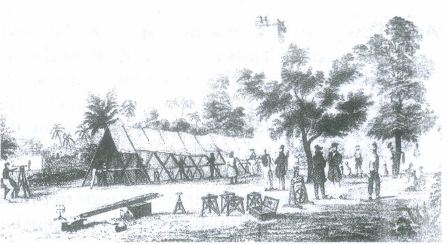
Name the artist of this painting.
1.
(i) The report was published in 'The Hindustan Times' of 22 March, 1946.
(ii) This report was about a strike by policemen against the unhealthy food provided by the government.
(iii) The grievance of policemen was that the government did not treat them well and provided unhealthy and inedible food.
(iv)These type of literary sources provide the information about those events and activities that do not find mention in official records. These types of sources inform us about condition of contemporary society and events.
2.
(i) The British historians divided Indian history into three periods, namely, ancient, medieval and modern.
(ii) This method of periodization was not suitable in context to India because this method had various limitations.
(iii) Except in Europe, we cannot find any such type of sequence and evidence to define these three ages in any other country in the world.
(iv) The Britishers came in India and rule over here without following the principles of equality, freedom, democracy, etc.
(v) In Europe, presence of these symbols denoted modern age.
3.
(i) Literary sources prove to be most important in gaining knowledge about past events.
(ii) The Britishers laid the foundation of keeping records of each and every plan, policy, decision, instruction, agreement, and treaty, etc.
(iii) They started preserving important written documents such as letters, memos, etc.
(iv) Record rooms were established across all the important offices in rural as well as urban areas.
(v) Later, archives and museums were established to protect these records and documents so that they could be accessed in the future.
4.
(i) Robert Clive, the General who stood victorious in the Battle of Plassey, had asked James Rennel to produce maps of India.
(ii) James Rennel was a passionate supporter of British rule in India.
(iii) He knew that maps were important for the Britishers to conquer other parts of India and extend their dominion.
(iv) Therefore, he produced several maps for the Britishers, and as a staunch supporter of the British.
(v) He even produced a picture depicting Brahmins offering their sacred texts to Britannia which further proves that he was a supporter of British rule in India.
5.
(i) Surveys in any field are very important and crucial in the sense that they helps one to collect the right data, figures, information and reports regarding a subject.
(ii) For a historian, surveys are equally important because a historian studies facts about history.
(iii) For the historians, archeological surveys are important because they deal with the past.
(iv) A historian can come across certain information like the ancient civilizations, the behaviours of human beings in the past, structure of the society, the culture and the traditions, habits and their livelihood.
(v) These are important because the historians can assess actual information prevalent during the period and what transformation has been brought or will be taking place in future.
6.
(i) Survey means a study or investigation of important facts and figures regarding a particular subject, topic or a country for acquiring additional and specific information for further study or investigation.
(ii) In the early 19th century, detailed surveys were conducted throughout the country in almost all the major fields.
(iii) Such as, the topography, studying the cropping pattern.
(iv) Botanical surveys, zoological surveys, archeological surveys, anthropological surveys and forest surveys, etc.
(v) In order to collect necessary information regarding the country.
7.
(i) History is a record of significant events written in chronological order.
(ii) It is the subject from where we find out how things were in the past and how things have changed in the past.
(iii) We periodise a time in order to characterise it into different periods on the basis of some significant events that have happened during those days.
(iv) These demarcations of time into different periods in the past is known as 'Periodisation', which become important for history.
(v) They help to reflect our ideas quickly about the happenings and changes from one period to the next.
8.
(i) History is a record of significant events that have occurred over a period of time or on a particular day in the past.
(ii) History is a subject which deals with past events, such as when a battle was fought, period of dynasties, when a king was crowned, birth of any religion and various other changes, etc.
(iii) History is also important to know the exact date and year of any particular event.
(iv) Hence, we continue to associate history with a string of dates, since details of any such events which have occurred in the past cannot be determined without referring to the specific dates. So, in other words, we can say that history is synonymous with dates.
9.
The events covered in the Modern History of India are:
(i) Establishment of company rule.
(ii) The set up of British administration system i.e. land revenue, economic policies, etc.
(iii) The first War of India's Independence-The Revolt of 1857.
(iv) End of Mughal Empire.
(v) Direct control over India by British Government.
(vi) The new socio-economic reform movement began in India.
(vii) The role of National leaders or era of rise of Nationalism.
(viii) Freedom Movement and Independence.
10.
The painting was drawn by James Prinsep in 1832.

8th Standard CBSE Syllabus & Materials
8th Standard CBSE
CBSE 8th Science Particulate Nature of Matter - New Model Questions Papers Study Material - QB365 Set A
NEW8th Standard CBSE
CBSE 8th Science Pressure, Winds, Stroms and Cyclones - New Model Questions Papers Study Material - QB365 Set A
NEW8th Standard CBSE
CBSE 8th Mathematics Quadrilaterals - New Model Questions Papers Study Material - QB365 Set A
NEW8th Standard CBSE
CBSE 8th Mathematics A story of Numbers - New Model Questions Papers Study Material - QB365 Set A



CBSE 8th Standard CBSE Subjects
CBSE Standards




