
 100% FREE ACCESS
8th Standard CBSE Syllabus & Materials
8th Standard CBSE
CBSE 8th Social Science Theme D - Factors of Production - New Model Questions Papers Study Material - QB365 Set A
NEW8th Standard CBSE
CBSE 8th Social Science Theme C - Universal Franchise and India's Electoral System - New Model Questions Papers Study Material - QB365 Set A
NEW8th Standard CBSE
CBSE 8th Social Science Theme B - The Rise of the Marathas - New Model Questions Papers Study Material - QB365 Set A
NEW8th Standard CBSE
CBSE 8th Social Science Theme B - Reshaping India's Political Map - New Model Questions Papers Study Material - QB365 Set A
NEW8th Standard CBSE
CBSE 8th Social Science Theme A - Natural Resources and Their Use - New Model Questions Papers Study Material - QB365 Set A
NEW8th Standard CBSE
CBSE 8th Science Keeping Time with Skies - New Model Questions Papers Study Material - QB365 Set A

Published on: 20/11/2019
How, When and Where
Download CBSE Class 8th Standard CBSE Social Science question papers, sample papers, important questions, and previous year solved papers in PDF format. Get free study materials, NCERT solutions, and exam preparation resources for Class 8th Standard CBSE Social Science
Questions + Answers key
Take MCQ Social Science Test
1.
Census means:
Official enumeration of the population after every 10 years.
Official enumeration of the population after every 12years
Official enumeration of the people after every 14years.
Official counting of the people after every 15 years.
2.
Colonisation means:
Conquest of one country by another.
Subjugation of one country by another country.
Subjugation of one country by another, leading to political, social and economic changes.
Economic exploitation of one country by another
3.
An advertisement for Lipton tea suggested that royalty all over the world was associated with this tea. When did the advertisement appear?
1920
1925
1922
1932
4.
The British thought surveys were important for
effective administration
effective judgement
writing history
None of the above
5.
A History of British India was written by
Mahatma Gandhi
Lord Mountbatten
James Mill
Dadabhai Naoroji
6.
How did the advent of printing press help in spreading news and information in a more effective way?
7.
What points should be kept in mind while dividing (classifying) history?
8.
What was the effect of colonisation on India?
9.
Why did James Rennel produce the first map of India?
10.
Why and how do we periodise a time in history?
11.
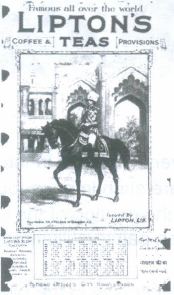
In which year this advertisement was published?
12.
Mill justified the British rule in India. Is it clear by his periodisation of history? Justify.
13.
James Mill divided Indian history into three periods- ____________,__________ and _________.
14.
In the villages,_____________surveys were conducted
15.
A History of British India is a massive ___________work.
16.
The Royal Indian Navy Mutiny started in ___________
17.
Census operations are held _____________
18.
How have the historians divided the Indian history?
19.
What is included in primary sources of History?
20.
How many capital cities were founded in the small area on the Western bank of the river Yamuna over the last 1000 years?
21.
Suggest one of the most important sources used by historians in writing about the last 250 years of Indian history.
22.
What evil practices according to James Mill dominated the Indian social life before the British came to India?
23.
Are official records the best sources of information?
24.
Who were 'Calligraphists'?
25.
What are Secondary Sources of history?
26.
What is Renaissance?
27.
What is Nationalism?
1.
(a)
Official enumeration of the population after every 10 years.
2.
(c)
Subjugation of one country by another, leading to political, social and economic changes.
3.
(c)
1922
4.
(a)
effective administration
5.
(c)
James Mill
6.
(i) Before the advent of printing press, documents were written by hand, this was time consuming and when the printing press arrived, the speed of work improved.
(ii) Newspapers were published and the issues in them were debated upon by the common people.
(iii) The reformers and leaders were able to convey their ideas to masses in short time.
(iv) Poets and novelists were also able to express their thoughts. Thus, printing presses helped in spreading news and information in a more effective way.
7.
Following are the points that should be kept in view or in mind while classifying history into three parts:
(i)There is no fixed date or proof as when the first period ended and the other period began.
(ii) Each period evolved gradually from the previous one.
(iii) In different continents, modern period began at different time. For example, modern period in Europe began in 15th century, while in India, it began in 18th century.
8.
The effect of colonisation on India are as follows:
(i) The British came to our country and established their rule, subjugating local nawabs and rajas.
(ii) The British established control over the economy and society, collected revenue to meet all their expenses, bought the goods they wanted at low prices, produced crops they needed for export.
(iii) The British rule brought about the changes in values and tastes, customer and practices. It brought about the changes in the political, economic, social and cultural sphere.
9.
James Rennel was asked by Robert Clive to produce maps of Hindustan. Rennel was an enthusiastic supporter of British colonialism. He saw the preparation of maps as essential to the process of domination. Thus, he produced the first map of India in 1782.
10.
We periodise a time in order to characterize it into different periods on the basis of some significant events that have happened during those days. These demarcations of time into different periods in the past is known as 'periodization', which become important for history as they help to reflect our ideas quickly about the happenings and changes from one period to the next.
11.
This advertisement was published in 1922.
12.
In his book, 'A History of British India', James Mill divided Indian history into three periods-. Hindu, Muslim, and British. He thought that all Asian societies were at a lower level of civilisation than Europe. Mill pointed out that before the British came to India, Hindu and Muslim despots ruled India. At that time, some factors like religious intolerance, caste taboos, and superstitious practices dominated India's social life. Mill felt that only British rule could save the Indians from the darkness. Thus, he advocated the theory of expanding colonisation, i.e. the British should conquer all the territories in India to ensure enlightenment and happiness for Indians. He strongly believed that India can be capable of progress only with the help of the British. In this way, he justified the British rule in India.
13.
()
Hindu, Muslim, British
14.
()
revenue
15.
()
three, volume
16.
()
February 1946
17.
()
Every ten years
18.
()
Historians have divided the Indian history into three parts:
(i) Ancient,
(ii) Medieval,
(iii) Modern
19.
()
Government Reports, Literary and Artistic evidences like books and paintings and archaeological remains.
20.
()
There were 14 capital cities founded in this small area.
21.
()
The official records of the British administration is one of the most important sources used by historians in writing about the last 250 years of Indian history.
22.
()
According to James Mill, the evil practices that dominated to the Indian social life were religious intolerance, caste taboos and superstitious practices.
23.
(i) No, because they provide the views of people who are in power.
(ii) They are usually biased and provide only an official view of an incident, which cannot be deemed to be right source of information with common man's point of view.
24.
Calligraphists were experts in the art of beautiful handwriting. In the early years of the 19th century, important documents were carefully copied and beautifully written by the Calligraphists.
25.
(i) The conclusions that are reached by scholars and historians after carefully examining and studying the original source such as official documents, newspapers, magazines and original documents are known as Secondary Sources of History.
(ii) The secondary sources of history provide us valuable information about the famous personalities and the contemporary societies and policies.
26.
It means re-birth and refers to European history from 14th to 16th century when there was revival of art, learning and culture
27.
The system of rigid allegiance, devotion and loyalty towards one's nation is known as Nationalism

8th Standard CBSE Syllabus & Materials
8th Standard CBSE
CBSE 8th Science Particulate Nature of Matter - New Model Questions Papers Study Material - QB365 Set A
NEW8th Standard CBSE
CBSE 8th Science Pressure, Winds, Stroms and Cyclones - New Model Questions Papers Study Material - QB365 Set A
NEW8th Standard CBSE
CBSE 8th Mathematics Quadrilaterals - New Model Questions Papers Study Material - QB365 Set A
NEW8th Standard CBSE
CBSE 8th Mathematics A story of Numbers - New Model Questions Papers Study Material - QB365 Set A



CBSE 8th Standard CBSE Subjects
CBSE Standards




