
 100% FREE ACCESS
8th Standard CBSE Syllabus & Materials
8th Standard CBSE
CBSE 8th Social Science Theme D - Factors of Production - New Model Questions Papers Study Material - QB365 Set A
NEW8th Standard CBSE
CBSE 8th Social Science Theme C - Universal Franchise and India's Electoral System - New Model Questions Papers Study Material - QB365 Set A
NEW8th Standard CBSE
CBSE 8th Social Science Theme B - The Rise of the Marathas - New Model Questions Papers Study Material - QB365 Set A
NEW8th Standard CBSE
CBSE 8th Social Science Theme B - Reshaping India's Political Map - New Model Questions Papers Study Material - QB365 Set A
NEW8th Standard CBSE
CBSE 8th Social Science Theme A - Natural Resources and Their Use - New Model Questions Papers Study Material - QB365 Set A
NEW8th Standard CBSE
CBSE 8th Science Keeping Time with Skies - New Model Questions Papers Study Material - QB365 Set A

Published on: 01/01/2019
Class 8 Model Question
Download CBSE Class 8th Standard CBSE Social Science question papers, sample papers, important questions, and previous year solved papers in PDF format. Get free study materials, NCERT solutions, and exam preparation resources for Class 8th Standard CBSE Social Science
Questions + Answers key
Take MCQ Social Science Test
1.
Cognizable means:
Police can arrest the person only after the permission of the magistrate
Police can arrest a person only after the permission of the court.
A charge or crime for which the police is entitled to arrest a person without seeking permission of the court.
The police cannot arrest a person on any condition.
2.
Which one of the following is NOT a leading producer of copper in the world?
Bolvia
Ghana
Chile
Zimbabwe
3.
'Right to health' is included in
Act 21
Act 42
Act 356
Act 29
4.
Repressor means a law:
based on force or pressure
passed against the will of the people
to prevent the person's right to criticize
All of these
5.
The political aim of the Birsa Movement was to drive away:
The moneylenders
Missionaries
Hindu landlords and the government
All of them
6.
The Constitution of India recognises the right to water as being a part of ___________
Right to Life
Right to Equality
Cultural and Educational Right
None of the above
7.
What makes an object or substance a resource?
Utility
Value
Usability
Both 'a' and 'c'
8.
According to the Fundamental Rights mentioned in the Indian Constitution, which of the following is prohibited?
Human trafficking
Forced labour
Children under 14 years of age working in hazardous occupations
All of the above
9.
In 1786, the ________________ was invented by ___________
spinning jenny, Arkwright
spinning jenny, Kaye
steam engine, Kaye
steam engine, Arkwright
10.
The British preserve official documents because
the preserved documents reveal the progress made by the country in the past.
one can study the notes and reports which were prepared in the past.
their copies may be made and used in modern times.
All of the above
11.
Write a note on IT industry
12.
Explain the term Mainstream in context to the chapter marginalisation.
13.
What were the political causes of the Revolt?
14.
Will the government intervene if some religious group says that their religion allows them to practise infanticide? Give reasons for your answer.
15.
What was the reason behind the major landslide at Pangi village?
16.
No Place Inside the Classroom
In the Bombay Presidency, as late as 1829, untouchables were not allowed into even government schools. When some of them pressed hard for that right, they were allowed to sit on the veranda outside the classroom and listen to the lessons, without "polluting" the room where upper caste boys were taught.
Some people thought this situation was better than the total lack of education for untouchable people. Would you agree with this view?
17.
Imagine that you are a nawab's nephew and have been brought up thinking that you will one-day be king. Now you find that this will not be allowed by the British because of the new Doctrine of Lapse. What will be your feelings? What will you plan to do so that you can inherit the crown?
18.
Copper and iron ore are ubiquitous resources.
19.
The Veda Samaj was founded in Madras in 1864.
20.
Lahore Gate Improvement Scheme was planned in 1880.
21.
Fishing and agricultural activities are secondary in nature.
22.
By the first decade of the 19th century, cultivation system developed and the prices in market rose.
23.
What is 'Black gold'
24.
What is a Company?
25.
Name the countries where the textile industry is concentrated?
26.
Which group dominated the Congress after its split in 1907?
27.
Define the term 'Adivasi'.
28.
Who was Potti Sriramulu?
29.
Who defends the accused?
30.
How the potters are called in India?
31.
What is the full-form of EVM?
32.
Name the kingdoms which were annexed on the basis of 'Doctrine of Lapse?
33.
In the hilly terrains, the major and widely spread natural disaster is ___________
34.
The population increase in the world is mainly due to rapid increase in_______
35.
The book Majha Pravaas was written by________
36.
____________was done on small patches of land, mostly in forest.
37.
Mahatma Gandhi abruptly called of the ________ Movement when it took violent turn.
38.
Agro based industry
39.
Industrial Township
40.
Survey after every ten years
41.
Polio
42.
FIR
43.
Explain the role of the judge in the Indian Judicial Criminal System.
44.
Discuss one of the successes of government water deparbnents in India.
45.
Why do you think reservation for Dalits and women is important in Parliament?
46.
What steps did the East India Company take to improve the system of vernacular education?
47.
What was a "Spinning Jenny" ? Explain.
48.
Who were the revolutionaries?
49.
What is a Parliamentary form of government?
50.
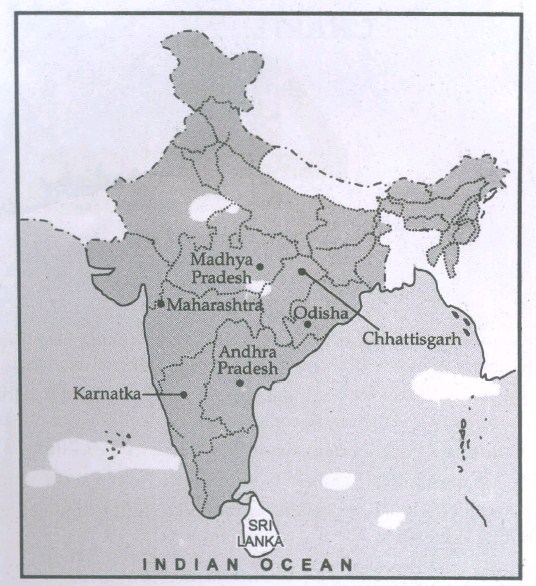
In the given outline map of India, identify and name the five major manganese producing states .
51.
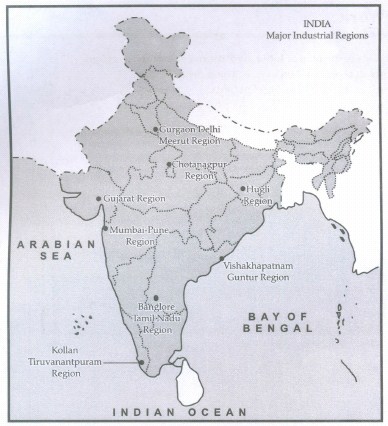
Mention the major industrial regions of India and show them on the outline map of India.
52.
Read the source and answer the questions given below: According to a report of the Geological Survey of India: Iron smelting was at one time a widespread industry in India and there is hardly a district away from the great alluvial tracts of the Indus, Ganges and Brahmaputra, in which slag heaps are not found. For the primitive iron smelter finds no difficulty in obtaining sufficient supplies of ore from deposits that no European ironmaster would regard as worth his serious consideration.
(i) What do you understand by slag heaps?
(ii) Why did the process of iron smelting decline by the late 19th century?
53.
Classify the power resources briefly.
1.
(c)
A charge or crime for which the police is entitled to arrest a person without seeking permission of the court.
2.
(b)
Ghana
3.
(a)
Act 21
4.
(d)
All of these
5.
(d)
All of them
6.
(a)
Right to Life
7.
(d)
Both 'a' and 'c'
8.
(d)
All of the above
9.
(d)
steam engine, Arkwright
10.
(d)
All of the above
11.
(i) The early computers were extremely expensive and large, requiring a lot of space.
(ii) The invention of a small electronic device called chip or IC, changed the shape, size, and capabilities of the computers.
(iii) The development of chip led to the availability of small, powerful and affordable computers and related equipments, which became a key reason for the growth of IT industry.
12.
In this chapter, this term is used to refer to a cultural context, in which the customs and practices that are followed are those of the dominant community.
13.
(i) The British policies of annexation led the displacement of a large number of rulers, specially the Doctrine of Lapse made the ruling section of society angry.
(ii) The annexation of Awadh on the ground of misgovernment was greatly resented.
(iii) The British provided no alternative sources of employment to the people who lost their job due to collapse of their local ruler's administration
14.
The government will intervene if some religious group says that their religion allows them to practise infanticide. It is a crime to practise infanticide and the government will not allow it even if some religion endorses it. The Constitution provides Right to Freedom in addition to the Right to Freedom of Religion. The infant's right to life will be violated if infanticide is practised. Therefore the government will not allow it.
15.
This landslide was triggered by intense blasting at Pangi village. It was a human factor which was responsible for this major landslide.
16.
Dalits are allowed to sit on the veranda outside the classroom and listen to the lessons without polluting the classrooms. Some people thought this situation is better than the total lack of education for untouchables. I do not agree with this view.
The Right to Education is reflected in international law in Article 26 of the Universal Declaration of Human Rights. The fulfilment of the Right to Education can be assessed using the 4 As frame work which are Availability, Accessibility, Acceptability and Adaptibility. According to Accessibility, all children should have equal access to school services regardless of gender, race, religion, ethnicity or socio-economic status.
Thus, it is not right to allow the untouchable to sit on the veranda outside the classroom. They must fight for their own right.
17.
My feelings would be of disappointment and anger.
I would train an army and fight with the British for my right. After defeating the British, I would capture the throne vacated by my uncle after his death. I would join with the other leaders who also opposed the Doctrine of Lapse.
18.
(b)
19.
(a)
20.
(b)
21.
(b)
22.
(b)
23.
()
Coal is known as black gold due to its black appearance and great value as a fuel in industries and for domestic purposes.
24.
()
A company is a form of business set up by people or by the government.
25.
()
The textile industry is concentrated in India, Hong Kong, South Korea, Japan and Taiwan
26.
()
The moderates dominated the Congress after its split in 1907
27.
()
The term literally means 'original inhabitants'. They are communities who lived, and often continue to live in close association with forests.
28.
()
Potti Sriramulu was a veteran Gandhian who went on a hunger strike demanding the formation of Andhra state to protect the interests of Telegu speakers.
29.
()
The defence lawyer defends the accused.
30.
()
The potters in India are called as kumors in Eastern India and kumhars in North India.
31.
()
EVM is the acronym for Electronic Voting Machine.
32.
()
The kingdoms like Satara, Sambalpur, Udaipur, Nagpur and Jhansi were annexed on the basis of 'Doctrine of Lapse'.
33.
()
Landslides
34.
()
life expectancy
35.
()
Vishnubhat Godse
36.
()
shifting cultivation
37.
()
Non-Cooperation
38.
()
Cotton textile
39.
()
Jamshedpur
40.
()
Census
41.
()
Preventable disease
42.
()
Police
43.
(i) The judge is like an umpire in a game and conducts the trial impartially and in an open court.
(ii) The judge hears all the witnesses and any other evidence presented by the prosecution and the defence.
(iii) The judge decides whether the accused person is guilty or innocent on the basis of the evidence presented and in accordance with the law.
(iv) If the accused is convicted, then the judge pronounces the sentence.
(v) He may send the person to jailor impose a fine or both, depending on what the law prescribes.
44.
There are cases of success in government's water departments. The water supply department in Mumbai raises enough money through water charges to cover its expenses on supplying water. In Hyderabad, the department has increased coverage and improved performance in revenue collection. In Chennai, the department has started harvesting the rainwater. It has handed over the services of transporting and distributing water to private companies on government rates.
45.
(i) It has been observed that representative democracy cannot produce a perfect reflection of the society.
(ii) There is a realisation that when interests and experiences separate, then it is important to ensure that communities that have been historically marginalized, are given adequate representation.
(iii) Similarly, it has more recently been suggested that there should be reservation of seats for women.
(iv) With this in mind, some seats are reserved in the Parliament for SCs and STs. This has been done so that the MPs elected from these constituencies will be familiar with and can represent Dalit and Adivasi interests in Parliament
46.
(i) East India Company appointed a number of government pandits, each incharge of looking after four to five schools.
(ii) The task of the pandit was to visit the pathshalas and try and improve the standard of teaching.
(iii) Each guru was asked to submit periodic reports and take classes according to a regular timetable.
(iv)Teaching was now based on textbooks and learning was tested through annual examination.
(v) Students were asked to pay regular fees, attend regular classes, sit on fixed seats and obey the new rules of discipline.
(vi) Pathshalas which accepted the new rules were supported through government grants. Those who were unwilling to work within the new system, received no government support.
47.
A machine by which a single worker could operate several spindles on towhich thread was spun. When the wheel was turned, all the spindles rotated.
48.
The revolutionaries were a small group of people who suggested that the use of violence to make a radical change within the society would be necessary to overthrow the British rule.
49.
A parliamentary form is a system of government where Parliament is supreme and the Council of Ministers are collectively responsible to the Parliament. The head of the state has nominal powers.
50.
51.
India has eight industrial regions and they are:
(i) Mumbai-Pune Region: It extends from Thane to Pune and the adjoining districts of Nasik and Sholapur.
(ii) Hugli Region: It extends from Bansbaria in the north to Birlanagar in the south.
(iii) Bangalore- Tamil Nadu Region: It extends from Banglore to all parts of Tamil Nadu except Villupuram.
(iv) Gujarat Region: It lies between Ahmedabad and Vadodara in the south to Jamnagar in the west.
(v) Chhotanagpur Region: It extends over Jharkhand, northern Odisha and western West Bengal.
(vi) Vishakhapatnam-Guntur Region: It extends from Vishakhapatnam district to Kurnool and Prakasam district in the south.
(vii) Gurgaon-Delhi-Merrut Region: It includes Gurgaon, Delhi, Shahadara, Faridabad, Ghaziabad, Meerut, Modinagar, Ambala, Agra and Mathura.
(viii) Kollam- Thiruvananthapuram Region: It is spread over Thiruvananthapuram, Kollam, Alwaye, Ernakulam, and Alappuzha districts.
52.
(i) Slag heaps are large mounds of waste material left after smelting of iron.
(ii) Various factors led to the decline of iron smelting by the late 19th century :
(a) People were denied access to the forests by the colonial government under the new forest laws.
(b) In areas where the access was granted, the iron smelters had to pay high taxes to the forest department for every furnace they used.
(c) Import of iron and steel from Britain increased, which lowered the demand for the iron produced by local smelters.
53.
Power resources can be classified as :
1. Conventional Resources: Include power resources that are common in use for long time. For example, Firewood, Hydel Power, Coal.
2. Non-Conventional Resources : Include those resources that are not so common in use, but can be used as alternate resources. For example, Solar Energy, Wind Energy, Geothermal Energy.

8th Standard CBSE Syllabus & Materials
8th Standard CBSE
CBSE 8th Science Particulate Nature of Matter - New Model Questions Papers Study Material - QB365 Set A
NEW8th Standard CBSE
CBSE 8th Science Pressure, Winds, Stroms and Cyclones - New Model Questions Papers Study Material - QB365 Set A
NEW8th Standard CBSE
CBSE 8th Mathematics Quadrilaterals - New Model Questions Papers Study Material - QB365 Set A
NEW8th Standard CBSE
CBSE 8th Mathematics A story of Numbers - New Model Questions Papers Study Material - QB365 Set A



CBSE 8th Standard CBSE Subjects
CBSE Standards




