
 100% FREE ACCESS
8th Standard CBSE Syllabus & Materials
8th Standard CBSE
CBSE 8th Social Science Theme D - Factors of Production - New Model Questions Papers Study Material - QB365 Set A
NEW8th Standard CBSE
CBSE 8th Social Science Theme C - Universal Franchise and India's Electoral System - New Model Questions Papers Study Material - QB365 Set A
NEW8th Standard CBSE
CBSE 8th Social Science Theme B - The Rise of the Marathas - New Model Questions Papers Study Material - QB365 Set A
NEW8th Standard CBSE
CBSE 8th Social Science Theme B - Reshaping India's Political Map - New Model Questions Papers Study Material - QB365 Set A
NEW8th Standard CBSE
CBSE 8th Social Science Theme A - Natural Resources and Their Use - New Model Questions Papers Study Material - QB365 Set A
NEW8th Standard CBSE
CBSE 8th Science Keeping Time with Skies - New Model Questions Papers Study Material - QB365 Set A

Published on: 30/09/2019
Judiciary
Download CBSE Class 8th Standard CBSE Social Science question papers, sample papers, important questions, and previous year solved papers in PDF format. Get free study materials, NCERT solutions, and exam preparation resources for Class 8th Standard CBSE Social Science
Questions + Answers key
Take MCQ Social Science Test
1.
Discuss the impact of the shortage of judges on the delivery of justice to Litigants.
2.
What values can be learned from the functioning of Indian Judiciary?
3.
Describe the evolution of courts in India.
4.
The Judiciary has played a crucial role in democratic India. Justify the statement.
5.
What do you understand by integrated judicial system?
6.
Make sentences with each of the glossary words given on the back page.
7.
Write a story around the theme, 'Justice delayed is justice denied'.
8.
Re-read excerpts from the judgement on the Olga Tellis vs Bombay Municipal Corporation case. Now write in your own words what the judges meant when they said that the Right to Livelihood was part of the Right to Life.
9.
Why do you think the introduction of Public Interest Litigation (PIL) in the 1980s is a significant step in ensuring access to justice for all?
10.
In the following illustration, fill in each tier with the judgments given by the various courts in the Sudha Goel case. Check your responses with others in class.
11.
Fill in the table given below based on what you have understood about criminal and civil law.
12.
Write two sentences of what you understand about the appellate system from the case .
13.
List two reasons why you believe an Independent Judiciary is essential to democracy.
14.
Do you think that any ordinary citizen stands a chance against a politician in this kind of judicial system? Why not?
15.
With the help of your teacher, fill in the blank spaces in the table below.
| Types of dispute | Example |
|---|---|
| Dispute between centre and the state | - |
| Dispute between two states | - |
| Dispute between two citizens | - |
| Laws that are in violation of the constitution | - |
1.
The number of vacancies in district and subordinate courts is 382 as per the given table. This has a significantly negative impact as many cases remain pending in the courts. In the course of extended period of cases remaining pending, many litigants die while others suffer as the accused and the criminals get enough time to negotiate and turn the cases in their favour. And as we all know, justice delayed is justice denied.
2.
One must conclude after examining the functions of Indian Judiciary that it plays a critical role in its democracy. It protects the citizens of the country against any possible misuse of authority by the Legislature and Executive.
Moreover, a citizen can go to the Judiciary directly to seek justice in case his/her Fundamental Rights have been violated.
From this, I have learned the value and importance of Indian Judiciary in strengthening the country's democracy besides my personal well-being.
3.
1. The first High Courts were established during the British rule in 1862. They were set-up in the three presidency cities of Calcutta, Bombay and Madras.
2. The Supreme Court that we have at present was preceded by the Federal Court of India
3. The Federal Court of India was established in 1937 during British rule.
4. It was located in the Chamber of Princes in the Parliament House. It was in operation till 1949.
5. The Supreme Court that we have today replaced that. The Delhi High Court was established in 1966. Now, the country has one Supreme Court at the top and 24 High Courts.
4.
The Judiciary has played a crucial role in democratic India in the following ways:
(i) It serves as a check on the powers of the Executive and Legislature.
(ii) It protects the Fundamental Rights of citizens against other citizens and the state.
5.
1. In India, we have an integrated judicial system This means that the decisions made by the higher courts are binding on the lower courts. The higher courts act as a point of reference or 'the court of record' for lower courts.
2. The integrated judicial system is also achieved through appellate system. According to this system, if a person is not satisfied with the judgement of a lower court, he/she can move to a higher court to appeal against the judgement.
6.
Acquit The court acquitted Mohan of all charges.
To Appeal: Tina is going to appeal against the judgement given by the lower court in domestic violence case.
Compensation The court awarded Deepaks widowed wife a compensation of l lakh.
Eviction The court has ordered the eviction of tenant who has not paid his rents for the last 10 years.
Violation Practising untouchability is a violation of the Constitution of India.
7.
Sunil, the bread-winner of his family, was killed in an accident. He left behind his wife and three daughters. His wife filed a case seeking compensation and a job to meet the family expenses. Since the car that hit Sunil belonged to the son of a local MLA, there was political interference in the case proceedings.
The case was transferred from one court to another. The case lingered on for more than 20 years. Sunil's wife and daughters worked as casual labourers to run the household. The wife borrowed money from the landlord to marry off her daughters. Finally 24 years later, the court awarded Sunil's wife a compensation oH lakh.
Justice delayed is justice denied.
8.
The Right to Life conferred by Article 21 has far-reaching implications. It means more than just animal existence. That is only one aspect of the Right of Life.
An equally important aspect of the Right Life is the Right to Livelihood because no person live without the means of living, which also means the means of livelihood. This is what the judges meant when they said that the Right to Livelihood was part of the Right to Life.
9.
Before the 1980s, litigation in courts was costly and time-consuming affair. As a result of this, the poor could not afford going to courts and get justice.
The introduction of the mechanism of Public Interest Litigation (PIL) by the Supreme Court in early 1980s gave increased access to justice. It allowed any individual or organisation to file a PIL in the High Court or the Supreme Court on behalf of those whose rights had been violated. The legal process was greatly simplified. Now even a letter or telegram addressed to the Supreme Court or the High Court could be treated as a PIL.So, the introduction of PIL was a significant step in ensuring access to justice for all.
10.
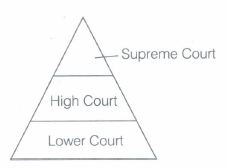
1. Lower Court Convicted Laxman, his mother Shakuntala and his brother-in-law Subhash Chandra and sentenced all three of them to death.
2. High Court Acquitted Laxman, Shakuntala and Subhash Chandra.
3. Supreme Court Sentenced Laxman and Shakuntala for life, acquitted Subhash due to lack of evidence.
11.
| Description of Violation | Branch of Law Followed | Procedure to be Followed |
| A group of girls are persistently harassed by a group of boys while walking to school | Criminal | Filling of FIR, Investigation, filling of case , trail, judgement, and punishment according to verdict |
| A tenant who is being forced to move out files a case in court against the landlord | Civil law | Filling of the case against the landlord, trial and relief to the tenant. |
12.
1. The appellate system of the Indian Judiciary is one through which an appeal is made in the higher court against the judgement of the lower court if the person is not satisfied with the verdict.
2. In the case 'State (Delhi Administration) Vs Laxma n Kumar and others', the three accused went to the High Court to appeal against the verdict of the Trial Court and later women's organisation appealed against the High Court decision in the Supreme Court through the Indian Federation of women lawyers.
13.
Two reasons why an Independent judiciary is essential to democracy are as follows:
1. It provides impartial judgement which is integral to democracy.
2. It protects the Fundamental Rights of citizens.
14.
No, an ordinary citizen does not stand a chance against a politician in this kind of judicial system. This is because the Judiciary does not enjoy the power to function independently, it works under pressure from the government and acts on their behalf.
15.
| Type of dispute | Example |
|---|---|
| Dispute between centre and the state | Dissolution of Bihar Assembly |
| Dispute between two states | Kaveri (Cauvery) water between Karnataka and Tamilnadu |
| Dispute between two citizens | Dispute between landowner and tenant |
| Laws that are in violation of the constitution | Sealing of business establishment in Delhi. |

8th Standard CBSE Syllabus & Materials
8th Standard CBSE
CBSE 8th Science Particulate Nature of Matter - New Model Questions Papers Study Material - QB365 Set A
NEW8th Standard CBSE
CBSE 8th Science Pressure, Winds, Stroms and Cyclones - New Model Questions Papers Study Material - QB365 Set A
NEW8th Standard CBSE
CBSE 8th Mathematics Quadrilaterals - New Model Questions Papers Study Material - QB365 Set A
NEW8th Standard CBSE
CBSE 8th Mathematics A story of Numbers - New Model Questions Papers Study Material - QB365 Set A



CBSE 8th Standard CBSE Subjects
CBSE Standards




