
 100% FREE ACCESS
8th Standard CBSE Syllabus & Materials
8th Standard CBSE
CBSE 8th Social Science Theme D - Factors of Production - New Model Questions Papers Study Material - QB365 Set A
NEW8th Standard CBSE
CBSE 8th Social Science Theme C - Universal Franchise and India's Electoral System - New Model Questions Papers Study Material - QB365 Set A
NEW8th Standard CBSE
CBSE 8th Social Science Theme B - The Rise of the Marathas - New Model Questions Papers Study Material - QB365 Set A
NEW8th Standard CBSE
CBSE 8th Social Science Theme B - Reshaping India's Political Map - New Model Questions Papers Study Material - QB365 Set A
NEW8th Standard CBSE
CBSE 8th Social Science Theme A - Natural Resources and Their Use - New Model Questions Papers Study Material - QB365 Set A
NEW8th Standard CBSE
CBSE 8th Science Keeping Time with Skies - New Model Questions Papers Study Material - QB365 Set A

Published on: 16/08/2019
The Changing World of Visual Arts
Download CBSE Class 8th Standard CBSE Social Science question papers, sample papers, important questions, and previous year solved papers in PDF format. Get free study materials, NCERT solutions, and exam preparation resources for Class 8th Standard CBSE Social Science
Questions + Answers key
Take MCQ Social Science Test
1.
The British defeated Sirajuddaulah in the battle of__________.
2.
A wall painting_________.
3.
G Farrington was a visiting British ______________
4.
Thomas and William Daniell stayed in India for _________________
5.
Paintings which depicted scenes from British imperial history and their victories are called ________________
6.
What was the picturesque?
7.
What is mural painting? Give example from history when mural painting was used.
8.
Why did European portrait painting become popular in India?
9.
Why did some artists produce cheap popular prints? What influence would such prints have had on the minds of people who looked at them?
10.
Why did the scroll painters and potters come to Kalighat? Why did they begin to paint new themes?
11.
Realism meant a belief that artists had to :
Faithfully observe and depict the subject
Faithfully observe the landscape
Draw from their imagination
Draw and paint landscape
12.
General Baird was
an artist
a trader
a commander of the British army
a Governor-General
13.
When did Thomas Daniell and William Daniell come to India?
1785
1765
1755
1855
14.
Samuel Bourne was a famous
photographer
painter
historian
biographer
15.
Mural painting means
oil painting
miniature painting
wall painting
None of the above
16.
Why were the paintings on Indian themes displayed in Britain?
17.
How were the figures in scroll paintings traditionally drawn?
18.
Who became a dependent pensioner of the East India Company after a war with the British in 1770s?
19.
Name the different forms of imperial art.
20.
What art form did Thomas Daniell and his nephew William Daniell adopt?
21.
Raja Ravi Varma introduced the dual style of painting.
22.
The art of portrait making became popular as the Rajas and the Maharajas wished to see them at the canvas.
23.
Tipu Sultan never encouraged local cultural traditions.
24.
After the 1850s, we see a new trend within the Kalighat artists
25.
Japanese artists who visited India tried to develop an Asian art movement.
26.
Victoria Terminus
27.
History painting
28.
Local painters of India
29.
Francis Hayman
30.
Thomas and William Daniell
31.
Answer the following questions related to this picture:
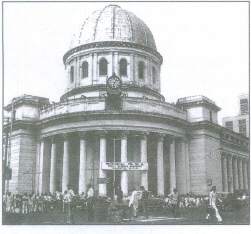
(i)The British followed which style of architecture in Calcutta?
(ii) What are the main features of Gothic style?
(iii) What did the British want their buildings to express?
(iv) Victoria Terminus in Bombay is built in which style of architecture?
32.
What were the characteristics of the Kalighat paintings?
33.
Look at the given picture.
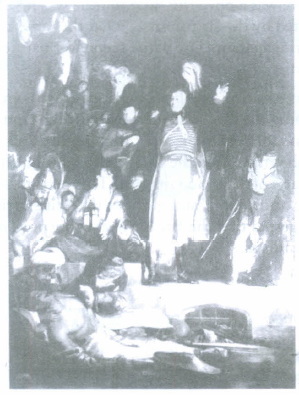
David Wilkie was commissioned by David Baird's wife to paint this picture. Why do you think she wanted such a picture painted?
34.
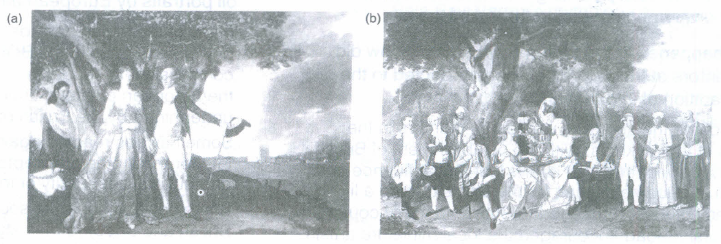
Look carefully at figures (a) and (b)
(i) In what ways are the Indians depicted as inferior?
(ii) Notice the clothes the British are wearing. What do they convey to you?
1.
()
Plassey
2.
()
Mural
3.
()
artist
4.
()
seven years
5.
()
history paintings
6.
This style of painting depicted India as a quaint land, to be explored by travelling British artists; its landscape was rugged and wild, seemingly untamed by human hands.
7.
A mural is any piece of artwork painted or applied directly on a wall, ceiling or other large permanent surface. This form of art was used from upper paleolithic time to modern time.
King like Tipu Sultan continued to encourage local traditions and had the walls of his palace at Seringapatam covered with mural paintings done by the local artists. One of these mural paintings celebrates the victory of Tipu and Haidar Ali in the Battle of Polilur (1780) in which they defeated the British troops.
8.
The rich and powerful people, both British and Indian, wanted to see themselves on canvas.
Indian tradition of portrait painting was in form of miniature (very small detailed painting) at that time.
A stream of European portrait painters came to India in the 18th century. They made portraits that were life-size images that looked lifelike and real.
9.
By the late 19th century, mechanical printing presses were set-up in different parts of India which allowed prints to be produced in even larger numbers.
Popular pictures of Hindu deities printed in large numbers, so that even the poor could buy them. With the spread of nationalism, popular prints of Bharat Mata or nationalist heroes of the freedom movement became popular.
Ravi Varma set-up printing press where his religious paintings were mass produced. These prints carried nationalist messages and influenced large number of people and created nationalistic fervour.
10.
The scroll painters and potters came to Kalighat and settled there because at that time Calcutta was expanding as a commercial and administrative centre. Calcutta appeared as a place of opportunity where people came to make a new livelihood for them.
Village artists also came and settled here in the hope of new patrons and buyers. They began to paint new themes because values, tastes, social norms and customs were undergoing fast changes after the 1840s. Kalighat painters responded to these changes and produced paintings on social and political themes.
11.
(a)
Faithfully observe and depict the subject
12.
(c)
a commander of the British army
13.
(a)
1785
14.
(a)
photographer
15.
(c)
wall painting
16.
()
The paintings on Indian themes were displayed in Britain to give an idea to the people about the new land conquered by the Company.
17.
()
Traditionally, the figures in scroll paintings are drawn flat, not rounded.
18.
()
Muhammad Ali Khan, Nawab of Arcot became a dependent pensioner of the East India Company after a war with the British in 1770s.
19.
()
The different forms of imperial art are:
20.
()
Artists Thomas Daniell and his nephew William Daniell adopted picturesque landscape painting technique.
21.
(a)
22.
(a)
23.
(b)
24.
(b)
25.
(a)
26.
()
Bombay
27.
()
A category of imperial art
28.
()
Company painting
29.
()
History painting
30.
()
Picturesque landscape painting
31.
(i) In Calcutta, most of the buildings built by British had rounded arches and pillars. This style was borrowed from the Classical style of Greece and Rome.
(ii) Pointed arches in the buildings and elongated structures are the typical characteristics of Gothic style.
(iii) The British wanted their buildings to express their power and glory and their cultural achievements.
(iv)Victoria Terminus in Bombay is built in Gothic style.
32.
In Bengal, around the pilgrimage centre of the temple of Kalighat, a new style of paintings known as Kalighat painting was developed by local village scroll painters and potters.
Its main characteristics were:
(i) The images of the Kalighat paintings did not appear to be realistic and lifelike.
(ii) These images rallied around religious themes and the artist used shading effect in order to give three-dimensional effect.
(iii) The Kalighat painters used a bold non-realistic style in which figures emerged as large and powerful.
(iv) These paintings had minimum of lines, details and colours.
33.
David Wilkie was commissioned by General Baird's wife to paint the triumph at Seringapatam, where Tipu Sultan was finally defeated by the British troops. In this painting General Baird is standing triumphantly in the middle. Tipu lies dead in semi-darkness.
His army was defeated, his royal clothes torn and stripped off. Mrs Baird exactly wanted this to show that the kings who opposed the British Shall meet the same fate like Tipu Sultan.
34.
(i) In these two pictures. Indians are depicted as inferior and submissive. In both these paintings. Indians are shown as maid and servants who work for their white masters.
(ii) The Britishers are flaunting their costly and regal dresses. By wearing expensive dresses, they want to convey their supremacy, aristocracy to us.

8th Standard CBSE Syllabus & Materials
8th Standard CBSE
CBSE 8th Science Particulate Nature of Matter - New Model Questions Papers Study Material - QB365 Set A
NEW8th Standard CBSE
CBSE 8th Science Pressure, Winds, Stroms and Cyclones - New Model Questions Papers Study Material - QB365 Set A
NEW8th Standard CBSE
CBSE 8th Mathematics Quadrilaterals - New Model Questions Papers Study Material - QB365 Set A
NEW8th Standard CBSE
CBSE 8th Mathematics A story of Numbers - New Model Questions Papers Study Material - QB365 Set A



CBSE 8th Standard CBSE Subjects
CBSE Standards




