
 100% FREE ACCESS
8th Standard CBSE Syllabus & Materials
8th Standard CBSE
CBSE 8th Social Science Theme D - Factors of Production - New Model Questions Papers Study Material - QB365 Set A
NEW8th Standard CBSE
CBSE 8th Social Science Theme C - Universal Franchise and India's Electoral System - New Model Questions Papers Study Material - QB365 Set A
NEW8th Standard CBSE
CBSE 8th Social Science Theme B - The Rise of the Marathas - New Model Questions Papers Study Material - QB365 Set A
NEW8th Standard CBSE
CBSE 8th Social Science Theme B - Reshaping India's Political Map - New Model Questions Papers Study Material - QB365 Set A
NEW8th Standard CBSE
CBSE 8th Social Science Theme A - Natural Resources and Their Use - New Model Questions Papers Study Material - QB365 Set A
NEW8th Standard CBSE
CBSE 8th Science Keeping Time with Skies - New Model Questions Papers Study Material - QB365 Set A

Published on: 05/09/2019
The Changing World of Visual Arts
Download CBSE Class 8th Standard CBSE Social Science question papers, sample papers, important questions, and previous year solved papers in PDF format. Get free study materials, NCERT solutions, and exam preparation resources for Class 8th Standard CBSE Social Science
Questions + Answers key
Take MCQ Social Science Test
1.
What is mural painting? Give example from history when mural painting was used.
2.
How did European photographers create the images of India?
3.
Why did European portrait painting become popular in India?
4.
Why did some artists produce cheap popular prints? What influence would such prints have had on the minds of people who looked at them?
5.
In what way did the British history paintings in India reflect the attitudes of imperial conquerors?
6.
General Baird was
an artist
a trader
a commander of the British army
a Governor-General
7.
Who among these was a portrait painter?
Rober Kerr Porter
Johann Zoffany
David Wilkie
G Farrington
8.
When did Thomas Daniell and William Daniell come to India?
1785
1765
1755
1855
9.
Raja Ravi Varma decided to set-up a picture production team and printing press on the outskirts of
Calcutta
Bombay
Madras
Hyderabad
10.
Samuel Bourne was a famous
photographer
painter
historian
biographer
11.
How were the figures in scroll paintings traditionally drawn?
12.
Name one of the presses that was set-up in late 19th century Calcutta.
13.
Name the two puppet nawabs installed in Murshidabad by the British after the Battle of Plassey (1757).
14.
Who was General Baird?
15.
With whom did the European artists come to India?
16.
Describe in your own words one painting from this chapter which suggests that the British were more powerful than Indians. How does the artist depict this?
17.
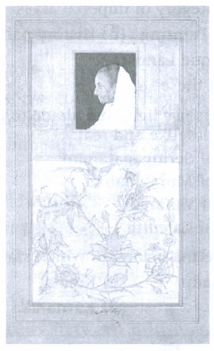
Look at the given figure along with the images of Indian miniatures you saw in the History book of Class VII. Can you identify some of the elements of similarity between them? Look for differences too.
18.
What was the reason behind the Indian nawabs began commissioning imposing oil portraits by European painters?
19.
G Farrington was a visiting British ______________
20.
With the spread of nationalism, popular prints of the early 20th century began carrying ______________ messages.
21.
Abanindranath Tagore was the _______________ of Rabindranath Tagore.
22.
Thomas and William Daniell stayed in India for _________________
23.
Muhammad Ali Khan of Arcot became a dependent ______________ of the East India Company in the 1770s.
24.
Tipu Sultan's Dariya Daulat palace at Seringapatam had mural paintings on its walls.
25.
After the 1850s, we see a new trend within the Kalighat artists
26.
The most famous photographic studio 'Bourne and Shephard was set-up in Bombay.
27.
Nandalal Bose was a student and disciple of Abanindranath Tagore.
28.
Japanese artists who visited India tried to develop an Asian art movement.
1.
A mural is any piece of artwork painted or applied directly on a wall, ceiling or other large permanent surface. This form of art was used from upper paleolithic time to modern time.
King like Tipu Sultan continued to encourage local traditions and had the walls of his palace at Seringapatam covered with mural paintings done by the local artists. One of these mural paintings celebrates the victory of Tipu and Haidar Ali in the Battle of Polilur (1780) in which they defeated the British troops.
2.
By the mid-19th century, many photographers from Europe came to India and began travelling.
They took different types of pictures such as:
(i) Some took photographs of imperial officials, presenting them as figures of authority and power.
(ii) Others took pictures of ruined buildings and picturesque landscapes.
(iii) Others recorded moments of British military triumph.
(iv) There were also some who recorded the cultural diversity of India in ways that tried to show how India was a primitive country.
3.
The rich and powerful people, both British and Indian, wanted to see themselves on canvas.
Indian tradition of portrait painting was in form of miniature (very small detailed painting) at that time.
A stream of European portrait painters came to India in the 18th century. They made portraits that were life-size images that looked lifelike and real.
4.
By the late 19th century, mechanical printing presses were set-up in different parts of India which allowed prints to be produced in even larger numbers.
Popular pictures of Hindu deities printed in large numbers, so that even the poor could buy them. With the spread of nationalism, popular prints of Bharat Mata or nationalist heroes of the freedom movement became popular.
Ravi Varma set-up printing press where his religious paintings were mass produced. These prints carried nationalist messages and influenced large number of people and created nationalistic fervour.
5.
History painting is one of the important categories of imperial art. This type of art reflected the attitudes of the colonial power.
British history paintings in India reflected the attitudes of imperial conquerors in these ways:
(i) British triumph served as rich material for history painters in Britain.
(ii) These painters drew on first hand sketches and accounts of travellers to depict a favourable image of British action in India.
(iii) These paintings were based on the power, victories, supremacy of the British.
(iv) The paintings, named 'Lord Clive meeting Mir Jafar, 'The Storming of Seringapatam' etc depicted British triumphs, not the agression and immoral path they took to win.
These paintings tried to establish the fact that the Britishers were more powerful than Indians.
6.
(c)
a commander of the British army
7.
(b)
Johann Zoffany
8.
(a)
1785
9.
(b)
Bombay
10.
(a)
photographer
11.
()
Traditionally, the figures in scroll paintings are drawn flat, not rounded.
12.
()
The Calcutta Art Studio was one of the presses that was-set up in the late 19th century Calcutta.
13.
()
After the Battle of Plassey, the British installed first Mir Jafar then Mir Qasim in Murshidabad.
14.
()
General Baird was the commander of the British army, who led the British army that stormed Tipu Sultan's fort.
15.
()
With the British traders and rulers, the European artists came to India.
16.
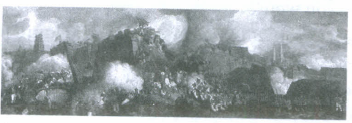
The painting given above is painted by Rober Kerr Porter in 1800. In this painting, the painter has drawn the storming of Seringapatam, the capital of Tipu Sultan by the British troops. Tipu Sultan of Mysore was a powerful king, but he was finally defeated by the British in 1799 at the famous Battle of Seringapatam. The battle scene was painted by the artist.
In this painting, the British troops are shown storming the fort from all sides, cutting Tipu Sultan's soldiers to pieces. Climbing the wall, the British army raised the British flag aloft on the ramparts of Tipu Sultan's fort. This picture depicts action and energy, and glorifies the British triumph. It suggested that the British were more powerful than Indians.
17.
Miniature paintings are small-sized paintings, generally done by water colour on cloth or paper. The most notable traditions of miniature painting in India are the Mughal, Rajasthani, Pahari and Deccani courts. In these paintings, there are very few human characters seen with front face. Most of the human characters are seen with side profile. Big eyes, pointed nose and slim waist are the features of these paintings. Human characters have worn traditional Indian dresses and jewellery.
18.
Many of the Indian nawabs who lost their power and status to the British began commissioning imposing oil portraits by the European painters. Their power was undermined by the British officials.
Some nawabs reacted against this interference, others accepted the political and cultural superiority of the British.
Some nawabs hoped to socialise with the British and adopted their styles and tastes. Some nawabs like Muhammad Ali Khan of Arcot even gifted portraits to the King of England and the Directors of the East India Company.
19.
()
artist
20.
()
nationalist
21.
()
nephew
22.
()
seven years
23.
()
pensioner
24.
(a)
25.
(b)
26.
(b)
27.
(a)
28.
(a)

8th Standard CBSE Syllabus & Materials
8th Standard CBSE
CBSE 8th Science Particulate Nature of Matter - New Model Questions Papers Study Material - QB365 Set A
NEW8th Standard CBSE
CBSE 8th Science Pressure, Winds, Stroms and Cyclones - New Model Questions Papers Study Material - QB365 Set A
NEW8th Standard CBSE
CBSE 8th Mathematics Quadrilaterals - New Model Questions Papers Study Material - QB365 Set A
NEW8th Standard CBSE
CBSE 8th Mathematics A story of Numbers - New Model Questions Papers Study Material - QB365 Set A



CBSE 8th Standard CBSE Subjects
CBSE Standards




