
 100% FREE ACCESS
8th Standard CBSE Syllabus & Materials
8th Standard CBSE
CBSE 8th Social Science Theme D - Factors of Production - New Model Questions Papers Study Material - QB365 Set A
NEW8th Standard CBSE
CBSE 8th Social Science Theme C - Universal Franchise and India's Electoral System - New Model Questions Papers Study Material - QB365 Set A
NEW8th Standard CBSE
CBSE 8th Social Science Theme B - The Rise of the Marathas - New Model Questions Papers Study Material - QB365 Set A
NEW8th Standard CBSE
CBSE 8th Social Science Theme B - Reshaping India's Political Map - New Model Questions Papers Study Material - QB365 Set A
NEW8th Standard CBSE
CBSE 8th Social Science Theme A - Natural Resources and Their Use - New Model Questions Papers Study Material - QB365 Set A
NEW8th Standard CBSE
CBSE 8th Science Keeping Time with Skies - New Model Questions Papers Study Material - QB365 Set A

Published on: 14/08/2019
Women, Caste and Reform
Download CBSE Class 8th Standard CBSE Social Science question papers, sample papers, important questions, and previous year solved papers in PDF format. Get free study materials, NCERT solutions, and exam preparation resources for Class 8th Standard CBSE Social Science
Questions + Answers key
Take MCQ Social Science Test
1.
The Veda Samaj was founded in Madras in 1864.
2.
Rashsundari Debi secretly learned to read and write in the flickering light of candles at night.
3.
The Child Marriage Restraint Act was passed in 1829.
4.
Who were "the untouchables"? What was their social condition in the Indian Society ?
5.
Describe the role played by Muslim women in promoting education among women.
6.
What were the different reasons people had for not sending girls to school?
7.
Imagine you are a teacher in the school set-up by Rokeya Hossain. There are 20 girls in your charge. Write an account of the discussions that might have taken place on anyone day in the school.
8.
Madigas were an important untouchable caste of present day's:
Madhya Pradesh
Orissa
Bihar
Andhra Pradesh
9.
Sri Narayan Guru, in present day's Kerala belonged to a low caste of:
Ezhavas
Mahar
Madigas
Agarias
10.
Periyar founded
Temple Entry Movement
Self-Respect Movement
Dalit Movement
None of the above
11.
A widow's home was established at Poona by
Tarabai Shinde
Pandita Ramabai
Bal Gangadhar Tilak
Begum Rokeya Sakhawat Hossain
12.
Widow Remarriage Act was passed in the year
1826
1846
1856
1876
13.
Name one social reformer who used the religious texts to argue in favour of widow remarriage.
14.
How many "Varnas" are there? Name them.
15.
What formed the basis for the division of Indian society ?
16.
When did Dr BR Ambedkar start temple entry movement?
17.
Name one of the lower castes of Gujarat who work for the upper caste.
18.
Who was Mumtaz Ali?
19.
What do you mean by sati?
20.
What was the condition of women in the earlier days?
21.
Look at the given picture and answer the following questions.
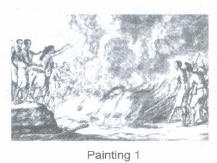
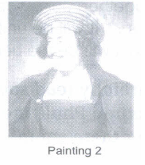
(i) Name the artist of painting 1 and 2.
(ii) In Which year these paintings were made.
22.
Discuss the work and contribution of Ishwarchandra Vidyasagar for the upliftment of women.
23.
___________ _____________ urged the people to strive for racial equality in America.
24.
Swami Oayanand Saraswati founded the reform association called in __________ __________ in ______________
25.
In aristocratic Muslim household in North India, women learnt to read the __________________ in Arabic.
26.
Ambedkar was born into a _____________family.
27.
Tarabai Shinde wrote a book named ________________
28.
A great Scholar of Sanskrit
29.
Low caste Exhavas
30.
Sati
31.
The Prarthana Samaj
32.
The Singh Sabha Movement
1.
(a)
2.
(a)
3.
(b)
4.
(i) In the Hindu caste system, there were four Varnas-the Brahmins, the Kshatriyas, the Vaishyas and the Shudras. Apart from these four groups, there were people at the lowest rank of the society who were known as the untouchables by "upper caste people". They were also known to be the fifth Varnas. The social condition of the untouchables was very miserable.
(ii) The "Upper Caste" people did not allow them to enter temples, draw water from the wells or bathe in those public ponds where higher castes people used to took bath. The untouchables were seen as inferior human beings.
5.
From the early 20th century, some Muslim women played a significant role in promoting education among women. Begums of Bhopal founded a primary school for girls at Aligarh.
A leading feminist writer and social worker Begum Rokeya Sakhawat Hossain started schools for Muslim girls in Patna and Calcutta. Begum Rokeya criticised the conservative ideas of the religious leaders which were responsible for the inferior place of women in society.
6.
The first schools for girls were opened in the mid-19th century.
People feared to send their girls to school as:
(i) They feared that schools would take girls away from home, prevent them from doing their domestic duties.
(ii) They felt that girls should stay away from public places. Girls had to travel through public place in order to reach school and this would have a corrupting influence on them.
7.
An account of the discussion:
Girls were not allowed the access to education.
Fundamentalists opposed her.
She opened muslim girls schools at Patna and Calcutta.
Madame Rokeya Hossain opposed this dictum and advocated for girl education.
8.
(d)
Andhra Pradesh
9.
(a)
Ezhavas
10.
(b)
Self-Respect Movement
11.
(b)
Pandita Ramabai
12.
(c)
1856
13.
()
Ishwarchandra Vidyasagar used the ancient religious texts to argue in favour of widow remarriage.
14.
()
There are four Varnas-Brahmans, Kshatriyas, Vaishyas and Shudras.
15.
()
The society in India was divided on the lines of castes or the Varna system.
16.
()
In 1927, Dr BR Ambedkar started temple entry movement and led three such movements between 1927 and 1935.
17.
()
Dublas of Gujarat laboured for upper caste landowners cultivating their fields and working at a variety of odd jobs at the landlord's house.
18.
()
Mumtaz Ali was a social reformer who reinterpreted verses from the Koran to argue for the education of women.
19.
()
Widows who chose death by burning themselves on the funeral pyre of their husbands were called 'sati'.
20.
(i) Women were married at an early age.
(ii) Women were forced to burn themselves on the funeral pyre of their husbands. Woman who died in this manner, whether willing or otherwise, were called Sati which meant virtuous women.
(iii) Women's right to property were also restricted.
(iv) Women had virtually no access to education. In many parts of the country, people believed that if a woman was educated, she would become a widow.
21.
(i) Balthazar Solvyn is the artist of painting 1 and Rembrandt Peale is the artist of painting 2.
(ii) Painting 1 was made in 1813.
Painting 2 was made in 1833.
22.
Ishwarchandra Vidyasagar was a social reformer, philosopher, academician, philanthropist and a key figure of the Bengal Renaissance. His works and contribution for the upliftment of women are as follows:
(i) He did a lot for the education of women, as he believed that it was our primary duty to educate a woman because she was the real teacher of her child. He opened and ran many schools for girls at his own expense.
(ii) Vidyasagar strongly protested against polygamy and child marriage.
(iii) It was due to his effort, the Hindu Widow Remarriage Act 1856 was passed which allowed the widows to remarriage. He had also opposed the sati system.
Ishwarchandra worked endlessly to provide equal education to all men and women irrespective of their caste, religion and gender. He believed that the status of women and all kinds of injustice and inequalities that they face could be changed only through education.
23.
()
Abraham Lincoln
24.
()
Arya Samaj, 1875
25.
()
Koran
26.
()
Mahar
27.
()
Stripurushtulna
28.
()
Pandita Ramabai
29.
()
Critic of Hindu culture
30.
()
Burning of women at husband's funeral pyre
31.
()
Bombay
32.
()
Amritsar

8th Standard CBSE Syllabus & Materials
8th Standard CBSE
CBSE 8th Science Particulate Nature of Matter - New Model Questions Papers Study Material - QB365 Set A
NEW8th Standard CBSE
CBSE 8th Science Pressure, Winds, Stroms and Cyclones - New Model Questions Papers Study Material - QB365 Set A
NEW8th Standard CBSE
CBSE 8th Mathematics Quadrilaterals - New Model Questions Papers Study Material - QB365 Set A
NEW8th Standard CBSE
CBSE 8th Mathematics A story of Numbers - New Model Questions Papers Study Material - QB365 Set A



CBSE 8th Standard CBSE Subjects
CBSE Standards




