
 100% FREE ACCESS
8th Standard CBSE Syllabus & Materials
8th Standard CBSE
CBSE 8th Social Science Theme D - Factors of Production - New Model Questions Papers Study Material - QB365 Set A
NEW8th Standard CBSE
CBSE 8th Social Science Theme C - Universal Franchise and India's Electoral System - New Model Questions Papers Study Material - QB365 Set A
NEW8th Standard CBSE
CBSE 8th Social Science Theme B - The Rise of the Marathas - New Model Questions Papers Study Material - QB365 Set A
NEW8th Standard CBSE
CBSE 8th Social Science Theme B - Reshaping India's Political Map - New Model Questions Papers Study Material - QB365 Set A
NEW8th Standard CBSE
CBSE 8th Social Science Theme A - Natural Resources and Their Use - New Model Questions Papers Study Material - QB365 Set A
NEW8th Standard CBSE
CBSE 8th Science Keeping Time with Skies - New Model Questions Papers Study Material - QB365 Set A

Published on: 01/01/2019
8th Std Slip Test
Download CBSE Class 8th Standard CBSE Social Science question papers, sample papers, important questions, and previous year solved papers in PDF format. Get free study materials, NCERT solutions, and exam preparation resources for Class 8th Standard CBSE Social Science
Questions + Answers key
Take MCQ Social Science Test
1.
The appropriate source of energy for coastal area is:
Tidal energy
Solar energy
Biogas
Wind energy
2.
Bore well water is brackish and is not used for:
Toilets
Washing
Gardening
Cooking and drinking purposes
3.
Fundamental Duties were included in the Constitution in 1976 through the
38th Amendment
42nd Amendment
40th Amendment
39th Amendment
4.
Kusum and Palash flowers are used for :
extracting oil from the seeds
colouring clothes and leather
cooking and making food
All of them
5.
When was the Sedition Act passed?
1858
1860
1870
1919
6.
Right to a healthy environment is intrinsic to the Fundamental Right of
Right to Equality
Right against Exploitation
Right to Life
Right to Freedom
7.
Who files an FIR?
The public
The police
The lawyer
None of these
8.
It signifies development of human beings i.e. developing the quality and capacity of people state.
Human resources
Human-made resources
Human resources development
None of the above
9.
_____________ was the foremost textile centre in India during the 18th century.
Calcutta
Bombay
Dacca
Ahmedabad
10.
When New Delhi was built, the National Museum and the National Archives were both located close to the
Supreme Court
Parliament House
Viceregal Palace
Red Fort
11.
We should minimise the depletion of natural resources.
12.
A plot of land is cleared by felling the trees and burning them is called shifting cultivation.
13.
The Begums of Bhopal started schools for Muslim girls in Patna.
14.
The British in Delhi lived in the 'white' areas.
15.
The Blue Rebellion started in 1857.
16.
Discuss the American concept of Secularism.
17.
Describe the role of the following organizations towards abolition of caste based discrimination.
(i) Brahm Samaj,
(ii) Prarthana Samaj,
(iii) Paramhans Mandali
18.
What were the terms and treaty of Allahabad?
19.
How are Adivasi societies different from the mainstream?
20.
Find out the inputs, outputs and processes involved in the manufacture of a leather shoe.
21.
Name any two steps that government has taken to conserve plants and animals.
22.
What impact did Bahadur Shah Zafar's support of the rebellion have on the people and the ruling families?
23.
Forest based industry
24.
British period
25.
Basic Needs
26.
Cross-examination
27.
Craze starts for printed Indian cotton textiles in England and Europe
28.
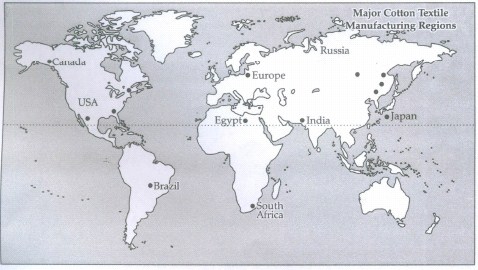
Give the distribution of cotton textile industry in the world. Also mark the same on the map of world.
29.
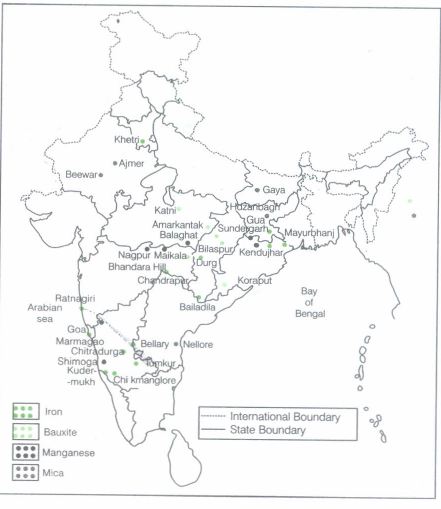
With the help of an atlas, on an outline map of India, mark the distribution of the following minerals: Iron, bauxite, manganese and mica.
30.
Do you think water is available in Chennai and affordable by all? Discuss.
31.
Write a short note on Wood's despatch.
32.
How is government formed in a democracy?
33.
In the context of the Shanti's case, did she get a fair trail?
34.
Who provides the public facilities?
35.
What is Unicameral legislature?
36.
Define vulnerable groups.
37.
When was Battle of Buxar fought?
38.
What is quarrying?
39.
Name the natural fibres?
40.
What is meant by 'Universal Adult Franchise'?
41.
What is meant by Sarvajanik?
42.
Name the artist of the painting named the 'Storming of Seringapatam'.
43.
The highest percent of land under crop land is in ___________.
44.
----------is an act of protest by the people outside a building or shop to prevent others from entering.
45.
About 90% of the world's population lives in about_____ of the land.
46.
What was Sepoy?
47.
Verrier Elwin was a British____________
48.
What was the outcome of partition of Bengal?
49.
What is Executive?
50.
Write a short note on Calico Act
51.
What are the different techniques used for mineral extraction?
1.
(a)
Tidal energy
2.
(d)
Cooking and drinking purposes
3.
(b)
42nd Amendment
4.
(b)
colouring clothes and leather
5.
(c)
1870
6.
(c)
Right to Life
7.
(b)
The police
8.
(c)
Human resources development
9.
(c)
Dacca
10.
(c)
Viceregal Palace
11.
(a)
12.
(a)
13.
(b)
14.
(b)
15.
(a)
16.
The American concept of Secularism means the separation of religion and state. They both have separate sphere of their own jurisdiction. No religious classification can be on the basis of any public policy. State cannot aid any religious institution. It cannot extend financial support to educational institutions run by religious communities. Religion is totally a private matter and not a matter of state policy or law.
17.
(i) Brahmo Samaj : The Brahmo Samaj formed in 1830,prohibited all forms of idolatry and sacrifice, believed in the Upanishads, and forbade its members from criticizing other religious practices. It critically drew upon the ideals of religions, especially those of Hinduism and looked at their negative and positive dimensions.
(ii) Prarthana Samaj : It was established in 1867 at Bombay. The Prarthana Samaj sought to remove caste restrictions, abolish child marriage, encourage the education of women, and end the ban on widow remarriage.
(iii) Paramhans Mandali : In Bombay, the Paramhans Mandali was founded in 1840 to work for the abolition of caste. Many of its reformers and members of reform associations were people of the upper castes.
18.
Following were the terms and treaty of Allahabad:
(i) The kingdom of Awadh was restored to the Nawab Shuja-ud-daullah.
(ii) The nawab paid the company a sum of Rs.50 lakhs and the company promised to support Awadh against any outside attack, using its own troops, but the expenses would be borne by the nawab.
(iii) The Mughal empire granted the Company the 'Diwani' of Bengal, Bihar and Orrisa.
(iv) The company gave the Mughal emperor an annual pension of Rs.26 Lakhs.
19.
Adivasi societies are distinctive because there is often very little or no hierarchy among them. This makes them radically different from communities organised around principles of jati-varna (caste) or those that were ruled by kings. They have their own culture, customs, religions etc.
20.
Input Raw materials like leather, labour, cost of land, transport, infrastructure.
Process Activities to convert hide into tough leather, spinning, printing.
Output Leather shoes
21.
The two steps that government has taken to conserve plants and animals are as follows:
(a) The government has taken some good steps in order to conserve plants and animals which include establishment of national parks, wildlife sanctuaries and biosphere reserves in different parts of India.
(b) Awareness programmes like social forestry and Vanamahotasava are encouraged at the regional and community levels.
22.
Bahadur Shah Zafar's support to the rebellion had a significant impact. Threatened by the expansion of British rule, many of the ruling families felt that if the Mughal emperor could rule again, they too would be able to rule their own territories once more, under Mughal authority. When people saw an alternative possibility which appealed to them, they felt inspired and enthused. It gave them the courage, hope and confidence to act.
Some examples of this effect are:
(i) Many troop regiments mutinied to join other troops at nodal points like Delhi, Kanpur and Lucknow.
(ii) Nana Saheb proclaimed himselfPeshwa and a governor under the Mughal king.
(iii) Birjis Qadr, son of the deposed Nawab Wajid Ali Shah in Lucknow, acknowledged that he ruled under the Mughal king.
(iv) In Jhansi, Rani Lakshmibai joined the rebel sepoys and fought the British along with Tantia Tope, the general of Nana Saheb.
23.
()
Furniture
24.
()
Colonial
25.
()
Public facilities
26.
()
Witnesses
27.
()
1680s
28.
Distribution of Cotton Textile Industry in the World:
The cotton textile industry is one of the oldest industries in the world. It originated in the Indus Valley about 5000years ago. Till the industrial revolution, cotton cloth was made by using hand spinning techniques and handlooms. The industrial revolution in the 18th century brought a phenomenal change in the textile industry. Power looms facilitated development of cotton textile industry, first in the Great Britain and later in the other parts of the world. India, China, and Japan are the important producers of cotton textiles
29.
30.
(i)Water supply in Chennai is marked by shortages.
(ii)Municipal supply meets only about half the needs of the people of the city, on an average.
(iii) There are areas which get more water regularly than others. Those areas that are close to the storage points get more water, whereas colonies further away receive less water.
(iv) Apart from the availability of water, access to 'safe' drinking water is also available to some people and this depends on their afford ability.
(v) The burden of shortfall in water supply falls mostly on the poor.
(vi) The middle class, when faced with water shortage, are able to cope through a variety of private means such as digging bore wells, buying water from tankers and using bottled water for drinking.
31.
(i) In 1854, the East India Company in London sent an educational despatch to the Governor-General in India. Issued by Charles Wood, the President of the Board of Control of the Company, it came to be known as Wood's Despatch.
(ii) Outlining the educational policy that was to be followed in India, it emphasized once again the practical benefits of a system of European learning, as opposed to Oriental knowledge.
(iii) It emphasized on European ways of life, as it would change their tastes and desires, and create a demand for British goods.
(iv) European learning would improve the moral character of Indians. It would make them truthful and honest, and thus supply the Company with civil servants who could be trusted and depended upon.
(v) Education in English crippled Indians, distanced them from their own social surroundings, and made them "strangers in their own lands". Speaking a foreign tongue, despising local culture, the English educated did not know how to relate to the masses.
(vi) Western education, Mahatma Gandhi said, focused on reading and writing rather than oral know-ledge; it valued textbooks rather than live experience and practical knowledge. He argued that education ought to develop a person's mind and soul.
32.
In a democracy, government is formed after elections. After the elections, a list is
prepared which indicates the winner of each Lok Sabha seat. These winners become the Members of Parliament (MPs). The political party with the majority of these MPs forms the government.
Since there are 543 seats in Lok Sabha, a party must secure at least half i.e. 272 seats in Parliament to form government. Sometimes, no single political party is able
to win 272 seats on its own and get the majority to form the government. In that
situation, two or more political parties with similar concerns join together to get the
majority and form a Coalition Government.
33.
Yes, Shanti did get a fair trial. Firstly, Shanti has given a copy of the charge sheet and all other evidence that the prosecution presented against her. Shanti was charged with the offence of theft that was defined as a crime in the law. The trial was held in an open court in public view. Her brother could attend the court hearings.
Shanti's lawyer was given an opportunity to cross-examine all the prosecution witnesses.
Although the police filed a case of theft against Shanti, the judge assumed her to be innocent. The judge decided the matter only on the basis of the evidence before the court. The evidence showed that some young men and not Shanti was the thief. In Shanti's case, justice was finally done to her because she was given a fair trial.
34.
()
The government provides the public facilities.
35.
()
It is a legislature with a single house.
36.
()
Certain groups in the society often come across discriminatory treatment and need special attention to avoid potential exploitation. This population constitutes what is referred to as Vulnerable Groups.
37.
()
It was fought in 1764.
38.
()
Minerals that lie near the surface are simply dug out by the process known as quarrying.
39.
()
Natural fibres are obtained from wool, silk, cotton and jute.
40.
()
Universal Adult Franchise means that everybody above the age of 18 regardless any caste, class, religion, gender and race can have a right to vote.
41.
()
Sarvajanik is 'of or for all the people' (Sarva= all + janik = of the people)
42.
()
The Storming of Seringapatam was painted by Rober Kerr Porter in 1800.
43.
()
India
44.
()
Picket
45.
()
10%
46.
()
The term sepoy was used by East India Company for soldiers.
47.
()
anthropologist
48.
The partition of Bengal infuriated people all over India. All sections of the Congress opposed it. Large public meetings and demonstrations were organised and new methods of protest developed. Its outcome was the Swadeshi Movement.
49.
Executive is that organ of government which implements the laws made by the legislature.
50.
(i) When the Portuguese first came to India in search of spices, they landed in Calicut on the Kerala coast in South - West India.
(ii) The cotton textiles which they took back to Europe, along with the spices, came to be called as "calico" (derived from Calicut), and subsequently, calico became the general name for all cotton textiles.
(iii) By the early 18th century, worried by the popularity of Indian textiles, wool and silk makers in England began protesting against the import of Indian cotton textiles.
(iv) In 1720, the British government enacted a legislation banning the use of printed cotton textiles chintz - in England. This Act was known as the CalicoAct
51.
Generally, it is believed that mining is the only form of mineral extraction. hilt ~here are many other techniques for mineral extraction.
These are :
(i)Mining: Mining is the process of excavation of the minerals both from deep as well as shallow areas. There are two methods of mining:
(a) Open cast mining : It is a mining technique in which material is extracted by digging a large hole, rather than tunneling.
(b) Shaft mining : It is a type of underground mining done by use of a rnineshaft. It may also refer to the act of excavation the shaft itself.
(ii) Drilling: It is a type of shaft mining. It is generally used for oil and natural gas excavation.
(iii) Quarrying: It is generally used to extract minerals which lie near the surface by simply digging.

8th Standard CBSE Syllabus & Materials
8th Standard CBSE
CBSE 8th Science Particulate Nature of Matter - New Model Questions Papers Study Material - QB365 Set A
NEW8th Standard CBSE
CBSE 8th Science Pressure, Winds, Stroms and Cyclones - New Model Questions Papers Study Material - QB365 Set A
NEW8th Standard CBSE
CBSE 8th Mathematics Quadrilaterals - New Model Questions Papers Study Material - QB365 Set A
NEW8th Standard CBSE
CBSE 8th Mathematics A story of Numbers - New Model Questions Papers Study Material - QB365 Set A



CBSE 8th Standard CBSE Subjects
CBSE Standards




