
 100% FREE ACCESS
8th Standard CBSE Syllabus & Materials
8th Standard CBSE
CBSE 8th Social Science Theme D - Factors of Production - New Model Questions Papers Study Material - QB365 Set A
NEW8th Standard CBSE
CBSE 8th Social Science Theme C - Universal Franchise and India's Electoral System - New Model Questions Papers Study Material - QB365 Set A
NEW8th Standard CBSE
CBSE 8th Social Science Theme B - The Rise of the Marathas - New Model Questions Papers Study Material - QB365 Set A
NEW8th Standard CBSE
CBSE 8th Social Science Theme B - Reshaping India's Political Map - New Model Questions Papers Study Material - QB365 Set A
NEW8th Standard CBSE
CBSE 8th Social Science Theme A - Natural Resources and Their Use - New Model Questions Papers Study Material - QB365 Set A
NEW8th Standard CBSE
CBSE 8th Science Keeping Time with Skies - New Model Questions Papers Study Material - QB365 Set A

Published on: 05/09/2019
Weavers, Iron Smelters and Factory Owners
Download CBSE Class 8th Standard CBSE Social Science question papers, sample papers, important questions, and previous year solved papers in PDF format. Get free study materials, NCERT solutions, and exam preparation resources for Class 8th Standard CBSE Social Science
Questions + Answers key
Take MCQ Social Science Test
1.
What problem did the Indian textile industry face in the early years of its development?
2.
Describe briefly the production of Wootz steel, as described by Francis Buchanan.
3.
How did the development of cotton industries in Britain affect textile producers in India?
4.
How do the names of different textiles tell us about their histories?
5.
Why would the iron and steel making industry be affected by the defeat of the nawabs and rajas?
6.
Finely woven cloth from India was referred as :
Chintz
Muslin
Calico
Long cloth
7.
The Meiji regime assumed power in Japan in _________
1868
1878
1898
1908
8.
From the 16th century, who began buying Indian textiles for sale in Europe?
The Spanish
European trading companies
East India Company
The Dutch
9.
_______________ became the general name for all cotton textiles from India
Chhint
Chintz
Khassa
Calico
10.
India was the world's largest producer of cotton textiles around the year ____________
1850
1750
1730
1680
11.
Look at the given picture and answer the following questions.
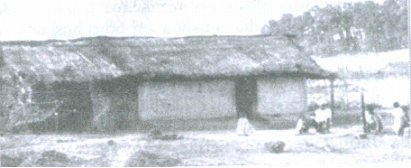
(i) Name the community, who was lived in this village?
(ii) In which century a series of famines devastated the dry tracts of India.
12.
Look at the given pictures and answer the following questions.
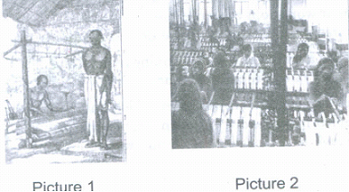
(i) What are the Tanti weavers doing in the above pictures 1?
(ii) What is shown in picture 2?
13.
In what ways were the steps followed for industrialising Japan different from those followed by the British in industrialising India?
14.
The Indian textile industry found it difficult to __________with the cheap textiles imported from Britain.
15.
The_________ was passed in the year 1720 by the British government.
16.
British came to be known as the "___________of the world."
17.
_________ steel was produced all over South India during the late 18th century in smelting furnaces by the local people.
18.
Indian textiles were famous all over the world for their __________ and ___________
19.
TISCO started steel production in 1914
20.
Calico Act was implemented in 1720
21.
Wool and silk makers in England welcomed the import of Indian textiles.
22.
Printed Indian cotton cloth had various names like bandanna, chintz, and khassa.
23.
The industrialization of Britain was not connected with the colonization of India.
24.
How did the Indian cotton mills prove to be helpful to the British during the First World War?
25.
How were the duties of spinning and weaving divided among traditional communities making cotton textiles?
26.
In which region of India was Wootz steel produced?
27.
What characteristics of printed Indian cotton textiles made them popular in Europe?
28.
Why were Indian textiles renowned all over the world by 1750?
1.
In the early years of its development, the Indian textile industry had to face the following problems:
(i) Indian textiles had to compete with British textiles in the European and American markets.
(ii) Exporting textiles to England became very difficult due to high duties imposed on the Indian textiles.
(iii) English and European companies stopped buying Indian goods and giving advances to the weavers.
(iv) By the 1830s, as the British cotton cloth flooded the Indian markets, thousands of weavers became unemployed.
2.
Francis Buchanan described the production of Wootz steel as follows:
(i) In a smelting furnace, iron was mixed with charcoal and put inside small clay pots
(ii) By an intricate control of furnace temperatures, the smelters produced steel ingots.
(iii) These steel ingots were then fashioned into swords with very hard and sharp edges.
3.
The development of cotton industries in Britain affected textile producers in India due to the following factors:
(i) Competition in Foreign Markets By the beginning of the 19th century, English-made cotton textiles ousted Indian textiles from their traditional markets in Europe, Africa and America. This threw thousands of Indian weavers out of employment.
(ii) High Import Duties/Ban on Imports Exporting textiles to England became increasingly difficult due to the very high duties imposed on Indian textiles imported into Britain.
(iii) Capture of the Indian Market By the 1830s, British cotton cloth flooded Indian markets. By the 1880s, two-thirds of all cotton clothes worn by Indians were made of cloth produced in Britain.
4.
The origins of the names of different textiles tell us about their histories. For example, (i) Muslin is a word meaning any finely woven textile. The name of this cloth is derived from Mosul (a town in Iraq), where European traders first saw fine cotton cloth from India, which was brought from India by Arab traders.
(ii) Calico is a generic name for all cotton textiles. This is derived from Calicut, a port town in Kerala, where the Portuguese first landed in India. They took back Indian cotton textiles to Europe, where these came to be called calico.
(iii) Chintz, a printed cotton cloth, is a term derived from the Hindi word chhint, a cloth with small and colourful flowery designs.
5.
The East India Company gradually conquered different states and expanded its territory. Nawabs and rajas were forced to admit the supremacy of the Company. The requirements of weapons by the native rulers became lesser. Thus, the swords and armour making industry died with the conquest of India by the British. Imports of iron and steel from England displaced the iron and steel produced by craftspeople in India. By the late 19th century, the craft of iron smelting was in decline due to political, social and economic reasons.
6.
(b)
Muslin
7.
(a)
1868
8.
(b)
European trading companies
9.
(d)
Calico
10.
(b)
1750
11.
(i) Agarias - a community of iron smelters were lived in this village.
(ii) In the late 19th century a series of famines devastated the dry tracts of India.
12.
(i) In picture 1, Tanti weavers are working in the pit loom.
(ii) Women workers of the cotton factory are shown in picture 2.
13.
The basic difference between India and Japan was that India was run by the British colonial government, while Japan was an independent country. While the colonial government in India, which wanted to expand the market for British goods, did not support Indian industrialists, the Japanese Government encouraged the growth of industries.
They did this by developing postal and telegraph services, railways and steam-powered shipping. They also imported advanced technology from the West and gave generous loans to industrialists, besides selling large industries started by the government to business families very cheaply. Thus in India, colonial domination created barriers to industrialization, while in Japan the fear of foreign conquest spurred industrialisation.
14.
()
Compete
15.
()
Spinning jenny
16.
()
workshop
17.
()
Wootz
18.
()
quality, craftsmanship
19.
(b)
20.
(a)
21.
(b)
22.
(a)
23.
(b)
24.
()
The Indian cotton mills proved to be helpful to the British during the First World War by producing cloth for supply to the military.
25.
()
The spinning of cotton thread from raw cotton was done mostly by women and the weaving of thread to make cloth was done mostly by men.
26.
()
Wootz steel was produced all over South India, but particularly in the state of Mysore.
27.
()
The characteristics of printed Indian cotton textiles which made them popular in Europe were their exquisite floral designs, fine texture and low cost.
28.
()
Indian textiles were renowned all over the world by 1750 because of their fine quality and exquisite craftsmanship.

8th Standard CBSE Syllabus & Materials
8th Standard CBSE
CBSE 8th Science Particulate Nature of Matter - New Model Questions Papers Study Material - QB365 Set A
NEW8th Standard CBSE
CBSE 8th Science Pressure, Winds, Stroms and Cyclones - New Model Questions Papers Study Material - QB365 Set A
NEW8th Standard CBSE
CBSE 8th Mathematics Quadrilaterals - New Model Questions Papers Study Material - QB365 Set A
NEW8th Standard CBSE
CBSE 8th Mathematics A story of Numbers - New Model Questions Papers Study Material - QB365 Set A



CBSE 8th Standard CBSE Subjects
CBSE Standards




