
 100% FREE ACCESS
8th Standard CBSE Syllabus & Materials
8th Standard CBSE
CBSE 8th Social Science Theme D - Factors of Production - New Model Questions Papers Study Material - QB365 Set A
NEW8th Standard CBSE
CBSE 8th Social Science Theme C - Universal Franchise and India's Electoral System - New Model Questions Papers Study Material - QB365 Set A
NEW8th Standard CBSE
CBSE 8th Social Science Theme B - The Rise of the Marathas - New Model Questions Papers Study Material - QB365 Set A
NEW8th Standard CBSE
CBSE 8th Social Science Theme B - Reshaping India's Political Map - New Model Questions Papers Study Material - QB365 Set A
NEW8th Standard CBSE
CBSE 8th Social Science Theme A - Natural Resources and Their Use - New Model Questions Papers Study Material - QB365 Set A
NEW8th Standard CBSE
CBSE 8th Science Keeping Time with Skies - New Model Questions Papers Study Material - QB365 Set A

Published on: 05/08/2019
Weavers, Iron Smelters and Factory Owners
Download CBSE Class 8th Standard CBSE Social Science question papers, sample papers, important questions, and previous year solved papers in PDF format. Get free study materials, NCERT solutions, and exam preparation resources for Class 8th Standard CBSE Social Science
Questions + Answers key
Take MCQ Social Science Test
1.
Why did the Indian iron smelting industry decline in the 19th century?
2.
How did the development of cotton industries in Britain affect textile producers in India?
3.
The Meiji regime assumed power in Japan in _________
1868
1878
1898
1908
4.
From the 16th century, who began buying Indian textiles for sale in Europe?
The Spanish
European trading companies
East India Company
The Dutch
5.
_____________ was the foremost textile centre in India during the 18th century.
Calcutta
Bombay
Dacca
Ahmedabad
6.
_______________ became the general name for all cotton textiles from India
Chhint
Chintz
Khassa
Calico
7.
In the 1850s, Britain came to be known as the _____________
textile hub
most industrialised nation
workshop of the world
devil's workshop
8.
Francis Buchanan toured through Mysore in ___________a year after Tipu Sultan's death
9.
The ________and__________ were household spinning instruments
10.
Weavers often belonged to that specialised in weaving.
11.
Around the year_________India was by far the world's largest producer of cotton textiles
12.
Dorabji Tata discovered one of the finest iron ores in the world in the __________ hills of Chhattisgarh.
13.
Calico Act was implemented in 1720
14.
Wool and silk makers in England welcomed the import of Indian textiles.
15.
Strict implementation of the forest laws by the British Colonial Government hastened the decline of the craft of iron smelting.
16.
Cotton mills got a heavy demand for production of khadi during the freedom movement in India.
17.
Handloom weaving continued to exist in India because machines were unable to produce saris with intricate borders or cloth with traditional woven patterns.
18.
Charkha put in the flag of Indian National Congress
19.
British colonial government buys 90 percent of TISCO steel production
20.
Arkwright invents steam engine
21.
TISCO starts steel production in Jamshedpur
22.
Tipu Sultan killed
23.
Look at the given picture and answer the following questions.
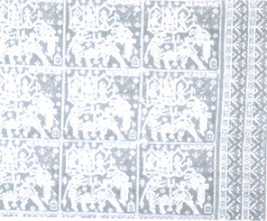
(i) What is shown in the picture?
(ii) Where was Patola woven?
(iii) Why was Patola highly valued in Indonesia?
24.
Why it was famous?
25.
In which locations in India was Patola woven during the mid-19th century?
26.
What was a "Spinning Jenny" ? Explain.
27.
Mention the names of famous weaves. Which united provinces did they belong to?
28.
Write a short note on Calico Act
1.
The Indian iron smelting industry declined in the 19th century due to:
(i) Strict implementation of forest laws The British colonial administration prevented the free movement of people into reserved forests with these laws. Charcoal, an essential ingredient in the iron smelting process, which was made by burning wood, thus could not be obtained easily.
(ii) High taxes on running furnaces In some areas where the British allowed access to forests, iron smelters had to pay a very high tax to the forest department for every furnace they used. This reduced their income.
(iii) Imports from Britain By the late 19th century, iron and steel were being imported from Britain. Ironsmiths began using the imported iron to manufacture utensils and implements. This reduced the demand for iron produced by local smelters.
(iv) Famines In the late 19th century, a series of famines devastated some parts of India where smelters worked. Thus they migrated looking for some other livelihood to survive.
2.
The development of cotton industries in Britain affected textile producers in India due to the following factors:
(i) Competition in Foreign Markets By the beginning of the 19th century, English-made cotton textiles ousted Indian textiles from their traditional markets in Europe, Africa and America. This threw thousands of Indian weavers out of employment.
(ii) High Import Duties/Ban on Imports Exporting textiles to England became increasingly difficult due to the very high duties imposed on Indian textiles imported into Britain.
(iii) Capture of the Indian Market By the 1830s, British cotton cloth flooded Indian markets. By the 1880s, two-thirds of all cotton clothes worn by Indians were made of cloth produced in Britain.
3.
(a)
1868
4.
(b)
European trading companies
5.
(c)
Dacca
6.
(d)
Calico
7.
(c)
workshop of the world
8.
()
1800
9.
()
Aurang
10.
()
Charkha, takli
11.
()
1750
12.
()
Rajhara
13.
(a)
14.
(b)
15.
(a)
16.
(b)
17.
(a)
18.
()
1931
19.
()
1912
20.
()
1786
21.
()
1912
22.
()
1799
23.
(i) Patola weave of the mid-19th century is shown in the above picture.
(ii) Patola was woven in Surat, Ahmedabad, and Patan.
(iii) Parola was highly valued in Indonesia, it became part of the local weaving tradition there.
24.
()
It was famous for its mulmul and jamdani weaving.
25.
()
Patola was woven in Ahmedabad, Patan and Surat during the mid-19th century.
26.
A machine by which a single worker could operate several spindles on towhich thread was spun. When the wheel was turned, all the spindles rotated.
27.
Patola and Jamdani were the famous weaves. patola was woven in Surat, Ahmedabad and Patna. jamdani had its origin in Dacca (Bengal) and Lucknow (United Provinces).
28.
(i) When the Portuguese first came to India in search of spices, they landed in Calicut on the Kerala coast in South - West India.
(ii) The cotton textiles which they took back to Europe, along with the spices, came to be called as "calico" (derived from Calicut), and subsequently, calico became the general name for all cotton textiles.
(iii) By the early 18th century, worried by the popularity of Indian textiles, wool and silk makers in England began protesting against the import of Indian cotton textiles.
(iv) In 1720, the British government enacted a legislation banning the use of printed cotton textiles chintz - in England. This Act was known as the CalicoAct

8th Standard CBSE Syllabus & Materials
8th Standard CBSE
CBSE 8th Science Particulate Nature of Matter - New Model Questions Papers Study Material - QB365 Set A
NEW8th Standard CBSE
CBSE 8th Science Pressure, Winds, Stroms and Cyclones - New Model Questions Papers Study Material - QB365 Set A
NEW8th Standard CBSE
CBSE 8th Mathematics Quadrilaterals - New Model Questions Papers Study Material - QB365 Set A
NEW8th Standard CBSE
CBSE 8th Mathematics A story of Numbers - New Model Questions Papers Study Material - QB365 Set A



CBSE 8th Standard CBSE Subjects
CBSE Standards




