
 100% FREE ACCESS
8th Standard Syllabus & Materials
8th Standard
TN 8th Tamil இயல் 3 - கல்வி கரையில - வினைமுற்று Important Questions And Answers Study Material - QB365 Set A
NEW8th Standard
TN 8th Tamil இயல் 2 - ஈடில்லா இயற்கை - மயங்கொலிகள் Important Questions And Answers Study Material - QB365 Set A
NEW8th Standard
TN 8th Tamil இயல் 2 - ஈடில்லா இயற்கை -பட்டமரம் Important Questions And Answers Study Material - QB365 Set A
NEW8th Standard
TN 8th Tamil இயல் 2 - ஈடில்லா இயற்கை - இயற்கையை போற்றுவோம் Important Questions And Answers Study Material - QB365 Set A
NEW8th Standard
TN 8th Tamil இயல் 1 - தமிழ் இன்பம் - ஆழிக்கு இணை Important Questions And Answers Study Material - QB365 Set A
NEW8th Standard
TN 8th Tamil இயல் 2-ஈடில்லா இயற்கை - திருக்குறள் Important Questions And Answers Study Material - QB365 Set A

Published on: 13/05/2022
QB365 provides detailed and simple solution for every book back questions in class 8 Maths subject.It will helps to get more idea about question pattern in every book back questions with solution.
latest Book back QuestionsDownload Tamil Nadu 8th Standard Maths question papers, model tests, one-mark questions, important questions, and public exam papers in PDF format. Free study materials and answer keys for TN State Board students.
Questions + Answers key
Take MCQ Maths Test1.
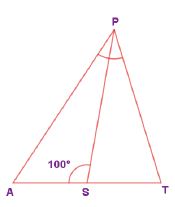
In ΔPAT, the bisector of ∠P, meets AT at S. If ∠APT = 70o and ∠ASP = 100o, find ∠A and ∠T.
2.
Evaluate: \(\left( \frac { 4 }{ 3 } -\left( \frac { -3 }{ 2 } \right) \right) +\left( \frac { -5 }{ 3 } \div \frac { 30 }{ 12 } \right) +\left( \frac { -12 }{ 9 } \times \frac { -27 }{ 16 } \right) \)
3.
The product of two rational numbers is \(\frac { -2 }{ 3 } \) If one number is \(\frac { 3 }{ 7 } \) find the other.
4.
Find \(\frac { -5 }{ 8 } \times 7\)
5.
Add: \(\frac { -5 }{ 9 } ,\frac { -4 }{ 3 } ,\frac { 7 }{ 12 } \)
6.
Write the following decimal numbers as rationals.
3.0
7.
Find the value of (103)3
8.
Find the value of 9982 by using (a − b)2 identity
9.
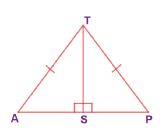
(Illustrating RHS Congruence)
If TAP is an isosceles triangle with TA = TP and ∠TSA = 90°
Is ∠P = ∠A? Why?
10.
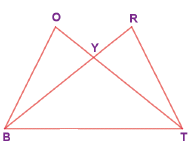
(Illustrating ASA Congruence)
If ∠YTB ≡∠YBT and ∠BOY ≡∠TRY, prove that Δ BOY ≡ Δ TRY
11.
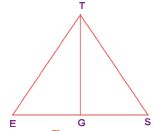
(Illustrating SSS and SAS Congruence)
If ∠E =∠S and G is the midpoint of ES, prove that Δ GET ≡ Δ GST.
12.
(Illustrating SSS similarity)
Prove that ΔPQR ~ ΔPRS in the given Fig
.JPG)
13.
(Illustrating SAS Similarity)
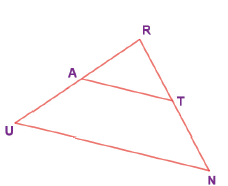
If A is the midpoint of RU and T is the midpoint of RN, prove that ΔRAT ~ ΔRUN .
14.
If Guru wants to multiply the expressions (2x+3y+50) and 3xy , what is the resultant expression?
15.
If the side of a square carpet is 3x2 metre, then find its area
16.
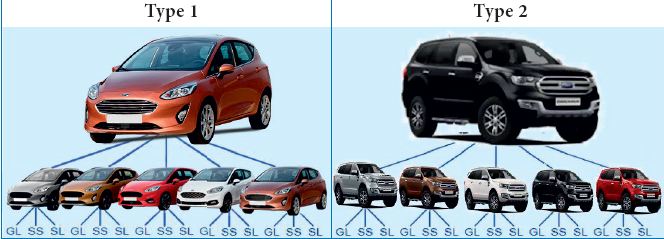
Madhan wants to a buy a new car. The following choices are available for him.
1) There are 2 types of cars as shown in the Figure
2) There are 5 colours available in each type as shown in Figure
3) There are 3 models available in each colour
(i) GL (standard model)
(ii) SS (sports model)
(iii) SL (luxury model)
(i) In how many different ways can Madhan buy any one of the new cars?
(ii) If the white colour is not available in Type 2, then in how many ways can Madan buy a new car among the given options?
17.
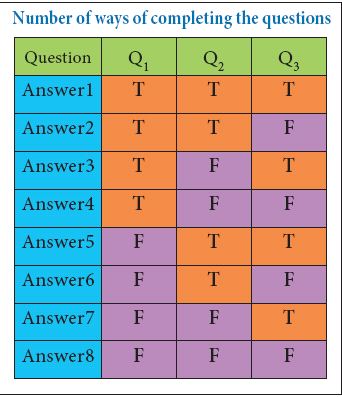
In how many ways, can the students answer 3 true or false type questions in a slip test?
18.
What are the possible outcomes if a fair die is rolled?
.JPG)
19.
(Illustrating AA Similarity)
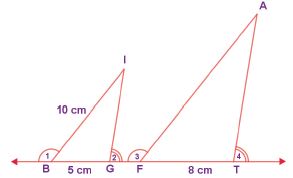
In the given Fir, if ∠1 ≡ ∠3 and ∠2 ≡∠4 then, prove that ΔBIG ~ ΔFAT . Also find FA.
20.
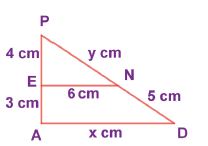
In Fig, if ΔPEN ~ ΔPAD, then find x and y.
21.
Find the unknowns in the following figures
.JPG)
22.
Find the unknowns in the following figures
.JPG)
23.
Kamalesh has a dining table, circular in shape of radius 70 cm, whereas Tharun has a circular quadrant dining table of radius 140 cm. Whose dining table has a greater area? \(\left(\pi=\frac{22}{7}\right)\)
24.
A circular shaped gymnasium ring of radius 35 cm is divided into 5 equal arcs shaded with different colours. Find the length of each of the arcs.
25.
The radius of a sector is 21cm and its central angle is 120°. Find the length of the arc
1.
Now, PS is the bisector of ∠P
∴ ∠APS = ∠TPS = 35o
From ΔAPS,
∠A+∠APS+∠ASP=180o (angle sum property in Δ APS)
∠A + 35 + 100o = 180o
⇒∠A = 180o−135o = 45o
From ΔTPS,
∠T + ∠TPS + ∠TSP = 180o (angle sum property in Δ TPS)
⇒∠T + 35o + 80o = 180o
⇒∠T = 180o − 115 = 65o
2.
\(\left( \frac { 4 }{ 3 } -\left( \frac { -3 }{ 2 } \right) \right) +\left( \frac { -5 }{ 3 } \div \frac { 30 }{ 12 } \right) +\left( \frac { -12 }{ 9 } \times \frac { -27 }{ 16 } \right) =\left( \frac { 4 }{ 3 } +\frac { 3 }{ 2 } \right) +\left( \frac { -5 }{ 3 } \times \frac { 12 }{ 30 } \right) +\left( \frac { -12 }{ 9 } \times \frac { -27 }{ 16 } \right) \)
= \(\left( \frac { 8 }{ 9 } +\frac { 9 }{ 6 } \right) +\left( \frac { -1 }{ 1 } \times \frac { 4 }{ 6 } \right) +\left( \frac { -3 }{ 1 } \times \frac { -3 }{ 4 } \right) \)
= \(\left( \frac { 17 }{ 6 } \right) +\left( \frac { -4 }{ 6 } \right) +\left( \frac { 9 }{ 4 } \right) \)
= \(\left( \frac { 17-4 }{ 6 } \right) +\frac { 9 }{ 4 } =\frac { 13 }{ 6 } +\frac { 9 }{ 4 } \)
= \(\frac { 26+27 }{ 12 } =\frac { 53 }{ 12 } \)
3.
Let the other number be x
Given, \(\frac { 3 }{ 7 } x=\frac { -2 }{ 3 } \)
Multiplying by the reciprocal of \(\frac { 3 }{ 7 } \) that is, \(\frac { 7 }{ 3 } \)
\(\Rightarrow \frac { 7 }{ 3 } \times \frac { 3 }{ 7 } \times x=\frac { 7 }{ 3 } \times \frac { -2 }{ 3 } \)
\(\Rightarrow x=\frac { -14 }{ 9 } \)
4.
\(\frac { -5 }{ 8 } \times 7=\frac { -5 }{ 8 } \times \frac { 7 }{ 1 } =\frac { -5\times 7 }{ 8\times 1 } =\frac { -35 }{ 8 } \)
5.
LCM of 9, 3, 12 = 36
\(\frac { -5 }{ 9 } +\frac { -4 }{ 3 } +\frac { 6 }{ 12 } =\frac { -5 }{ 9 } \times \frac { 4 }{ 4 } +\frac { -4 }{ 3 } \times \frac { 12 }{ 12 } +\frac { 7 }{ 12 } \times \frac { 3 }{ 3 } \)
= \(\frac { -20 }{ 36 } +\frac { -48 }{ 36 } +\frac { 21 }{ 36 } =\frac { -20-48+21 }{ 36 } \)
= \(\frac { -47 }{ 36 } \)
6.
\(3.0=\frac { 30 }{ 10 } =\frac { 3 }{ 1 } \)
7.
Now,(103)3 = (100 + 3)3
Comparing this with (a+ b)3,we get a = 100,b = 3
(ab)3 = a3 + 3a2b + 3ab2 + b3 replacing a, b values,
(100+3)3 = (100)3 +3(100)2(3) + 3(100)(3)2 + (3)3
= 1000000 + 3(10000)(3) + 3(100)(9) + 27
= 1000000 + 9000 + 2700 + 27
(103)3 = 1092727
8.

We know, 998 can be expressed as (1000 − 2)
Now (a - b)a2 - 2ab + b2
(1000 - 2)2 = (1000)22(1000(2) + (2)2
= 1000000 - 4000 + 4
(998)2 = 996004
9.
Given TA = TP
∴ ∠P = ∠A (if angles then sides)
10.
Proof:
| Statements | Reasons | |
|---|---|---|
| 1 | ∠YTB ≡ ∠YBT | given |
| 2 | BY ≡ TY | if angles, then sides |
| 3 | ∠BYO ≡ ∠TYR | vertical angles are congruent |
| 4 | ∠BOY ≡ ∠TRY | given |
| 5 | Δ BOY ≡ Δ TRY | by AAS (4,3,2) |
| 6 | ∠OBY ≡ ∠RTY | follows from 3 and 4 |
| 7 | Δ BOY ≡ Δ TRY | by ASA (6,2,3) |
11.
Proof:
| Statements | Reasons | |
|---|---|---|
| 1 | ∠E ≡ ∠S | given |
| 2 | ET ≡ ST | if angles, then sides |
| 3 | G is the midpoint of ES | given |
| 4 | EG ≡ SG | follows from 3 |
| 5 | TG ≡ TG | reflexive property |
| 6 | Δ GET ≡ Δ GST | by SSS (2,4,5) & also by SAS (2,1,4) |
12.
Now, \(\frac { PQ }{ PR } =\frac { 20 }{ 15 } =\frac { 4 }{ 3 } \)
\(\frac { PR }{ PS } =\frac { 15 }{ 11.25 } =\frac { 4 }{ 3 } \)
Also, \(\frac { QR }{ RS } =\frac { 12 }{ 9 } =\frac { 4 }{ 3 } \)
We find \(\frac { PQ }{ PR } =\frac { PR }{ PS } =\frac { QR }{ RS } \)
That is, their corresponding sides are proportional.
∴ By SSS Similarity, ΔPQR ~ ΔPRS
.JPG)
13.
Proof
| Statements | Reasons | |
|---|---|---|
| 1 | ∠ART = ∠URN | ∠R is common in ΔRAT and ΔRUN |
| 2 | RA = AU = \( \frac12\) RU | A is the midpoint of RU |
| 3 | RT = TN = \( \frac12\)RN | T is the midpoint of RN |
| 4 | \(\frac { RA }{ RU } =\frac { RT }{ TN } \)=\( \frac12\) | the sides are proportional from 2 and 3 |
| 5 | ΔRAT~ΔRUN | by SAS (1 and 4) |
14.
The resultant expression
=3xy × (2x+3y+50)
=3xy(2x)+3xy(3y)+3xy(50)
=6x2y+9xy2+150xy
15.
The area of the square carpet, A = (side × side) sq. units.
= 3x2×3x2
= 3×3×x2×x2
A = 9x4 sq.m
16.
(i) Here, we have 2 types of car with 5 different colors and 3 models in each color.
.JPG)
Total number of different way to buy a new car by Madhan = 2 x 5 x 3 = 30. (You can also find the number of ways from the figure shown above).
(ii) If the white colour is not available in Type 2, then..
.JPG)
For Type 1, we have 5 colors and 3 models and hence there are 5 x 3 = 15 choices.
For Type 2, we have only 4 colors and 3 models and hence there are 4 x 3 = 12 choices.
Therefore, the total number of different ways 15 + 12 = 27 ways.
The above example illustrates both the addition and multiplication principles.
17.
Assuming that the question Q1 is answered True, questions Q2 and Q3 can be answered as TT, TF, FT, and FF in 4 ways.
Similarly, assuming that the question Q2 is answered False, Q2 and Q3 can also be answered as TT, TF, FT, and FF in 4 ways.
Thus, as each question has only two options (True or False), the number of ways of answering these 3 questions in a slip test is 2 x 2 x 2 = 8 possible ways
18.
.JPG)
There are 6 different outcomes, namely 1, 2, 3, 4, 5 and 6. All the 6 outcomes cannot occur simultaneously. Hence, there are 6 different possible outcomes in rolling a die.
19.
Proof:
| Statements | Reasons | |
|---|---|---|
| 1 | ∠1 ≡ ∠3 | given |
| 2 | ∠IBG ≡ ∠AFT | supplements of congruent angles are congruent |
| 3 | ∠2 ≡ ∠4 | given |
| 4 | ∠IGB ≡ ∠ATF | supplement of congruent angles are congruent |
| 5 | ΔBIG~ΔFAT | by AA property (2, 4) |
Also, their corresponding sides are proportional
⇒ \(\frac { BI }{ FA } =\frac { BG }{ FT } \Rightarrow \frac { 10 }{ FA } =\frac { 5 }{ 8 } \)
⇒ FA = \(\frac { 10\times 8 }{ 5 } =\frac { 80 }{ 5 } \) = 16 cm
20.
Given that ΔPEN ~ ΔPAD,
∴ \(\frac { PE }{ PA } =\frac { EN }{ AD } \Rightarrow \frac { 4 }{ 7 } =\frac { 6 }{ x } \Rightarrow x=\frac { 42 }{ 4 } \)
Also, \(\frac { PE }{ PA } =\frac { PN }{ PD } =\frac { y }{ y+5 } \)
i.e. \(\frac { 4 }{ 7 } =\frac { y }{ y+5 } \) ⇒ 4y + 20 =7y ⇒ 7y - 4y = 20
3y = 20 ⇒ \(y=\frac { 20 }{ 3 } \)cm
21.
Now, from Fig in ΔABC \(\angle\)A = x (vertically opposite angles)
Similarly \(\angle\)B = \(\angle\)C = \(\angle\)x (Why?)
⇒ \(\angle\)A + \(\angle\)B + \(\angle\)C = 180o (angle sum property in ΔABC)
⇒ 3x = 180o
⇒ x = 60o
⇒ y = 180o − 60o = 120o
22.
Now, from Fig \(\angle\)140o+ \(\angle\)z = \(\angle\)180o (linear pair)
⇒ \(\angle\)z = 180o −140o = 40o
Also \(\angle\)x+ \(\angle\)z= \(\angle\)70 + \(\angle\)z (exterior angle property)
⇒\(\angle\)x=70o
Also \(\angle\)z+ \(\angle\)y + 70o = 180o (angle sum property in ΔABC)
⇒ 40o + \(\angle\)y + 70o = 180o
⇒ \(\angle\)y = 180o − 110o = 70o
23.
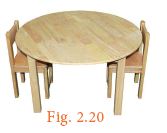
Area of the dining table of Kamalesh = πr2 sq. units
\(=\frac{22}{7}\times70\times70\)
A = 15400 sq.cm (approximately.)
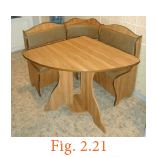
Area of the circular quadrant dining table of Tharun
\(=\frac{1}{4}\pi r^2=\frac{1}{4}\times \frac{22}{7}\times140 \times140\)
A = 15400 sq.cm (approximately.)
We find that, the area of the dining tables of both of them have the same area.
24.
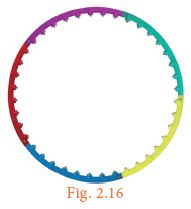
Radius, r = 35 cm and n = 5
Length of each of the arcs, l = \(\frac{1}{n}\times 2\pi r\) units
\(=\frac{1}{5}\times2\times \pi\times35\)
l = 14 π cm
25.

length of the arc ,\(l=\frac { { \theta }^{ 0 } }{ { 360 }^{ 0 } } \times 2\pi r\)
\(=\frac { { 120 }^{ 0 } }{ { 360 }^{ 0 } } \times 2\times \pi \times 21\)
\(=\frac { 1 }{ 3 } \times 2\times \pi \times 21\)
\(l=14\pi cm(or)\)
\(=14\times \frac { 22 }{ 7 } \)
= 44 cm (approximately)

8th Standard Syllabus & Materials
8th Standard
TN 8th Tamil இயல் 3 - கல்வி கரையில - பாடறிந்து ஒழுகுதல் Important Questions And Answers Study Material - QB365 Set A
NEW8th Standard
TN 8th Tamil இயல் 3-கல்வி கரையில - பல்துறைக் கல்வி Important Questions And Answers Study Material - QB365 Set A
NEW8th Standard
TN 8th Tamil இயல் 3-கல்வி கரையில - புத்தியைத் தீட்டு Important Questions And Answers Study Material - QB365 Set A
NEW8th Standard
TN 8th Tamil இயல் 2 - ஈடில்லா இயற்கை - தமிழர் மருத்துவம் ( நேர்காணல்) Important Questions And Answers Study Material - QB365 Set A



Tamilnadu Stateboard 8th Standard Subjects
Tamilnadu Stateboard Standards




