
 100% FREE ACCESS
8th Standard Syllabus & Materials
8th Standard
TN 8th Tamil இயல் 3 - கல்வி கரையில - வினைமுற்று Important Questions And Answers Study Material - QB365 Set A
NEW8th Standard
TN 8th Tamil இயல் 2 - ஈடில்லா இயற்கை - மயங்கொலிகள் Important Questions And Answers Study Material - QB365 Set A
NEW8th Standard
TN 8th Tamil இயல் 2 - ஈடில்லா இயற்கை -பட்டமரம் Important Questions And Answers Study Material - QB365 Set A
NEW8th Standard
TN 8th Tamil இயல் 2 - ஈடில்லா இயற்கை - இயற்கையை போற்றுவோம் Important Questions And Answers Study Material - QB365 Set A
NEW8th Standard
TN 8th Tamil இயல் 1 - தமிழ் இன்பம் - ஆழிக்கு இணை Important Questions And Answers Study Material - QB365 Set A
NEW8th Standard
TN 8th Tamil இயல் 2-ஈடில்லா இயற்கை - திருக்குறள் Important Questions And Answers Study Material - QB365 Set A

Published on: 13/05/2022
QB365 provides detailed and simple solution for every book back questions in class 8 Maths subject.It will helps to get more idea about question pattern in every book back questions with solution.
latest Book back QuestionsDownload Tamil Nadu 8th Standard Maths question papers, model tests, one-mark questions, important questions, and public exam papers in PDF format. Free study materials and answer keys for TN State Board students.
Questions + Answers key
Take MCQ Maths Test1.
Use Ceasar Cipher table set + 4 and to try to solve the given secret sentence.
fvieo mr gshiw ger fi xvmgoc
2.
Relation between Time and Distance:
A train runs constantly at a speed of 80km/hr. Draw a time – distance graph for this situation. Also find the
(i) time – taken to cover 240 km.
(ii) distance covered in 5 ½ hours.
3.
Relation between Quantity and Cost
The following table gives the quantity of milk and its cost.
| Quantity of milk | 5 | 10 | 15 | 20 |
| Cost of milk | 150 | 300 | 450 | 600 |
Plot the graph.
4.
Draw the graph of y = 5 x
| x | -3 | -1 | 0 | 2 | 3 |
| y | -15 | -5 | 0 | 10 | 15 |
5.
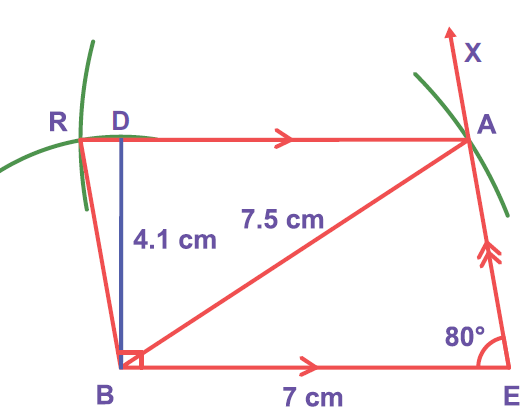
Construct a parallelogram BEAR with BE = 7 cm, BA = 7.5 cm and ㄥBEA = 800. Also find its area.
6.
Construct a parallelogram CALF with CA = 7 cm, CF = 6 cm and AF = 10 cm. Also find its area.
7.
Construct a parallelogram BIRD with BI = 6.5 cm, IR = 5 cm and ㄥBIR = 700. Also find its area.
8.
Solve 2x + 5 = 9
9.
Solve the equation: x − 7 = 6
10.
7 is added to a given number to give 19.
11.
The bacteria in a culture grows by 5% in the first hour, decreases by 8% in the second hour and again increases by 10% in the third hour. Find the count of the bacteria at the end of 3 hours, if its initial count was 10000.
12.
The population of a town is increasing at the rate of 6% p.a. It was 238765 in the year 2018. Find the population in the year 2016 and 2020.
13.
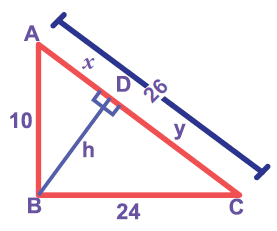
From the figure, find x and y and verify Δ ABC is a right angled triangle.
14.
Find the area of a rectangular plot of land shown in the figure.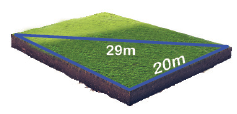
15.
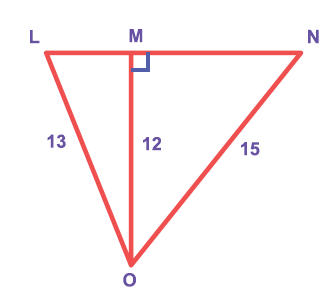
Find LM, MN, LN and also the area of Δ LON.
16.
Can a right triangle have sides that measure 5cm, 12cm and 13cm?
17.
Akila scored 80% in an examination. If her score was 576 marksAkila scored 80% of marks in an examination. If her score was 576 marks, then find the maximum marks of the examination.
18.
The income of a person is increased by 10% and then decreased by 10%. Find the change in his income.
19.
If the price of Orid dhall after 20% increase is Rs. 96 per kg, find the original price of Orid dhall per kg.
20.
If x % of 600 is 450 then, find the value of x.
1.
Let us make Ceasar Cipher table first. Here, we have to set to + 4 table. For that, we have to start letter e to set as A, f as B … likewise d as Z. Now, the + 4 Ceasar Cipher table looks like
| Plain Text | a | b | c | d | e | f | g | h | i | j | k | l | m | n | o | p | q | r | s | t | u | v | w | x | y | z |
| Cipher Text | W | X | Y | Z | A | B | C | D | E | F | G | H | I | J | K | L | M | N | O | P | Q | R | S | T | U | V |
The given plain text is
fvieo mr gshiw ger fi xvmgoc
To crack this secret code, follow the steps given below.
Step 1: Using Ceasar Cipher table, let us first match the most repeated letters. This will help us to progress faster.
fvieo mr gshiw ger fi xvmgoc

Step 2: Then, let us find remaining letters to complete the code.
.png)
Thus, the secret sentence is, BREAK IN CODES CAN BE TRICKY
2.
Given, the train runs constantly at a speed of 80 km/hr.
i.e For 1 hour = 80 km
2 hours = 2 × 80 = 160 km
3 hours = 3 × 80 = 240 km
| Hour | 1 | 2 | 3 | 4 | 5 |
| Distance | 80 | 160 | 240 | 320 | 400 |
We can tabulate as above, Take a suitable scale
1) Mark the number of hours on the x-axis.
2) Mark the distance inKm on the y-axis.
3) Plot the points (1,80) (2,160) (3,240) (4,320) and (5,400).
4) Join the points and get a straight line3.
5) From the graph.
(i) Time taken to cover 240 km is 3 hrs.
(ii) Th e distance covered in 5 ½ hrs 440 km.
.png)
3.
1. Take a suitable scale on both the axes Here, we take on the x axis
1cm = 5 litres on the, y axis
1cm = 100 rupees.
2. Mark number of litres of milk along the x -axis.
3. Mark the cost of milk along the y-axis.
4. Plot the points (5,150) (10,300) (15,450) (20,600).
5. Join the points.
This graph can help us to estimate few more things also. Suppose we like to find the cost of 25 litres of milk. Mark 25 on the x-axis, follow the line parallel to y-axis through 25 till we meet the drawn line at P. From P we take a horizontal line to meet the y-axis. This meeting point of y-axis is the required answer.
Thus, the cost of 25 litres of milk is Rs.750. This is the graph of linear equation in two quantities, and hence they are in direct variation.
.png)
4.
The given equation y = 5 x means that for any value of x , y takes five
times of x value.
Plot the point (−3,−15) (−1,−5) (0,0) (2,10) (3,15)
| x | y=5x+1 |
| −3 −1 0 2 3 |
5 × (−3) = −15 5 × (−1) = −5 5 × (0) = 0 5 × (2) = 10 5 × (3) = 15 |
.png)
5.
Given:
BE = 7 cm, BA = 7.5 cm and ㄥBEA = 800
.png)
Steps:
1. Draw a line segment BE = 7 cm.
2. Make an angle ㄥBEX =80° at E on \(\overset { \_ \_ }{ BE } \).
3. With B as centre, draw an arc of radius 7.5 cm cutting \(\overset { \_ \_ }{ EX } \) at A and Join BA.
4. With B as centre, draw an arc of radius equal to the length of \(\overset { \_ \_ }{ AE } \).
5. With A as centre, draw an arc of radius 7 cm. Let both arcs cut at R.
6. Join BR and AR.
7. BEAR is the required parallelogram.
Calculation of area:
Area of the parallelogram BEAR = bh sq. units
= 7 x 4.1 = 28.7 sq. cm
6.
Given:
CA = 7 cm, CF = 6 cm and AF = 10 cm
.png)
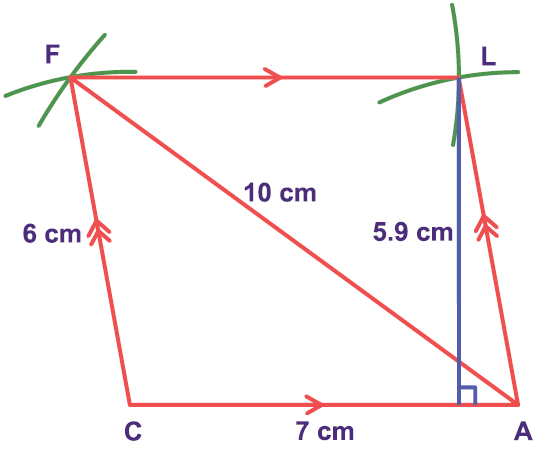
Steps:
1. Draw a line segment CA = 7 cm.
2. With C and A as centres, draw arcs of radii 7 cm and 6 cm respectively. Let them cut at F.
3. Join CF and AF.
4. With A and F as centres, draw arcs of radii 6 cm and 7 cm respectively. Let them cut at L.
5. Join AL and FL.
6. CALF is the required parallelogram.
Calculation of area:
Area of the parallelogram CALF = bh sq. units
= 7 x 5.9 = 41.3 sq. cm
7.
Given:
BI = 6.5 cm, IR = 5 cm and ㄥBIR = 700
.png)
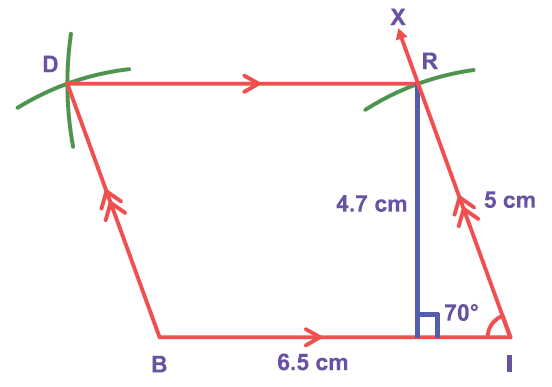
Steps:
1. Draw a line segment BI = 6.5 cm.
2. Make an angle ㄥBIX = 700 at I on \(\overset { \_ \_ }{ BI } \).
3. With I as centre, draw an arc of radius 5 cm cutting IX at R.
4. With B and R as centres, draw arcs of radii 5 cm and 6.5 cm respectively. Let them cut at D.
5. Join BD and RD.
6. BIRD is the required parallelogram.
Calculation of area:
Area of the parallelogram BIRD = bh sq. units
= 6.5 × 4.7 = 30.55 sq. cm
8.
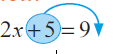
2x = 9 − 5
2x = 4
x = \(\frac { 4 }{ 2 } \)
x = 2
9.
x – 7 = 6
x – 7 + 7 = 6 + 7
x = 13
10.
Let the number be n.
When 7 is added to this number we get n + 7.
This result is to give 19.
Therefore, the equation is n + 7 = 19.
11.
Bacteria at the end of 3 hours
a = p\(\left( 1+\frac { a }{ 100 } \right) \left( 1-\frac { b }{ 100 } \right) \left( 1+\frac { c }{ 100 } \right) \)('-' because ‘decrease’)
= 10000\(\left( 1+\frac { 5 }{ 100 } \right) \left( 1-\frac { 8 }{ 100 } \right) \left( 1+\frac { 10 }{ 100 } \right) \)
= 10000 x \(\frac { 105 }{ 100 } \times \frac { 92 }{ 100 } \times \frac { 110 }{ 100 } \)
A = Rs.10626
12.
Let the population in 2016 be ‘P’.
Then, A = P\({ \left( 1+\frac { r }{ 100 } \right) }^{ n }\)
⇒ 238765 = p\({ \left( 1+\frac { 6 }{ 100 } \right) }^{ 2 }=P{ \left( \frac { 53 }{ 50 } \right) }^{ 2 }\)
⇒ P = 238765 x \(\frac { 50 }{ 53 } \times \frac { 50 }{ 53 } \)
∴ P = 212500
Let the population in 2020 be ‘A’
Then, A= P\({ \left( 1+\frac { r }{ 100 } \right) }^{ n }\)
∴ A = 238765\({ \left( 1+\frac { 6 }{ 100 } \right) }^{ 2 }\)
= 238765 x \(\frac { 53 }{ 50 } \times \frac { 53 }{ 50 } \)
= 95.506 x 53 x 53
A = 268276
∴ The population in the year 2016 is 212500 and that in the year 2020 is 268276.
13.
Now, by altitude-on-hypotenuse theorem,
AB2 = AD x AC gives,
102 = x × 26
\(\Rightarrow x=\frac { 100 }{ 26 } =\frac { 50 }{ 13 } units\quad and\)
BC2 = CD × AC gives,
242 = y × 26
\(\Rightarrow y=\frac { 576 }{ 26 } =\frac { 288 }{ 13 } units\quad and\)
In Δ ABC, AB2 + BC2 = 102 + 242 = 676 = 262 = AC2 Therefore, Δ ABC is a right angled triangle.
14.
Here, the hypotenuse is 29 m. One side of the right triangle is 20 m. let the other side be ‘l’ m Therefore, by Pythagoras theorem,
l2 = 292 − 202 = 841 − 400 = 441 = 212
∴ l = 21m
Therefore, the area rectangular plot of land = l × b square units. = 20 × 21 = 210 m2.
15.
From Δ LMO, by Pythagoras theorem,
LM2 = OL2 − OM2
⇒ LM2 = 132 −122 = 169 −144 = 25 = 52
∴ LM = 5 units
From Δ NMO, by Pythagoras theorem,
MN2 = ON2 − OM2
= 152 −122 = 225 −144 = 81 = 92
∴ MN = 9 units
Hence, LN = LM + MN = 5 + 9 = 14 units
Area of Δ LON = \(\frac { 1 }{ 2 } \) × base × height
= \(\frac { 1 }{ 2 } \) × LN × OM
= \(\frac { 1 }{ 2 } \) × 14 × 12
= 84 square units.
16.
Take a = 5, b = 12 and c = 13
Now, a2 + b2 = 52 +122 = 25 +144 = 169 = 132 = c2
By the converse of Pythagoras theorem, the triangle with given measures is a right angled triangle.
17.
Let the maximum marks be x.
Now, 80% of x = 576
\(\frac { 80 }{ 100 } \)\(\times\) x = 576
⇒ x = 576 x \(\frac { 100 }{ 10 } \)
x = 720 marks
Therefore, the total marks in the examination = 720.
18.
Let his income be rs x.
Income after 10% increase is
\(100+100 \times \frac{10}{100}=Rs. 110\)
Now, income after 10% decrease is
\(110-110 \times \frac{10}{100}=110-11=Rs. 99\)
Net change in his income = 100 – 99 = 1
Percentage change \(=\frac{1}{100} \times 100 \%=1 \%\)
That is, income of the person is reduced by 1%.
Aliter
Let his income be Rs. 100
Income after 10% increase is
100 + 100 × \(\frac{10}{100}\) = Rs.110
Now, income after 10% decrease is,
110 – 110 × \(\frac{10}{100}\) = 110 – 11 = Rs. 99
∴ Net change in his income = 100 – 99 = 1
Percentage change = × = \(\frac{1 }{100}\) × 100% = 1%
That is, income of the person is reduced by 1%.
19.
Let the original price of Orid dhall be Rs x.
New price aft er price of 20% increase = x +\(\frac { 20 }{ 100 } x=\frac { 120x }{ 100 } \)
Given that, 96 = \(\frac { 120x }{ 100 } \)
∴ x = \(\frac { 96\times 100 }{ 200 } \)
∴ Original price of Orid dhall per kg, x = Rs. 80
20.
x% of 600 = 450
\(\frac { x }{ 100 } \)× 600 = 450
\(x=\frac { 450 }{ 6 } \)
x = 75

8th Standard Syllabus & Materials
8th Standard
TN 8th Tamil இயல் 3 - கல்வி கரையில - பாடறிந்து ஒழுகுதல் Important Questions And Answers Study Material - QB365 Set A
NEW8th Standard
TN 8th Tamil இயல் 3-கல்வி கரையில - பல்துறைக் கல்வி Important Questions And Answers Study Material - QB365 Set A
NEW8th Standard
TN 8th Tamil இயல் 3-கல்வி கரையில - புத்தியைத் தீட்டு Important Questions And Answers Study Material - QB365 Set A
NEW8th Standard
TN 8th Tamil இயல் 2 - ஈடில்லா இயற்கை - தமிழர் மருத்துவம் ( நேர்காணல்) Important Questions And Answers Study Material - QB365 Set A



Tamilnadu Stateboard 8th Standard Subjects
Tamilnadu Stateboard Standards




