
 100% FREE ACCESS
8th Standard Syllabus & Materials
8th Standard
TN 8th Tamil இயல் 3 - கல்வி கரையில - வினைமுற்று Important Questions And Answers Study Material - QB365 Set A
NEW8th Standard
TN 8th Tamil இயல் 2 - ஈடில்லா இயற்கை - மயங்கொலிகள் Important Questions And Answers Study Material - QB365 Set A
NEW8th Standard
TN 8th Tamil இயல் 2 - ஈடில்லா இயற்கை -பட்டமரம் Important Questions And Answers Study Material - QB365 Set A
NEW8th Standard
TN 8th Tamil இயல் 2 - ஈடில்லா இயற்கை - இயற்கையை போற்றுவோம் Important Questions And Answers Study Material - QB365 Set A
NEW8th Standard
TN 8th Tamil இயல் 1 - தமிழ் இன்பம் - ஆழிக்கு இணை Important Questions And Answers Study Material - QB365 Set A
NEW8th Standard
TN 8th Tamil இயல் 2-ஈடில்லா இயற்கை - திருக்குறள் Important Questions And Answers Study Material - QB365 Set A

Published on: 15/06/2021
QB365 provides detailed and simple solution for every book back questions in class 8 Maths subject.It will helps to get more idea about question pattern in every book back questions with solution.
Download Tamil Nadu 8th Standard Maths question papers, model tests, one-mark questions, important questions, and public exam papers in PDF format. Free study materials and answer keys for TN State Board students.
Questions + Answers key
Take MCQ Maths Test1.
Use Ceasar Cipher table set + 4 and to try to solve the given secret sentence.
fvieo mr gshiw ger fi xvmgoc
2.
Relation between Time and Distance:
A train runs constantly at a speed of 80km/hr. Draw a time – distance graph for this situation. Also find the
(i) time – taken to cover 240 km.
(ii) distance covered in 5 ½ hours.
3.
Relation between Principal and Simple Interest:
A bank gives 10% simple interest on deposits made by Senior citizens. Illustrate by a graph the relation between the deposit and the interest gained. Use the graph to compute
(i) The annual interest obtainable for investment of Rs.450;
(ii) The amount a Senior citizen has to invest to get an annual simple interest of Rs.80.
4.
Graph the equation y = x + 1.
Begin by choosing a couple of values for x and y. It will firstly help to see
(i) what happens to y when x is zero and
(ii) what happens to x when y is zero.
After this we can go on to find one or two more values.
Let us find at least two more ordered pairs. For easy graphing, let us avoid fractional answers. We shall make suitable guesses.
5.
Given that one pair of new born rabbits they produce a new pair each month and from the second month, each new pair can breed themselves. Find how many pairs of rabbits are bred from one pair in a year, and find the relationship between the number of months and the number of pairs of rabbits by tabulation (a pair means (a male and a female)).
6.
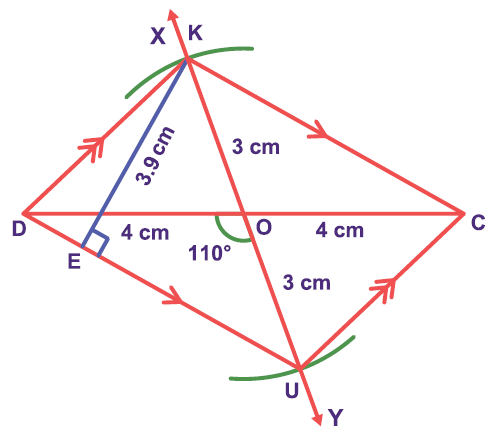
Construct a parallelogram DUCK with DC = 8 cm, UK = 6 cm and ㄥDOU = 1100. Also find its area.
7.
Solve \(\frac { 4y }{ 3 } -7=\frac { 2 }{ 5 } y\)
8.
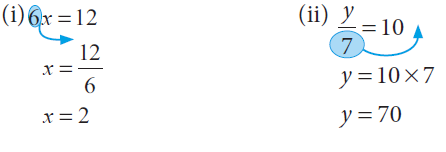
Solve the equation: 3x = 51
9.
The sum of 4 times a number and 18 is 28.
10.
Find the difference in C.I and S.I for
(i) P = Rs.5000, r = 4% p.a, n = 2 years.
(ii) P = Rs.8000, r = 5% p.a, n = 3 years.
11.
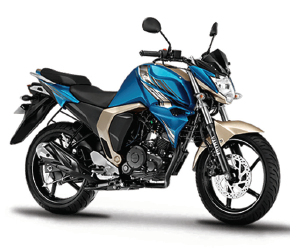
The value of a motor cycle 2 years ago was Rs.70000. It depreciates at the rate of 4% p.a. Find its present value.
12.
Find the C.I for the data given below:
(i) Principal = Rs. 4000, r = 5% p.a, n = 2 years, interest compounded annually.
(ii) Principal = Rs. 5000, r = 4% p.a, n = 1 \(\frac { 1 }{ 2 } \) years, interest compounded half-yearly.
(ii) Principal = Rs. 30000, r = 7% for I year, r = 8% for II year, compounded annually.
(iv) Principal = Rs. 10000, r = 8% p.a, n = 2 \(\frac { 3 }{ 4 } \) years, interest compounded yearly.
13.
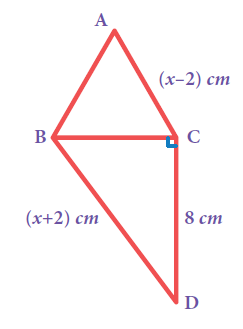
Δ ABC is equilateral and CD of the right triangle BCD is 8 cm. Find the side of the equilateral Δ ABC and also BD.
14.
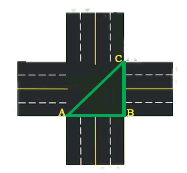
A junction where two roads intersect at right angles is as shown in the figure. Find AC if AB = 8 m and BC = 15 m.
15.
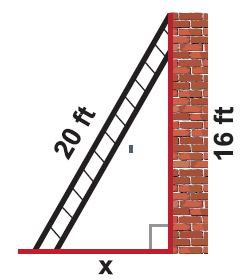
A 20- feet ladder leans against a wall at height of 16 feet from the ground. How far is the base of the ladder from the wall?
16.
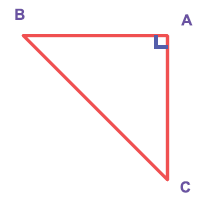
In the figure, AB ⊥ AC
a) What type of Δ is ABC?
b) What are AB and AC of the Δ ABC?
c) What is CB called as?
d) If AC = AB then, what is the measure of ㄥB and ㄥC?
17.
If the population in a town has increased from 20000 to 25000 in a year, fi nd the percentage increase in population.
18.
In a leadership election between two persons A and B, A wins by a margin of 192 votes. If A gets 58% of the total votes, find the total votes polled.
19.
When a number is decreased by 25% it becomes 120. Find the number.
20.
900 boys and 600 girls appeared in an examination of which 70% of the boys and 85%of the girls passed out in the examination. Find the total percentage of students who did not pass.
1.
Let us make Ceasar Cipher table first. Here, we have to set to + 4 table. For that, we have to start letter e to set as A, f as B … likewise d as Z. Now, the + 4 Ceasar Cipher table looks like
| Plain Text | a | b | c | d | e | f | g | h | i | j | k | l | m | n | o | p | q | r | s | t | u | v | w | x | y | z |
| Cipher Text | W | X | Y | Z | A | B | C | D | E | F | G | H | I | J | K | L | M | N | O | P | Q | R | S | T | U | V |
The given plain text is
fvieo mr gshiw ger fi xvmgoc
To crack this secret code, follow the steps given below.
Step 1: Using Ceasar Cipher table, let us first match the most repeated letters. This will help us to progress faster.
fvieo mr gshiw ger fi xvmgoc

Step 2: Then, let us find remaining letters to complete the code.
.png)
Thus, the secret sentence is, BREAK IN CODES CAN BE TRICKY
2.
Given, the train runs constantly at a speed of 80 km/hr.
i.e For 1 hour = 80 km
2 hours = 2 × 80 = 160 km
3 hours = 3 × 80 = 240 km
| Hour | 1 | 2 | 3 | 4 | 5 |
| Distance | 80 | 160 | 240 | 320 | 400 |
We can tabulate as above, Take a suitable scale
1) Mark the number of hours on the x-axis.
2) Mark the distance inKm on the y-axis.
3) Plot the points (1,80) (2,160) (3,240) (4,320) and (5,400).
4) Join the points and get a straight line3.
5) From the graph.
(i) Time taken to cover 240 km is 3 hrs.
(ii) Th e distance covered in 5 ½ hrs 440 km.
.png)
3.
Using the formula for calculating the simple interest, the following table of values is prepared.
| Deposit(in.Rs) | 100 | 200 | 300 | 500 | 1000 |
| Anaual S.I(in.Rs) | 10 | 20 | 30 | 50 | 100 |
| Deposit | Interest |
| 100 | \(\frac { 100\times 1\times 10 }{ 100 } \)=10 |
| 200 | \(\frac { 200\times 1\times 10 }{ 100 } \)=20 |
| 300 | \(\frac { 300\times 1\times 10 }{ 100 } \)=30 |
| 500 | \(\frac { 500\times 1\times 10 }{ 100 } \)=50 |
| 1000 | \(\frac { 1000\times 1\times 10 }{ 100 } \)=100 |
These are the points which are to be plotted in the graph sheet. Let us take the deposits along x-axis and
annual simple interest along y-axis.
We choose the scale as follows:
Then we plot the points and draw the straight line.
From the graph we find:
(i) Corresponding to Rs.300 on the x-axis, we get the interest as Rs.30 on the y-axis.
(ii) Corresponding to Rs.70 on the y-axis, we get the deposit as Rs.700 on the x-axis.
.png)
4.
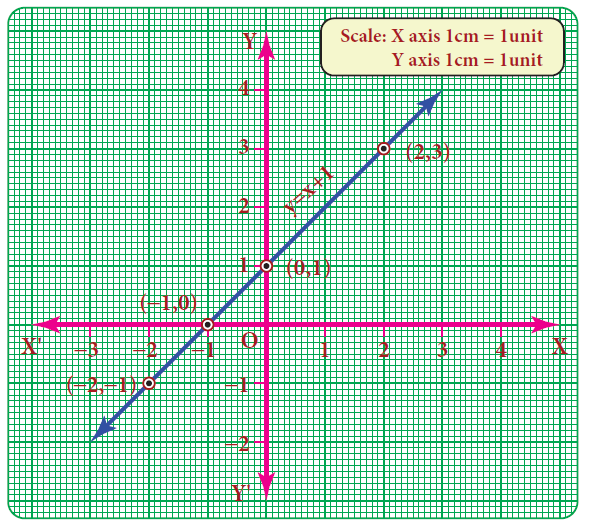
| x | -2 | -1 | 0 | 1 | 2 |
| y | -1 | 0 | 1 | 2 | 3 |
| x | y = x+1 |
| −2 −1 0 1 2 |
−2+1 = –1 −1+1 = 0 0+1 = 1 1+1 = 2 2+1 = 3 |
5.
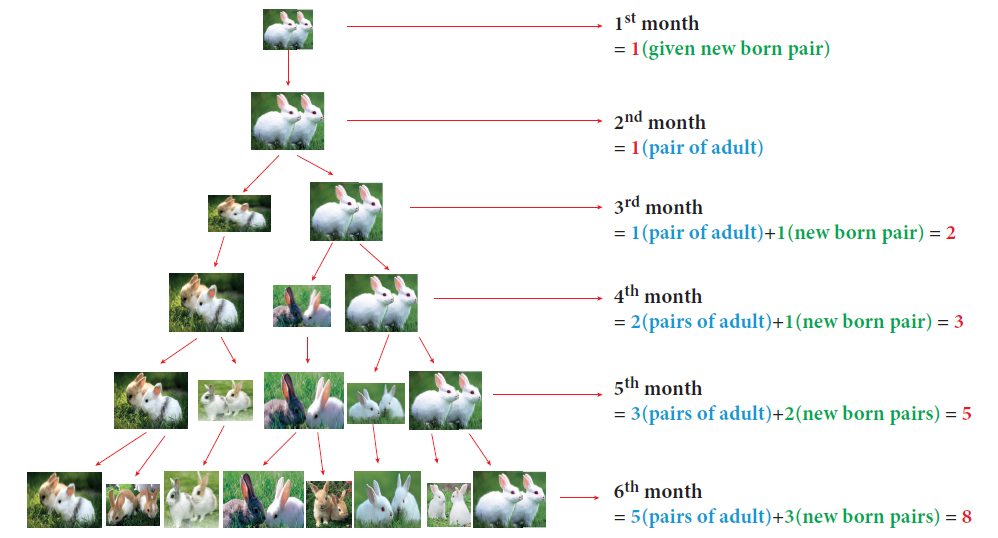
The above figure clearly forms the sequence is 1, 1, 2, 3, 5, 8... Here, we find the pattern in which each number is in the Fibonacci sequence, obtained by adding together with previous two. Going on like this to find subsequent numbers at the twelfth month, we will get 144 pairs of rabbits. In the other words, twelfth Fibonacci number is 144.
| Number of months | 1 | 2 | 3 | 4 | 5 | 6 | 7 | 8 | 9 | 10 | 11 | 12 |
| Number of pairs of rabbits | 1 | 1 | 2 | 3 | 5 | 8 | 13 | 21 | 34 | 55 | 89 | 144 |
6.
Given:
DC = 8 cm, UK = 6 cm and ㄥDOU = 1100
.png)
Steps:
1. Draw a line segment DC = 8 cm.
2. Mark O the midpoint of \(\overset { \_ \_ }{ DC } \).
3. Draw a line \(\overset { \_ \_ }{ XY } \) through O which makes ㄥDOY = 1100.
4. With O as centre and 3 cm as radius draw two arcs on \(\overset { \_ \_ }{XY } \)on either sides of \(\overset { \_ \_ }{DC } \). Let the arcs cut \(\overset { \_ \_ }{ OX } \)at K and \(\overset { \_ \_ }{OY } \) at U
5. Join \(\overset { \_ \_ }{DU } \) , \(\overset { \_ \_ }{UC } \), \(\overset { \_ \_ }{CK } \) and \(\overset { \_ \_ }{KD } \).
6. DUCK is the required parallelogram.
Calculation of Area:
Area of the parallelogram DUCK = bh sq.units
= 5.8 x 3.9 = 22.62sq.cm
7.
(Rearranging the like terms)
\(\frac { 4y }{ 3 } -\frac { 2 }{ 5 } =7\)
\(\frac { 20y-6y }{ 15 } =7\)
14y = 7 ×15
y = \(\frac { 7\times 15 }{ 2 } \)
y = \(\frac { 15 }{ 2 } \)
8.
3x = 51 (Given)
3 x x = 51
\(\frac { 3\times x }{ 3 } =\frac { 51 }{ 3 } (\div 3\quad on\quad both\quad sides)\)
x = 17
likewise, doing division by 3 on both sides is the same as changing the number 3 on the LHS to it's reciprocal \(\frac { 1 }{ 3 } \) and multiplying it on the RHS and vice-versa.
9.
Let the number be x.
4 times the number is 4x.
Adding 18 now, we get 18 + 4x.
The result now should be 28.
Thus, the equation has to be 18 + 4x = 28.
10.
C.I –S.I = P\({ \left( \frac { r }{ 100 } \right) }^{ 2 }\)= 5000 x \(\frac { 4 }{ 100 } \times \frac { 4 }{ 100 } \) = Rs 8
(ii) C.I –S.I = P\({ \left( \frac { r }{ 100 } \right) }^{ 2 }\left( 2+\frac { r }{ 100 } \right) \)
= 8000 x \(\frac { 5 }{ 100 } \times \frac { 5 }{ 100 } \) x \(\left( 3+\frac { 5 }{ 100 } \right) \)
= 20 x \(\frac { 61 }{ 20 } \) = Rs.61
11.
Depreciated value = P\({ \left( 1-\frac { r }{ 100 } \right) }^{ n }\)
= 70000\({ \left( 1-\frac { 4 }{ 100 } \right) }^{ 2 }\)
= 70000 x \(\frac { 96 }{ 100 } \times \frac { 96 }{ 100 } \)
= Rs.64512
12.
(i) Amount, A = P\({ \left( 1+\frac { r }{ 100 } \right) }^{ n }\)
= 4000\({ \left( 1+\frac { 5 }{ 100 } \right) }^{ 2 }\)
= 4000 x \(\frac { 21 }{ 20 } \)x\(\frac { 21 }{ 20 } \)
A = Rs. 4410
∴C.I = A − P = 4410 – 4000 = Rs. 410
(ii) Amount, A = P\({ \left( 1+\frac { r }{ 100 } \right) }^{ 2n }\)= 5000\({ \left( 1+\frac { 4 }{ 200 } \right) }^{ 2\times \frac { 3 }{ 2 } }\) = 5000 x \(\frac { 51 }{ 50 } \times \frac { 51 }{ 50 } \times \frac { 51 }{ 50 } \)
= 51 × 10.2 × 10.2
= Rs. 5306.04
∴ C.I = A − P = Rs.5306.04 – Rs.5000
= Rs.306.04
(iii) A = P\(\left( 1+\frac { a }{ 100 } \right) \left( 1+\frac { b }{ 100 } \right) \)
= 3000\(\left( 1+\frac { 7 }{ 100 } \right) \left( 1+\frac { 8 }{ 100 } \right) \)
= 30000 x \(\frac { 107 }{ 100 } \times \frac { 108 }{ 100 } \)
= Rs.34668
∴ C.I = A − I = 34668 - 30000 = 4668.
(iv) A = P\({ \left( 1+\frac { r }{ 100 } \right) }^{ a }\left( 1+\frac { \frac { b }{ c } \times r }{ 100 } \right) =10000{ \left( 1+\frac { 8 }{ 100 } \right) }^{ 2 }\left( 1+\frac { \frac { 3 }{ 4 } \times 8 }{ 100 } \right) \)
= 10000\({ \left( \frac { 27 }{ 25 } \right) }^{ 2 }\left( \frac { 53 }{ 50 } \right) \)
= 10000 x \(\frac { 27 }{ 25 } \times \frac { 27 }{ 25 } \times \left( \frac { 53 }{ 50 } \right) \)
A = 12363.84
∴C.I = 12363.84 − 10,000
= Rs.2363.84
13.
As Δ ABC is equilateral from the figure, AB = BC = AC = (x − 2) cm.
∴ From Δ BCD, by Pythagoras theorem
BD2 = BC2 + CD2
⇒ (x + 2)2 = (x − 2)2 + 82
x2 + 4x + 4 = x2 − 4x + 4 + 82
⇒ 8x = 82
⇒ x = 8 cm
∴ The side of the equilateral Δ ABC = 6 cm and BD = 10 cm.
14.
Now Δ ABC is right angled.
Therefore, by Pythagoras theorem,
AC2 = AB2 + BC2
⇒ AC2 = 82 +152 = 64 + 225 = 289
AC2 = 172
⇒ AC = 17m.
Therefore, the length of the diagonal of the two intersecting roads is 17 m.
15.
The ladder, wall and the ground form a right triangle with the ladder as the hypotenuse. From the figure, by Pythagoras theorem,
202 = 162 + x2
⇒ 400 = 256 + x2
⇒ x2 = 400 − 256 = 144 = 122
⇒ x = 12 feet
Therefore, the base (foot) of the ladder is 12 feet away from the wall.
16.
a) Δ ABC is right angled as AB ⊥ AC at A.
b) AB and AC are legs of Δ ABC.
c) CB is called as the hypotenuse.
d) ㄥB + ㄥC = 900 and equal angles are opposite to equal sides. Hence, ㄥB = ㄥC = \(\frac { { 90 }^{ 0 } }{ 2 } \) = 450
17.
Increase in population = 25000 − 20000
= 5000
∴ Percentage increase in population =\(\frac { 5000 }{ 20000 } \)x 100
= 25%
18.
Let the total votes polled be x.
Votes polled in favour in A = 58% of x =\(\frac { 58x }{ 100 } \)
Votes polled in favour of B = (100 − 58)% of x = 42% of x = \(\frac { 42x }{ 100 } \)
Given, Winning margin A− B = 192
That is, \(\frac { 58x }{ 100 } \)- \(\frac { 42x }{ 100 } \) = 192
⇒\(\frac { 16x }{ 100 } \)=192
x = 192 x \(\frac { 100 }{ 16 } \)
x = 1200 votes
19.
Let the number be x.
x-\(\frac { 25 }{ 100 } x\) = 120
\(\frac { 100x-25x }{ 100 } \) = 120
\(\frac { 75x }{ 100 } \) = 120
x = \(\frac { 120\times 100 }{ 75 } \)
x = 160
20.
Number of students who did not pass = 30% of boys + 15% of girls
=\(\frac { 30 }{ 100 } \) x 900 + \(\frac { 15 }{ 100 } \) x 600
= 270 + 90 = 360
∴ Percentage of students who did not pass =\(\frac { 360 }{ 1500 } \) x 100 = 24%

8th Standard Syllabus & Materials
8th Standard
TN 8th Tamil இயல் 3 - கல்வி கரையில - பாடறிந்து ஒழுகுதல் Important Questions And Answers Study Material - QB365 Set A
NEW8th Standard
TN 8th Tamil இயல் 3-கல்வி கரையில - பல்துறைக் கல்வி Important Questions And Answers Study Material - QB365 Set A
NEW8th Standard
TN 8th Tamil இயல் 3-கல்வி கரையில - புத்தியைத் தீட்டு Important Questions And Answers Study Material - QB365 Set A
NEW8th Standard
TN 8th Tamil இயல் 2 - ஈடில்லா இயற்கை - தமிழர் மருத்துவம் ( நேர்காணல்) Important Questions And Answers Study Material - QB365 Set A



Tamilnadu Stateboard 8th Standard Subjects
Tamilnadu Stateboard Standards




