
 100% FREE ACCESS
8th Standard Syllabus & Materials
8th Standard
TN 8th Tamil இயல் 3 - கல்வி கரையில - வினைமுற்று Important Questions And Answers Study Material - QB365 Set A
NEW8th Standard
TN 8th Tamil இயல் 2 - ஈடில்லா இயற்கை - மயங்கொலிகள் Important Questions And Answers Study Material - QB365 Set A
NEW8th Standard
TN 8th Tamil இயல் 2 - ஈடில்லா இயற்கை -பட்டமரம் Important Questions And Answers Study Material - QB365 Set A
NEW8th Standard
TN 8th Tamil இயல் 2 - ஈடில்லா இயற்கை - இயற்கையை போற்றுவோம் Important Questions And Answers Study Material - QB365 Set A
NEW8th Standard
TN 8th Tamil இயல் 1 - தமிழ் இன்பம் - ஆழிக்கு இணை Important Questions And Answers Study Material - QB365 Set A
NEW8th Standard
TN 8th Tamil இயல் 2-ஈடில்லா இயற்கை - திருக்குறள் Important Questions And Answers Study Material - QB365 Set A

Published on: 13/05/2022
QB365 provides detailed and simple solution for every book back questions in class 8 Maths subject.It will helps to get more idea about question pattern in every book back questions with solution.
latest Book back QuestionsDownload Tamil Nadu 8th Standard Maths question papers, model tests, one-mark questions, important questions, and public exam papers in PDF format. Free study materials and answer keys for TN State Board students.
Questions + Answers key
Take MCQ Maths Test1.
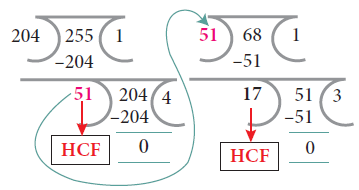
Do the given repeated division problem in repeated subtraction method and verify the HCF of 255, 204 and 68.
2.
Find the HCF of 144 and 120
3.
There are 270 ginger chocolates, 384 milk chocolates and 588 coconut chocolates. What is the largest number of containers possible so that each container contains the same number of chocolates of each kind?
4.
From home, Rajan rides on his motorbike at 35 km/hr and reaches his office 5 minutes late. If he had ridden at 50 km/hr, he would have reached his office 4 minutes earlier. How far is his office from his home?
5.
The denominator of a fraction is 3 more than its numerator. If 2 is added to the numerator and 9 is added to the denominator, the fraction becomes \(\frac { 5 }{ 6 } \). Find the original fraction.
6.
There is a wooden piece of length 2m. A carpenter wants to cut it into two pieces such that the first piece is 40 cm smaller than twice the other piece. What is the length of the smaller piece?
7.
A bus is carrying 56 passengers with some people having Rs.8 tickets and the remaining having Rs.10 tickets. If the total money received from these passengers is Rs.500, find the number of passengers with each type of tickets.
8.
Construct a trapezium DESK in which \(\overset { \_ \_ }{ DE } \) is parallel to \(\overset { \_ \_ }{ KS } \), DE = 8 cm, ES = 5.5 cm, KS = 5 cm and KD = 6 cm. Find also its area.
9.
Construct a trapezium CARD in which \(\overset { \_ }{ CA } \) is parallel to \(\overset { \_ }{ DR} \), CA = 9 cm, ㄥCAR = 70, AR = 6 cm and CD = 7 cm. Also find its area.
10.
A family went to a hotel and spent Rs. 350 for the food and paid extra 5% as GST. Calculate the CGST and SGST.
11.
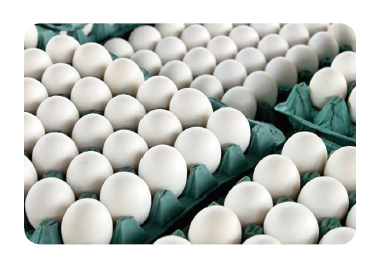
A woman bought some eggs at the rate of 4 eggs for Rs.18 and sold them at the rate of 5 eggs for Rs. 24. She gained Rs. 90 in selling all the eggs. How many eggs did she buy?
12.
The price of a rain coat was slashed from Rs. 1060 to Rs. 901 by a shopkeeper in the winter season to boost the sales. Find the rate of discount given by him.

13.
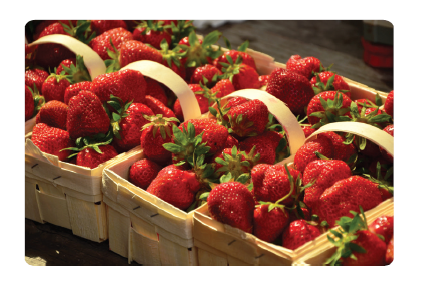
The cost price of 16 boxes of strawberries is equal to the selling price of 20 boxes of strawberries. Find the gain or loss percentage.
14.
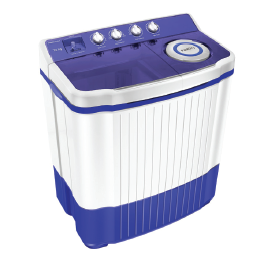
Ranjith bought a washing machine for Rs. 16150 and paid Rs. 1350 for its transportation. Then, he sold it for Rs. 19250. Find his gain or loss percentage.
15.
If the selling price of a LED TV is equal to \(\frac{5}{4}\) of its cost price, then find the gain / profit percentage.
1.
STEP 1: Here, let p = 255, q = 204 and r = 68 Check whether p = q or p > q or p < q. Here p > q.
STEP 2: Let us find the HCF of 255 and 204 first. Now, subtract smaller number from larger number till p = q.
| First | 255 – 204 = 51 | Repeat | 204 – 51 = 153 | Repeat | 153 – 51 = 102 |
| Repeat | 102 – 51 = 51 | Repeat | 51 – 51 = 0 |
Now p = q, Hence, we conclude that the HCF of 255 and 204 is 51.
STEP 3: Now repeated same procedure for r – HCF (p, q) Now, subtract smaller number from larger number till HCF (p, q) = r.
| First | 68 – 51 = 17 | Repeat | 51 – 17 = 34 |
| Repeat | 34 – 17 = 17 | Repeat | 17 – 17 = 0 |
Now HCF (p, q) = r, Hence, we conclude that the HCF of 255, 204 and 68 is 17. Comparing both the repeated division and repeated subtraction methods, in finding the HCF, we can conclude that the repeated subtraction, in one way is easier and gives the HCF faster that the repeated division and one would want to easely do subtraction rather than division. Isn’t it?
2.
STEP 1: Here , take m = 144 and n = 120 Check whether m = n or m > n or m < n. Here m > n.
STEP 2: Subtract the smaller number from the larger number till m = n.
| First | 144 – 120 = 24 | Repeat | 120 – 24 = 96 | Repeat | 96 – 24 = 72 |
| Repeat | 72 – 24 = 48 | Repeat | 48 – 24 = 24 | Repeat | 24 – 24 = 0 |
Now m = n , Hence, we conclude that the HCF of 144 and 120 is 24.
3.
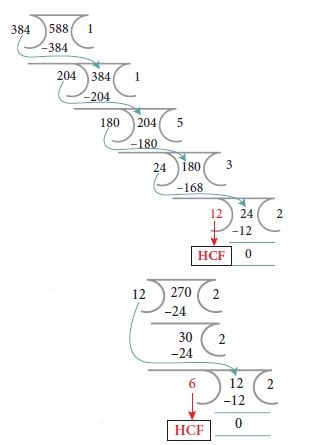
Here, we have to find HCF of 270, 384 and 588
STEP 1: First find the HCF of any two of the given numbers (follow the same step 1, 2 and 3 of the above example). Here, find HCF of (384, 588) first.
STEP 2: The HCF of the first two numbers which is 12 becomes the divisor and the third number 270 becomes the dividend.
STEP 3: Repeat this division process till the remainder becomes zero. The last divisor is the HCF. Here, 6 is the last divisor.
Hence, HCF of 270, 384 and 588 is 6. Therefore, we needs 6 containers so that each of them contains (270 ÷ 6 = 45) 45 ginger chocolates, (384 ÷ 6 = 64) 64 milk chocolates and (588 ÷ 6 = 98) 98 coconut chocolates.
4.
Let the distance be ‘ x ’ km. (Recall that time = \(\frac { Distance }{ Speed } \))
Time taken to cover ‘ x ’ km at 35 km/hr: T1 = \(\frac { x }{ 35 } hr\)
Time taken to cover ‘ x ’ km at 50 km/hr: T2 = \(\frac { x }{ 50 } hr\)
According to the problem, the difference between two timings
= 4–(–5)
= 4+5 = 9 minutes
= \(\frac { 9 }{ 60 } \)hour (changing minutes to hour)
Given, T1 – T2 =\(\frac { 9 }{ 60 } \)
\(\frac { x }{ 35 } \)-\(\frac { x }{ 50 } \) = \(\frac { 9 }{ 60 } \)
\(\frac { 10x-7x }{ 350 } =\frac { 9 }{ 60 } \)
\(\frac { 3x }{ 350 } =\frac { 9 }{ 60 } \)
x \(=\frac { 9 }{ 60 } \times \frac { 350 }{ 3 } \)
The distance to his office x = 17\(\frac { 1 }{ 2 } \) km.
5.
Let the original fraction be \(\frac { x }{ y } \)
Given that y = x + 3. (Denominator = Numerator + 3).
Therefore, the fraction can be written as \(\frac { x }{ x+3 } \).As per the given condition, \(\\ \frac { x+2 }{ (x+3)+9 } =\frac { 5 }{ 6 } \)
By cross multiplication, 6( x +2) = 5 ( x +3+9)
6 x +12 = 5( x +12)
6 x +12 = 5 x +60
6 x − 5 x = 60 − 12
x = 60 − 12
x = 48.
Therefore, the original fraction is \(\frac { x }{ x+3 } =\frac { 48 }{ 48+3 } =\frac { 48 }{ 51 } \).
6.
Let us assume that the length of the first piece is x cm.
Th en the length of the second piece is (200cm – x cm) i.e., (200 − x) cm.
According to the given statement (change m to cm),
First piece = 40 less than twice the second piece.
x = 2× (200 − x) − 40
x = 400 − 2x − 40
x + 2x = 360
3x = 360
x = \(\frac { 360 }{ 3 } \)
x = 120
Thus the length of the first piece is 120cm and
the length of second piece is 200cm − 120cm = 80cm, which happens to be the smaller.
7.
Let the number of passengers having Rs.8 tickets be y. Then, the number of passengers with Rs.10 tickets is (56−y).
Total money received from the passengers = Rs.500
That is, y × Rs.8 + (56 − y) × Rs.10 = 500
8y +560 −10y = 500
8y−10y = 500 − 560
− 2y = − 60
y = \(\frac { 60 }{ 2 } \)
y = 30
Hence, the number of passengers having,
(i) Rs.8 tickets = 30
(ii) Rs.10 tickets = 56−30 = 26
8.
Given:
DE = 8 cm, ES = 5.5 cm, KS = 5 cm, KD = 6 cm and \(\overset { \_ \_ }{ DE } \) || \(\overset { \_ \_ }{ KS } \)
.png)
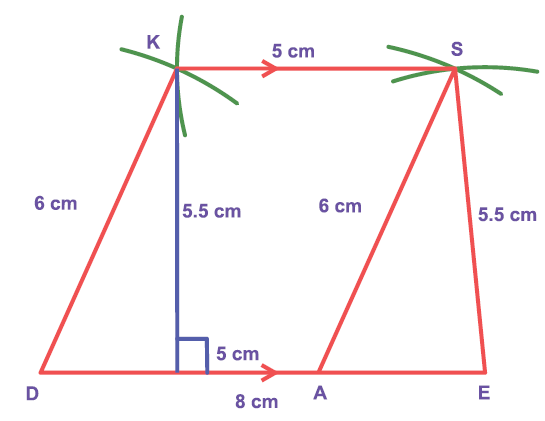
Steps:
1. Draw a line segment DE = 8cm.
2. Mark the point A on DE such that DA = 5 cm.
3. With A and E as centres, draw arcs of radii 6 cm and 5.5 cm respectively. Let them cut at S. Join AS and ES.
4. With D and S as centres, draw arcs of radii 6 cm and 5 cm respectively. Let them cut at K. Join DK and KS.
5. DESK is the required trapezium.
Calculation of area:
Area of the trapezium DESK = \(\frac { 1 }{ 2 } \) x h x (a + b) sq. units
= \(\frac { 1 }{ 2 } \) x 5.5 x (8 + 5) = 35.75 sq. cm
9.
Given:
CA = 9 cm, ㄥCAR = 700 AR = 6 cm, and CD = 7 cm and \(\overset { \_ }{ CA } \) || \(\overset { \_ }{ DR } \)
.png)
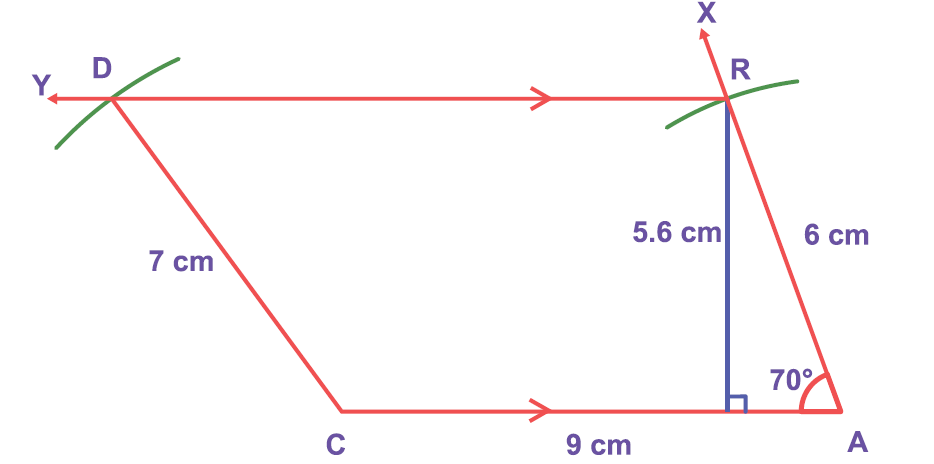
Steps:
1. Draw a line segment CA = 9 cm.
2. Construct an angle ㄥCAX = 700 at A.
3. With A as centre, draw an arc of radius 6 cm cutting AX at R.
4. Draw RY parallel to CA.
5. With C as centre, draw an arc of radius 7 cm cutting RY at D.
6. Join CD. CARD is the required trapezium.
Calculation of area:
Area of the trapezium CARD = \(\frac { 1 }{ 2 } \) x h x(a + b) sq.units
= \(\frac { 1 }{ 2 } \) x 5.6 x (9 + 11) = 56 sq. cm
10.
Cost of the food = Rs. 350
Extra 5% GST is equally shared by Central and State Governments at 2.5% each
∴ CGST = SGST = 350 x \(\frac { 2.5 }{ 100 } \) = Rs. 8.75
11.
Let the number of eggs bought by her be x.
Then, Cost Price = \(\frac { 18 }{ 4 } \times x= \frac { 9x }{ 2 } \)
Selling Price = Rs.\(\frac { 24 }{ 5 } \times x=\frac { 24x }{ 5 } \)
∴ Gain = S.P – C.P = \( \frac { 24x }{ 5 } -\frac { 9x }{ 2 } \)
= \(\frac { 48x-45x }{ 10 } =\frac { 3x }{ 10 } \)
Given, gain = Rs. 90
That is,\(\frac { 3x }{ 10 } \) = Rs. 90
∴ x = \(\frac { 90\times 10 }{ 3 } \) = 300
12.
Given,
Discount = Marked Price –Selling Price
= 1060 – 901
= Rs. 159
∴ Discount = \(\frac { 159 }{ 1060 } \)× 100%
= 15%
13.
Let the C.P of one strawberry box be Rs. x.
Then C.P of 20 strawberry boxes = 20 x and
S.P of 20 strawberry boxes = C.P of 16 strawberry boxes = 16 x
Thus, S.P < C.P, hence there is a loss.
Loss = C.P –S.P = 20 x − 16 x = 4 x
∴ Loss % =\(\left( \frac { Loss }{ C.P } \times 100 \right) \)%
=\(\left( \frac { 4x }{ 20x } \times 100 \right) \)%
= 20 %
14.
Total C.P of the washing machine
= C.P + Overhead Expenses
= 16150 + 1350 = Rs. 17500
S.P = Rs. 19250
Therefore, we find S.P > C.P.
Gain % = \(\left( \frac { Gain }{ C.P } \times 100 \right) %\)% = \(\left( \frac { 19250-17500 }{ 17500 } \times 100 \right) %\)
=\(\frac { 1750 }{ 17500 } \times 100\) = 10%
15.
Let the C.P of the LED TV be rs x.
∴ S.P = \(\frac { 5 }{ 4 } \)x
Profit = S.P – C.P = \(\frac { 5 }{ 4 } \)x - x = \(\frac { x }{ 4 } \)
∴Profit % =\(\left( \frac { Profit }{ C.P } \times 100 \right) %\)
=\(\left( \frac { { x }/{ 4 } }{ x } \times 100 \right) %\)
=\(\left( \frac { 1 }{ 4 } \times 100 \right) %\) = 25%

8th Standard Syllabus & Materials
8th Standard
TN 8th Tamil இயல் 3 - கல்வி கரையில - பாடறிந்து ஒழுகுதல் Important Questions And Answers Study Material - QB365 Set A
NEW8th Standard
TN 8th Tamil இயல் 3-கல்வி கரையில - பல்துறைக் கல்வி Important Questions And Answers Study Material - QB365 Set A
NEW8th Standard
TN 8th Tamil இயல் 3-கல்வி கரையில - புத்தியைத் தீட்டு Important Questions And Answers Study Material - QB365 Set A
NEW8th Standard
TN 8th Tamil இயல் 2 - ஈடில்லா இயற்கை - தமிழர் மருத்துவம் ( நேர்காணல்) Important Questions And Answers Study Material - QB365 Set A



Tamilnadu Stateboard 8th Standard Subjects
Tamilnadu Stateboard Standards




