
 100% FREE ACCESS
8th Standard Syllabus & Materials
8th Standard
TN 8th Tamil இயல் 3 - கல்வி கரையில - வினைமுற்று Important Questions And Answers Study Material - QB365 Set A
NEW8th Standard
TN 8th Tamil இயல் 2 - ஈடில்லா இயற்கை - மயங்கொலிகள் Important Questions And Answers Study Material - QB365 Set A
NEW8th Standard
TN 8th Tamil இயல் 2 - ஈடில்லா இயற்கை -பட்டமரம் Important Questions And Answers Study Material - QB365 Set A
NEW8th Standard
TN 8th Tamil இயல் 2 - ஈடில்லா இயற்கை - இயற்கையை போற்றுவோம் Important Questions And Answers Study Material - QB365 Set A
NEW8th Standard
TN 8th Tamil இயல் 1 - தமிழ் இன்பம் - ஆழிக்கு இணை Important Questions And Answers Study Material - QB365 Set A
NEW8th Standard
TN 8th Tamil இயல் 2-ஈடில்லா இயற்கை - திருக்குறள் Important Questions And Answers Study Material - QB365 Set A

Published on: 13/05/2022
QB365 provides detailed and simple solution for every book back questions in class 8 Maths subject.It will helps to get more idea about question pattern in every book back questions with solution.
latest Book back QuestionsDownload Tamil Nadu 8th Standard Maths question papers, model tests, one-mark questions, important questions, and public exam papers in PDF format. Free study materials and answer keys for TN State Board students.
Questions + Answers key
Take MCQ Maths Test1.
Carpenter A takes 15 minutes to fit the parts of a chair while Carpenter B takes 3 minutes more than A to do the same work. Working together, how long will it take for them to fit the parts for 22 chairs?
2.
A can do a piece of work in 12 hours, B and C can do it 3 hours whereas A and C can do it in 6 hours. How long will B alone take to do the same work?
3.
A soap factory produces 9600 soaps in 6 days working 15 hours a day. In how many days will it produce 14400 soaps working 3 hours more a day?
4.
210 men working 12 hours a day can finish a job in 18 days. How many men are required to finish the job in 20 days working 14 hours a day?
5.
Simplify: (3.769 x 10⁵) + (4.21 x 10⁵)
6.
Evaluate:\(\sqrt { 286225 } \) and use it to compute \(\sqrt { 2862.5 } +\sqrt { 28.6225 } \)
7.
A group of 1536 cadets wanted to have a parade forming a square design. Is it possible? If it is not possible how many more cadets would be required?
8.
A greeting card has an area 90 cm2. Between what two whole numbers is the length of its side?
9.
If (625)x 15625, x = find x2 and x3.
10.
2401 plants are planted in a garden such that each contains as many plants as the number of rows. Find the number of rows and the number of plants in each row.
11.
A square carpet covers an area of 1024 m2 of a big hall. It is placed in the middle of the hall. What is the length of a side of the carpet?
12.
Evaluate:
\(\cfrac { { 10 }^{ x } }{ { 10 }^{ -3 } } ={ 1 }0^{ 9 }\)
13.
Simplify:\(\cfrac { { 9 }^{ 2 }\times { 7 }^{ 2 }\times { 2 }^{ 5 } }{ { 84 }^{ 3 } } \)
14.
Evaluate : (3-1 + 4-2 + 5-3)0
15.
Evaluate:(50 + 6- 1) x 33
16.
Evaluate:\(\left( { 2 }^{ -5 }\div { 2 }^{ 7 } \right) \times { 2 }^{ -2 }\)
17.
Evaluate:\(\left( \cfrac { 1 }{ 2 } \right) ^{ -5 }\)
18.
Find the smallest number by which 200 should be multiplied to make it a perfect cube.
19.
What is the square root of cube root of 46656?
20.
Find two smallest perfect square numbers which when multiplied together gives a perfect cube number
21.
Find the square root of each of the following fractions.
(i) \(\cfrac { 144 }{ 221 } \)
(ii) \(7\cfrac { 18 }{ 49 } \)
(iii) \(6\cfrac { 1 }{ 4 } \)
(iv) \(4\cfrac { 25 }{ 36 } \)
22.
Find the least square number which is divisible by each of the numbers 8,12 and 15.
23.
Write
(i) 102 and
(ii) 112 as the sum of consecutive odd natural numbers
24.
Examine if each of the following is a perfect square:
(i) 725
(ii) 190
(iii) 841
(iv) 1089
25.
Find the square root by long division method.
(i)17956
(ii) 11025
(iii) 6889
(iv) 1764
(v) 418609
1.
Carpenter A fits the parts of a chair in 1 minute = \(\cfrac { 1 }{ 15 } \)
Carpenter B fits the parts of a chaaiir In 1 minute = \(\cfrac { 1 }{ 18 } \)
(A+B) fit the parts in 1 minute = \(\cfrac { 1 }{ 15 } +\cfrac { 1 }{ 18 } =\cfrac { 6+5 }{ 90 } =\cfrac { 11 }{ 90 } \)
Time taken to fit. 1 chair = \(\cfrac { 90 }{ 11 } \) mtrs

Time taken to fit the parts for 22 chairs = 3 hours
2.
(A + C)'s 1 day work = \(\cfrac { 1 }{ 6 } \)
A's 1 day work = \(\cfrac { 1 }{ 12 } \)
C's 1 day work = \(\cfrac { 1 }{ 6 } -\cfrac { 1 }{ 12 } =\cfrac { 2-1 }{ 12 } =\cfrac { 1 }{ 12 } \)
(B + C)'s 1 day work = \(\cfrac { 1 }{ 3 } \)
B's Iday work = \(\cfrac { 1 }{ 3 } -\cfrac { 1 }{ 12 } =\cfrac { 4-1 }{ 12 } =\cfrac { 3 }{ 12 } =\cfrac { 1 }{ 4 } \)
B alone can complete the work in 4 hours.
3.
| Number of Soaps | Days | Time (hours) |
| 9600 | 6 | 15 |
| 14400 | x | 18 |
Number of Soaps increase, so the days also increase.
So it is direct variation
The multiplying factor is \(\cfrac { 14400 }{ 9600 } \)
Time increase days decrease
So it is indirect variation
The multiplying factor is \(\cfrac { 15 }{ 18 } \)
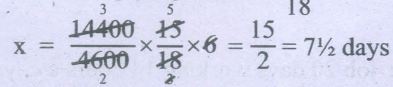
It will produce 14400 soaps in 71/2th days.
4.
| Men | Time (hours) | Days |
| 210 | 12 | 18 |
| x | 14 | 20 |
Days increase. So men will decrease
So, it is inverse proportion
The multiplying factor is \(\cfrac { 18 }{ 20 } \)
Time increase, so men will decrease.
So, it is inverse proportion
The multiplying factor is \(\cfrac { 12 }{ 14 } \)
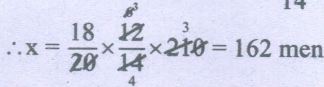
162 men are required to finish the job 20 days working 14 hours a day.
5.
(3.769 x 10⁵) + 4.21 x 10⁵
3.769 x 10⁵ + 4.21 x 10⁵
(3.769 + 4.21)105
7.979 x 10⁵
6.
\(\sqrt { 286225 } \)
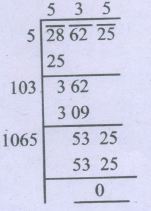
\(\sqrt { 286225 } =535\)
\(\sqrt { 2862.5 } =53.5\)
\(\sqrt { 28.6225 } =5.35\)
\(\sqrt { 2862.5 } +\sqrt { 28.6225 } =53.5+5.35\)
= 58.85
7.
Total number of cadets = 1536
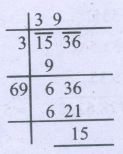
If we take 39 x 39 cadets
15 cadets would be remained,
So square design should be 40 x 40
40 x 40 = 1600
. Number of cadets would be
required = 1600 - 1536 = 64
8.
Area of the greeting card = 90cm2
= 9 x 10cm2
The length of its side are 9cm and 10 cm.
9.
(625)x = 15625
(252)x = (25)3
252x = 253
2x = 3
x = 3/2
\({ x }^{ 2 }=\left( \cfrac { 3 }{ 2 } \right) ^{ 2 }=\cfrac { 9 }{ 4 } \)
\({ x }^{ 3 }=\left( \cfrac { 3 }{ 2 } \right) ^{ 3 }=\cfrac { 27 }{ 8 } \)
\({ x }^{ 2 }=\cfrac { 9 }{ 4 } \)
\({ x }^{ 3 }=\cfrac { 27 }{ 8 } \)
10.
Total number of plants = 2401
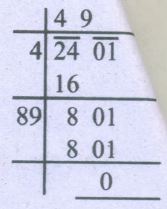
Plants in one row = \(\sqrt { 2401 } \)
=49
Number of plants in each row = 49
Number of rows = 49
11.
Area of the square carpet = 1024 m2
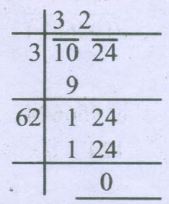
The length of a si.de of the carpet = \(\sqrt { 1024 } \)
= 32m
The length of a side of the carpet = 32m
12.
\(\cfrac { { 10 }^{ x } }{ { 10 }^{ -3 } } ={ 1 }0^{ 9 }\)
= 10x+3 = 109
The bases are equal
Equate the exponents,
x+3 = 9
x = 9-3 = 6
x = 6
13.
\(\cfrac { { 9 }^{ 2 }\times { 7 }^{ 2 }\times { 2 }^{ 5 } }{ { 84 }^{ 3 } } \) = \(\cfrac { \left( { 3 }^{ 2 } \right) ^{ 2 }\times { 7 }^{ 3 }\times { 2 }^{ 5 } }{ \left( { 2 }^{ 2 }\times 3\times 7 \right) ^{ 3 } } \)
= \(\cfrac { { 3 }^{ 4 }\times { 7 }^{ 3 }\times { 2 }^{ 5 } }{ { 2 }^{ 6 }\times { 3 }^{ 3 }\times { 7 }^{ 3 } } \)
= \(\cfrac { { 3 }^{ 4-3 }\times { 7 }^{ 3-3 } }{ { 2 }^{ 6-5 } } \)
= \(\cfrac { { 3 }^{ 1 }\times { 7 }^{ 0 } }{ { 2 }^{ 1 } } =\cfrac { 3\times 1 }{ 2 } =\cfrac { 3 }{ 2 } \)
14.
\(\left( { 3 }^{ -1 }+{ 4 }^{ -2 }+{ 5 }^{ -3 } \right) ^{ 0 }=1\)
15.
\(\left( { 5 }^{ o }+{ 6 }^{ -1 } \right) \times { 3 }^{ 3 }=\left( 1+\cfrac { 1 }{ 6 } \right) \times { 3 }^{ 3 }\)
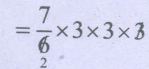
= \(\cfrac { 63 }{ 2 } \)
16.
\(\left( \cfrac { { 2 }^{ -5 } }{ { 2 }^{ 7 } } \right) ={ 2 }^{ -2 }={ 2 }^{ -5 }\times { 2 }^{ -7 }\times { 2 }^{ -2 }\)
\({ 2 }^{ -5-7-2 }={ 2 }^{ -14 }\)
17.
\(\left( \cfrac { 1 }{ 2 } \right) ^{ -5 }=\cfrac { 1 }{ { 2 }^{ 3 } } ={ 2 }^{ 5 }=2\times 2\times 2\times 2\times 2=32\)
18.
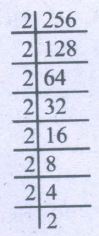
200 = 2 x 2 x 2 x 5 x 5
We have one triplets. We need one more 5 to get another triplet.
5 should be multiplied to make 200 a perfect cube.
19.
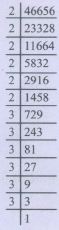
\(\sqrt [ 3 ]{ 46656 } =\sqrt [ 3 ]{ { 2 }^{ 6 }\times { 3 }^{ 6 } } =\left( { 2 }^{ 6 }\times { 3 }^{ 6 } \right) ^{ 1/3 }\)
= 22 \(\times\) 32
Square root of \({ 2 }^{ 2 }\times { 3 }^{ 2 }\) is \(\sqrt { { 2 }^{ 2 }\times { 3 }^{ 2 } } \)
= \(\left( { 2 }^{ 2 }\times { 3 }^{ 2 } \right) ^{ 1/6 }\)
= 2 \(\times\) 3 = 6
The square root of cube root of 46656 is 6.
20.
The two smallest perfect square numbers are 4 and 16
4 and 16 are perfect square.
And also 4 x 16 = 64 is a perfect cube.
21.
(i) \(\cfrac { 144 }{ 225 } \)
\(\sqrt { \cfrac { 144 }{ 225 } } =\sqrt { \cfrac { { 12 }^{ 2 } }{ { 15 }^{ 2 } } } =\cfrac { 12 }{ 15 } \)
\(\sqrt { \cfrac { 144 }{ 225 } } =\cfrac { 12 }{ 15 } \)
(ii)
\(7\cfrac { 18 }{ 49 } \)
\(\sqrt { 7\cfrac { 18 }{ 49 } } =\sqrt { \cfrac { 361 }{ 49 } } =\sqrt { \cfrac { { 19 }^{ 2 } }{ { 7 }^{ 2 } } } =\cfrac { 19 }{ 7 } =2\cfrac { 5 }{ 7 } \)
\(\sqrt { 7\cfrac { 18 }{ 49 } } =2\cfrac { 5 }{ 7 } \)
(iii)
\(6\cfrac { 1 }{ 4 } \)
\(\sqrt { 6\cfrac { 1 }{ 4 } } =\sqrt { \cfrac { 25 }{ 4 } } =\sqrt { \cfrac { { 5 }^{ 2 } }{ { 2 }^{ 2 } } } =\cfrac { 5 }{ 2 } =2\cfrac { 1 }{ 2 } \)
\(\sqrt { 6\cfrac { 1 }{ 4 } } =2\cfrac { 1 }{ 2 } \)
(iv) \(4\cfrac { 25 }{ 36 } \)
\(\sqrt { 4\cfrac { 25 }{ 36 } } =\sqrt { \cfrac { 169 }{ 36 } } =\sqrt { \cfrac { { 13 }^{ 2 } }{ { 6 }^{ 2 } } } =\cfrac { 13 }{ 6 } =2\cfrac { 1 }{ 6 } \)
= \(\sqrt { 4\cfrac { 25 }{ 36 } } =2\cfrac { 1 }{ 6 } \)
22.
The given numbers are 8, 12 and 15
L.C.M of 8, 12 and 15
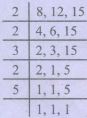
L.C.M = 2 x 2 x 2 x 3 x 5
= 22 X 2 x 3 x 5 = 120
The prime factors 2,3 and 5 do not have a pairs.
So we can multiply 120 by 2 x 3 x 5
120 x 2 x 3 x 5 = 3600 = 22 x i X 32 X 52
So 3600 is the square number divisible by 8, 12 and 15.
23.
(i)
\(\left( \cfrac { n+1 }{ 2 } \right) ^{ 2 }={ 10 }^{ 2 }\)
\(\cfrac { n+1 }{ 2 } =10\)
n + 1 = 20
n = 20 - 1 = 19
The sum of consecutive odd natural numbers is,
1 + 3 + 5 + 7 +.... + 19
(ii) 112
\(\left( \cfrac { n+1 }{ 2 } \right) ^{ 2 }={ 11 }^{ 2 }\)
\(\cfrac { n+1 }{ 2 } =11\)
n + 1 = 22
n = 22 - 1 = 21
The sum of consecutive odd natural numbers is,
1 + 3 + 5 + 7 + .... + 21
24.
(i)

725 = 5 x 5 x 29
= 52 x 29
The second prime number 29 does not have a pair. Hence 725 is not a perfect square number.
(ii)

190 = 2 x 5 x 19
All the three prime numbers do not have pairs.
Hence 190 is not a perfect square number.
(iii) 841

841 = 29 x 29 = 292
\(\sqrt { 841 } =\sqrt { 29^{ 2 } } =29\)
\(\sqrt { 841 } =29\)
Hence 841 is a perfect square number.
(iv) 1089
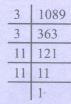
1089 = 3 x 3 x 11 x 11
= 32X112
\(\sqrt { 1089 } =\sqrt { { 3 }^{ 2 }\times { 11 }^{ 2 } } \)
= \(\sqrt { (3\times 11)^{ 2 } } \)
= 3 x 11
= 33
\(\sqrt { 1089 } =33\)
Hence 1089 is a perfect square number.
25.
(i)

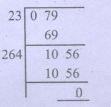
\(\sqrt { 17956 } =134\)
(ii) \(\sqrt { 11025 } \)
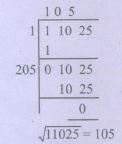
(ii)
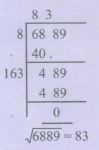
(iv)
(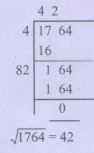 i
i
(v)
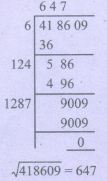

8th Standard Syllabus & Materials
8th Standard
TN 8th Tamil இயல் 3 - கல்வி கரையில - பாடறிந்து ஒழுகுதல் Important Questions And Answers Study Material - QB365 Set A
NEW8th Standard
TN 8th Tamil இயல் 3-கல்வி கரையில - பல்துறைக் கல்வி Important Questions And Answers Study Material - QB365 Set A
NEW8th Standard
TN 8th Tamil இயல் 3-கல்வி கரையில - புத்தியைத் தீட்டு Important Questions And Answers Study Material - QB365 Set A
NEW8th Standard
TN 8th Tamil இயல் 2 - ஈடில்லா இயற்கை - தமிழர் மருத்துவம் ( நேர்காணல்) Important Questions And Answers Study Material - QB365 Set A



Tamilnadu Stateboard 8th Standard Subjects
Tamilnadu Stateboard Standards




