
 100% FREE ACCESS
8th Standard Syllabus & Materials
8th Standard
TN 8th Tamil இயல் 3 - கல்வி கரையில - வினைமுற்று Important Questions And Answers Study Material - QB365 Set A
NEW8th Standard
TN 8th Tamil இயல் 2 - ஈடில்லா இயற்கை - மயங்கொலிகள் Important Questions And Answers Study Material - QB365 Set A
NEW8th Standard
TN 8th Tamil இயல் 2 - ஈடில்லா இயற்கை -பட்டமரம் Important Questions And Answers Study Material - QB365 Set A
NEW8th Standard
TN 8th Tamil இயல் 2 - ஈடில்லா இயற்கை - இயற்கையை போற்றுவோம் Important Questions And Answers Study Material - QB365 Set A
NEW8th Standard
TN 8th Tamil இயல் 1 - தமிழ் இன்பம் - ஆழிக்கு இணை Important Questions And Answers Study Material - QB365 Set A
NEW8th Standard
TN 8th Tamil இயல் 2-ஈடில்லா இயற்கை - திருக்குறள் Important Questions And Answers Study Material - QB365 Set A

Published on: 15/06/2021
QB365 provides detailed and simple solution for every book back questions in class 8 Maths subject.It will helps to get more idea about question pattern in every book back questions with solution.
Download Tamil Nadu 8th Standard Maths question papers, model tests, one-mark questions, important questions, and public exam papers in PDF format. Free study materials and answer keys for TN State Board students.
Questions + Answers key
Take MCQ Maths Test1.
In ΔABC, S is the circumcentre, BC = 72 cm and DS = 15 cm. Find the radius of its circumcircle.
2.
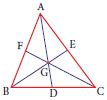
ABC is a triangle and G is its centroid. If AD = 12 cm, BC = 8 cm and BE = 9 cm, find the perimeter of DBDG
3.
In the figure, ABC is a triangle and CD is one of its medians.
If AD = 9x − 13 and BD = 4x + 2, find the length of the side AB.

4.
X, Y and Z can do a piece of job in 4, 6 and 10 days respectively. If X,Y, and Z work together to complete, then find their separate shares if they will be paid Rs 3100 for completing the job.

5.
P and Q can do a piece of work in 20 days and 30 days respectively. They started the work together and Q left after some days of work and P finished the remaining work in 5 days. After how many days from the start did Q leave?
6.
A and B together can do a piece of work in 16 days and A alone can do it in 48 days. How long will B done take to complete the work?
7.
If 15 men take 40 days to complete a work, how long will it take if 15 more men join them to complete the same work?
8.
If 81 students can do a painting on a wall of length 448 m in 56 days. How many students can do the painting on a similar type of wall of length 160 m in 27 days?

9.
If a company pays Rs. 6 lakh for 15 workers for 20 days, what would it pay for 5 workers for 12 days?
10.
Evaluate:\(\sqrt [ 3 ]{ \cfrac { 9261 }{ 8000 } } \)
11.
Find the smallest number by which 675 must be multiplied to obtain a perfect cube
12.
Find the value of \(\sqrt { 256 } \)
13.
Is 108 a perfect square number
14.
Find the square root of 64 by repeated subtraction method.
15.
Find the square of 345 using diagonal method.
1.
As S is the circumcentre of ΔABC, it is equidistant from A,B and C. So AS = BS = CS = radius of its circumcircle. As AD is the perpendicular bisector of BC \(BD=\cfrac { 1 }{ 2 } \times BC=\cfrac { 1 }{ 2 } \times 72=36cm\)
In right-angled triangle BDS, by Pythagoras theorem
BS2 = BD2 + SD2 = 362 + 152 = 1521 = 392 ⇒ BS = 39cm.
ஃThe radius of the circumcircle of ΔABC is 39 cm.
2.
ABC is a triangle and G is its centroid
If, \(AD=12cm\Rightarrow GD=\cfrac { 1 }{ 3 } \) of \(AD=\cfrac { 1 }{ 3 } (12)=4cm\) and
\(BE=9cm\Rightarrow BG=\cfrac { 2 }{ 3 } \) of \(BE=\cfrac { 2 }{ 3 } (9)=6cm\)
Also D is a midpoint of \(BC\Rightarrow BD=\cfrac { 1 }{ 2 } \) of \(BC=\cfrac { 1 }{ 2 } (8)=4c\)
ஃ The perimeter of ΔBDG = BD + GD + BG = 4 + 4 + 6 = 14 cm
3.
AD = DB, since D is the midpoint of AB. (Why?)
Therefore, 9x − 13 = 4x + 2. Solving this (try!) simple equation, we get x = 3.
Hence, AB = 2(9x − 13) = 2(9(3) − 13)=28 units.
4.
Since they all work for the same number of days, the ratio in which they share the money is equal to the ratio of their work done per day.
That is,\(\cfrac { 1 }{ 4 } :\cfrac { 1 }{ 6 } :\cfrac { 1 }{ 10 } =\cfrac { 15 }{ 60 } :\cfrac { 10 }{ 60 } :\cfrac { 6 }{ 60 } =15:10:6\)
Here, the total parts = 15 + 10 + 6 = 31
Hence, A’ s share =\(\cfrac { 15 }{ 31 } \times 3100=Rs.1500\), B; share = \(\cfrac { 10 }{ 31 } \times 3100=Rs.1000\) and
C’ s share is Rs.3100 - (Rs.1500 + Rs.1000) = Rs.600
5.
P’s 1 day’s work = \(\cfrac { 1 }{ 20 } \) and Q’s 1 day’s work = \(\cfrac { 1 }{ 30 } \)
P’s work for 5 days = \(\cfrac { 1 }{ 20 } \times 5=\cfrac { 5 }{ 20 } =\cfrac { 1 }{ 4 } \)
Therefore, the remaining work = \(1-\cfrac { 1 }{ 4 } =\cfrac { 3 }{ 4 } \) (Total work is always 1)
This remaining work was done by both P and Q.
Work done by P and Q in a day = \(\cfrac { 1 }{ 20 } +\cfrac { 1 }{ 30 } =\cfrac { 5 }{ 60 } =\cfrac { 1 }{ 12 } \)
Therefore, the number of days they worked together =\(\cfrac { 3/4 }{ 1/12 } =\cfrac { 3 }{ 4 } \times \cfrac { 12 }{ 1 } =9days.\)
So, Q left after 9 day from the days the work started.
6.
(A+ B) ’s 1 day’s work = \(\cfrac { 1 }{ 16 } \)
A’s 1 day’s work = \(\cfrac { 1 }{ 48 } \)
ஃ B’s 1 day’s work = \(\cfrac { 1 }{ 16 } -\cfrac { 1 }{ 48 } \)
= \(\cfrac { 3-1 }{ 48 } =\cfrac { 2 }{ 48 } =\cfrac { 1 }{ 24 } \)
ஃB alone can complete the work in 24 days
7.
If 15 men can complete the work in 40 days, then the work measured in terms of person days = 15 × 40 = 600. person days.
If the same work is to be done by 30 (15 + 15) men, then the number of days they will take is \(\cfrac { 600 }{ 30 } =20days\)
8.
Multiplicative Factor Method:
| Students | Days | Length of the wall (Work) |
| \({ l }_{ x }^{ 81 }D\) | \({ l }_{ 27 }^{ 56 }\) | \(_{ 160 }^{ 448 }{ D }\) |
Step 1:
Here, less days means more students. So, it is an inverse variation.
ஃ The multiplying factor is \(\cfrac { 56 }{ 27 } \)
Step 3:
\(\therefore x=81\times \cfrac { 56 }{ 27 } \times \cfrac { 160 }{ 448 } \)
x = 60 students.
Formula Method:
Here,P1 = 81,D1 = 56 and W1 = 448
P2 = x, D2 = 27 and W2 = 160
Using the formula,\(\cfrac { { P }_{ 1 }\times { D }_{ 1 } }{ { W }_{ 1 } } =\cfrac { { P }_{ 2 }\times { D }_{ 2 } }{ { W }_{ 2 } } \)
We have,\(\cfrac { 81\times 56 }{ 448 } =\cfrac { x\times 27 }{ 160 } \)
\(\Rightarrow x=\cfrac { 81\times 56 }{ 448 } \times \cfrac { 160 }{ 27 } \)
x = 60 students.
9.
Proportion Method:
| Workers | Payment (Work) | Days |
| \({ D }_{ 5 }^{ 15 }\) | \({ D }_{ x }^{ 6 }{ D }\) | \(_{ 12 }^{ 20 }{ D }\) |
Here, the unknown is the payment (x). It is to be compared with the workers and the days.
Step 1:
Here, less days means less payment. So, it is a direct proportion.
ஃ The proportion is 20 : 12 :: 6 : x ⟶1
Step 2:
Also, less workers means less payment. So, it is a direct proportion again.
ஃ The proportion is 15 : 5 :: 6 : x ⟶2
Step 3:
Combining 1 and 2
\(\begin{matrix} 20:12 \\ 15:5 \end{matrix}\} ::6:x\)
We know that the product of the extremes = the product of the means
So,20 x 15 = 12 x 6 x 5 ⇒ \(x=\cfrac { 12\times 6\times 5 }{ 20\times 15 } =Rs.1.2lakh\)
Multiplicative Factor Method
| Workers | Payment (Work) | Days |
| \({ D }_{ 5 }^{ 15 }\) | \({ D }_{ x }^{ 6 }{ D }\) | \(_{ 12 }^{ 20 }{ D }\) |
Here, the unknown is the payment (x). It is to be compared with the workers and the days.
Step 1:
Here, less days means less payment. So, it is a direct proportion.
ஃ The multiplying factor is \(\cfrac { 12 }{ 20 } \) (take the reciprocal).
Step 2:
Also, less workers means less payment. So, it is a direct proportion again.
ஃ The multiplying factor is \(\cfrac { 5 }{ 15 } \) (take the reciprocal)
Step 3:
\(\therefore x=6\times \cfrac { 12 }{ 20 } \times \cfrac { 5 }{ 15 } \)
x = Rs.1.2 lakh
Formula Method
Here, P1= 15D, D1= 20 and W1= 6
P2 = 5, D2 = 12 and W2 = x
Using the formula,\(\cfrac { { P }_{ 1 }\times { D }_{ 1 } }{ { W }_{ 1 } } =\cfrac { { P }_{ 2 }\times { D }_{ 2 } }{ { W }_{ 2 } } \)
We have,\(\cfrac { 15\times 20 }{ 6 } =\cfrac { 5\times 12 }{ x } \)
\(\Rightarrow x=\cfrac { 5\times 12\times 6 }{ 15\times 20 } =Rs.12lakh\)
10.
\(\sqrt [ 3 ]{ \cfrac { 9261 }{ 8000 } } =\cfrac { \sqrt [ 3 ]{ 9261 } }{ \sqrt [ 3 ]{ 8000 } } =\cfrac { \left( 21\times 21\times 21 \right) ^{ 1/3 } }{ \left( 20\times 20\times 20 \right) ^{ 1/3 } } =\cfrac { 21 }{ 20 } \)
11.
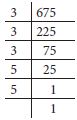
We find that, 675 = 3 x 3 x 3 x 5 x 5 …………….(i)
Grouping the prime factors of 675 as triplets, we are leftover with 5 x 5.
We need one more 5 to make it a perfect cube
To make 675 a perfect cube, multiply both sides of (i) by 5.
675 x 5 = (3 x 3 x 3 x 5 x 5) x 5
3375 = 3 x 3 x 3 x 5 x 5 x 5
Now, 3375 is a perfect cube. Thus, the smallest required number to multiply 675 such that the new number perfect cube is 5.
12.
\(\sqrt { 256 } =\sqrt { 16\times 16 } =\sqrt { 16 } \times \sqrt { 16 } =4\times 4=16\) or \(\sqrt { 256 } =\sqrt { 64\times 4 } =\sqrt { 64 } \times \sqrt { 4 } =8\times 2=16\)
Try to fill up the following table of similar problems using \(\sqrt { a\times b } =\sqrt { a } \times \sqrt { b } \)
13.
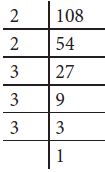
Here, 108 = 2 x 2 x 3 x 3 x 3
= 22 x 32 x 32
Here, the prime factor 3 does not have a second pair. Hence, 108 is not a perfect square number.
14.
We proceed as follows:
Step 1: 64 – 1 = 63
Step 2: 63 – 3 = 60
Step 3: 60 – 5 = 55
Step 4: 55 – 7 = 48
Step 5: 48 – 9 = 39
Step 6: 39 – 11 = 28
Step 7: 28 – 13 = 15
Step 8: 15 – 15 = 0
We have subtracted successive odd numbers (starting from 1) repeatedly from the given number 64. We get zero in the 8th step.
Therefore \(\sqrt { 64 } =8\). If we don't get zero, then the given number is not a perfect square.
Given that 685584 is a perfect square number. Is it possible for us to fi nd out its square
root by the method of successive subtraction of odd numbers?
Yes, we can, but it will be time consuming and tedious. So we need to consider other methods of fi nding the root of square numbers.
15.
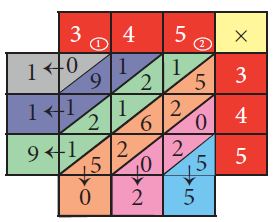
Create a 3 × 3 square below and to the left of 345 (red). Make a diagonal in each of the 9 squares created. Place the product value, say, 5 × 3 = 15, 1 in the upper part and 5 in the lower part of the square. After filling all the squares, add the numbers through coloured diagonals. The arrow indicated numbers from the left 119025 square of 345.
ஃ3452 = 119025.

8th Standard Syllabus & Materials
8th Standard
TN 8th Tamil இயல் 3 - கல்வி கரையில - பாடறிந்து ஒழுகுதல் Important Questions And Answers Study Material - QB365 Set A
NEW8th Standard
TN 8th Tamil இயல் 3-கல்வி கரையில - பல்துறைக் கல்வி Important Questions And Answers Study Material - QB365 Set A
NEW8th Standard
TN 8th Tamil இயல் 3-கல்வி கரையில - புத்தியைத் தீட்டு Important Questions And Answers Study Material - QB365 Set A
NEW8th Standard
TN 8th Tamil இயல் 2 - ஈடில்லா இயற்கை - தமிழர் மருத்துவம் ( நேர்காணல்) Important Questions And Answers Study Material - QB365 Set A



Tamilnadu Stateboard 8th Standard Subjects
Tamilnadu Stateboard Standards




