
 100% FREE ACCESS
8th Standard Syllabus & Materials
8th Standard
TN 8th Tamil இயல் 3 - கல்வி கரையில - வினைமுற்று Important Questions And Answers Study Material - QB365 Set A
NEW8th Standard
TN 8th Tamil இயல் 2 - ஈடில்லா இயற்கை - மயங்கொலிகள் Important Questions And Answers Study Material - QB365 Set A
NEW8th Standard
TN 8th Tamil இயல் 2 - ஈடில்லா இயற்கை -பட்டமரம் Important Questions And Answers Study Material - QB365 Set A
NEW8th Standard
TN 8th Tamil இயல் 2 - ஈடில்லா இயற்கை - இயற்கையை போற்றுவோம் Important Questions And Answers Study Material - QB365 Set A
NEW8th Standard
TN 8th Tamil இயல் 1 - தமிழ் இன்பம் - ஆழிக்கு இணை Important Questions And Answers Study Material - QB365 Set A
NEW8th Standard
TN 8th Tamil இயல் 2-ஈடில்லா இயற்கை - திருக்குறள் Important Questions And Answers Study Material - QB365 Set A

Published on: 15/06/2021
QB365 provides detailed and simple solution for every book back questions in class 8 Maths subject.It will helps to get more idea about question pattern in every book back questions with solution.
Download Tamil Nadu 8th Standard Maths question papers, model tests, one-mark questions, important questions, and public exam papers in PDF format. Free study materials and answer keys for TN State Board students.
Questions + Answers key
Take MCQ Maths Test1.
Draw a pie diagram to represent the following data, which shows the expenditure of paddy cultivation in 2 acres of land.
| Particulars | Seeds | Ploughing | Wages | Fertilizer | Harvest | Others |
| Expenses (Rs) | 2000 | 6000 | 10000 | 7000 | 8000 | 3000 |
Also,
1. Find the percentage of the head in which he had spent more?
2. What percentage of money was spent for seeds?
2.
XYZ is a triangle and G is its centroid. If GP = 2.5 cm, GY = 6 cm and ZR = 12 cm, find XP, QY and GR.

3.
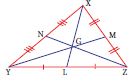
In the figure G is the centroid of the triangle XYZ.
(i) If GL = 2.5 cm, find the length XL.
(ii) If YM = 9.3 cm, find the length GM.
4.
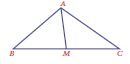
In the figure, ABC is a triangle and AM is one of its medians. If BM = 3.5 cm, find the length of the side BC.
5.
A and B can do a piece of work in 12 days and 9 days respectively. They work on alternate days starting with A on the first day. In how many days will the work be completed?
6.
A works 3 times as fast as B and is able to complete a task in 24 days less than the days taken by B. Find the time in which they can complete the work together.
7.
6 women or 8 men can construct a room in 86 days. How long will it take for 7 women and 5 men to do the same type of room?
8.
If 48 men working 7 hours a day can do a work in 24 days, then in how many days will 28 men working 8 hours a day can complete the same work?
9.
A mat of length 180 m is made by 15 women in 12 days. How long will it take for 32 women to make a mat of length 512 m?

10.
Find the cube root of 27000.
11.
Is 400 a perfect cube?
12.
Find the least number by which 250 is to be multiplied (or) divided so that the resulting number is a perfect square. Also, find the square root in that case
13.
Find the square root of 324 by prime factorisation
14.
Examine if (8, 15, 17) is a Pythagorean triplet
15.
Find the sum of the odd natural numbers 1 + 3 + 5 + 7 + ... ... ... + 99.
1.
| Particulars | Expenses | Central angle |
| Seeds | 2000 | \(\cfrac { 2000 }{ 36000 } \times { 360 }^{ 0 }={ 20 }^{ 0 }\) |
| Plough | 6000 | \(\cfrac { 6000 }{ 36000 } \times { 360 }^{ 0 }={ 60 }^{ 0 }\) |
| Coolie | 10000 | \(\cfrac { 10000 }{ 36000 } \times { 360 }^{ 0 }={ 100 }^{ 0 }\) |
| Fertilizer | 7000 | \(\cfrac { 7000 }{ 36000 } \times { 360 }^{ 0 }={ 70 }^{ 0 }\) |
| Harvesting | 8000 | \(\cfrac { 8000 }{ 36000 } \times { 360 }^{ 0 }={ 80 }^{ 0 }\) |
| Others | 3000 | \(\cfrac { 3000 }{ 36000 } \times { 36 }0^{ 0 }={ 30 }^{ 0 }\) |
| Total | 36000 | 360° |
Expenditure of paddy cultivation in 2 acres.
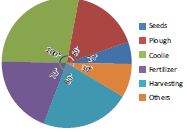
1. He spent more for wages Rs.10,000. Converting into percentage, We have
\(Wages=\cfrac { 10000 }{ 36000 } \times 100\%\)
2. He spent Rs. 2000 for seeds. Converting into percentage,We have
\(\\ Seeds=\cfrac { 2000 }{ 36000 } \times 100\%=5.55\%\)
2.
Centroid G divides each median in the ratio 2:1
ஃ XG = 2GP ⇒ XG = 2(2.5) = 5 cm and XP = XG + GP = 5 + 2.5 = 7.5 cm.
Similarly, GY = 2GQ ⇒ 6 = 2GQ ⇒ GQ = 3 cm and QY = 3 + 6 = 9 cm.
Now, ZR = 12 cm ⇒ GR + GZ = 12 cm ⇒ GR + 2GR = 12 cm ⇒ GR = 4 cm
3.
(i) Since G is the centroid, XG : GL = 2 : 1 which gives XG : 2.5 = 2 : 1.
Therefore, we get 1 x (XG) = 2 x (2.5) ⇒ XG = 5 cm.
Hence, length XL = XG + GL = 5 + 2.5 = 7.5 cm.
(ii) If YG is of 2 parts then GM will be 1 part. (Why?)
This means YM has 3 parts.
3 parts is 9.3 cm long. So GM (made of 1 part) must be 9.3 ÷ 3 = 3.1 cm.
4.
AM is median ⇒ M is the midpoint of BC.
Given that, BM = 3.5 cm, hence BC = twice the length BM = 2 x 3.5 cm = 7 cm.
5.
Since they work on alternate days, let us consider a period of two days.
In the period of 2 days, work done by A and B = \(\cfrac { 1 }{ 12 } +\cfrac { 1 }{ 9 } =\cfrac { 7 }{ 36 } \)
If we consider 5 such time periods for the fraction \(\cfrac { 7 }{ 36 } \) (we consider 5 periods because
7 goes 5 times completely in 36),
work done by A and B in 5\(\times\)2(=10)days = \(5\times \cfrac { 7 }{ 36 } =\cfrac { 35 }{ 36 } \)
Therefore, the remaining work = \(1-\cfrac { 35 }{ 36 } =\cfrac { 1 }{ 36 } \)
This is done by A (why?) in \(\cfrac { 1 }{ 36 } \times 12=\cfrac { 1 }{ 3 } daysB\)
So, the total time taken = \(10days+\cfrac { 1 }{ 3 } days=10\cfrac { 1 }{ 3 } days\)
6.
If B does the work in 3 days, then A will do it in 1 day. That is, the difference is 2 days.
Here, given that the difference between A and B in completing the work is 24 days. Therefore,
A will take \(\cfrac { 24 }{ 2 } =12\) days and B will take 3 x 12 = 36 days to complete the work separately.
Hence, the time taken by A and B together to complete the work =\(\cfrac { ab }{ a+b } days\)
= \(\cfrac { 12\times 36 }{ 12+36 } =\cfrac { 12\times 36 }{ 48 } =9days\)
7.
Person days Method:
Here, let M and W denote a men and a women respectively.
Given that,\(6W=8M\Rightarrow 1W=\cfrac { 8 }{ 6 } M=\cfrac { 4 }{ 3 } M\)
Now,\(7W+5M=7\times \cfrac { 4 }{ 3 } M+5M=\cfrac { 43M }{ 3 } \)
If 8M can construct the room in 86 days, then \(\cfrac { 43M }{ 3 } \) can construct the same type of room in \(8M\times 86\div \cfrac { 43M }{ 3 } =8M\times 86\times \cfrac { 3 }{ 43M } =48days\)
Formula Method:
Required time to construct the room = \(\cfrac { xyp }{ xb+ya } \)
= \(\cfrac { 6\times 8\times 86 }{ 6\times 5+8\times 7 } =\cfrac { 6\times 8\times 86 }{ 30+56 } =\cfrac { 6\times 8\times 86 }{ 86 } =48days\)
(or)
Required time to construct the room = \(\cfrac { p }{ \frac { a }{ x } +\frac { b }{ y } } \)
= \(\cfrac { 86 }{ \frac { 7 }{ 6 } +\frac { 5 }{ 8 } } =\cfrac { 86\times 48 }{ 86 } =48days\)
8.
Multiplicative Factor Method:
| Men | Hours | Days |
| \(l\begin{matrix} 48 \\ 28 \end{matrix}\) | \(\begin{matrix} 7 \\ 8 \end{matrix}l\) | \(l\begin{matrix} 24 \\ x \end{matrix}l\) |
Step 1:
Here, less men means more days. So, it is an inverse variation.
ஃ Th e multiplying factor is \(\cfrac { 48 }{ 28 } \) .
Step 2:
Also, more hours means less days. So, it is an inverse variation.
ஃ The multiplying factor is \(\cfrac { 7 }{ 8 } \) .
Step 3:
\(\therefore x=24\times \cfrac { 48 }{ 28 } \times \cfrac { 7 }{ 8 } =36days\)
Formula Method:
Here, P1= 48, D1= 24, H1 = 7 and W1 = 1(why?)
P2 = 28,D2 = x,H2 = 8 and W2 = 1(why?)
Using the formula,\(\cfrac { { P }_{ 1 }\times { D }_{ 1 }\times { H }_{ 1 } }{ { W }_{ 1 } } =\cfrac { { P }_{ 2 }\times { D }_{ 2 }\times { H }_{ 2 } }{ { W }_{ 2 } } \)
We have,\(\cfrac { 48\times 24\times 7 }{ 1 } =\cfrac { 28\times \times \times 8 }{ 1 } \)
\(\Rightarrow x=\cfrac { 48\times 24\times 7 }{ 28\times 8 } =36days\)
9.
Proportion Method:
| Length (Work) | Women | Days |
| \({ D }_{ 512 }^{ 180 }\) | \(_{ 32 }^{ 15 }{ l }\) | \({ D }_{ x }^{ 12 }l\) |
Here, the unknown is the days (x). It is to be compared with the length and the women.
Step 1:
Here, more length means more days. So, it is a direct proportion.
∴ The proportion is 180 : 512 :: 12 : x ➝1
Step 2:
Also, more women means less days. So, it is an inverse proportion
∴The proportion is 32 : 15 :: 12 : x➝2
Step 3:
Combining 1 and 2
\(\begin{matrix} 180:512 \\ 32:15 \end{matrix}\} ::12:x\)
We know that the product of the extremes = the product of the means

So,\(180\times 32\times x=512\times 12\times 15\Rightarrow x\cfrac { 512\times 12\times 15 }{ 180\times 32 } =16days\)
Here, the unknown is the days (x). It is to be compared with the length and the women
Step 1:
Here, more length means more days. So, it is a direct proportion.
ஃ The multiplying factor is \(\cfrac { 512 }{ 180 } \) (take the reciprocal).
Step 2:
Also, more women means less days. So, it is an inverse proportion.
ஃ The multiplying factor is \(\cfrac { 15 }{ 32 } \) (no change)
Step 3:
\(\therefore x=12\times \cfrac { 512 }{ 180 } \times \cfrac { 15 }{ 32 } =16\ days\)
Formula Method:
Here, P1 = 15,D1 = 12 and W1 = 180
P2 = 32,D2 = x and W2 = 512
Using the formula,\(\cfrac { { P }_{ 1 }\times { D }_{ 1 } }{ { W }_{ 1 } } =\cfrac { { P }_{ 2 }\times { D }_{ 2 } }{ { W }_{ 2 } } \)
We have,\(\cfrac { 15\times 12 }{ 180 } =\cfrac { 32\times x }{ 512 } \)
\(\Rightarrow 1=\cfrac { 32\times x }{ 512 } \Rightarrow x=\cfrac { 512 }{ 32 } =16days\)
Remark: Students may answer in any of the three given methods dealt here.
10.
By prime factorisation, we have 27000 = 2 x 2 x 2 x 3 x 3 x 3 x 5 x 5 x 5
\(\therefore \sqrt [ 3 ]{ 2700 } =2\times 3\times 5=30\)
11.
By prime factorization, we have \(400=\underbrace { 2\times 2\times 2 } \times 2\times 5\times \)
There is only one triplet. To make further triplets, we will need two more 2’s and one more 5.
Therefore, 400 is not a perfect cube.
12.
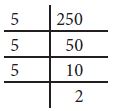
We find 250 = 5 x 5 x 5 x 2
= 52 x 5 x 2
Here, the prime factors 5 and 2 do not have pairs.
Therefore, we can either divide 250 by 10 (5 x 2) or multiply 250 by 10.
(i) If we multiply 250 by 10, we get 2500 = 52 × 5 × 2 × 5 × 2 and therefore the square root for 2500 would be 5 x 5 x 2 = 50.
(ii) If we divide 250 by 10 we get 25 and in that case we get \(\sqrt { 25 } =\sqrt { { 5 }^{ 2 } } =5\)
13.
First, resolve the given number into prime factors. Group the identical factors in pairs and then take one from them to find the square root.
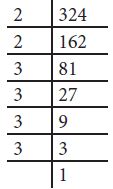
Now, 324 = 2 x 2 x 3 x 3 x 3 x 3
= 22 x 32 x 3
= (2 x 3 x 3)2
\(\therefore \sqrt { 324 } =\sqrt { \left( 2\times 2\times 3 \right) ^{ 2 } } \)
= 2 x 3 x 3
= 18
14.
We have, 82 = 8 × 8 = 64, 152 = 15 × 15 = 225 and 172 = 17 × 17 = 289
We find, 82 + 152 = 64 + 225 = 289 = 172
Thus, 82 + 152 = 172
∴ (8, 15, 17) is a Pythagorean triplet
15.
Solution:
Here, there are 50 odd numbers from 1 to 99.
The sum of the fi rst n consecutive odd natural numbers = n2
The sum of the fi rst 50 consecutive odd natural numbers = 502
= 50 × 50 = 2500

8th Standard Syllabus & Materials
8th Standard
TN 8th Tamil இயல் 3 - கல்வி கரையில - பாடறிந்து ஒழுகுதல் Important Questions And Answers Study Material - QB365 Set A
NEW8th Standard
TN 8th Tamil இயல் 3-கல்வி கரையில - பல்துறைக் கல்வி Important Questions And Answers Study Material - QB365 Set A
NEW8th Standard
TN 8th Tamil இயல் 3-கல்வி கரையில - புத்தியைத் தீட்டு Important Questions And Answers Study Material - QB365 Set A
NEW8th Standard
TN 8th Tamil இயல் 2 - ஈடில்லா இயற்கை - தமிழர் மருத்துவம் ( நேர்காணல்) Important Questions And Answers Study Material - QB365 Set A



Tamilnadu Stateboard 8th Standard Subjects
Tamilnadu Stateboard Standards




