
 100% FREE ACCESS
8th Standard Syllabus & Materials
8th Standard
TN 8th Tamil இயல் 3 - கல்வி கரையில - வினைமுற்று Important Questions And Answers Study Material - QB365 Set A
NEW8th Standard
TN 8th Tamil இயல் 2 - ஈடில்லா இயற்கை - மயங்கொலிகள் Important Questions And Answers Study Material - QB365 Set A
NEW8th Standard
TN 8th Tamil இயல் 2 - ஈடில்லா இயற்கை -பட்டமரம் Important Questions And Answers Study Material - QB365 Set A
NEW8th Standard
TN 8th Tamil இயல் 2 - ஈடில்லா இயற்கை - இயற்கையை போற்றுவோம் Important Questions And Answers Study Material - QB365 Set A
NEW8th Standard
TN 8th Tamil இயல் 1 - தமிழ் இன்பம் - ஆழிக்கு இணை Important Questions And Answers Study Material - QB365 Set A
NEW8th Standard
TN 8th Tamil இயல் 2-ஈடில்லா இயற்கை - திருக்குறள் Important Questions And Answers Study Material - QB365 Set A

Published on: 15/06/2021
QB365 provides detailed and simple solution for every book back questions in class 8 Maths subject.It will helps to get more idea about question pattern in every book back questions with solution.
Download Tamil Nadu 8th Standard Maths question papers, model tests, one-mark questions, important questions, and public exam papers in PDF format. Free study materials and answer keys for TN State Board students.
Questions + Answers key
Take MCQ Maths Test1.
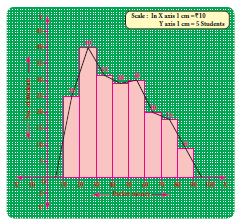
The following is the distribution of pocket money of 200 students in a school.
| Pocket money | 10-20 | 20-30 | 30-40 | 40-50 | 50-60 | 60-70 | 70-80 | 80-90 |
| Number of Students | 25 | 40 | 33 | 28 | 30 | 20 | 16 | 8 |
Draw a frequency polygon using histogram.
2.
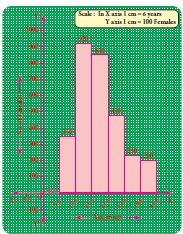
The following table gives the number of literate females in the age group 10 to 45 years in a town.
| Age group | 10-15 | 16-21 | 22-27 | 28-33 | 34-39 | 40-45 |
| No. of females | 350 | 920 | 850 | 480 | 230 | 200 |
Draw a histogram to represent the above data
3.
Construct a square RAMP of a diagonal 8 cm. Also find its area.
4.
Construct a rectangle LIME with LI = 6 cm and IE = 7 cm. Also find its area.
5.
Construct a rhombus FARM with FR = 7 cm and ㄥF = 80° .Also find its area.
6.
Construct a rhombus LEAF with LE = 6 cm and ∠L = 65°. Also find its area
7.
Write in scienticfic form : 642.398
8.
Express 4−5 as a power with the base 2.
9.
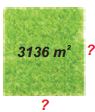
The area of a square field is 3136 m2. Find its perimeter
10.
Simplify:\(\sqrt { 2\cfrac { 7 }{ 9 } } \)
11.
Simplify:\(\sqrt { 12 } \times \sqrt { 3 } \)
12.
Combine the scientific notations:(3.7 x 10⁻⁵)(2 x 10⁻³)
13.
Simplify and write the answer in exponential form:
\(\left( -3 \right) ^{ 4 }\times \left( \cfrac { 5 }{ 3 } \right) ^{ 4 }\)
14.
Simplify: (−2)5 x (−2)−3
15.
Find the value of 4−3
1.
Represent the pocket money along x- axis and number of students along the y–axis.
Draw a histogram for the given data. Now, mark the midpoints of the upper sides of the consecutive rectangles. Also mark the midpoints of two imagined class intervals 0-10 and 90-100 whose frequency is 0 on x- axis. Now, join all the midpoints with the help of ruler. We get a frequency polygon imposed on the histogram.
2.
The given distribution is discontinuous. If we represent the given data as it is by a graph we shall get a bar graph, as there will be gaps in between the classes. So, convert this into a continuous distribution using the adjustment factor 0.5.
The first class interval can be written as 9.5-15.5 and the remaining class intervals are changed in the same way. There are no changes in frequencies.
The new continuous frequency table is
| Age group | 9.5-15.5 | 15.5-21.5 | 21.5-27.5 | 27.5-33.5 | 33.5-39.5 | 39.5-45.5 |
| No of females | 350 | 920 | 830 | 480 | 230 | 200 |
The histogram is constructed as below
3.
Given: diagonal = 8 cm
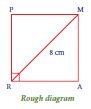
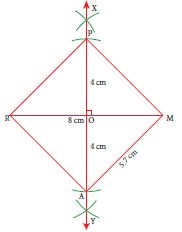
(i) Draw a line segment RM = 8 cm.
(ii) Draw the perpendicular bisector XY to RM. Let it bisect RM at O.
(iii) With O as centre, draw arcs of radius 4 cm on either side of O which cut OX at P and OY at A.
(iv) Join RA, AM, MP and PR.
(v) RAMP is the required square.
Calculation of area:
Area of square RAMP = a2 sq.units
= 5.7 x 5.7 = 32.49sq.cm
4.
Given: LI = 6 cm and IE = 7 cm
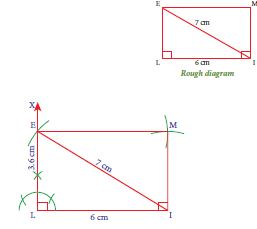
Steps:
(i) Draw a line segment LI = 6 cm.
(ii) At L, construct LX ⊥LI .
(iii) With I as centre, draw an arc of radius 7 cm and let it cut LX at E.
(iv) With I as centre and LE as radius draw an arc. Also, with E as centre and LI as radius draw an another arc. Let them cut at M.
(v) Join IM and EM.
(vi) LIME is the required rectangle.
Calculation of area:
Area of rectangle LIME = l x b sq.units
= 6 x 3.6 = 21.6 sq.cm
5.
Given: FR = 7 cm and ∠F = 80°
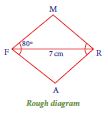
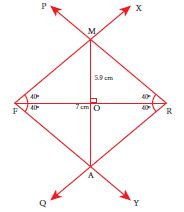
Steps:
(i) Draw a line segment FR = 7 cm.
(ii) At F, make ∠RFX = ∠RFY = 40° on either side of FR.
(iii) At R, make ∠FRP = ∠FRQ = 40° on either side of FR.
(iv) Let FX and RP cut at M and FY and RQ cut at A.
(v) FARM is the required rhombus
Calculation of area:
Area of rhombus FARM =\(\cfrac { 1 }{ 2 } \times { d }_{ 1 }\times { d }_{ 2 }sq.units\)
= \(\cfrac { 1 }{ 2 } \times 7\times 5.9=20.65sq.cm\)
6.
Given: KE = 6 cm and ∠L = 65°
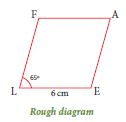
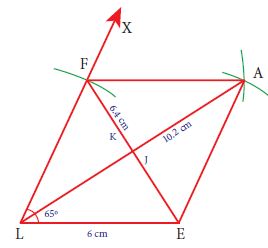
(i) Draw a line segment LE = 6 cm.
(ii) At L on LE, make ∠ELX = 65°
(iii) With L as centre draw an arc of radius 6 cm. Let it cut LX at F.
(iv) With E and F as centres, draw arcs of radius 6 cm each and let them cut at A.
(v) Join EA and AF.
(vi) LEAF is the required rhombus
Calculation of area:
Area of rhombus LEAF = \(\cfrac { 1 }{ 2 } \times { d }_{ 1 }\times { d }_{ 2 }sq.units\)
= \(\cfrac { 1 }{ 2 } \times 6.4\times 10.2=32.64\ sq.cm\)
7.
1642.398 =1.642398 × 10³
8.
Since 4 = 22, we write 4−5 = (22 )−5 = 22×(−5)
= 2−10 [Here, we use (am)n = amn ]
9.
Given that the area of the square field = 3136 m2.
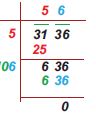
ஃ The side of square field =\(\\ \sqrt { 3136 } \ m=\) 56 m
ஃ The perimeter of the square field = 4 x side
= 4 x 56
= 224 m
10.
\(\sqrt { 2\cfrac { 7 }{ 9 } } =\sqrt { \cfrac { 25 }{ 9 } } =\sqrt { \cfrac { { 5 }^{ 2 } }{ { 3 }^{ 2 } } } =\cfrac { 5 }{ 3 } =1\cfrac { 2 }{ 3 } \)
11.
Remembering the rule,\(\sqrt { a } \times \sqrt { b } =\sqrt { a } \times \sqrt { b } \)
\(\sqrt { 12 } \times \sqrt { 3 } =\sqrt { 12\times 3 } =\sqrt { 36 } =\sqrt { { 6 }^{ 2 } } =6\)
12.
(3.7 x 10⁻⁵)(2 x 10⁻³) = 7.4 x 10⁻⁸
13.
\(\left( -3 \right) ^{ 4 }\times \left( \cfrac { 5 }{ 3 } \right) ^{ 4 }={ 3 }^{ 4 }\times \cfrac { { 5 }^{ 4 } }{ { 3 }^{ 4 } } ={ 5 }^{ 4 }=625\)
14.
(- 2)5´(- 2)-3 = (-2) 5 - 3 = ( - 2) 2 = - 2 x - 2 = 4 .
15.
\({ 4 }^{ -3 }=\cfrac { 1 }{ { 4 }^{ 3 } } =\cfrac { 1 }{ 4\times 4\times 4 } =\cfrac { 1 }{ 64 } \)

8th Standard Syllabus & Materials
8th Standard
TN 8th Tamil இயல் 3 - கல்வி கரையில - பாடறிந்து ஒழுகுதல் Important Questions And Answers Study Material - QB365 Set A
NEW8th Standard
TN 8th Tamil இயல் 3-கல்வி கரையில - பல்துறைக் கல்வி Important Questions And Answers Study Material - QB365 Set A
NEW8th Standard
TN 8th Tamil இயல் 3-கல்வி கரையில - புத்தியைத் தீட்டு Important Questions And Answers Study Material - QB365 Set A
NEW8th Standard
TN 8th Tamil இயல் 2 - ஈடில்லா இயற்கை - தமிழர் மருத்துவம் ( நேர்காணல்) Important Questions And Answers Study Material - QB365 Set A



Tamilnadu Stateboard 8th Standard Subjects
Tamilnadu Stateboard Standards




