
 100% FREE ACCESS
8th Standard Syllabus & Materials
8th Standard
TN 8th Tamil இயல் 3 - கல்வி கரையில - வினைமுற்று Important Questions And Answers Study Material - QB365 Set A
NEW8th Standard
TN 8th Tamil இயல் 2 - ஈடில்லா இயற்கை - மயங்கொலிகள் Important Questions And Answers Study Material - QB365 Set A
NEW8th Standard
TN 8th Tamil இயல் 2 - ஈடில்லா இயற்கை -பட்டமரம் Important Questions And Answers Study Material - QB365 Set A
NEW8th Standard
TN 8th Tamil இயல் 2 - ஈடில்லா இயற்கை - இயற்கையை போற்றுவோம் Important Questions And Answers Study Material - QB365 Set A
NEW8th Standard
TN 8th Tamil இயல் 1 - தமிழ் இன்பம் - ஆழிக்கு இணை Important Questions And Answers Study Material - QB365 Set A
NEW8th Standard
TN 8th Tamil இயல் 2-ஈடில்லா இயற்கை - திருக்குறள் Important Questions And Answers Study Material - QB365 Set A

Published on: 13/05/2022
QB365 provides detailed and simple solution for every Book back Questions in class 8 Science Subject. It will helps to get more idea about question pattern in every book back questions with solution.
latest Book back QuestionsDownload Tamil Nadu 8th Standard Science question papers, model tests, one-mark questions, important questions, and public exam papers in PDF format. Free study materials and answer keys for TN State Board students.
Questions + Answers key
Take MCQ Science Test1.
What are the achievements of Chandrayaan - 1?
2.
List out the uses of magnets
3.
What are the properties of sound?
4.
What can you suggest to your classmates to keep himself/herself clean and healthy?
5.
Write about the human axial skeleton, giving suitable labelled diagram.
6.
Why does a light paddle wheel placed in the path of cathode rays begin to rotate, when cathode rays fall on it?
7.
It is said that sleeping beneath the tree during night is bad for health. What is the reason?
8.
Why does the bottom of a lake not freeze in severe winter even when the surface is all frozen?
9.
Explain Osmosis with an example.
10.
Write any five differences between monocot and dicot plants.
11.
How micro organisms are useful in the field of medicine?
12.
Explain how food items are spoiled by chemical reactions?
13.
What is reflection? Write short notes on regular and irregular reflection?
14.
Give the different types of friction and explain each with an example.
15.
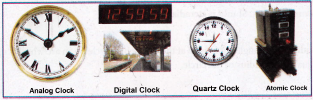
Write a short note on different types of clocks.
1.
1. Chandrayaan-I discovered presence of water molecules in the lunar soil.
2. It confirmed that the Moon was completely molten once
3. It has recorded images of the landing site of the US space-craft Apollo-15 and Apollo-11.
4. It has provided high-resolution spectral data on the mineralogy of the Moon
5. The existence of aluminium, magnesium and silicon were picked up by the X-ray camera.
6. More than 40,000 images have been transmitted by the Chandrayaan-1 camera in 75 days.
7. The acquired images of peaks and craters show that the Moon mostly consists of craters.
8. It beamed back its first images of the Earth in its entirety
9. Chandrayaan-1 has discovered large Eaves on the lunar surface that can act as human shelter on the Moon
2.
i) In ancient times the magnet in the form of 'direction stone' helped seamen to find the directions during a voyage.
ii) Magnets are used to generate electricity in dynamos.
iii) Magnets are used in electric bells and electric motors.
iv) Magnets are used in loudspeakers and microphones.
v) Magnets are used in computer in its storage devices such as hard disks.
vi) In industries, magnetic conveyor belts are used to sort out magnetic substances from scraps mixed with non-magnetic substances.
vii) In banks, the magnets enable the computers to read the MICR numbers printed on a cheque.
viii) The tip of the screw drivers are made slightly magnetic so that the screws remain attached to the tip
ix) An extremely powerful electromagnet is used in the fast moving Maglev train to remain floating above the tracks.
x) At hospitals, extremely strong electro magnets are used in the MRI (Magnetic Resonance Imaging) to scan the specified internal organ.
3.
i) Loudness
1. Loudness of sound is used to distinguish a weak sound from a loud sound.
2. The loudness of a sound depends on its amplitude
3. Higher the amplitude louder will be the sound.
4. The unit of loudness of sound is decibel (dB).
ii) Pitch
1. The pitch of sound is used to distinguish between a flat sound and a shrill sound.
2. Higher the frequency of sound; higher will be the pitch or shrill
Examples of low pitch sound -the roar of a lion, male voice and the beating of a drum.
Examples of high pitch sound - whistle, female voice and violin
iii) Quatity or Timbre
1. The quality or timbre is used to distinguish between two sounds that have the same pitch and amplitude.
4.
Personal hygiene habits:
(i) Shower or bath daily.
(ii) Always wash your hands before and after meals.
(iii) Keep fingernails clean and dipped.
(iv) Wash your teeth and mouth before and after each meal.
(v) Avoid touching your face, nose or mouth while preparing food.
(vi) Avoid coughing or sneezing around food and close your mouth by using hand kerchief while you cough in public places.
(vii) If you are to taste the food, use a clean spoon.
(viii) Change your clothes regularly and wash them cleanly especially undergarments.
(ix) Don't defecate in open field. Use clean toilets for defecation.
(x) If you are not well, avoid self-medication consult a doctor.
5.
Axial Skeleton
The axial skeleton consists of the bones along the axis, or central line, of the human body. The axial skeleton consists of the skull, facial bones, sternum, ribs and vertebral column.
a) Skull
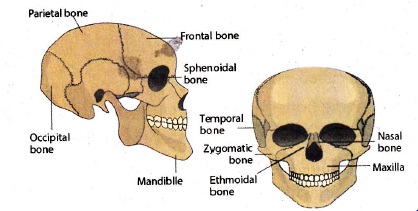
Skull is a hard structure made up of small bonds. It is formed by 22 bones out of which 8 bones are fixed together to form the cranium and 14 bones fuse to form the face. Skull placed on the top of the backbone can be moved up, down and sidewards
b) Vertebral Column
.jpg)
(i) Vertebral column running at the back of the body is also called the backbone. It is in the trunk region to offer support to the upper part of the body.
(ii) Vertebral column is made up individual bones called as vertebrae. Total vertebral column consists, of 7 cervical vertebrae, 12 thoracic and 5 lumnar vertebrae, 5 fused sacral and 3 fused coccygeal vertebrae.
(iii) Vertebral column runs from the base of the Skull to the hip bone forming a tube. Spinal cord passes through this hollow tube. Vertebrae are joined by gliding point which allow the body to be bent back, front or side wards.
c) Sternum or Rib cage
.jpg)
(i) The rib cage occupies the chest region. It is a cone shaped structure tirade up of 12 pairs of ribs. Ribs are attached to vertebrae at the back which curve around to form a cage, 10 pairs of ribs are attached to the breast bone at the front. 2 pairs of lower ribs are free at front. These are called as free-floating ribs; Rib cage is set up in such 4 way that it can contract and expand during the process of breathing.
(ii) Rib cage protects the underlying lungs, heart and some part of Liver.
6.
It is because the small particles of the cathode rays (electrons) have mass and energy. This energy is used in rotating the paddle wheels.
7.
i) During night photosynthesis does not occur. So, tree will not release oxygen and take in oxygen.
ii) Trees respire and they take in oxygen and release carbon dioxide. Due to their huge size, they take up comparatively more Oxygen than a human being. So, we will not get sufficient oxygen under a tree during night. It may cause breathing problems and suffocation. So it is bad for health.
8.
When a lake freezes, the upper layer freezes due to being in contact with the cold atmosphere. This ice sheet doesn't sink as it is less dense than water. Once frozen, the ice sheet acts as an insulator and it insulates the water at the bottom from cooling and freezing. It keeps the water inside warm enough to be in a liquid form.
9.
(i) Osmosis is the movement of solvent particles across a semipermeable membrane from a dilute solution into a concentrated solution.
(ii) The solvent moves to dilute the concentrated solution and equalize the concentration on both sides of the membrane.
(iii) The movement of liquids in and out cells is dependent on the concentration of the solution surrounding it.
(iv) There are three types of situations in which this could vary.
i) Isotonic
Here the concentration of external and internal solutions of the organism are the same.
eg: When red blood cells are in an isotonic solution it will retain its disc shape because the flow of water in and out the cell is at the same rate.
ii) Hypotonic:
Here the external solution concentration is less compared to the concentration of the inner solution of an organism. In this case water will rush into the organism.
eg: When red blood cells are in hypotonic solution, the cell swells and haemolysis occurs.
iii) Hypertonic:
Here the external solution concentration is greater than the concentration of the inner solution of an organism. In this case the water will rush out of the organism.
eg: When red blood cells are in a hypertonic solution, it will result in crenation of blood cell.
10.
| S.No | Monocot | Dicot |
| 1 | Seed has one cotyledon | Seed has two cotyledon |
| 2 | Leaves have parallel venation | Leaves have reticulate venation |
| 3 | Plants have fibrous root system | Plants have tap root system |
| 4 | Flowers are trimerous and not differentiated into calyx and corolla |
Flowers are tetramerous or pentamerous. Calyx and corolla are well differentiated |
| 5 | Pollination occurs mostly by wind Eg: Grass, Paddy |
Pollination occurs mostly by insects Eg: Bean, Mango |
11.
We obtain antibiotics and vaccines from microbes.
Antibiotics:
The word 'Anti' means against. Antibiotic is a substance produced by living organisms which is toxic for other organisms. Sir Alexander Fleming was the first person to discover the antibiotic penicillin in the year 1928. The antibiotic penicillin was obtained from the fungi penicillium chrysogenum. It is used to treat disease such as tetanus, diphtheria, antibiotic streptomycin is obtained from Streptomyces bacteria to cure various bacterial infections eg, Plague.
Vaccines:
Vaccines are prepared from dead or weakened microbes - Edward Jenner was the first person to discover small pox vaccine. He coined the term vaccination. When the vaccine is injected to the body of a patient, the body produces antibodies to fight against the germs. These antibodies remain inside the body and protects from future invasion of the germs. Therefore vaccination is otherwise called as immunization.
Eg: MMR vaccine for measles, Mumps, Rubella.
BCG (Bacille Calmette Guerin) vaccine for tuberculosis.
12.
(i) Spoilage of food and vegetables:
Food spoilage may be defined as any change that causes food unfit for human consumption
The chemical reactions catalyzed by the enzymes result in the degradation of food quality such as development of bad tastes and odour, detorioration and loss of nutrients.
Eg: Rotten eggs develop a bad smell due to the formation of hydrogen sulphide gas.
Decaying of vegetables and fruits due to microbes.
(ii) Rancidity of fishes and meat:
Fishes and meat contains high levels of polyunsaturated fatty acids.
These fatty acids undergo oxidation when exposed to air or light.
It results in bad odour. This process is called rancidity.
(iii) Apples and fruits turn brown when cut:
It is due to chemical reaction with oxygen in air.
The cells of apples contain an enzyme called tyrosinase that when in contact with oxygen catalyses a biochemical reaction of plant's phenolic compounds to brown pigments known as melanins.
13.
Reflection of light:
i) The bouncing back of the light rays as they fall on the smooth, shiny and polished surface is called reflection.
ii) Based on the nature of the surface, reflection can be classified into two types.
i) Regular reflection
ii) Irregular reflection
Regular Reflection :
1. When a beam of light falls on a smooth surface, it gets reflected. This reflection is called regular reflection.
2. After reflection, the reflected rays will be parallel to each other.
3. The angle of incidence and angle of reflection of each ray will be equal.
4. The law of reflection is obeyed in this reflection and thus a clear image is formed,
5. It is also known as specular reflection.
6. Example: Reflection of light by a plane mirror.
Irregular Reflection :
1. In a body having a rough or irregular surface each region of the surface is inclined at different angles.
2. When light falls on such a rough surface, the light rays are reflected at different angles. This reflection is called irregular reflection.
3. The angle of incidence and the angle of reflection each ray are not equal.
4. The law of reflection is not obeyed in this reflection and thus the image is not clear.
5. It is also known as diffused reflection.
6. Example: Reflection of light from a wall.
14.
Types of Friction:
Friction can be classifed into two basic types
I Static friction
II. Kinetic friction
I. Static friction:
The friction experienced by the bodies which are at rest is called static friction.
eg:- a knot in a thread.
II. Kinetic friction:
Friction existing during the motion of bodies is called kinetic friction
Kinetic friction can be classified into two types
(i) Sliding friction
(ii) Rolling friction
(i) Sliding friction:
When a body slides over the surface of another body, the friction acting between the surfaces in contact is called sliding friction
eg: Sliding on snow in a sled.
(ii) Rolling friction:
When a body rolls over another surface, the friction acting between the surfaces in contact is called rolling friction.
eg: Wheels in vehicles, trolleys, Suitcases.
15.
Types of clocks:
I. Types of clocks based on display
(i) Analog clocks:
1. It looks like a classic clock.
2. It has three hands such as hours hand, minutes hand and seconds hand to show the time
3. Analog clocks can be driven either mechanically or electronically.
(ii) Digital clocks:
1. A digital clock displays the time directly
2. It shows the time in numerals or other symbols.
3. It may have a 12 hours or 24 hours display,
II. Types of clocks based on working mechanism
(i) Quartz clock:
1. These clocks are activated by electronic oscillations which are controlled by a 'quartz crystal'.
2. The quartz clock is more accurate than the mechanical clock.
3. Accuracy - One second in every 109 seconds.
(ii) Atomic clock:
1. These clocks are making use of periodic vibrations occurring within the atom
2. Accuracy - One second in every 10 seconds.
3. Atomic clocks are used in Global positioning System, Global Navigation Satellite System and International time distribution services.

8th Standard Syllabus & Materials
8th Standard
TN 8th Tamil இயல் 3 - கல்வி கரையில - பாடறிந்து ஒழுகுதல் Important Questions And Answers Study Material - QB365 Set A
NEW8th Standard
TN 8th Tamil இயல் 3-கல்வி கரையில - பல்துறைக் கல்வி Important Questions And Answers Study Material - QB365 Set A
NEW8th Standard
TN 8th Tamil இயல் 3-கல்வி கரையில - புத்தியைத் தீட்டு Important Questions And Answers Study Material - QB365 Set A
NEW8th Standard
TN 8th Tamil இயல் 2 - ஈடில்லா இயற்கை - தமிழர் மருத்துவம் ( நேர்காணல்) Important Questions And Answers Study Material - QB365 Set A



Tamilnadu Stateboard 8th Standard Subjects
Tamilnadu Stateboard Standards




