
 100% FREE ACCESS
8th Standard Syllabus & Materials
8th Standard
TN 8th Tamil இயல் 3 - கல்வி கரையில - வினைமுற்று Important Questions And Answers Study Material - QB365 Set A
NEW8th Standard
TN 8th Tamil இயல் 2 - ஈடில்லா இயற்கை - மயங்கொலிகள் Important Questions And Answers Study Material - QB365 Set A
NEW8th Standard
TN 8th Tamil இயல் 2 - ஈடில்லா இயற்கை -பட்டமரம் Important Questions And Answers Study Material - QB365 Set A
NEW8th Standard
TN 8th Tamil இயல் 2 - ஈடில்லா இயற்கை - இயற்கையை போற்றுவோம் Important Questions And Answers Study Material - QB365 Set A
NEW8th Standard
TN 8th Tamil இயல் 1 - தமிழ் இன்பம் - ஆழிக்கு இணை Important Questions And Answers Study Material - QB365 Set A
NEW8th Standard
TN 8th Tamil இயல் 2-ஈடில்லா இயற்கை - திருக்குறள் Important Questions And Answers Study Material - QB365 Set A

Published on: 16/06/2021
QB365 provides detailed and simple solution for every Book back Questions in class 8 Science Subject. It will helps to get more idea about question pattern in every book back questions with solution.
Download Tamil Nadu 8th Standard Science question papers, model tests, one-mark questions, important questions, and public exam papers in PDF format. Free study materials and answer keys for TN State Board students.
Questions + Answers key
Take MCQ Science Test1.
Write about the types of conservation.
2.
What is a weed? Explain the different methods of weed control.
3.
What are the different types of fuels?
4.
Explain the neutralization reactions in our daily life.
5.
What is Electrolysis? Explain the electrolysis of water.
6.
Write a note on Apollo missions.
7.
Write a note on Earth’s magnetism.
8.
Describe the structure and function of the human ear?
9.
Adolescence is the energistic stage. What health and good habits you want to develop?
10.
What is a streamlined body? How does it help in the movement of animals that fly or swim in water?
11.
How can we prove that the electrons carry negative charge?
12.
How do astronauts breathe when they go beyond earth’s atmosphere?
13.
Explain the mechanism of breathing.
14.
Write the economic importance of Gymnosperms.
15.
How can we improve the beneficial bacterial count in human beings?
1.
Conservation is of two types, They are:
a. In-situ conservation (within habitat)
b. Ex-situ conservation (outside the habitat)
In-situ conservation:
It is nothing but conservation of living resources within the natural ecosystem in which they occur. This is achieved by protection of natural habitat and maintenance of endangered species in certain protected areas such as national parks, wildlife or bird sanctuaries and biosphere reserves. In India, there are about 73 national parks, 416 sanctuaries and 12 biosphere reserves.
(a) National Parks:
A National park is an area which is strictly reserved for the betterment of the wildlife. Here, activities like forestry, grazing or cultivation are not permitted. Even private ownership rights are not allowed in these areas. The national parks cover an area of 100 - 500 square kilometers. In these parks a single plant or animal species are preserved.
(b) Wildlife sanctuaries:
A sanctuary is a protected area which is reserved for the conservation of animals only. Human activities like harvesting of timber, collection of forest products and private ownership rights are allowed here. Controlled interference like tourist activity is also allowed. The differneces between national parks and wildlife sanctuaries are given in table.
(c) Biosphere reserves:
Biosphere is a protected area where human population also forms the part of the system. The area of these places will be around 5000 square kilometers. They conserve the eco system, species and genetic resources. These areas are set up mainly for economic development.
Ex-situ conservation
It is the conservation of wildlife outside their habitat, Establishing zoos and botanical gardens, conservation of genes, seedling and tissue culture are some of the strategies followed in this method.
(a) Botanical gardens
It is a place where flowers, fruits and vegetables are grown. These place provide a healthy and calm environment.
(b) Zoological parks:
Zoological parks are the areas where wild animals are conserved. In India there are about 800 zoological parks.
(c) Tissue Culture:
It is a trchnique of growing plant cells, tissues, organs, seeds or other plant parts in a sterile environment on a nutrient medium.
(d) Seed bank:
(i) The seed bank preserves dried seeds by storing them in a very low temperature.
(ii) The largest seed bank in the world is the Millennium Seed Bank in England.
(e) Cryo Bank:
It is a technique by which a seed or embryo is preserved at a very low temperature. It is usually preserved in liquid nitrogen at -196°C. This is helpful for the conservation of species facing etinction.
2.
In an agriculture field many other undesirable plants may grow naturally along with the main crop. These undesirable plants are called weeds. The removal of weeds is called weeding, Weeding is an important process because weeds compete with the crop plants for the nutrients, sunlight, war, space and other resources. It results in the undernourishment of crops and leads to low yield. It is mandatory to remove seeds from the field to achieve the expected yield Farmers adopt many ways to remove weeds and control their growal. Some of them are explained below.
Mechanical methods
This is the most common method in which weeds are destroyed physically. Hand pulling or weeding with the help of weeding hole is the oldest and most efficient method for controlling weeds.
Tillage methods:
It is one of the practical methods of destroying weeds of all categories, weeds are buried in the soil and also exposed to sun heat by deep ploughing
Crop rotation:
In this methed, proper rotation of crops is followed for controlling crop associated and parasitic weeds.
Summer tillage:
Deep ploughing after harvest of Rabi crop and exposing underground parts of weeds to strong sunlight during summer months is useful for destroying many annual and perennial weeds.
Biological weed control
In this method, bio agents like insects and pathogens are used to control weeds. The objectives of biological control are not eradication, but reduction and regulation of the weed population
Chemical methods:
Chemical methods are very effective in certain cases and have great scope in weed control. The chemicals used for killing the weeds or inhibiting their growth are called herbicides. These chemicals are mixed with water and sprayed over the crops.
Integrated weed management
Integrated weed management combines different agronomic practices and herbicides use to manage weeds, so that the reliance on any one weed control technique is reduced. Mechanical, biological, cultural and chemical methods are included in integrated weed managements.
3.
Fuels are classified into solid, liquid and gaseous fuels according to their physical state.
i) Solid fuels:
1. Fuels like wood and coal are in solid state and they are called solid fuels.
2. This type of fuel was the first one to be used by man.
3. These fuels are easy to store and transport.
4. The production cost is also very low.
ii) Liquid fuels:
1. Most of the liquid fuels are derived from the fossil remains of dead plants and animals. Petroleum oil, coal tar and alcohol are some of the liquid fuels.
2. These fuels give more energy on burning and burn without ash.
iii) Gaseous fuels:
1. Coal gas, oil gas, producer gas and hydrogen are some of the gaseous fuels.
2. These fuels can be easily transported through pipes and they do not produce pollution.
4.
i) Ant bite:
Ant bite injects formic acid which cause burning sensation and pain. To neutralise it, we apply the base calcium hydroxide.
ii) Wasp Sting:
Wasp sting injects an alkaline substance when we are bitten by wasp. To neutralise it we apply vinegar which is an acid.
iii) Tooth decay:
Bacteria in our mouth decomposes the food in the gaps. It leads to acid formation and tooth decay. To neutralise it we brush our teeth with basic tooth paste.
iv) Acidity
Excessive secretion of hydrochloric acid in stomach causes burning sensation in chest area and ulcer. To neutralise the acid, we have to consume antacids like magnesium hydroxide, a weak base.
v) Agriculture
Acidic soil is not suitable for plant growth. To neutralise it, farmers add lime fertilizers like powdered lime and limestone.
vi) Industries
Effluents from the industries contain acids like sulphuric acid. To neutralise it we add lime before it is discharged into rivers and streams.
5.
Electrolysis of water:
The process of breaking down of water molecules by the passage of electric current is known as electrolysis of water
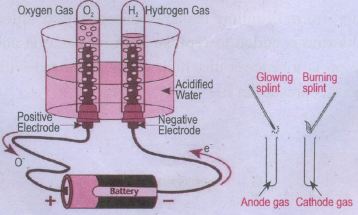
Experiment:
(i) A glass beaker is fixed with two carbon electrodes and it is filled with water upto one third of its volume.
(ii) The positive carbon electrode acts as anode and the negative carbon electrode acts as cathode.
(iii) Two test tubes are placed on the electrodes.
(iv) The electrodes are connected to a battery and current is passed until the test tubes are filled with a particular gas.
(v) If the gas collected is tested using a burning splint we can notice that the gas in cathode side burns with a popping sound when the burning splint, is brought near the mouth of the test tube.
(vi) This property is shown by hydrogen gas and it is confirmed that the gas inside the test tube is hydrogen.
(vii) The burning splint placed near the anode side burns more brightly confirming that it is oxygen.
(viii) This experiment shows that water is made up of hydrogen and oxygen.
(ix) The ratio of hydrogen and oxygen is 2: 1
(x) For every two volumes of hydrogen collected at the cathode, there is one volume of oxygen collected at the anode.
\(2{ H }_{ 2 }O\underrightarrow { Electrolysis } 2{ H }_{ 2 }+{ O }_{ 2 }\)
6.
1. Apollo Missions are the most popular missions of NASA.
2. These missions made American Astronauts to land on the Moon
3. It consists of totally 17 missions. Among them Apollo -8 and Apollo-11 are more remarkable.
4. Apollo-8 was the first manned mission to go to the Moon. It orbited around the Moon and came back to the Earth.
5. Apollo-11 was the first "Man Landing Mission to the moon. It landed on the Moon on 20 July 1969.
6. Neil Armstrong was the first man to walk on the surface of the Moon
7.
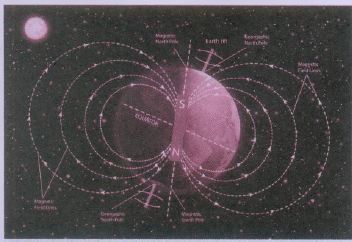
1. Earth has been assumed as a huge magnetic dipole.
2. The south pole of the imaginary magnet inside the Earth is located near the geographic north pole.
3. The north pole of the imaginary magnet inside the Earth is located near the geographic south pole.
4. The line joining these magnetic poles is called the magnetic axis,
5. The magnetic axis intersects the geographic north pole at a point called the north geomagnetic pole or northern magnetic pole.
6. It intersects the geographic south pole at a point called the south geomagnetic pole or southern magnetic pole.
7. The magnetic axis and the geographical axis (axis of rotation) do not coincide with each other.
8. The magnetic axis of the Earth is inclined at an angle of about 10° to 15" with the geographical axis.
9. The exact cause of the Earth's magnetism is not known even today.
10. The cause of the Earth's magnetism, are
a) Masses of magnetic substances in the Earth
b) Radiations from the Sun
c) Action of the Moon
11. It is believed that the Earth's magnetic field is due to the molten charged metallic fluid inside the Earth's surface with a core of radius of about 3500 km compared to the Earth's radius of 6400 km.
8.
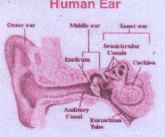
► The outer and visible part of the human car is called pinna (curved in shape).
► It is specially designed to gather sound from the environment.
► Then sound reaches the ear drum (tympanic membrane) through the ear canal.
► When the sound wave strikes the drum, the ossicles move inward and outward to create the vibrations.
► These vibrations are then picked up by special types of cells in the inner ear.
► From the inner ear the vibrations are sent to the brain in the form of signals.
► The brain perceives these signals as sounds.
9.
To keep the body healthy, every adolescent needs to have a healthy diet, exercise and hygiene.
Healthy diet:
Adolescence is a stage of rapid growth and development. Hence a diet with proper calories and other nutrients is needed for proper growth and physical activity. A balanced diet is required which includes proteins, carbohydrates, fats and vitamins in requisite proportions. Apart from this, the body needs calcium, phosphorus, iodine and iron because there is an increase in skeletal mass and blood volume during adolescence.
Physical exercise:
Walking, playing outdoor games and doing exercise keep the body fit and healthy. It leads to mental peace.
Hygiene:
i) Have a bathrobe or twice a day, paying special attention to underarms, groins and genitals.
ii) Change the underwear daily. It should be made of cotton and washed and cleaned everyday.
iii) For adolescents, the increased activity of sweat glands sometimes enhances body odor. If cleanliness is not maintained there are chances of having fungal, bacterial and other infections.
10.
Streamlined body
(i) A streamlined body is the shape of the body that reduces resistance when moving
(ii) Streamlined bodies often have a teardrop shape.
(iii) Streamline shape reduces the friction of movement to a minimum thus decreasing overall drag
(iv) Streamlined body of birds help the particles of air to move upload them quickly and come together smoothly on the other side. The air does not provide much resistance to the body so that they can fly easily in air spending less energy.
(v) Streanilined body of fishes help them to move smoothly with the flow of water. Its body shape reduces friction while moving in water. It helps in the orientation of the fish movements in a particular direction.
11.
J.J. Thomson found that cathode rays were attracted by the positively charged plate and repelled by the negatively charged plate. This led him to the conclusion that the cathode rays (electrons) were made of negatively charged particles.
12.
Spacesuits contain oxygen cylinders and the astronauts carryout artificial respiration to breathe when they go beyond earth's atmosphere. In long term stay in space, Electrolysis of water helps them to generate oxygen.
13.
Inspiration (Inhalation)
► The process of taking air into the lungs is called inspiration,
► During inspiration, the sternum is pushed up and outward and the diaphragm is pulled down
► This increases the volume of the thoracic cavity the pressure decreases.
► The air outside the body flows into the lungs.
► Here the exchange of gases takes place between the air and blood.
Expiration (Exhalation)
► The process of expelling air from the lungs is called expiration or exhalation.
► Upon exhalation, the lungs recoil to force the air out of the lungs
► The intercostal muscles relax, returning the chest wall to its original position.
► During exhalation, the diaphragm also relaxes, moving higher into the thoracic cavity.
► This increases the pressure within the thoracic cavity relative to the environment.
► Air rushes out of the lungs due to the pressure gradient.
► This movement of air out of the lungs is a passive event.
Exchange of gases in the Alveoli:
► The content of oxygen in the inhaled air in alveoli is more than the blood flowing through the capillaries
► So, the oxygen moves into the blood by simple diffusion.
► Haemoglobin in the blood combines with oxygen to form oxyhaemoglobin.
► The blood carrying oxygen reaches the heart through blood vessels.
► The heart pumps it to all the tissue in the body.
► The tissue releases carbon-dioxide which is carried back to alveoli by the blood.
► Carbon dioxide diffuses from the blood to the air in the alveoli and it sent out of the body when the air is exhaled.
14.
i) Woods of many conifers are used in the paper industries Eg: pinus, Agathis.
ii) Conifers are the sources of softwood for construction, packing and plywood industry Eg: Cedrus, Agathis.
iii) Turpentine is an essential oil used for paint preparation extracted from the resin of pinus
iv) It is also used medicinally for relief from pain and bronchitis etc.
v) Seeds of Pinus gerardiana are edible.
vi) Ephedrine is an alkaloid extracted from Ephedra. It cures asthma and respiratory problem.
vii) Araicaroa bidwillii is an ornamental plant.
15.
1. Eat a diverse range of foods.
2. Eat lots of vegetables, legumes, beans and fruit,
3. Eat fermented foods.
4. Don't eat too many artificial sweeteners.
5. Eat prebiotic foods.
6. Breast feed for atleast six months.
7. Eat whole grains.
8. Eat a plant-based diet.
9. Eat foods rich in polyphenols.
10. Take a probiotic supplement.

8th Standard Syllabus & Materials
8th Standard
TN 8th Tamil இயல் 3 - கல்வி கரையில - பாடறிந்து ஒழுகுதல் Important Questions And Answers Study Material - QB365 Set A
NEW8th Standard
TN 8th Tamil இயல் 3-கல்வி கரையில - பல்துறைக் கல்வி Important Questions And Answers Study Material - QB365 Set A
NEW8th Standard
TN 8th Tamil இயல் 3-கல்வி கரையில - புத்தியைத் தீட்டு Important Questions And Answers Study Material - QB365 Set A
NEW8th Standard
TN 8th Tamil இயல் 2 - ஈடில்லா இயற்கை - தமிழர் மருத்துவம் ( நேர்காணல்) Important Questions And Answers Study Material - QB365 Set A



Tamilnadu Stateboard 8th Standard Subjects
Tamilnadu Stateboard Standards




