
 100% FREE ACCESS
8th Standard Syllabus & Materials
8th Standard
TN 8th Tamil இயல் 3 - கல்வி கரையில - வினைமுற்று Important Questions And Answers Study Material - QB365 Set A
NEW8th Standard
TN 8th Tamil இயல் 2 - ஈடில்லா இயற்கை - மயங்கொலிகள் Important Questions And Answers Study Material - QB365 Set A
NEW8th Standard
TN 8th Tamil இயல் 2 - ஈடில்லா இயற்கை -பட்டமரம் Important Questions And Answers Study Material - QB365 Set A
NEW8th Standard
TN 8th Tamil இயல் 2 - ஈடில்லா இயற்கை - இயற்கையை போற்றுவோம் Important Questions And Answers Study Material - QB365 Set A
NEW8th Standard
TN 8th Tamil இயல் 1 - தமிழ் இன்பம் - ஆழிக்கு இணை Important Questions And Answers Study Material - QB365 Set A
NEW8th Standard
TN 8th Tamil இயல் 2-ஈடில்லா இயற்கை - திருக்குறள் Important Questions And Answers Study Material - QB365 Set A

Published on: 16/06/2021
QB365 provides detailed and simple solution for every book back questions in class 8 Social Science subject.It will helps to get more idea about question pattern in every book back questions with solution.
Download Tamil Nadu 8th Standard Social Science question papers, model tests, one-mark questions, important questions, and public exam papers in PDF format. Free study materials and answer keys for TN State Board students.
Questions + Answers key
Take MCQ Social Science Test
1.
Write a paragraph about the conventional signs and symbols.
2.
Explain the different types of scales in detail.
3.
Describe the flora and fauna of Antarctica
4.
Classify the industries through a flow chart.
5.
Classify and explain the industries based on the source of raw materials.
6.
Explain the contribution of Social Reformers for the eradication of social evils.
7.
India became an agricultural colony of Britain. How?
8.
Describe colonial urban development.
9.
What is the requirement for a two wheeler rider during night?
10.
Give a detailed explanation on the causes of landslides.
11.
Write an essay on air pollution.
12.
Explain in detail about the various causes of migration?
13.
How do handicraft products differ from machine made products?
14.
What are the effects of black money on economy?
15.
Explain the types of bank Deposits.
16.
Write about the evolution of Money?
17.
On what grounds that the citizenship of a person is cancelled?
18.
Give a detailed explanation on different forms of precipitation.
19.
Explain the different stages involved in the hydrological cycle.
20.
Write about the wind and its types.
21.
Classify and explain the soil?
22.
Classify and explain the rocks.
23.
Prove that there was no common purpose among the leaders of the Great revolt of 1857.
24.
What are the factors for the success of the british? Factors for the sccess of the british.
25.
Will the Government intervene if some religious group says that their religion allows them to practice human sacrifice?
1.
i) Conventional signs are symbols used in maps to represent different features.
ii) The symbols are explained in the key of the map.
iii) These symbols give a lot of information in a limited space.
iv) With the use of these symbols, maps can be drawn easily and the concept of the map can be understood well.
v) There is an International agreement regarding the use of certain symbols.
vi) The symbols fall under this category are called Conventional Symbols.
vii) Other category is called contextual symbols which are decided by the cartographers.
2.
Scales on maps can be represented in three different ways. They are,
i) Statement or verbal scale
ii) Representative Fraction (RF) or Ratio Scale
iii) Graphical or Bar Scale
i) Statement or Verbal Scale
In this method, the map scale is stated in words.ie, I cm to 1 km. It means 1 cm distance on the map corresponds tol km distance on the ground. Thus it is written on the map like 1 cm to 1km, 1 inch to 1 mile etc.
Simple statement scale has the following characteristics.
i) If the numerator is in centimeter, the denominator is either in meters or kilometers.
ii) If the numerator is in inch, the denominator is in miles.
ii) Representative Fraction (RF) or Numerical Fraction or Ratio Scale
i) It shows the relationship between the map distance and the corresponding ground distance in the same units of length. R.F. is generally shown as a fraction.
ii) For example, a fraction of 1:50,000 shows that one unit of length on the map represents 50,000 of the same units on the ground i.e., 1 cm or 1 inch on the map represents 50,000cm or 50,000 inches respectively on the ground.
iii) RF is represented as 1/50,000 or 1:50,000
iii) Graphical or Bar Sclae or Linear Scale.
i) A graphic scale looks like a small ruler drawn at the bottom of the page.
ii) This line is divided and sub divided into lengths each of which represents a certain distance on the ground
iii) In this way distances on the ground can directly be measured and read off from the map by using a piece of string or dividers
iv) This scale has added advantage for taking copies or maps as the measurement does not change.
3.
Flora :
i) Since the temperature is below freezing point almost throughout the year, no major vegetation is found in this continent.
ii) Simple plants like algae, mosses, liverworts, lichens and microscopic fungi can survive and grow in Antarctica.
iii) Some algae live in the snow, while other plants grow on the coastal rocky land that is ice free.
iv) A few species of plants, such as plankton, algae and mosses are seen in and around Antarctica's fresh and saltwater lakes.
Fauna:
(i) Small red fish called krill are found in large shoals .It is the food for many warm blooded sea animals.
(ii) The living creatures of this region include whales, seals, walrus and sea birds like penguins, albatross, polar Skua and Stout.
(iii) The blue whale is the largest animal which feeds on plankton. All these animals and birds have a thick layer of fat called blubber which helps them to withstand the cold condition. Penguin birds in Antarctica cannot fly. They have webbed feet and flipper instead of wings. Small invertebrates are the only land animals which live in the continent.
4.
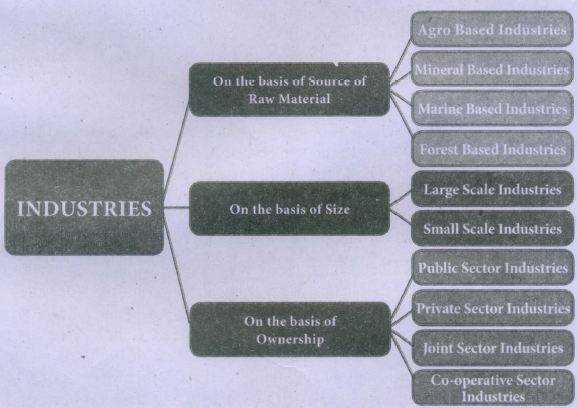
5.
Industries are classified on various basis in the following ways.
1. Agro-based industries
These industries use plant and animal based products as their raw materials.
eg. Food Processing, Vegetable Oil, Cotton Textile, Dairy Products, etc.
2. Mineral Based Industries:
These are the industries that use mineral ores as their raw materials. Iron made from iron ore is the product of mineral based industry. Cement, Machine Tools, etc. are the other examples of mineral based industries.
3. Marine Based Industries:
These industries use products from the sea and oceans as raw materials.
eg. Processed Sea Food, Fish Oil manufacturing units etc.
4. Forest Based Industries:
These industries use forest products as their raw materials.
e.g Pulp & Paper, Furniture and some Pharmaceuticals industries, etc.
6.
Raja Rammohan Roy :
1. Raja Rammohan Roy, the pioneer of Indian Social reform movement was a casteless crusader of Sati after having seen this practice in the case of his own sister-in-law.
2. He started his camping against this in human evil practice.
3. Influenced by the ruthless attack of the movement led by Rammohan Roy, the British Government declared this act as “Culpable Homicide”.
4. Raja Rammohan Roy is most remembered for helping Lord William Bentinck to declare the practice of Sati a punishable offence in 1829.
5. He also protested against the child marriage and female infanticide.
6. He favoured the remarriage of widows, female education and women's right to property.
Ishwar Chandra Vidhyasagar:
1. Ishwar Chandra Vidhyasagar carried on the movement for female education, widow remarriage and abolition of polygamy in Bengal
2. He submitted petitions to this effect to the Indian Legislative Council and to the passing of the Hindu Widow Remarriage Act in 1856.
3. His son Narayanachandra set an example to others by marrying a widow of his choice.
4. To promote female education, Vidliyasagar founded several girls schools in the districts in Bengal
Kandukuri Veeresalingam :
1. Kandukuri Veeresalingam Pantulu was the earliest champion in South India of women's emartipation
2. He published a journal Viveka Vardhani.
3. He opened his first girls school in 1874 and made widow remarriage and female education the key points of his programme for social reform
M.G. Ranade and B.M.Malabari:
1. In Bombay Presidency, M.G. Ranade and B.M. Malabari carried on the movement for the upliftment of women
2. In 1869, Ranade joined the Widow Remarriage Association and encouraged widow remarriage and female education and opposed child marriage.
3. In 1887, he started the National Social Conference, which became a pre-eminent institution for social reform.
4. In 1884. B.M. Malahari a journalist, started a movement for the abolition of child marriage
5. He published pamphlets on this subject and appealed to the Government to take action,
Gopal Krishna Gokhale:
1. In 1905, Gopal Krishna Gokhale started the servant of India Society which took up such social reform measures as primary education, female education and depressed dasses upliftment.
2. The spread of female education led to several other social reforms of great consequences, such as the abolition of purdah, which further led to the participation of women in the freedom struggle
Periyar E.V.R.
1. Periyar E.V.R. was one of the greatest social reformers of Tamil Nadu
2. He advocated women education, widow remarriage and inter-caste marriages and opposed child marriages.
Women Reformers:
1. Women reformers like Pandita Ramabai, Rukhmabai and Tarabai Shinde tried to extent further.
2. In 1889, Pandita Ramabai opened Sarada Sadan (Home of Learning) for Hindo Widows in Bombay.
3. Theosophical Society was established at Chennai by Dr. Annie Besant.
4. Dr. S. Dharmambal showed great interest in implementing widow remarriage and women education.
5. Among Moovalur Ramamırdham Ammalyar raised her voice against Devadasi System along with Dr. Muthulakshmi Ammaiyar
7.
1. In the beginning of Eighteenth Century, the policies of the British proved harmful to the process of urbanization.
2. Later, the economic policies followed by the British led to the rapid transformation of India's economy into a colonial economy and development of cities.
3. With the help of one-way free trade predominance of British Indian manufacturing industries were destroyed.
4. The effect of this wholesale destruction of the Indian manufacturing industries, led to the ruin of the millions of artisans and craftsman.
5. There was a sudden collapse of the urban handicrafts industry which had for centuries made India's name in the markets of the entire civilised world.
6. Towns and cities long famed for their specialized products gazed continually shrinking market.
7. As a result, old populous manufacturing towns such as Dacca, Murshidabad, Surat and Lucknow lost their previous importance.
8. The entire industrial structure crashed down under stiff competition of imported goods.
9. The traditional industrial base of Indian cities, made by the indigenous handicraft production was destroyed by industrial revolution.
10. The high import duties and other restrictions imposed on the import of Indian goods into Britain and Europe led to the decline of Indian industries.
11. Thus, India became the agricultural colony of Britain.
8.
Port Cities:
1. The British arrived in India for trading
2. Madras, Calcutta and Bombay became the important ports.
3. They played important role in trade.
4. These cities became the prominent commercial areas with all European - styled buildings
5. The English East India Company built its factories and fortified them for the protection for their settlement
Cantonment Towns:
1. The British occupied the Indian territory and political power by their military force.
2. So, they needed strong military camps and established the Cantonments.
3. The Cantonments were thus an entirely new kind of urban centres.
4. Army people began to live in these places and gradually they were grown up a city
Hill Stations
1. British were often visited India for specific purpose
2. The British coming from a cool temperate climate, found the Indian summer season inhospitable
3. So the cool climate of Indian hills was seen as protective and advantage
4. It protected the Europeans from bot weather and epidemics. So they built up the alternative capitals in cool areas, like Darjeeling was the alternative of Calcutta, Daradun was the alternative of Delhi.
5. Hill Stations became strategic places for billeting troops, guarding frontiers and launching compaigns.
6. The introduction of railways made hill station more accessible.
Railway Towns:
1. Railway towns were also a type of urban settlements and were established in 1853 after the introduction of railways by the British
2. By the nature of railway transport, all the towns were located on the plains.
9.
i) There should be a good quality headlight in the vehicle
ii) Driver should use helmet of good quality and ISI certified.
iii) Over speeding should be avoided.
iv) Long drive in the lonely roads should be avoided.
10.
i) Landslide is a rapid downward movement of rock, soil and vegetation down the slope under the influence of gravity.
ii) Landslides are generally sudden and infrequent
iii) Presence of steep slope and heavy rainfall are the major causes of landslides.
Other causes of landslides:
i) Weak ground structure
ii) Deforestation
iii) Earthquakes
iv) Volcanic eruptions
v) Mining
vi) Construction of roads and railways over the mountains.
landslide prone
i) Landslides are very common along the steep slopes of the Himalayas the Western Ghats and along the river valleys.
ii) In Tamil Nadu Kodaikanal and Ooty and frequently affected by landslides.
11.
Air pollution is the contamination of the indoor or outdoor air by a range of gases and solids that modify its natural characteristics and percentage.
Air pollutants can be categorised into primary and secondary pollutants. A primary pollutant is an air pollutant emitted directly from a source.
Primary Pollutants:
i) Oxides of Sulphur
ii) Oxides of Nitrogen
iii) Oxides of Carbon
iv) Particulate Matter
v) Other primary pollutants
A secondary pollutant is not directly emitted as such, but forms when other pollutants react in the atmosphere.
Secondary Pollutants:
i) Ground Level Ozone
ii) Smog.
12.
Various causes of migration
a) Ecological or Natural causes of Migration
b) Economic causes of Migration
c) Socio-cultural Causes of Migration
d) Demographic Causes of Migration
e) Political causes of Migration
a) Ecological or Natural causes of Migration
The causes operate under this category ate natural ones. They include volcanic eruption, man-kind changed considerably. (ex.) earthquake, food, drought etc..
b) Economic causes of Migration
i) Economy is one of the most imported causes of human migration from one area to another
ii) The availability of fertile agricultural land employment opportunities, development of technology etc
c) Socio-cultural causes of Migration:
Migration of women after marriage and migration associated with pilgrimage are based on the socio-cultural customs.
d) Demographic causes of Migration
In demographic sense, the population composition like age and sex, over population and under population are the major causes of migration
e) Political causes of Migration
Various political causes like colonization, wars, government policies etc., have always been playing Important role in human migration from to time. Wars lave been one of the significant causes of migration since ancient time.
13.
1. Handicraft products are manmade items. It is commonly referred to as handmade crafts.
2. In this process, skilled people create different types of items from goods and convert them into decorative pieces out of paper clay, wood rock, stone and cheap tools.
3. These are prepared solely by hands and do not involve the use of any machinery.
4. Many rural people still earn their livelihood from their creative pieces of art.
5. But some products can be made quickly by machines in which there is no need for man's effort
6. The biggest advantage of machine made is that it is faster. Machine made goods are cheaper.
14.
Black money is any money on which it is not paid to the government. Black money is money earned through an illegal activity controlled by country regulations.
Effects of Black money on economy:
1. Dual economy.
2. Tax evasion, thereby loss of revenue to the government.
3. Undermining equity.
4. Widening the gap between the rich and poor.
5. Lavish consumption spending.
6. Distortion of production pattern.
7. Distribution of scarce resources.
8. Effects on production.
15.
i) Student Savings Account
ii) Savings Deposits.
iii) Current Account Deposit
iv) Fixed Deposits (Term Deposit)
Student Savings Account:
i) Some banks offer savings Accounts specially for young people from schools and colleges.
ii) The main feature is to maintain lower minimum balance (zero).
Savings Deposit:
i) Savings deposits are opened by the customers to save the part of their current income.
ii) The customers can withdraw their money from their account when they require it.
iii) The Bank also gives a small amount of interest to the money.
Current Account Deposit:
i) Current accounts are generally opened by business firms, traders, and public authorities.
ii) It helps in frequent banking transactions
Fixed Deposits:
i) Fixed Deposits accounts are meant for investors who want their principle to be safe and yield then fixed yields.
ii) The fixed deposits are also called as term deposits as, normally, they are fixed for specified period.
16.
i) The word money is derived from Roman word "Moneta Juno
ii) The Indian rupee is derived from the Sanskrit word - Rupya
iii) Today we use paper notes and coins as money.
iv) Many stages of evolution:
Commodity money
Metallic money
Paper money.
Plastic money
Electronic money.
Commodity money:
In the earliest period of human civilization, any commodity that was generally in demand and chosen by common consent was used as money.
eg: Furs, Skins, Salts, Rice, Wheat, Utensils, Weapons, etc.
Metalic money:
With the progress of human civilization, commodity money changed in to metallic money.
Metals like gold, silver, copper were used.
Paper money:
i) It was found inconvenient as well as dangerous to carry gold and silver coins from place to place.
ii) The invention of paper money marked a very important stage in the development of money.
Plastic money:
i) The latest type of plastic money is in the form of Credit cards and Debit cards.
ii) They aim for cashless transactions
E-Money:
Electronic money is a money which exists in banking computer system and is available through electric system.
17.
Renunciation : (a voluntary act)
when a person after acquiring the citizenship of another country gives up his/ her Indian citizenship.
Termination : (by operation of Law)
When an Indian citizen voluntarily acquires the citizenship of another country he/ she automatically ceases to be an Indian citizen.
Deprivation : (Compulsary Termination)
The citizenship is deprived on the basis of an order of the government of India in case involving acquisition of India citizenship by fraud, false representation or being disloyal to the constitution.
18.
Precipitation refers to all forms of water that fall from clouds and reaches the earth surface. Common types of precipitation included rain, sleet, freezing rain, hail and snow.
1. Rain:
(i) The most common kind of precipitation is rain.
(ii) The precipitation in the form of water droplets is called rain.
(iii) The precipitation in which the size of rain drops are < 0.5mm in diameter is know as drizzle and the rain drops with> 0.5mmin diameter is known as rain.
2. Sleet
The precipitation which takes place in the form of mixture of water droplets and tiny particles of ice (5mm in diameter) is known as sleet.
3. Freezing rain
(i) At other times raindrops falling through cold air near the ground do not freeze in the air.
(ii) Instead, the raindrops freeze when they touch a cold surface.
(iii) This is called freezing rain and the drops of water are usually greater than 0.5mm in diameter.
4. Hail
(i) The precipitation which consists of round pellets of ice which are larger than 5mm in diameter is called hail or hail
stones.
(ii) Hail forms only in cumulonimbus clouds. during thunderstorms.
5. Snow
(i) Often water vapour in a cloud is converted directly into snow pieces due to lowering of temperature.
(ii) It appears like a powdery mass of ice.
(iii) The precipitation in the form of powdery mass of ice is known as snowfall.
(iv) It is common in the polar and high mountainous regions.
19.
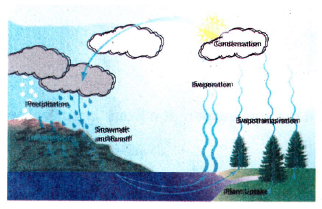
1) Evaporation :
i) Evaporation refers to the process in which the liquid form of water changes into gaseous form.
ii) Water begins to evaporate at OoC (32oF) and the process takes place very slowly.
iii) Temperature is the prime element which affects the rate of evaporation.
2) Condensation:
i) It refers to the process in which the gaseous form of water changes into liquid form.
ii) condensation generally occurs in the atmosphere when warm air rises, cools and loses its capacity to hold water vapour
3) Precipitation:
i) Precipitation refers to all forms of water that fall from clouds and reaches the earth's surface.
ii) Common types of precipitation includes rain, sleet, freezing rain, hail and snow.
iii) The most common kind of precipitation is rain.
iv) The precipitation in the form of water droplets is called rain
4) Infiltration:
i) Water entering the soil at the surface of the ground is termed as infiltration.
ii) Infiltration allows the soil temporarily to store water, making it available for plants use and organisms in the soil.
iii) Infiltration is an important process where rain water soaks into the ground, through the soil and underlying rock layers
5) Percolation:
i) Percolation is the downward movement of infiltrated,water through soil and rock layers.
ii) The percolation process represents the flow of water from unsaturated zone to the saturate d zone.
6) Runoff :
i) Runoff is the water that is pulled by gravity across land surface.
ii) It replenishes ground water and suqf3ce water as it percolates into an aquifer or moves into a river, stream or watershed.
20.
The horizontal movement of air is called wind.
The winds move from high pressure to low pressure.
Winds get their name from the direction from which they blow i.e, wind blows from south west is called southwest monsoon.
The wind systems are broadly categorized into three as follows.
i) Planetary winds
ii) Seasonal winds
iii) Local winds
Planetary winds:
These Winds are the ones which blow almost in the same direction throughout the year. So, they are called as Permanent or planetary winds.
Eg: Trade winds, Westerlies and polar easterlies.
Seasonal winds:
Seasonal winds are those which change their direction according to season in a year.
They are called as monsoon winds.
These winds blow from sea to land during summer and land to sea during winter.
Local winds:
These winds are the winds blow over a small area only during a particular time of a day or a short period of a year.
Eg: Land breeze and sea breeze.
21.
Classification of soils:
Soils are classified on the basis of their formation; colour, physical and chemical properties. Soil is classified into six types.
1. Alluvial soil:
(i) These soils are found in the regions of river valleys, food plains and coastal regions.
(ii) It is the most productive of all the soils. Suitable for cultivation of sugarcane, jute, rice, wheat and other food crops.
2. Black soils:
Formed by withering of igneous rocks: Black soil is clay in nature. it is retentive of moisture. It is ideal for growing cotton .
3. Red soils:
(i) Formed by weathering of metamorphic and crystalline rocks.
(ii) The presence of iron oxide makes this soil brown to red in colour.
(iii) Found in semi-arid regions. It is. not a fertile soil. It is suitable for millet cultivation.
4. Mountain soils:
(i) Found over the slopes of mountains.
(ii) Soils in these regions are thin and acidic.
(iii) However characteristic of soil differs from region to region based on the altitude.
5. Desert soils:
These are sandy soil found in the hot desert regions.
(i) These soils are porous and saline.
(ii) Since it is infertile, agriculture in these soils is not so successful.
22.
According to the mode of formation the rocks are classified into three as follows
1. Igneous Rocks
2. Sedimentary Rocks
3. Metamorphic Rocks
Igneous Rocks:
1. The igneous rocks are formed by the solidification of molten magma.
2. These rocks are also called as the 'Primary Rocks' or 'Parent Rocks' as all other rocks are formed from these rocks.
3. Igneous rocks are of two types. They are
Extrusive Igneous Rocks.
Intrusive Igneous Rocks.
Sedimentary Rocks:
1. The sedimentary rocks are formed by the sediments derived and deposited by various agents.
2.Due to high temperature and pressure, the undistrubed sediments of long period cements to form sedimentary rocks.
3. These rocks consist of many layers which were formed by the sediments deposited at different periods. As it consists of many strata, it is also known as 'stratified rocks.
4. The three types of sedimentary rocks are
i) Organic Sedimentary Rocks
ii) Mechanical Sedimentary Rocks
iii) Chemical Sedimentary rocks
Metamorphic Rocks:
When Igneous and sedimentary rocks are subjected to high temperature and pressure, the original rocks get altered to form a new kind of rock called metamorphic rocks.
Metamorphism is of two types
1. Thermal Metamorphism
2. Dynamic Metamorphism
23.
Leaders :
1. No common plan of action
2. No centralised leadership
3. The weapons were not modern and well equipped.
4. Lack of organisation
5. Leaders were not so match to British generals.
Mangal Pande
He was a Loyal young sepoy in the British troop. He shot his sergent for not respecting his country's culture and his loyalty.
Central India
In Central India, the revolt was guided by Rani Lakshmi Bai of Jhansi.
Rani Lakshmi Bai
1. fought bravely and killed in the battle because of the policy of Doctrine of Lapse of Lord Dalhousie.
2. The leaders of the revolt had no planning and performance.
3. Muslims wanted to re-establish muslim rule.
4. Hindus wanted to establish the influence of Maratha.
5. Every leaders was involved in the revolt for their selfish interest. The British sergent was not respecting the country's culture and his loyalty.
Bahadur Shah - II:
The sepoys declared Bahadur Shah II as a leader for the revolt. But his commander Bahadurkhan led the revolt.
Kampun
The son of last Peshwa Bajirao Nana Sahib became the leader in Kanpur revolt. He drove away the English and declared himself the peshwa.
Lucknow:
The wife of the Nawab of the Awadh. Begam Hasrath Mahal revolted against the English - But she was compelled to hide in Nepal.
24.
1. The French were the most serious rivals to the English in India.
2. The English were successful in establishing their supremacy in India
3. The following were the causes for the success of the English in India.
4. The English had good financial position.
5. The Government in England rendered adequate support to the English East India Company.
6. The English had good trade facilities.
7. The English had a strong and superior naval power.
8. There was good understanding between the English Generals.
9. Development of textile was another cause.
10. There was scientific division of labour.
11. Economic prosperity and skilful diplomacy of the British.
12. The Indian merchants felt insecure.
13. The inequality and ignorance of the Indian kings.
25.
The government will definitely intervene if some religious group says that their religion allows them to practice in infanticide, Ample reason can be given in support of the answer. No religion teaches us to kill any living being, kindness is the root of all religions. Even the law of our country also declares that killing a human being is illegal. It is also against human rights.

8th Standard Syllabus & Materials
8th Standard
TN 8th Tamil இயல் 3 - கல்வி கரையில - பாடறிந்து ஒழுகுதல் Important Questions And Answers Study Material - QB365 Set A
NEW8th Standard
TN 8th Tamil இயல் 3-கல்வி கரையில - பல்துறைக் கல்வி Important Questions And Answers Study Material - QB365 Set A
NEW8th Standard
TN 8th Tamil இயல் 3-கல்வி கரையில - புத்தியைத் தீட்டு Important Questions And Answers Study Material - QB365 Set A
NEW8th Standard
TN 8th Tamil இயல் 2 - ஈடில்லா இயற்கை - தமிழர் மருத்துவம் ( நேர்காணல்) Important Questions And Answers Study Material - QB365 Set A



Tamilnadu Stateboard 8th Standard Subjects
Tamilnadu Stateboard Standards



