
 100% FREE ACCESS
8th Standard CBSE Syllabus & Materials
8th Standard CBSE
CBSE 8th Social Science Theme D - Factors of Production - New Model Questions Papers Study Material - QB365 Set A
NEW8th Standard CBSE
CBSE 8th Social Science Theme C - Universal Franchise and India's Electoral System - New Model Questions Papers Study Material - QB365 Set A
NEW8th Standard CBSE
CBSE 8th Social Science Theme B - The Rise of the Marathas - New Model Questions Papers Study Material - QB365 Set A
NEW8th Standard CBSE
CBSE 8th Social Science Theme B - Reshaping India's Political Map - New Model Questions Papers Study Material - QB365 Set A
NEW8th Standard CBSE
CBSE 8th Social Science Theme A - Natural Resources and Their Use - New Model Questions Papers Study Material - QB365 Set A
NEW8th Standard CBSE
CBSE 8th Science Keeping Time with Skies - New Model Questions Papers Study Material - QB365 Set A

Published on: 05/03/2020
8th Standard Mathematics Board Exam Model Question 2019-2020
Download CBSE Class 8th Standard CBSE Mathematics question papers, sample papers, important questions, and previous year solved papers in PDF format. Get free study materials, NCERT solutions, and exam preparation resources for Class 8th Standard CBSE Mathematics
Questions + Answers key
Take MCQ Mathematics Test
1.
Is \((-4) \times [(-8) \times (-5)] = [(-4) \times (-8)] \times (-5)?\)
2.
Simplify and write the answer in the exponential form: (-4)-3 \(\times\) (-5)-3 \(\times\) (5)3
3.
A courier-person cycles from a town to a neighbouring Suburban area to deliver a parcel to a merchant. His distance from the town at different times is shown by the following graph:
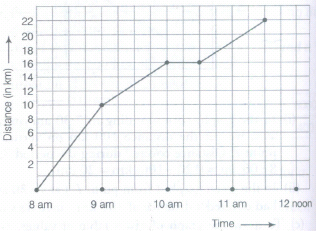
How far is the place of the merchant from the town?
4.
Factorise 19m2n3 - 57 mn2
5.
Find the proportion between side of a square and its perimeter.
6.
If the division N \(\div\) 2 leaves no remainder (i.e. zero remainder), what might be the one's digit of N?
7.
Find the cube of 17.
8.
Which of the following are not perfect squares? 33333
9.
Four horses are tethered with equal ropes at 4 corners of a square field of side 70 m, so that they just can reach one another.Find the area left ungrazed by the horses.
10.
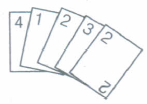
Rohan and Shalu are playing with 5 cards as shown in the figure. What is the probability of Rohanpicking a card without seeing, that has the number 2 on it?
11.
Using (x + a) (x + b) = x2 + (a + b)x + ab; find 5.1 x 5.2
12.
Given, P = Rs 40000 and R = 8% per annum compounded annually. Find the amount, if period is 2 yr.
13.
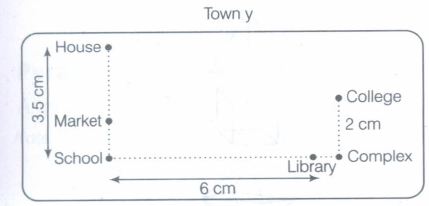
Use a ruler to measure the distance in cm between the places joined by dotted lines. If the map has been drawn using the scale 1 cm 10 km, find the actual distances between House and School.
14.
Two regular polygons are such that the ratio between their number of sides is 1 : 3 and the ratio of measure of their interior angles is 4:7. Find the number of sides of each polygon.
15.
Solve the following equations \(\frac { 2x }{ 3 } =18\)
16.
Solve the following linear equations:
m-\(\frac{m-1}{2}\)=1-\(\frac{m-2}{2}\)
17.
What is the smallest number by which 648 must be multiplied so that the product is a perfect cube?
18.
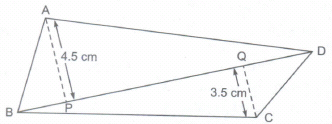
Find the length of the diagonal BD when, the area of the quadrilateral is 32 cm2.
19.
Express the following numbers in standard form 5463
20.
A man was engaged as typist for the month of February in 2009. He was paid Rs. 500 per day, but Rs.100 per day were deducted for the days he remained absent. He received Rs. 9200 as salary for the month. For how many days did he work?
21.
if mean of some observations is (4x 2-9) and their sum is 16x4 -81. Then , find the number of observations
22.
Find the values of the letters in each of the following and give reasons for the steps involved.\(\begin{matrix} \quad \quad A\ B \\ \quad \times \ \ \quad 3 \\ \_ \_ \_ \_ \_ \_ \_\_ \\ C\ A\ B \\ \_ \_ \_ \_ \_ \_ \_ \_ \end{matrix}\)
23.
Use the distributivity of multiplication of rational numbers over addition to simplify:
\({-5\over4}\times[{8\over5}+{16\over15}]\)
24.
Observe the following tables and find, if x and y are directly proportional
| x | 20 | 17 | 14 | 11 | 8 | 5 | 2 |
| y | 40 | 34 | 28 | 22 | 16 | 10 | 4 |
25.
By using suitable identity, evaluate \({ x }^{ 2 }+\frac { 1 }{ { x }^{ 2 } } ,if\ x+\frac { 1 }{ x } =5\quad \)
26.
A polyhedron has 20 faces and 12 vertices. Find the edges of the polyhedron.
27.
Find the value of \(\frac { \sqrt { 25.4016 } -\sqrt { 1.0609 } }{ \sqrt { 25.4016 } +\sqrt { 1.0609 } } \)
28.
The ratio between exterior angle and interior angle of a regular polygon is 1 : 3. Find the number of sides of the polygon. Also, find each of the interior and exterior angles.
29.
A milkman sold two of his buffaloes for Rs 20000 each. On one, he made a gain of 5% and on the other, a loss of 10%. Find his overall gain or loss. [Hint Find CP of each]
30.
Construct the following quadrilaterals. Quadrilateral PLAN PL = 4 cm, LA = 6.5 cm, \(\angle \)P = 90°, \(\angle \)A = 110°, \(\angle \)N = 85°
31.
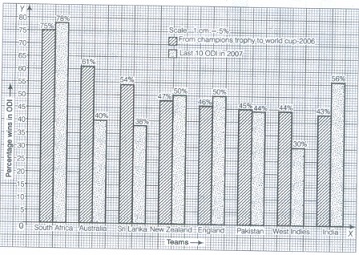
Percentage wins in ODI by 8 top cricket teams.
| Teams | From champions trophy to world cup 2006 |
Last 10 001 in 2007 |
| South Africa | 75% |
78% |
| Australia | 61% | 40% |
| Sri Lanka | 54% | 38% |
| New Zealand | 47% | 50% |
| England | 46% | 50% |
| Pakistan | 45% | 44% |
| West Indies | 44% | 30% |
| India | 43% | 56% |
32.
Find the cube of \({4\over5}\) .
33.
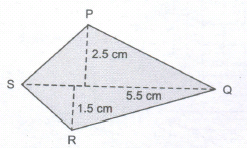
Find the area of quadrilateral PQRS shown in the figure:
34.
Find the values of x and y, if a and b are in inverse proportion.
| a | 12 | x | 8 |
| b | 30 | 5 | y |
35.
Find the common factors of the given terms 14pq = 28 p2q2
36.
The following data represent the expenditure on various items(named as A, B, ... ) of a family in a month. Represent the data in the form of a pie chart.
| Items | A | B | C | D | E |
| Amount (in Rs.) | 180 | 210 | 240 | 270 | 180 |
37.
If \(\frac{5^{m}\times5^{3}\times5{-2}}{5^{-5}}=5^{12}\)then find the value of m.
38.
The following pie chart shows that the performance is an examination in a particular year for 360 students. Study the pie chart and answer the question given here.
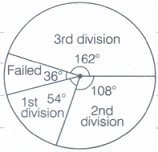
(a) Find the number of students who passed with 1st division.
(b) Find the number of students who passed with 2nd division with more than those with 1st division.
39.
Find the root of the equation \(\frac { \left( 2+y \right) \left( 7-y \right) }{ \left( 5-y \right) \left( 4+y \right) } =1\)
40.
What figure is formed, if only the height of a cube is increased or decreased?
41.
Find the least number by which we multiply to the 11760, so that we can get perfect number.
42.
Simplify (3x + 2y)2 + (3x- 2y)2.
43.
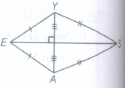
Construct the kite EASY, if AY = 8 cm, EY = 4 cm and SY = 6 cm in figure. Which properties of the kite did you use in the process?
44.
Find the buying price of the following, when 5% sale tax is added on the purchase of two bars of soap at Rs 35 each.
45.
Take identical cut-outs of congruent triangles of sides 3 cm, 4 cm and 5 cm. Arrange them as shown in the figure.
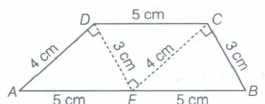
You get a trapezium. (Check it!) Which are the parallel sides here? Should the non-parallel sides be equal. You can get two more trapeziums using the same set of triangles. Find out them and discuss their shapes.
46.
The area of a trapezium is 40 cm2 . Its parallel sides are 12 cm and 8 cm. The distance between the parallel sides is
1 cm
2 cm
3 cm
4 cm
47.
Read the graph and answer the related question:
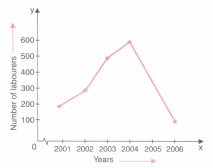
What was the difference of the number of labourers in the years 2002 and 2003?
100
200
300
400
48.
A perfect square number between 30 and 40 is
36
32
33
39
49.
The rent of 7 hectares is Rs.875. What is the rent of 16 hectares?
Rs.2000
Rs.15000
Rs.1600
Rs.1200
50.
In 102, the exponent is
1
2
10
1
51.
The factorisation of 6x2 - 5x - 6 is
(2x - 3)(3x + 2)
(2x + 3)(3x + 2)
(2x - 3)(3x - 2)
(2x + 3)(3x - 2)
52.
In a school out of 340 students, 55% students are of Science. The remaining students are of Commerce. Find the number of students of Commerce.
135
153
315
140
53.
The measure of each exterior angle of a regular polygon of 9 sides is
30°
40°
60°
45°
54.
Which of the following statements is true?
Natural numbers are associative for division
Whole numbers are associative for division
Integers are associative for division
Rational numbers are not associative for division
55.
Study the following frequency distribution table and answer the question given below:
| Daily wages (in Rs) | Number of workers |
| 290-325 | 5 |
| 325-360 | 2 |
| 360-395 | 4 |
| 395-430 | 6 |
| 430-465 | 7 |
| 465-500 | 5 |
The class with lowest frequency is
325-360
360-395
465-500
395-430
56.
The largest number of the three consecutive numbers is x + 1. Then, the smallest number is
x + 2
x + 1
x
x - 1.
57.
Find the smallest number by which the number 1296 must be divided to obtain a perfect cube.
6
2
4
3
58.
Which one of the following is a Pythagorian triplet?
(n2-1), 2n and (n2+ 1)
(n + 1)(n2-1) and (n2+ 1)
n, (n2-1) and (n2+ 1)
(n - 1), (n2- 1) and (n2 + 1)
59.
If x + y + z = 6 and z is an odd digit, then the 3-digit number xyz is
an odd multiple of 3
an odd multiple of 6
an even multiple of 3
an even multiple of 9
60.
Product of the monomials, -15p, -13q2, pq is
-165p2q3
195p2q3
195p3q2
-195p3q2
61.
We have 4 congruent equilateral triangles. What do we need more to make a pyramid?
An equilateral triangle
A square with same side length as of triangle
2 squares with side length same as triangle
2 equilateral triangles with side length same as triangle
62.
Is there a number which is equal to its cube but not equal to its squares? If yes find it.
63.
Take a clock and fix its minute hand at 12.
Record the angle turned through by the minute hand from its original position and the time that has passed, in the following table:
| Time Passed (T) (in minutes) |
(T1) 15 | (T2) 15 | (T3) 45 | (T4) 60 |
|---|---|---|---|---|
| Angle turned (A) (in degree) | (A1) 90 | (A2) __ | (A3) __ | (A4) __ |
| \(T\over A\) | - | - | - | - |
What do you observe about T and A? Do they increase together? Is \(T\over A\) same every time?
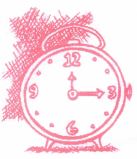
Is the angle turned through by the minute hand directly proportional to the time that has passed? Yes; From the above table, you can also see
T1 : T2 = A1 A2, because
T1 : T2 = 15 30= 1 :2
A1 : A2 = 90 180 = 1 :2
Check if T2: T3 = A2 A3 and T3 : T4 = A3 : A4
You can repeat this activity by choosing your own time interval.
64.
Present the following data in the form of a grouped frequency distribution table having 6 classes of equal size (one of the class being 40-48):
| 30 | 39 | 58 | 17 | 34 | 50 | 23 | 37 |
| 42 | 49 | 55 | 59 | 19 | 28 | 47 | 49 |
| 18 | 60 | 56 | 36 | 58 | 35 | 55 | 37 |
| 25 | 34 | 39 | 61 | 53 | 33 | 36 | 53 |
| 61 | 62 | 39 | 53 | 21 | 18 | 28 | 23 |
1.
Yes ; \((-4) \times [(-8) \times (-5)] = [(-4) \times (-8)] \times (-5) = 160 \)
2.
\((-4)^{-3} \times(5)^{-3} \times(-5)^{-3}=[(-4) \times 5 \times(-5)]^{-3}=[100]^{-3}=\frac{1}{100^{3}}\)
3.
22 km
4.
19mn2 (mn - 3)
5.
Let side of a square be a cm then its perimeter be 4a cm.
If we denote perimeter = P, then P = 4a
where, 4 is constant
∴ \(P\propto a\)
Hence, side of a square is directly proportional to its perimeter.
6.
Here, the remainder = 0. So, N is an even number, i.e. its one's digit is even. Therefore, the one's digit must be 0, 2, 4, 6 or 8.
7.
4913
8.
Not perfect square
9.
1050 m2
10.
\(\therefore\) Total number of outcomes = 5
\(\therefore\) Required probability = \(\frac{2}{5}\)
Hence, option (a) is correct.
11.
5.1 x 5.2= (5+ 0.1) (5+ 0.2)
= (5)2 + (0.1 + 0.2)(5) + (0.1) (0.2)
(x + a)(x + b) = x2 + (a + b)x + ab
= 25 + 1.5+ 0.02 = 26.52
12.
Rs 46656
13.
35 km
14.
Number of sides of first polygon = 4
Number of sides of second polyqon = 12
15.
We have \(\frac { 2x }{ 3 } =18\Rightarrow \frac { 2x }{ 3 } \times 3=18\times 3\)[multiplying both side by 3]
\(\Rightarrow\) 2x =18 x 3
\(\Rightarrow\) 2x = 54
\(\Rightarrow\) \(\frac { 2x }{ 2 } =\frac { 54 }{ 2 } \) [dividing both sides by 2]
\(\Rightarrow\) x = \(\frac { 54 }{ 2 } \), 27 which is the required solution
16.
m-\(\frac{m-1}{2}\)=1-\(\frac{m-2}{2}\)
We have m-\(\frac{m-1}{2}\)=1-\(\frac{m-2}{2}\)
It is a linear equation since it involves linear expressions only.
\(\Rightarrow\) m-\(\frac{m}{2}+\frac{1}{2}\)=1-\(\frac{m}{3}+\frac{1}{3}\)
\(\Rightarrow\) m-\(\frac{m}{2}+\frac{m}{3}\)=1+\(\frac{2}{3}+\frac{1}{2}\)
Transposing -\(\frac{m}{3}\)to LHS and \(\frac{1}{2}\)to RHS
\(\Rightarrow\) \(\frac { 6m-3m+2m }{ 6 } =\frac { 6+4-3 }{ 6 } \)
Taking LCM
\(\Rightarrow\) \(\frac { 5m }{ 6 } =\frac { 7 }{ 6 } \)
\(\Rightarrow\) m = \(\frac { 7 }{ 6 } \times \frac { 6 }{ 5 } =\frac { 7 }{ 5 } \)
Multiplying both sides by \(\frac{6}{5}\)
This is the required solution.
17.
64cm3
18.
Let the length of the diagonal BD be x cm
\(\because\) Area of a quadrilateral \(=\frac{1}{2}\times(diagonal)\times\) (Sum of the length of perpendiculars on the diagonal from the opposite vertices)
\(\therefore\) Area of the quadrilateral ABCD
\(=\frac{1}{2}\times BD\times(AP+CQ)\)
\(=\frac{1}{2}\times x\ cm\times(4.5\ cm+3.5\ cm)\)
\(=\frac{1}{2}\times x\times 8\ cm^2\)
Since area of the quadrilateral ABCD = 32 cm2
\(\therefore \frac{1}{2}x\times 8=32\Rightarrow x=\frac{32\times2}{8}\ cm=8\ cm\)
Thus, the required length of the diagonal BD = 8 cm.
19.
5.463x10³
20.
Suppose the man was absent on x days. Then,
he worked for (28 - x) days.
Thus, he will get the amount as per the given
condition for the February month
(28 - x) x 500 - x x 100 = 9200
\(\Rightarrow\) 28 x 500 - 500x -100x= 9200
\(\Rightarrow\) 600x = 9200 -14000 \(\Rightarrow\) -600 x = -4800
\(\Rightarrow\) x = -4800 x \(\left( -\frac { 1 }{ 600 } \right) =8\)
So, the man works for (28 - 8) i.e. 20 days
21.
Number of observations = 4x2+9
22.
\(\begin{matrix} \quad \quad A\ B \\ \quad \times \ \ \ \ \ 3 \\ \_ \_ \_ \_ \_ \_ \_\_ \\ \quad C\ A\ B \\ \_\_ \_ \_ \_ \_ \_ \_ \_ \end{matrix}\)
Here, we have three letters A, Band C whose values all to be found.
Since unit's digit of 3 x B is B. So, it must be B = 0 or B = 5
When B = 0, then
\(\begin{matrix} \quad \quad A\ 0 \\ \quad \times \quad 3 \\ \_ \_ \_ \_ \_ \_ \_ \\ C\ A\ 0 \\ \_ \_ \_ \_ \_ \_ \_ \_ \end{matrix}\)
and when B = 5, then
\(\begin{matrix} \quad \ A\ 5 \\ \quad \times \ 3 \\ \_ \_ \_ \_ \_ \_ \_ \_ \_ \\ C\quad A\quad 5 \\ \_ \_ \_ \_ \_ \_ \_ \_ \_ \_ \end{matrix}\)
Now, unit's digit of 3 x A is A. So, A must be 0 or 5 but A cannot be 0 because if A = 0, then AB becomes the one-digit number. So, A must be 5 and multiplication is either 50 x 3 or 55 x 3.
Here, the second possibility fails, since 55 x 3 = 165 but the first possibility is correct.
\(\therefore\) 50 x 3 = 150
Therefore, the puzzle is solved as shown below:
\(\begin{matrix} \quad \quad 5\quad 0 \\ \quad \times \quad 3 \\ \_ \_ \_ \_ \_ \_ \_ \_ \_ \\ 1\quad 5\quad 0 \\ \_ \_ \_ \_ \_ \_ \_ \_ \_ \_ \end{matrix}\)
Hence, A = 5, B = 0 and C = 1
23.
\(-3{1\over3}\)
24.
When x = 20,y= 40, then
\(\frac { x }{ y } =\frac { 20 }{ 40 } =\frac { 20\div 20 }{ 40\div 20 } \) [.: HCF of 20 and 40 = 20]
\(\Rightarrow \frac { x }{ y } =\frac { 1 }{ 2 } \)
When x = 17,y = 34, then
\(\frac { x }{ y } =\frac { 17 }{ 34 } =\frac { 17\div 17 }{ 34\div 17 } =\frac { 1 }{ 2 } \) [HCF of17 and 34 = 17]
When x = 14,y = 28, then
\(\frac { x }{ y } =\frac { 14 }{ 28 } =\frac { 14\div 14 }{ 28\div 14 } =\frac { 1 }{ 2 } \) [HCF of 14 and 28 = 14]
When x = 11,y = 22, then
\(\frac { x }{ y } =\frac { 11 }{ 22 } =\frac { 11\div 11 }{ 22\div 11 } =\frac { 1 }{ 2 } \) [HCF of 11 and 22=11]
When x = 8,y = 16,then
\(\frac { x }{ y } =\frac { 8 }{ 16 } =\frac { 8\div 8 }{ 16\div 8 } =\frac { 1 }{ 2 } \) [HCF of 8 and 16=8]
When x = 5,y = 10,then
\(\frac { x }{ y } =\frac { 5 }{ 10 } =\frac { 5\div 5 }{ 10\div 5 } =\frac { 1 }{ 2 } \) [HCFof 5and10=5]
When x = 2,y = 4, then
\(\frac { x }{ y } =\frac { 2 }{ 4 } =\frac { 2\div 2 }{ 4\div 2 } =\frac { 1 }{ 2 } \) [HCF of 2 and 4 = 2]
From above,we can say that the values of \(\frac { x }{ y } \) is same,in everycaseit is \(\frac { 1 }{ 2 } \) So, these values of x and y are directly proportional.
25.
Given,\(\ x+\frac { 1 }{ x } =5\)
\(\ \left( x+\frac { 1 }{ x } \right) ^{ 2 }=25\)
\(\left( x+\frac { 1 }{ x } \right) ^{ 2 }={ x }^{ 2 }+2\times x\times \frac { 1 }{ x } +\left( \frac { 1 }{ x } \right) ^{ 2 }\quad \)
(a+ b)2 =a2 + 2ab + b2. Here, a = x and \(b=\frac { 1 }{ x } \)
\(={ x }^{ 2 }+2+\left( \frac { 1 }{ { x }^{ 2 } } \right) ={ x }^{ 2 }+\left( \frac { 1 }{ { x }^{ 2 } } \right) +2\)
\(\left( x+\frac { 1 }{ x } \right) ^{ 2 }=25\)
\(\quad { x }^{ 2 }+\frac { 1 }{ { x }^{ 2 } } +2=25\)
\({ x }^{ 2 }+\frac { 1 }{ { x }^{ 2 } } =25-2=23\)
26.
30
27.
\(\frac { 401 }{ 607 } \)
28.
Let the regular polygon have n sides.
∴ Exterior angle =\(\frac { { 360 }^{ 0 } }{ n } \)
and interior angle = \({ 180 }^{ 0 }-\frac { { 360 }^{ 0 } }{ n } =\frac { 180^{ 0 }n-{ 360 }^{ 0 } }{ n } \)
According to the question,
\(\frac { { 360 }^{ 0 } }{ n } ;\frac { { 180 }^{ 0 }n-{ 360 }^{ 0 } }{ n } \)=1:3
⇒ \(\frac { { 360 }^{ 0 } }{ n } \times \frac { n }{ { 180 }^{ 0 }n-{ 360 }^{ 0 } } =\frac { 1 }{ 3 } \)
⇒ 3600 x 3 =1800n-3600
⇒ 10800+3600=1800n
⇒ \(\frac { { 1440 }^{ 0 } }{ 180^{ 0 } } \)=n ⇒ n=8
∴ Exterior angle = \(\frac { { 360 }^{ 0 } }{ n } =\frac { 360^{ 0 } }{ 8 } \)=450
and interior angle = 1800-450=1350
29.
Letcost price of Ist buffalo = Rs x
Given,gain per cent on Ist buffalo = 5%
∴ Gain amount on Ist buffalow = 5% of cost price of I st buffalo
= 5% of Rs x=Rs\((\frac{5}{100}\times x)\)=Rs \(\frac{5x}{100}\)
Selling price of Ist buffalo = Cost price of Ist buffalo + Gain amount on Ist buffalo
= Rs \((x+\frac{5x}{100})\)
= Rs \((\frac{100x+5x}{100})=Rs \frac{105x}{100}\)
Butselling price ofIst buffalo = Rs 20000
∴ \(\frac{105x}{100}\) = 2000 ⇒ 105x = 20000x100
⇒ x = \(\frac{20000\times100}{105}⇒ x=\frac{400000}{21}\)
⇒ x = Rs 19047.62
Letcostprice ofIInd buffalo be Rs y.
Given,lossper cent on IInd buffalow = -10%.
Lossamount on IInd buffalo = 10% of cost price of IInd buffalo
= 10% of Rs y =Rs \((\frac{10}{100}\times y)\)=\(\frac{Rs 10 y}{100}\)
Sellingprice of IInd buffalo = Cost price of IInd buffalo - Loss amount on the buffalo
=Rs \((y-\frac{10 y}{100})=Rs (y-\frac{10 y}{100})\)
=Rs \(\frac{100y-10y}{100}=Rs \frac{90 y}{100}\)
But selling price ofIInd buffalo = Rs 20000
∴ \(\frac{90 y}{100}\)=20000 ⇒ 90y =20000x100
⇒ \(y=\frac{20000\times100}{90}\)
⇒ y=\(\frac{200000}{9}\)
⇒ y=Rs 22222.22
∴ Total cost price of both buffaloes = Rs (x + y)
= Rs 19047.62 + Rs 22222.22 = Rs 41269.84
∴ Total selling price of both buffaloes = Rs 20000 + Rs 20000
= Rs 40000
∴ SP< CP
∴ Loss amount on both buffaloes
Cost price of both buffaloes - Selling price of both buffaloes
= Rs 41269.84 - Rs 40000
= Rs 1269.84
Hence, overall loss is Rs 1269.84.
30.
Firstly, draw a rough sketch of quadrilateral MORE, which helps us in deciding steps of construction.
Steps of construction
Step I Draw MO = 6 cm.
Step II At O, draw a ray OX making \(\angle \)MOX = 105°.
Step III Cut OR = 4.5 cm on ray OX.
Step IV At M, draw a ray MY making \(\angle \)OMY =60°.
Step V At R, draw a ray RZ making \(\angle \)ORZ = 105°, which meets the ray MY at E.
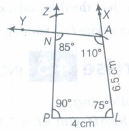
PLAN is the required quadrilateral.
31.
Here, comparison between percentage wins in ODI by 8 top cricket teams is given, so to represent the given information, we draw the double bar graph. So, draw two perpendicular axes OX and OY. Take teams on OX and percentage wins in ODI on OY Choose a suitable scale for OX and OY to draw double'bar graph.
Thus, we get the following double bar graph:
32.
\(\because\) We have \(({4\over 5})^3={4 \times4 \times4 \over 5\times 5\times 5}\)
\(=[\because ({m\over n})^3={m^3\over n^3}]={64\over 125}\)
\(Thus\ ({4\over5})^3={64\over 125}\)
33.
In this case, d = 5.5 cm, h1 = 2.5cm, h2 = 1.5 cm,
\(
\text { Area } =\frac{1}{2} d\left(h_{1}+h_{2}\right)
\)
\(=\frac{1}{2} \times 5.5 \times(2.5+1.5) \mathrm{cm}^{2}
\)
\(=\frac{1}{2} \times 5.5 \times 4 \mathrm{~cm}^{2}=11 \mathrm{~cm}^{2}\)
34.
It is given that a and b are in inverse proportion.
Hence, product of a and b will be a constant.
In case I, ab = 12 \(\times\) 30 = 360
In case II, \(5\times x=360 \Rightarrow x=\frac{360}{5}=72\)
in case III
\(8\times y=360 \Rightarrow y=\frac{360}{8}=45\)
Hence, the required value of x = 72 and y = 45.
35.
We have, 14pq = 2 x 7 x p x q
and 28p2q2 = 2 x 2 x 7 x p x p x p x q
The two terms have 2,7, P and q as common factors .
So, common factor of given terms
= 2 x 7 x p x q = 14 pq
36.
.png)
37.
Given, \(\frac{5^{m}\times5^{3}\times5{-2}}{5^{-5}}=5^{12}\)
⇒ \(\frac{5^{m+3-2}}{5^{-5}}=5^{12}\)
⇒ 5m+1+5 = 512
⇒ (5)m+6 = (5)12
⇒ m + 6 = 12 [ ∵ bases are same]
⇒ m= 12 - 6 = 6
38.
(a) 54
(b) 108
39.
we have \(\frac { \left( 2+y \right) \left( 7-y \right) }{ \left( 5-y \right) \left( 4+y \right) } =1\)
By cross-multiplication, we get
(2 + y)(7 - y) =(5 - y)(4 + y)
\(\Rightarrow\) 14 - 2y + 7y - y2 = 20 + 5y - 4y - y2
\(\Rightarrow\) 14 + 5y = 20 + Y \(\Rightarrow\) 5y - y = 20-14
\(\Rightarrow\) 4y = 6 \(\Rightarrow\) y = \(\frac { 6 }{ 4 } =\frac { 3 }{ 2 } \)
Thus, solution of the given equation is \(\frac { 3 }{ 2 } \)
40.
Cuboid
41.
15
42.
(3x + 2y)2 =(3x)2 + (2y)2 + 2 x(3x)(2y)
= 9x2 + 4y2 + 12xy
Similarly, (3x - 2y)2 = 9x2 + 4y2 -12xy
(3x + 2y)2 + (3x - 2y)2
= (9x2 + 4y2 + 12xy) + (9x2 + 4y2 -12xy)
=18x2+8y2
43.
Firstly, we draw a rough sketch of kite EASY, which helps us in deciding steps of construction.
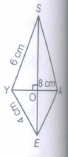
We know that, a kite has two distinct consecutive pairs of sides of equal length and its both diagonals are perpendicular to each other.
So, EY = AE = 4 cm and SY = SA = 6 cm
In \(\Delta\) AYE , EY +AE= 4+4=8 =AY
Since, the sum of the lengths of any two sides of a triangle must be greater than the third side, so \(\Delta\) AYE is not possible.
Hence, construct of kite EASY with given sides is not possible.
44.
Given, cost of one bar of soap = Rs 35
∴ Cost of two bars of soap = Rs (35 x 2) =Rs 70
Also, sale tax = 5%
Now, sale tax charged = 5% of cost of two bars of soap
= 5% of Rs 70
= Rs \((\frac{5}{100}\times 70)=\) Rs \(\frac{350}{100}\) = Rs 3.50
∴ Buyingprice of two bars of soap = Cost of two bars of soap + Sale tax
= Rs (70 + 350) = Rs 73.50
Hence, the buying price of two bars of soap is Rs 73.50.
45.
Given, three cut-outs of congruent triangles of sides 3 cm, 4 cm and 5 cm. On arranging them, we get a trapezium from the given figure, we have
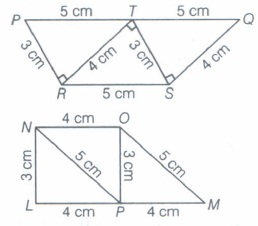
ㄥDEC = ㄥECB = 90° [alternate angles]
∴ DEIIBC
and DE = BC =3 cm
Also, EB = DC = 5 cm
So, EBCD is a parallelogram.
∴ EBIIDC
Also, AEB is a straight line, so AEB II DC. Therefore, in trapezium ABCD, sides AB and DC are parallel and non-parallel sides AD and BC are unequal. Also, non-parallel sides of a trapezium mayor may not be equd By using the same set of triangles, we can get two more trapeziums.
46.
\(\frac { (12+8)d }{ 2 } =40\Rightarrow d=4cm\)
47.
2002 \(\rightarrow \) 300
2003 \(\rightarrow \) 500
500-300=200
48.
36 = 6 x 6 = 62
49.
\({7\over 875}={16\over ?}⇒?={875\times16\over 7}=2000\)
50.
(b)
2
51.
6x2 - 5x - 6
= 6x2 - 9x + 4x - 6
= 3x(2x - 3) + 2(2x - 3)
= (2x - 3)(3x + 2).
52.
Number of Science students
= 340 \(\times \frac { 55 }{ 100 } \) = 187.
.. Number of students of Commerce
= 340 - 187 = 153.
53.
Required measure = \({360^\circ\over 9}=40^\circ\)
54.
(d)
Rational numbers are not associative for division
55.
Lowest frequency = 2 ⟶ 325-360.
56.
x -1, x, x + 1
57.
1296 = 2\(\times\) 2\(\times\) 2 \(\times\) 2 \(\times\) 3 \(\times\) 3 \(\times\) 3 \(\times\) 3
= 23 \(\times\) 2\(\times\) 33 \(\times\) 3.
58.
(a)
(n2-1), 2n and (n2+ 1)
59.
(a)
an odd multiple of 3
60.
(b)
195p2q3
61.
(b)
A square with same side length as of triangle
62.
Let the required number be x.
Then, according to the question
x3 = x ...(1) and x2≠x ...(2)
From (1), x3 -x = 0
⇒ x(x2 - 1) = 0
⇒ x = 0, ± 1
⇒ x = 0,1,-1
If x = 0, then x2 = x.
∴ x = is inadmissible
If x = 1 then x2 = x.
∴ x = 1 is inadmissible
If x = - 1, then x2 = (- 1)2 = 1 ≠ x(= - 1)
Hence, the required number is - 1.
63.
| Time Passed (T) (in minutes) |
(T1) 15 | (T2) 15 | (T3) 45 | (T4) 60 |
|---|---|---|---|---|
| Angle turned (A) (in degree) | (A1) 90 | (A2) __ | (A3) __ | (A4) __ |
| \(T\over A\) | \({15\over 90}={1\over6}\) | \({30\over 180}={1\over6}\) | \({45\over 270}={1\over6}\) | \({60\over 360}={1\over6}\) |
We observe about T and A that they increase together and is \(T\over A\) same every time.
Yes; The angle turned by the minute hand is directly proportional to the time that has passed.
On checking, we find that
T2 : T3 = A1 : A3 = 2: 3
and T3 : T4 = A3 : A4 = 3 : 4
64.
The highest observation = 62
The lowest observation = 17
One of the class intervals = 40-48
∴ Class size = Upper class limit - Lower class limit
= 48 - 40 = 8
∴ The appropriate classes can be:
16-24, 24-32, 32-40, 40-48, 48-56, 56-64
Thus, the frequency distribution table for the above data can be shown using the Tally marks
| Groups [Class intervals] | Tally marks | Frequency |
|---|---|---|
| 16-24 | .jpg) || || |
7 |
| 24-32 | |||| | 4 |
| 32-40 | | |
11 |
| 40-48 | || | 2 |
| 48-56 | |||| |
9 |
| 56-64 | || |
7 |
| Total | 40 |

8th Standard CBSE Syllabus & Materials
8th Standard CBSE
CBSE 8th Science Particulate Nature of Matter - New Model Questions Papers Study Material - QB365 Set A
NEW8th Standard CBSE
CBSE 8th Science Pressure, Winds, Stroms and Cyclones - New Model Questions Papers Study Material - QB365 Set A
NEW8th Standard CBSE
CBSE 8th Mathematics Quadrilaterals - New Model Questions Papers Study Material - QB365 Set A
NEW8th Standard CBSE
CBSE 8th Mathematics A story of Numbers - New Model Questions Papers Study Material - QB365 Set A



CBSE 8th Standard CBSE Subjects
CBSE Standards




