
 100% FREE ACCESS
8th Standard CBSE Syllabus & Materials
8th Standard CBSE
CBSE 8th Social Science Theme D - Factors of Production - New Model Questions Papers Study Material - QB365 Set A
NEW8th Standard CBSE
CBSE 8th Social Science Theme C - Universal Franchise and India's Electoral System - New Model Questions Papers Study Material - QB365 Set A
NEW8th Standard CBSE
CBSE 8th Social Science Theme B - The Rise of the Marathas - New Model Questions Papers Study Material - QB365 Set A
NEW8th Standard CBSE
CBSE 8th Social Science Theme B - Reshaping India's Political Map - New Model Questions Papers Study Material - QB365 Set A
NEW8th Standard CBSE
CBSE 8th Social Science Theme A - Natural Resources and Their Use - New Model Questions Papers Study Material - QB365 Set A
NEW8th Standard CBSE
CBSE 8th Science Keeping Time with Skies - New Model Questions Papers Study Material - QB365 Set A

Published on: 05/03/2020
8th Standard Mathematics Board Exam Sample Question 2020
Download CBSE Class 8th Standard CBSE Mathematics question papers, sample papers, important questions, and previous year solved papers in PDF format. Get free study materials, NCERT solutions, and exam preparation resources for Class 8th Standard CBSE Mathematics
Questions + Answers key
Take MCQ Mathematics Test
1.
Think of a few more examples for direct proportion.
2.
Solve the following equation \(\)\({z\over z+15}={4\over 9}\)
3.
Without finding the prime factors, estimate the cube roots of the following cubes:148877
4.
Find the radius of the base of a cylinder whose volume and height are 1.54 m2 and 1 m respectively.
5.
Using distributive law, find the square of 43.
6.
If \(\frac{6^{n}}{6^{-2}}=6^{3}\),then find the value of n.
7.
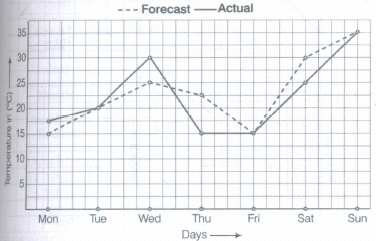
The following graph shows the temperature forecast and the actual temperature for each day of a week.
(a) On which days was the forecast temperature the same as the actual temperature?
(b) What was the maximum forecast temperature during the week?
(c) What was the minimum actual temperature during the week?
(d) On which day did the actual temperature differ the most from the forecast temperature?
8.
Find the value of a, if pqa=(3p+q)2-(3p-q)2
9.
Solve \({4\over7}+(-{4\over9})+{3\over7}+(-{13\over9})\)
10.
Simplify the following:\(\left( \frac { x }{ 5 } -\frac { 1 }{ 2 } \right) \left( \frac { 1 }{ 2 } +\frac { x }{ 5 } \right) \)
11.
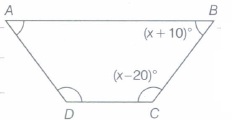
Find the value of x in the trapezium ABCD given below .
12.
Ranjit works in a multinational company as a senior executive with annual package of 12 lakh. He pays income tax regularly and donates 5% of his annual earning to an orphanage.
What amount of money he donate?
13.
Construct a quadrilateral RAIL, where RA = 6 cm, AI = 4.5 cm, \(\angle\)R = 60°, \(\angle\)A = 105° and \(\angle\)I = 110°.
14.
How many faces does the following solids have?
Hexahedron
15.
Read the following pictograph and answer the following questions.
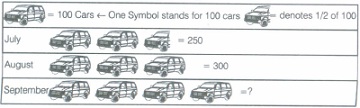
(i) How many cars were produced in the month of July?
(ii) In which month were maximum number of cars produced?
16.
Solve the following linear equations:
m-\(\frac{m-1}{2}\)=1-\(\frac{m-2}{2}\)
17.
Find three rational numbers between \(\frac { 1 }{ 2 } \) and (-2)
18.
Sonal and Anmol made sequence of the designs. Three of the designs are shown below:
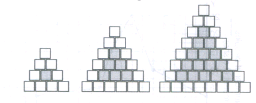
(a) Complete the table.
| Rows, r | 4 | 6 | 8 |
| Number of white tiles, w | 9 | - | - |
| Number of purple tiles, p | 1 | - | - |
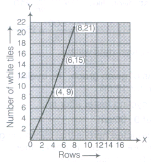
(b) Draw a graph of rows and number of white tiles. Draw another graph of the number of rows and the number of purple tiles. Put, the number of rows on the horizontal axis.
(c) Which graph is linear?
19.
212x5 is a multiple of 3 and 11. Find the value of x.
20.
Write each of the following numbers in usual form.
7.36x10⁵
21.
Three numbers are in the ratio 1 : 2 : 3 and the sum of their cubes is 4500. Find the numbers.
22.
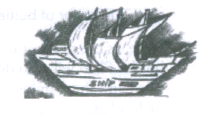
In a model of a ship, the mast is 9 cm high, while the mast of the actual ship is 12 m high. If the length of the ship is 28 m, how long is the model ship?
23.
Hamid has three boxes of different fruits. Box A weights 2\(\frac { 1 }{ 2 } \) kg more than box B and box C weights 10 \(\frac { 1 }{ 4 } \) kg more than box B. The total weights of the three boxes is 48\(\frac { 3 }{ 4 } \) How many kilograms does box A weigh?
24.
Find the square roots of 100 by the method of repeated subtraction.
25.
The area of a circle is given by the expression \(\pi { x }^{ 2 }+6\pi { x }^{ 2 }-9\pi \) sq unit. Find the perimeter of the circle, if x is the radius of the circle.
26.
Evaluate using suitable identities.
(i) (48)2
(ii) 1812-192
(iii) 497 x 505
(iv) 2.07 x 1.93
27.
Government plans to make flats, children's playground, dispensary and space for greenery in a plane field, which is in rectangular shape ABCD with length AB = 800 m, breadth AD = 600 m. He distributed the triangular region ABC divided by diagonal AC for flats. He make altitude MD on AC, where M is a point on AC and give triangular area AMD for greenery. Further, make altitude MN on CD and distribute triangular region MND and MNC for dispensary and children's play ground respectively. Then, construct the figure from above data and what type of value depicted by government?
28.
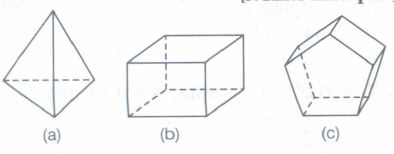
Name the following polyhedrons and verify the Euler's formula for each of them.
29.
Find CI on a sum of Rs 8000 for 2 yr at 5% per annum compounded annually.
30.
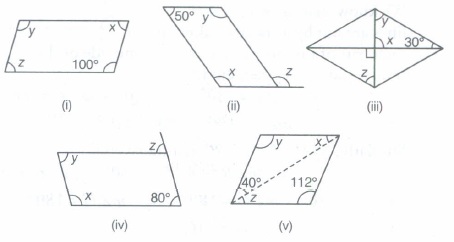
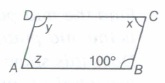
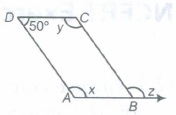
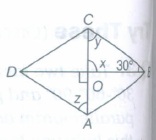
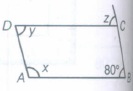
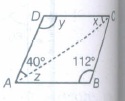
Consider the following parallelograms. Find the values of the unknowns x, y and z.
31.
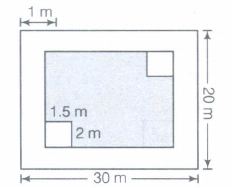
A rectangular park, whose length is 30 m and width is 20 m is shown in the following figure
(i) What is the total length of the fence surrounding it?
(ii) How much land is occupied by the park?
(iii) A path of 1 m width running inside along the perimeter of the park has to be cemented. How many bags of cement would be required to construct the cemented path, if 1 bag of cement is required to cement 4 m2area?
(iv) There are two rectangular flower beds of size 1.5 m \(\times\) 2 m each in the park as shown in the given figure and the rest has grass on it. Find the area covered by grass.
32.
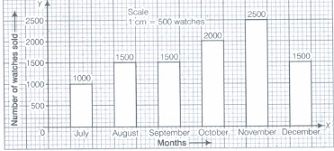
Draw an appropriate graph to represent the given information.
| Months | July | August | September | October | November | December |
|---|---|---|---|---|---|---|
| Number of watches sold |
1000 | 1500 | 1500 | 2000 | 2500 | 1500 |
33.
\(\frac{3}{8} \times\) _________ =\(1 \times \frac{3}{8}=\frac{3}{8}\).
34.
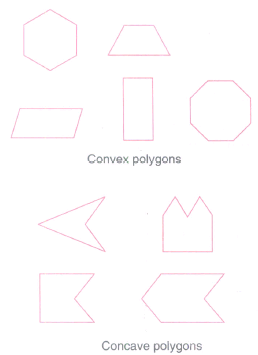
Can you find how these types of polygons differ from one another?
35.
The distance of the sum from the earth is 149,600,000,000 m. Express it in a standard form.
36.
Suppose 2 kg of sugar contains 9 X 10⁶ crystals. How many sugar crystals are there in 1.2 kg of sugar?
37.
Find and correct the errors in the following mathematical statements. x (3x+ 2)= 3x2 + 2
38.
The following table gives the body temperature in oF corresponding to oC. Draw the graph using the table and answer the questions that follow:
| Temperature(oC) | 0 | 15 | 30 |
|---|---|---|---|
| Temperature (oF) | 32 | 59 | 86 |
(a) What will be the temperature in oF, when it is 10oC?
(b) What will be the temperature in oC, when it is 68oF?
39.
Write the following number in usual form: 100 x 7 + 10 x 0 + 6
40.
Find the cube of \(5\frac { 2 }{ 7 } \).
41.
Find the square of the following numbers. 21
42.
What will be the curved surface area of a right circular cylinder having length 160 cm and radius of the base 7 cm?
43.
A TV set was bought for Rs 26250 including 5% VAT. Then find the original price of the TV set
44.
Simplify:(1.5x- 4y) (1.5x+ 4y+ 3) - 4.5x + 12y
45.
Suppose you spin the wheel.
.png)
List the number of outcomes of getting a green sector and not getting a green sector on this wheel (in the above figure).
46.
Can you construct the quadrilateral MIST, if we have 100° at \(\angle \)M instead of 75°. In the quadrilateral MIST, where MI = 3.5 cm, IS = 6.5 cm, \(\angle \)M = 75°, \(\angle \)I = 105° and \(\angle \)S = 120°?
47.
Look at the map given below:
Houses
B Town, India
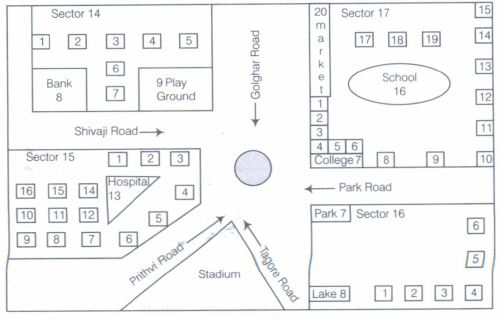
On which road, bank is situated?
48.
Find the value of a, if 6(3a -1)+ 3(2a + 3)= 1-7a.
49.
The diagram
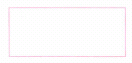
has the shape of a
square
rectangle
triangle
trapezium.
50.
Read the graph and answer the related question:
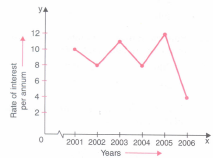
The fall in interest from 2001 to 2002 was
1%
2%
3%
4%
51.
The perfect square number out of 2, 3, 4 and 5 is
2
3
4
5
52.
The sum of 8pq and -17pq is
pq
9pq
-9pq
-pq.
53.
Which of the following numbers is not divisible by 9 ?
135
351
513
247.
54.
\(a \times (b \times c)=(a \times b) \times c\) is called
associative law for addition
associative law for multiplication
commutative law for addition
commutative law for multiplication.
55.
The one's digit of the cube of the number 50 is
1
0
5
4
56.
If amount of work completed by 'A' in one day is \(\frac { 1 }{ n } \) then the whole work will be finished by 'A' is:
n days
1 - n days
n - 1 days
none of these.
57.
Which of the following is equal to x3 - 225x
x(1 - 15x) (1 + 15x)
x(x - 15) (x + 15)
x(1 - 15x) ( 1 - 15x)
x(1+15x)(1-15x)
58.
VAT is always calculated on which of the following?
s. p
c.p
marked price
none of these
59.
Which of the following is a formula to find the sum of interior angles of a quadrilateral of n-sides?
\(\frac { n }{ 2 } \times { 180 }^{ o }\)
\(\left( \frac { n+1 }{ 2 } \right) \times { 180 }^{ o }\)
\(\left( \frac { n-1 }{ 2 } \right) \times { 180 }^{ o }\)
(n-2) x 180o
60.
Which of the following is the standard form of 0.00001275?
1.275 \(\times\) 10-5
1.275 \(\times\) 10-5
127.5 \(\times\) 10-7
127.5\(\times\) 107
61.
The measures of two adjacant angles of a parallelogram are in the ratio 4: 5. The measure of each of the angles of the parallelogram is :
60° and 120°
40° and 140°
80° and 100°
100° and l25°
62.
Monthly salary of a person is Rs 45000. The central angle of the sector representing his expenses on food and house rent on a pie chart is 60°. The amount he spends on food and house rent is
Rs 7500
Rs 4500
Rs 2500
Rs 6000
63.
The digit in the ten's place of a two-digit number is 3 more than the digit in the unit's place. If the digit at unit's place be b. Then, the number is
11b + 30
10b+30
11b+3
10b+3
64.
Which amongst the following is not a polyhedron?
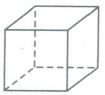
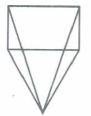

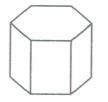
65.
Leela invited some friends for tea on her birthday. Her mother placed some plates and some puris on a table to be served. If Leela places 4 puris in each plate 1 plate would be left empty. But if she places 3 puris in each plate 1puri would be left. Find the number of plates and number of puris on the table.
66.
Take a clock and fix its minute hand at 12.
Record the angle turned through by the minute hand from its original position and the time that has passed, in the following table:
| Time Passed (T) (in minutes) |
(T1) 15 | (T2) 15 | (T3) 45 | (T4) 60 |
|---|---|---|---|---|
| Angle turned (A) (in degree) | (A1) 90 | (A2) __ | (A3) __ | (A4) __ |
| \(T\over A\) | - | - | - | - |
What do you observe about T and A? Do they increase together? Is \(T\over A\) same every time?
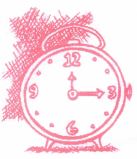
Is the angle turned through by the minute hand directly proportional to the time that has passed? Yes; From the above table, you can also see
T1 : T2 = A1 A2, because
T1 : T2 = 15 30= 1 :2
A1 : A2 = 90 180 = 1 :2
Check if T2: T3 = A2 A3 and T3 : T4 = A3 : A4
You can repeat this activity by choosing your own time interval.
67.
Present the following data in the form of a grouped frequency distribution table having 6 classes of equal size (one of the class being 40-48):
| 30 | 39 | 58 | 17 | 34 | 50 | 23 | 37 |
| 42 | 49 | 55 | 59 | 19 | 28 | 47 | 49 |
| 18 | 60 | 56 | 36 | 58 | 35 | 55 | 37 |
| 25 | 34 | 39 | 61 | 53 | 33 | 36 | 53 |
| 61 | 62 | 39 | 53 | 21 | 18 | 28 | 23 |
1.
Few more examples for direct proportion are as follows:
(i) Length of the cloth purchased and its total cost.
(ii) Number of months and total salary.
(iii) Number of hours of production and the amount of the commodity produced
2.
\({z\over z+15}={4\over 9}\)
By cross-multiplication, we have
9z = 4(z + 15) \(\Rightarrow\) 9z = 4z + 60
Transposing 4z to LHS, we have
9z - 4z = 60
\(5z=60\Rightarrow z={60\over 5}=12\)
\(\therefore \) z = 12.
3.
53
4.
70 cm
5.
We have, 43 = 40 + 3
\(\therefore\) 432 = (40 + 3)2 = (40 + 3)(40 + 3)
= 40(40 + 3) + 3(40 + 3)
= 40\(\times\)40 + 40\(\times\)3 + 3\(\times\)40 + 3\(\times\)3
= 1600 + 120 + 120 + 9 = 1849
6.
∵ \(\frac{6^{n}}{6^{-2}}=6^{3}\)
∴ 6n+2=63 ⇒ n+2=3 ⇒ n=3-2
⇒ n=1 [∵ bases of two equal numbers are same, so exponents will be same]
7.
(a) From the given graph, it is clear that the forecast temperature was the same as the actual temperature on Tuesday, Friday and Sunday. (This is indicated by the point at which both graphs meet).
(b) From the given graph, we can say that the maximum forecast temperature during the week was 35°C.
(c) From the given graph, we can say that the minimum actual temperature during the week was 15°C.
| (d) | Days | Difference between the actual and forecast temperature |
| Monday | 17.5 - 15 = 2.5o C | |
| Tuesday | 20 - 20 = 0°C | |
| Wednesday | 30 - 25 = 5°C | |
| Thursday | 22.5 - 15 = 7.5°C | |
| Friday | 15 - 15 = 0°C | |
| Saturday | 30 - 25 = 5° C | |
| Sunday | 35 - 35 = 0° C |
Since the maximum difference between temperatures is 7.5o C.
Hence, the actual temperature differed the most from the forecast temperature on Thursday.
8.
12
9.
We have, \({4\over7}+(-{4\over9})+{3\over7}+({13\over9})\)
\(=({4\over7}+{3\over7})+(-{4\over9}+{-13\over9})={7\over7}+(-{4\over9}-{13\over9}) \)
\(\\ =1+(-{17\over9})=1-{17\over9}={9-17\over9}=-{8\over9}\)
10.
\(\frac { { x }^{ 2 } }{ 25 } -\frac { 1 }{ 4 } \)
11.
95°
12.
Total annual income = Rs 1200000
∴ 5% of the total income
=1200000x\(\frac{5}{100}\)=Rs 60000
Thus, he donates Rs 60000 to an orphanage
13.
Let us draw a rough sketch of the required quadrilateral RAIL.
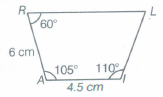
Steps of construction
Step I Draw AI = 4.5 cm and draw angle \(\angle \)lAX =105° and \(\angle \)AIY =110°.
Step II Draw an arc of 6 cm with centre A on AX and get the point R. So, AR = 6 cm.
Step III Now, make an angle of 60° on R.
Step IV Let it intersect IY at L.
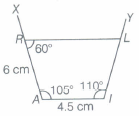
Thus, quadrilateral RAIL is the required quadrilateral.
14.
In a hexahedron there are 6 faces
15.
From the above pictograph, we observe that
(i) 250 cars were produced in the month of July.
(ii) The maximum number of cars were produced in the month of September.
16.
m-\(\frac{m-1}{2}\)=1-\(\frac{m-2}{2}\)
We have m-\(\frac{m-1}{2}\)=1-\(\frac{m-2}{2}\)
It is a linear equation since it involves linear expressions only.
\(\Rightarrow\) m-\(\frac{m}{2}+\frac{1}{2}\)=1-\(\frac{m}{3}+\frac{1}{3}\)
\(\Rightarrow\) m-\(\frac{m}{2}+\frac{m}{3}\)=1+\(\frac{2}{3}+\frac{1}{2}\)
Transposing -\(\frac{m}{3}\)to LHS and \(\frac{1}{2}\)to RHS
\(\Rightarrow\) \(\frac { 6m-3m+2m }{ 6 } =\frac { 6+4-3 }{ 6 } \)
Taking LCM
\(\Rightarrow\) \(\frac { 5m }{ 6 } =\frac { 7 }{ 6 } \)
\(\Rightarrow\) m = \(\frac { 7 }{ 6 } \times \frac { 6 }{ 5 } =\frac { 7 }{ 5 } \)
Multiplying both sides by \(\frac{6}{5}\)
This is the required solution.
17.
We have
A rational number between \(\frac { 1 }{ 2 } \)
= \(\left[ \frac { 1 }{ 2 } +(-2) \right] \div 2=\left[ \frac { 1-4 }{ 2 } \right] \div 2\)
= \(\left[ \frac { -3 }{ 2 } \right] \times \frac { 1 }{ 2 } =\frac { -3 }{ 4 } \)
A rational number between \(\frac { 1 }{ 2 } \) and \(\left( \frac { -3 }{ 4 } \right) \)
= \(\left[ \frac { 1 }{ 2 } +\left( \frac { -3 }{ 4 } \right) \right] \div 2\)
\(\left[ \frac { 2-3 }{ 4 } \right] \times \frac { 1 }{ 2 } =\frac { -1 }{ 4 } \times \frac { 1 }{ 2 } =\frac { -1 }{ 8 } \)
A rational number between \(\left( \frac { -3 }{ 4 } \right) \) and (-2)
= \(\left[ \left( \frac { -3 }{ 4 } \right) +(-2) \right] \div 2=\left[ \frac { (-3)+(-8) }{ 4 } \right] \times \frac { 1 }{ 2 } \)
= \(\frac { -11 }{ 4 } \times \frac { 1 }{ 2 } =\frac { -11 }{ 8 } \)
Thus, the three rational numbers
\(\left( \frac { -3 }{ 4 } \right) ,\left( \frac { -1 }{ 8 } \right) \) and \(\left( \frac { -11 }{ 8 } \right) \) are between \(\frac { 1 }{ 2 } \) and (-2)
18.
(a) The complete table is shown below:
| Rows, r | 4 | 6 | 8 |
| Number of white tiles, W | 9 | 15 | 21 |
| Number of purple tiles, p | 1 | 6 | 15 |
(b) Graph between rows and number of white tiles are shown as below:
Graph between rows and number of purple tiles are shown below:
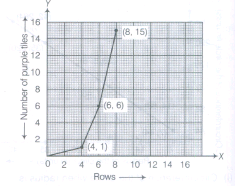
(c) No one graph is linear.
19.
Given, 212 x 5 is a multiple of 3.
So, sum of all its digits 2 + 1 + 2+ x + 5 must be divisible by 3. \(\Rightarrow\) 10 + x is a multiple of 3.
\(\Rightarrow\)10 + x = 0,3,6,9,12, ...
But x is a digit of number 212x5.
\(\therefore\) x can take values 0, 1, 2, 3, ... , 9.
\(\Rightarrow\)10 + x can take value 12, 15, 18.
So, 10 + x = 12 or 15 or 18
\(\Rightarrow\)10 + x = 12 or 10 + x = 15 or 10 + x = 18
\(\Rightarrow\)x = 2, x = 5, x = 8 .....................(i)
Similarly, 212 x 5 is a multiple of 11
Sum of the digits at even places is x + 1.
Sum of the digits at odd places = 5 + 2 + 2 = 9
\(\therefore\)Difference = 9 - x -1 = 8 - x
Now, 212 x 5 will be a multiple of 11.
So, 8 - x is a multiple of 11.
\(\Rightarrow\)8 - x = 0 or 11 or 22 \(\Rightarrow\) x = 8 or 3 or 14
But x is a digit of the number 212x5.
So, x = 0, 1,2 ... 9 \(\Rightarrow\) x = 8 ...............(ii)
From Eqs. (i) and (ii), we get x = 8 and the number is 21285
20.
736000
21.
Given, three numbers are in the ratio 1 : 2 : 3.
Let the numbers be x, 2x and 3x.
If the sum of their cubes is 4500, then
(x)3 + (2x)3 + (3x)3 = 4500
x3 + 8x3 + 27x3 = 4500
36x3 = 4500
⇒ x3 = \(\frac { 4500 }{ 36 } \)
⇒ x3 = 125
⇒ x = \(\sqrt [ 3 ]{ 125 } \)
⇒ x = \(\sqrt [ 3 ]{ 5\times 5\times 5 } \)
⇒ x = 5
So, the numbers are 5 x 1 ,5 x 2 ,5 x 3, i.e. 5,10 and 15.
22.
Let length of the ship and mast be x cm and y cm, respectively.
Now, we can make a table as shown below:
| Actual ship | Model ship | |
| Length of the ship (x) | 28m | X2cm |
| Height of the mast (y) | 12m | 9cm |
Here, as the height of the mast decreases, so the length of the ship also decreases in the same ratio. So, this is a case of direct proportion.
Here, x1 = 28m y1 = 12m y2 = 9cm,x2 = ?
Now, by using the relation\(\frac { { x }_{ 1 } }{ { y }_{ 1 } } =\frac { { x }_{ 2 } }{ { y }_{ 2 } } \)
\(\frac { 28m }{ 12m } =\frac { { x }_{ 2 }cm }{ 9cm } \Rightarrow { x }_{ 2 }\times 12=28\times 9\)
\({ x }_{ 2 }=\frac { 28\times 9 }{ 12 } =21\Rightarrow { x }_{ 2 }=21cm\)
Hence, the length of model ship is 21 cm.
23.
Let box B's weight be x kg.
Since, box A weights \(2\frac { 1 }{ 2 } \) kg more than box Band box C weights \(10\frac { 1 }{ 4 } \) kg more than box B.
Weight of box A = \(\left( x+2\frac { 1 }{ 2 } \right) kg=\left( x+\frac { 5 }{ 2 } \right) kg\)
Weight of box B = \(\left( x+10\frac { 1 }{ 4 } \right) kg=\left( x+\frac { 41 }{ 4 } \right) kg\)
Total weight of all the boxes
\(\left( x+\frac { 5 }{ 2 } +x+x+\frac { 41 }{ 4 } \right) kg\)
According to the question,
Total weight = \(48\frac { 3 }{ 4 } kg=\frac { 195 }{ 4 } kg\)
\(\therefore\) \(x+\frac { 5 }{ 2 } +x+x+\frac { 41 }{ 4 } =\frac { 195 }{ 4 } \)
\(\Rightarrow\) 4x + 10+ 4x + 4x + 41 = 195 [multiplying both sides by 4]
\(\Rightarrow\) 12x + 51 = 195 \(\Rightarrow\) 12x = 144 \(\Rightarrow\) x = 12
\(\therefore\) weight box
A = \(\left( 12+\frac { 5 }{ 2 } \right) kg=\frac { 29 }{ 2 } kg=14\frac { 1 }{ 2 } kg\)
24.
To find the square roots of 100, we subtract successive odd number starting from 1 as follows:
100 - 1 = 99, 99 - 3 = 96, 96 - 5 = 91, 91 - 7 = 84
84 -9 = 75, 75 -11 =64, 64 -13 = 51,51-15 =36
36-17 = 19, 19 - 19 = 0
We observe that the number 10 reduced to zero after subtracting first 10 odd numbers.
So, 100 is a perfect square.
\(\therefore \ \sqrt { 100 } =10\)
Hence, the square root of 100 is 10.
25.
3\(\pi \) unit
26.
(48)2=(50-2)2
Since, (a - b)2 = a2 - 2ab + b2
(50-2)2=(50)2-2x50x2+(2)2
= 2500 - 200 + 4
[(a-b)2=a2-2ab+b2]
= 2504 - 200 = 2304
(ii) 1812 -192 =(181-19)(181 + 19)
where, a = 50 and b = 2
= 162 x 200 = 32400
(iii) 497 x 505 =(500 - 3)(500 + 5)
= 5002 + (-3 + 5) x 500 + (-3)(5)
[.: (x + a)(x + b) = x2 + (a +b) x + ab]
= 250000 + 1000 -15 = 250985
(iv) 2.07 x1.93 = (2 + 0.07)(2 - 0.07)
= 22 -(0.07)2
[.: where, a = 50 and b = 2]
= 3.9951
27.
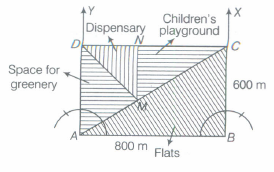
Steps of construction
Step I Draw a line AB = 8 cm. [\(\because\) 8 cm = 800 m]
Step II Draw rays BX and AY, such that \(\angle\) ABX = 90° and \(\angle\)BAY = 90°, respectively.
Step III Cut BC = 6 cm on AX and AD = 6 cm on AY.
Step IV Join C to D, then ABCD is the required rectangular field.
Step V Join A to C.
Step VI Make altitude MD on AC.
Step VII Make altitude MN on CD and write name of the regions.
The value depict, by this type of management of area by government is that they want to maintain all social, environmental aspects in society.
28.
| S.N. | Polyhedron | F | V | F+V | E | F+V-E |
| (a) | Tetrahedron | 4 | 4 | 8 | 6 | 2 |
| (b) | Cube | 6 | 8 | 14 | 12 | 2 |
| (c) | Pentagonal prism | 7 | 10 | 17 | 15 | 2 |
29.
Given,principal (P) = Rs 8000, time (n) = 2 yr, rate (R) = 5%
We know that,
Amount (A) = P\((1+\frac{R}{100})^{n}=8000(1+\frac{5}{100})^{2}\)
=\(8000(\frac{100+5}{100})^{2}\)
= \(8000(\frac{105}{100})^{2}=8000\times \frac{21}{20}\times \frac{21}{20}= \frac{80\times 21\times 21}{2\times2}\)
= 20x21x21 = Rs 8820
ஃ Compound Interest (CI) = Amount (A) - Principal (P)
= Rs(8820 - 8000) = Rs 820.
Alternate Method
Principalfor the Isr year, PI = Rs 8000, R = 5% and T = 2 yr
ஃ SI = SI at 5% per annum for Ist year
\(=\frac{8000\times 5\times 1}{100}\)=Rs 400 \([\therefore =\frac{P\times R\times T}{100}]\)
Amount at the end of Ist year = Principal + Simple interest
= Rs 8000 + Rs 400 = Rs 8400
Now, principal for the IInd year =Amount at the end of Ist year
= Rs 8400
SI2 = SI at 5% per annum for IInd year =Rs \(\frac{8400\times 5\times 1}{100}\)
= Rs(84x5) = Rs 420
Amount at the end of IInd year = Amount at the end of 1st year + SI2
= Rs(8400 + 420) = Rs 8820
ஃ Compound Interest (CI) =Amount (A) - Principal (P)
= Rs (8820 - 8000) = Rs 820
Hence, the compound interest is Rs 820.
30.
(i) Given, ABCD is a parallelogram in which ㄥB = 100°.
We know that, the sum of any two adjacent angles of a parallelogram is 180°.
ㄥA + ㄥB = 180°
[∴ ㄥA and ㄥB are adjacent angles]
⇒ z+1000=180° ⇒ z=1800-100° =80°
Also, opposite angles of a parallelogram are of equal measure.
∴ ㄥD=ㄥB ⇒ y=1000
and ㄥC=ㄥA ⇒ x=z=80°
Hence, the measure of x, y and z are 80°,100° and 80°, respectively.
(ii) Let a parallelogram be ABCD in which ㄥD = 50° .
We know that, the sum of any two adjacent angles of a parallelogram is 180°.
∴ ㄥA + ㄥD=50° ⇒ x + 500= 180°
⇒ x = 180°-50° = 130°
Also, opposite angles of a parallelogram are of equal measure.
∴ ㄥC=ㄥA ⇒ y=x=1300 and ㄥB=ㄥD=50°
Now, ㄥB + exterior ㄥB = 180°
⇒ 50° + z = 180° [by linear pair angle]
⇒ z = 1800- 50° = 130°
Hence, the measure of angles x, y and z are 130°, 130° and 130° , respectively.
(iii) Let a parallelogram be ABCD, in which ㄥCBO = 30°. Here, AC and BD intersect each other at O and ㄥAOD=90°.
∴ ㄥCOB = ㄥAOD=90°
[vertically opposite angles]
We know that, the sum of three angles of a triangle is 180°.
In ΔOBC,
ㄥCOB + ㄥOCB + ㄥCBO = 180°
⇒ 90° +y +30° = 180° ⇒ Y + 120° = 1800
y=1800 - 1200= 600
As AD II BC and AC is a transversal.
y = z = 60° [alternate interior angles]
Hence, the measure of angles x, y and z are 90°, 60 and 60° , respectively.
(iv) Let parallelogram be ABCD, in which ㄥB = 80°
We know that, the sum of any two adjacent angles of a parallelogram is 180°.
∴ ㄥB + ㄥC = 180° ⇒ 800+ ㄥC= 180°
⇒ ㄥC = 180° - 80°= 100°
Also, ㄥC + exterior ㄥC = 180° [by linear pair
:. exterior LC or z = 180° - 80°= 100°
Also, opposite angles of a parallelogram are of equal measure.
So, ㄥA = ㄥC ⇒ x = 100°
and ㄥD = ㄥB ⇒ y = 80°
Hence, the measure of angles x, y and z are 100°,80° and 100°, respectively.
(v) Let parallelogram be ABCD, in which
ㄥB = 112° and ㄥDAC = 40°.
We know that, the sum of any two adjacent angles of a parallelogram is 180°.
∴ ㄥA + ㄥB = 180°
⇒ (40° + z) + 112° = 180°
⇒ 400 + z + 112° = 180° ⇒ z+152°=1800
⇒ z = 1800-152°=280
Also, opposite angles of a parallelogram are of equal measure.
So, ㄥD = ㄥB ⇒ y=112°
Now, in ㄥACD, using angle sum property of a triangle,
ㄥCAD + ㄥD + ㄥDCA = 1800
⇒ 400+y+x=1800
⇒ 40° +112° + x = 180°
⇒ 152° + x =1800 - x=1800-152°=280
Hence, the values of x, y and z are 280, 112° and 28°, respectively.
31.
(i) Total length of the fence surrounding it = Perimeter of -he park = 30m + 20m + 30m + 20m = 100 m
(ii) Land occupied by the park = Area of the park = (30 \(\times\) 20) m2 = 600 m2
(iii) Area of cemented path = Area of the park - Area of the park left after cementing the path
= 600 m2 - [(30 - 2) \(\times\) (20 - 2)] m2 = 600 m2 - (28 \(\times\) 18) m2 = 600 m2 - 504 m2 = 96 m2
Number of cement bags = \(\frac { Area\quad of\quad the\quad path }{ Area\quad cemented\quad by\quad 1\quad bag } =\frac { 96 }{ 4 } \)=24
(iv) Area covered by the grass =Area of the park left after cementing the path - Area of rectangular beds
= 504 m2 -2(1.5 2)m2= 504m2-6m2=498m2
32.
Here, to represent the given information, we draw the bar graph. So, draw two perpendicular axes OX and OY. Take months on OX and number of watches sold on OY. Choose a suitable scale for OX and OY and drawbars of equal width with equal gaps in between.
Thus, we get the following bar graph
33.
\(\frac{3}{8} \times 1\)=\(1 \times \frac{3}{8}=\frac{3}{8}\).
34.
Yes, some of these are convex polygons while the others are concave polygons.
35.
1.496 \(\times\) 1011 m
36.
Here, x1= 2, y1= 9 x 10⁶, x3 = 1.2 and y3 =?
Now, by using the relation\(\frac { { x }_{ 1 } }{ { y }_{ 1 } } =\frac { { x }_{ 3 } }{ { y }_{ 3 } } \)
\(\frac { 2 }{ 9\times { 10 }^{ 6 } } =\frac { 1.2 }{ { y }_{ 3 } } \Rightarrow 2\times { y }_{ 3 }=1.2\times 9\times { 10 }^{ 6 }\)
\(\Rightarrow { y }_{ 3 }=\frac { 10.8\times { 10 }^{ 6 } }{ 2 } =5.4\times { 10 }^{ 6 }\Rightarrow { y }_{ 3 }=5.4\times { 10 }^{ 6 }\)
Hence, there are 5.4 \(\times\) 106 crystals of sugar in 1.2 kg of sugar.
37.
Given mathematical statement is incorrect.
Hence, the correct statement is x(3x + 2) =3x2 + 2x because when we multiply the expression enclosed in a bracket by a constant (or a variable) outside, each term of the expression has to be multiplied by the constant (or the variable).
38.
(a) 50oF (b)20oF
39.
706
40.
\(\frac { 50653 }{ 343 } \).
41.
441
42.
7040 cm2
43.
25000
44.
(1.5x - 4y)(1.5x + 4y + 3) - 4.5x + 12y
= 1.5x(1.5x + 4y +3) - 4y(1.5x + 4y + 3) -4.5x + 12y
= (1.5x\(\times\)1.5x) + (1.5x\(\times\)4y) + (1.5x\(\times\)3) - (4y\(\times\)1.5x) - (4y\(\times\)4y) - (4y\(\times\)3)-4.5x + 12y
= 2.25x2 + 6xy + 4.5x - 6xy -16y2- 12y - 4.5x + 12y
= 2.25x2+ (6 - 6)xy + (4.5 - 4.5)x - 161 + (12 - 12)y
= 2.25x2 + (0)xy + (0)x-16y2+ (o)y
= 2.25x2+ 0 + 0 - 16y2+ 0
= 2.25x2- 16y2
45.
On the wheel, there are three sectors of red colour and five sectors of green colour.
Number of outcomes of getting a green sector on this wheel = 5
Number of outcomes of not getting a green sector on this wheel
Number of outcomes of getting a red sector on this wheel = 3.
46.
Yes, the quadrilateral MIST can be constructed
with \(\angle\)M = 100°.
By angle sum property of a quadrilateral,
\(\angle\)M+ \(\angle\)I+ \(\angle\)S+ \(\angle\)T=360°
\(\Rightarrow\) 100°+105°+120°+ \(\angle\)T = 360°
\(\Rightarrow\) \(\angle\)T=35°
Thus, we have, MI = 3.5 cm, IS = 6.5 cm, \(\angle\)M =100°, \(\angle\)I = 105° and \(\angle\)S =120° and \(\angle\)T = 35°.
47.
Shivaji road
48.
a = \(\frac { -2 }{ 31 } \)
49.
(b)
rectangle
50.
10 - 8 = 2
51.
4 = 2 x 2 = 22
52.
Sum ={8 + (-17)}pq = - 9pq.
53.
2 + 4 + 7 = 13 is not divisible by 9.
54.
(b)
associative law for multiplication
55.
0\(\times\)0\(\times\)0=0.
56.
(a)
n days
57.
(b)
x(x - 15) (x + 15)
58.
(a)
s. p
59.
(d)
(n-2) x 180o
60.
(a)
1.275 \(\times\) 10-5
61.
(c)
80° and 100°
62.
(a)
Rs 7500
63.
(a)
11b + 30
64.
(c)
65.
Let the number of plates on the table be y and the number of puris be x.
Then, according to the first condition of the problem
4(y - 1) = x ...(1)
and, according to the second condition of the
problem
3y + 1= x ... (2)
From (1) and (2), we have
4(y - 1) = 3y + 1
⇒ 4y - 4 = 3y + 1
⇒ 4y - 3y = 1 + 4
⇒ y=5
Put y = 5 in (1), we get
x = 4(5) - 4 = 20 - 4 = 16
Hence, the number of plates and number of puris on the table are 5 and 16 respectively.
66.
| Time Passed (T) (in minutes) |
(T1) 15 | (T2) 15 | (T3) 45 | (T4) 60 |
|---|---|---|---|---|
| Angle turned (A) (in degree) | (A1) 90 | (A2) __ | (A3) __ | (A4) __ |
| \(T\over A\) | \({15\over 90}={1\over6}\) | \({30\over 180}={1\over6}\) | \({45\over 270}={1\over6}\) | \({60\over 360}={1\over6}\) |
We observe about T and A that they increase together and is \(T\over A\) same every time.
Yes; The angle turned by the minute hand is directly proportional to the time that has passed.
On checking, we find that
T2 : T3 = A1 : A3 = 2: 3
and T3 : T4 = A3 : A4 = 3 : 4
67.
The highest observation = 62
The lowest observation = 17
One of the class intervals = 40-48
∴ Class size = Upper class limit - Lower class limit
= 48 - 40 = 8
∴ The appropriate classes can be:
16-24, 24-32, 32-40, 40-48, 48-56, 56-64
Thus, the frequency distribution table for the above data can be shown using the Tally marks
| Groups [Class intervals] | Tally marks | Frequency |
|---|---|---|
| 16-24 | .jpg) || || |
7 |
| 24-32 | |||| | 4 |
| 32-40 | | |
11 |
| 40-48 | || | 2 |
| 48-56 | |||| |
9 |
| 56-64 | || |
7 |
| Total | 40 |

8th Standard CBSE Syllabus & Materials
8th Standard CBSE
CBSE 8th Science Particulate Nature of Matter - New Model Questions Papers Study Material - QB365 Set A
NEW8th Standard CBSE
CBSE 8th Science Pressure, Winds, Stroms and Cyclones - New Model Questions Papers Study Material - QB365 Set A
NEW8th Standard CBSE
CBSE 8th Mathematics Quadrilaterals - New Model Questions Papers Study Material - QB365 Set A
NEW8th Standard CBSE
CBSE 8th Mathematics A story of Numbers - New Model Questions Papers Study Material - QB365 Set A



CBSE 8th Standard CBSE Subjects
CBSE Standards




