
 100% FREE ACCESS
8th Standard CBSE Syllabus & Materials
8th Standard CBSE
CBSE 8th Social Science Theme D - Factors of Production - New Model Questions Papers Study Material - QB365 Set A
NEW8th Standard CBSE
CBSE 8th Social Science Theme C - Universal Franchise and India's Electoral System - New Model Questions Papers Study Material - QB365 Set A
NEW8th Standard CBSE
CBSE 8th Social Science Theme B - The Rise of the Marathas - New Model Questions Papers Study Material - QB365 Set A
NEW8th Standard CBSE
CBSE 8th Social Science Theme B - Reshaping India's Political Map - New Model Questions Papers Study Material - QB365 Set A
NEW8th Standard CBSE
CBSE 8th Social Science Theme A - Natural Resources and Their Use - New Model Questions Papers Study Material - QB365 Set A
NEW8th Standard CBSE
CBSE 8th Science Keeping Time with Skies - New Model Questions Papers Study Material - QB365 Set A

Published on: 15/09/2018
Model Question - I
Download CBSE Class 8th Standard CBSE Mathematics question papers, sample papers, important questions, and previous year solved papers in PDF format. Get free study materials, NCERT solutions, and exam preparation resources for Class 8th Standard CBSE Mathematics
Questions + Answers key
Take MCQ Mathematics Test
1.
Factorise x2 + 9x + 20
2.
A car takes 10 h to reach a destination by travelling at the speed of 65 km/h. How long will it take when the car travels at the speed of 50 km/h?
3.
Find the cube root of each of the following numbers by prime factorisation method.
175616
4.
Evaluate \((\frac{32}{243})^{-3/5}\)
5.
Using the formula, A=\((1+\frac{R}{100})^{n}\) calculate the amount and the compound interest for the following. P = Rs 500, R = 12% and n = 2yr
6.
if \({ x }^{ 2 }+\frac { 1 }{ { x }^{ 2 } } =23\) then find the value of \(\ x-\frac { 1 }{ x } \)
7.
The area of a trapezium is 34 cm2 and the length of one of the parallel sides is 10 cm and its height is 4 cm. Find the length of the other parallel side.
8.
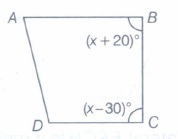
Find the value of x in the trapezium ABCD given below.
9.
We saw that 5 measurements of a quadrilateral can determine a quadrilateral uniquely. Do you think any five measurements of the quadrilateral can do this?
10.
Solve the following equations \(\frac { x }{ 3 } +1=\frac { 7 }{ 15 } \)
11.
The area of a rhombus and that of a square are equal. The side of the square is 6 cm. If one of the diagonal of the rhombus is 4 cm, then find the length of its other diagonal.
12.
In a television game show, the prize money of Rs.100000 is to be divided equally amongst the winners. Complete the following table and find whether the prize money given to an individual winner is directly or inversely proportional to the number of winners?
| Number of winners | 1 | 2 | 4 | 5 | 8 | 10 | 20 |
| Prize for each winner(inRs) | 100000 | 50000 | .... | .... | ..... | ..... | ..... |
13.
In a rare coin collection, there is one gold coin for every three non-gold coins. If 10 more gold coins are added to the collection, the ratio of gold coins to non-gold coins becomes 1 : 2. Based on the information, find the total number of coins in the collection now?
14.
Find the values of A, B, and C, if \(\begin{matrix} \quad \quad 4\ 5\ A \\ -\quad C\ B\ 7 \\ \_ \_ \_ \_ \_ \_ \_ \_ \_ \\ \ \quad2\ 8\ 4 \\ \_ \_ \_ \_ \_ \_ \_ \_ \_ \_ \end{matrix}\)
15.
Find the value of the following :
\(\frac { 181\times 181-119\times 119 }{ 300 } \)
16.
Study the following pie chart carefully to answer the questions.
Percentage wise distribution of teachers who teach six different subjects shown below.
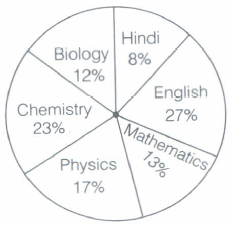
If total number teachers = 1800
(a) What is the total number of teachers teaching Chemistry, English and Biology?
(b) What is the difference between the total number of teachers who teach English and Physics together and the total number of teachers who teach Mathematics and Biology together?
17.
The angle between the two altitudes of a parallelogram through the vertex of an obtuse angle of the parallelogram is 45°. Find the measure of the obtuse angle.
18.
Calculate the amount and compound interest on Rs 62500 for 1\(\frac{1}{2}\) yr at 8% per annum compouned half-yearly.
19.
Using Euler's formula, find the value of unknown x, y, z, p, q and r in the following parts.
| Faces | Vertices | Edges | |
| (i) | 7 | 10 | x |
| (ii) | y | 12 | 18 |
| (iii) | 9 | z | 16 |
| (iv) | p | 6 | 12 |
| (v) | 6 | q | 12 |
| (vi) | 8 | 11 | r |
20.
Construct the following quadrilaterals. Rectangle OKAY OK = 7 cm, KA = 5 cm
21.
Write down the like terms in the given polynomial \(2c{ a }^{ 2 }+\frac { 1 }{ 2 } b{ c }^{ 2 }a+\frac { 2 }{ 3 } bc{ a }^{ 2 }+3{ a }^{ 2 }bc\)
22.
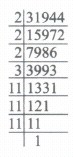
Is 31944 a perfect cube? If not then by which smallest natural number should 31944 be divided so that the quotient is a perfect cube?
23.
Express each of the following numbers in standard form.
0.0005
24.
Evaluate \({5\over7}+{-2\over3}+{-3\over7}+{5\over3}\)
25.
In how much time would the simple interest on a certain sum be 0.5 times of principal at 8% per annum?
26.
A grandfather is ten times older than his granddaughter. He is also 54 yr older than her. Find their present ages.
27.
All kites are rhombuses.
28.
The difference of the squares of two consecutive numbers is their sum
29.
The ordinate of a point is its distance from the Y-axis.
30.
The square of 87 will have 3 at the unit's place.
31.
If a2 ends in 9, then a3 ends in 7.
32.
The product of (3 + a) (3 + b) is 9+(a+b)3+3ab
33.
CP = MP - Discount
34.
In a two-digit number, the unit's place digit is x. If the sum of digits be 9, then the number is (10x - 9).
35.
If the sum of number of vertices and faces in a polyhedron is 16, then the number of edges in that shape is 12.
36.
For any rational number a and b, a - b = b - a.
37.
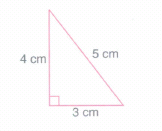
The perimeter of the figure is
12 cm
24 cm
6 cm
60 cm
38.
The unit digit in the square of the number 1333 is
3
6
9
1
39.
Observe the histogram and answer the related question:
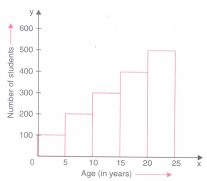
In which class interval, are the maximum number of students?
0-5
5-10
20-25
15-20
40.
The product of 7x and -12x is
84x2
-84x2
x2
-x2
41.
10 metres of cloth cost Rs.1000. What will 4 metres cost?
Rs.400
Rs.800
Rs.200
Rs.100
42.
The factorisation of 10x2 - 18x3 + 14x4 is
2x2(7x2 - 9x + 5)
2(7x2 - 9x + 5)
2x(7x2 - 9x + 5)
2x3(7x2 - 9x + 5).
43.
The sum of \(-\frac { 1 }{ 9 } \) and \(-\frac { 1 }{ 9 } \) is-
0
1
\(\frac { 2 }{ 9 } \)
\(\frac { -2 }{ 9 } \)
44.
If 5A x A = 399, then the value of A is
3
6
7
9
45.
The smallest number by which 841 be multiplied so that the product becomes a perfect cube is
29
27
25
23
46.
Which of the following is true for the adjacent angles of a parallelogram?
They are equal to each other
They are complementary angles
They are supplementary angles
None of the above
47.
1 m3 = 1 m x 1 m x 1m = ... cm3
48.
If the thickness of a pile of 12 cardboard sheets is 45 mm, then the thickness of a pile of 240 sheets is_________cm.
49.
A 4-digit number abcd is divisible by 11, if d + b = _________ or _________
50.
1000 = ____________
51.
The sum of two consecutive multiples of 10 is 210. The smaller multiple is........
1.
Here, we can take two factors 4 and 5 such that,
4 X 5 = 20 and 4 + 5 = 9.
Now, put these value in given expression
x2 +(4+5)x + 4 X5=x2 + 4x+5x + 4 X 5=x(x + 4) +5 (x+ 4)=(x + 4)(x +5).
2.
13 h
3.
By prime factorisation,
we have
175616 = 2 x 2 x 2 x 2 x 2 x 2 x 2 x 2 x 2 x 7x 7 x 7 = 2 x 2 x 2 x 7 = 56
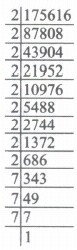
Thus, the cube root of 175616 is 56.
4.
\(\frac{27}{8}\)
5.
∵ A = P\((1+\frac{R}{100})^{n}\)
∴ A = 500\((1+\frac{12}{100})^{2}=500 (\frac{112}{100})^{2}\)
= 500\(\times \frac{12544}{10000}\) = Rs 627.2
∴ CI = A - P = Rs (627.2-500) = Rs 127.2
6.
\(\pm \sqrt { 21 } \)
7.
Given, area of trapezium = 34 cm2
and height of trapezium = 4 cm
Let length of one parallel side be x cm, then another parallel side is 10 cm.
Now, area of trapezium =\(\frac { 1 }{ 2 } \times \) sum of parellel sides\(\times\)Perpendicular distance between the parallel sides
⇒ 34 =\(\frac { 1 }{ 2 } \times \) (x+10) \(\times\)4 ⇒ 34 =2x(x+10)
⇒ 17 = x + 10
⇒ x = 17-10 = 7
Hence, the length of other parallel side is 7 cm
8.
In the trapezium ABCD, we have
AB II CD
Also,sum of interior angles B and C is 180°
∴ (x + 20)° + (x - 30)° =180°
⇒ 2x0 -100 =180°
⇒ 2x0 = 190°
⇒ x0 = 95°
9.
In case of a quadrilateral, it is necessary to have atleast the knowledge of five parts to be able to construct it uniquely. We shall need data about specified parts of the quadrilateral as follows:
(a) When four sides and one diagonal are given.
(b) When two diagonals and three sides are given.
(c) When two adjacent sides and three angles are given.
(d) When three sides and two included angles are given.
(e) When some special properties are given.
10.
\(x=\frac { -8 }{ 5 } \)
11.
Here, side of the square = 6 cm
\(\therefore\) Area of the square = Side x Side
= 6 cm x 6 cm = 36 cm2
Since, [Area of the rhombus]
= [Area of the square]
\(\therefore\) Area of the rhombus = 36 cm2
One of the diagonal of the rhombus = 4 cm
Let the other diagonal of the rhombus be
\(\therefore\) Area of rhombus
\(\therefore\frac{1}{2}\times Product \ of\ the\ diagonals\)
\(\therefore\) Area of the rhombus \(=\frac{1}{2}\times 4\times d\)
Now, \(\frac{1}{2}\times 4\times d=36\Rightarrow d=\frac{36\times 2}{4}=18\)
Thus, the required length of the rhombus = 18 cm.
12.
Here, it is clear that, more the number of winners, less is the prize money for each winner. So, it is a case of inverse proportion.
Let x2 = 2,y2 = 50000 and x3 = 4, y3 =?
We know that, x2y2 = x3 y3
∴ 2 x 50000 = 4 x y3
\({ y }_{ 3 }=\frac { 2\times 50000 }{ 4 } =\frac { 50000 }{ 2 } =25000\)
Now, x3 = 4, y3 = 25000 and x 4 = 5, y4 =?
∵ x3y3 = x4y4
4 X 25000 = 5 x y4
\({ \Rightarrow y }_{ 4 }=\frac { 4\times 25000 }{ 5 } =4\times 5000=20000\)
Now x4 =5,y4 =20000 and x5= 8,y5= ?
∵ x4y4 = x5y5
∴5 x 20000 = 8 x y5
\({ y }_{ 5 }=\frac { 5\times 20000 }{ 8 } =5\times 2500=12500\)
Now, x5 = 8, y5 = 12500 and x6 = 10, y6 =?
∵ x5y5 = x6y6
∴ 8 x 12500 = 10 x y6
\({ y }_{ 6 }=\frac { 8\times 12500 }{ 10 } =10000\)
Now, x6 = 10, y6 = 10000 and x7 = 20, y7 =?
∵ x6y6 = x7 y7
∴ 10 x 10000 = 20 x y7
\({ y }_{ 7 }=\frac { 10\times 10000 }{ 20 } =5000\)
Thus, the complete table is given below:
| Number of winners | 1 | 2 | 4 | 5 | 8 | 10 | 20 |
| Prize for each winner(in Rs) | 100000 | 50000 | 25000 | 20000 | 12500 | 10000 | 5000 |
∴ 1 x 100000 = 2 x 50000 = 4 x 25000 = 5 x 20000 = 8 x 12500 = 10 x10000 = 20 x 5000
100000 = 100000 = 100000 = 100000 = 100000 = 100000 = 100000
x1y1 = x2y2 = x3y3 = x4y4=x5y5 =x6y6 =x7y7
Hence, the prize money given to an individual winner is inversely proportional to the number of winners.
13.
Let the number of gold coins initially be x
Then, the number of non-gold coins be 3x. When,
10 more gold coins added
Then, the total number of gold coins = (10 + x)
Then, according to the question , \(\frac { (10+x) }{ 3x } =\frac { 1 }{ 2 } \)
\(\Rightarrow\) 2 (10 + x) = 3x \(\Rightarrow\) 20 + 2x = 3x \(\Rightarrow\) x = 20
Then, total number of coins at last = 3x + 10 + x = 4x + 10 = 4 x 20 + 10 = 90
14.
A = 1, B = 6 and C = 1
15.
62
16.
(a) Number of teachers teaching Chemistry = \(\frac{23}{100}\times\) 1800 = 414
Number of teachers teaching English = \(\frac{27}{100}\times\) 1800 = 496
Number of teachers teaching Biology = \(\frac{12}{100}\times\) 1800 = 216
Total numbers of teachers teaching Chemistry, English and Biology
= 414 + 486 + 216
= 1116
(b) Number of teachers teaching English = 486
Number of teachers teaching Physics = \(\frac{17}{100}\times\) 1800 = 306
Number of teachers teaching Mathematics = \(\frac{13}{100}\times\) 1800 = 234
Number of teachers teaching Biology = 216
\(\therefore\) Difference between the total number of teachers teaching English and Physics together and the total number of teachers who teach Mathematics and Biology together
= ( 486 + 306) - (234 + 216) = 792 - 450 = 342.
17.
Let ABCD is a parallelogram and the obtuse angles of the parallelogram are ㄥA and ㄥC.
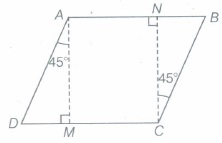
Let AM is the altitude drawn from the vertex A on DG and CN is the altitude drawn from the vertex C on AB.
∴ ㄥDAM = 45° and ㄥNCB = 45° [given]
In ΔAMD, we know that, sum of the interior angles of a triangle is 180°.
ㄥD + 45° + 90° = 180°
ㄥD =180° - 45° - 90°
=180° -135° = 45°
Similarly, in ΔCNB
ㄥB = 45°
Now, ㄥA + ㄥD =180°
[sum of adjacent angles In a paralleloprarn.is 180°]
∴ ㄥA + 45° = 180° [∵ㄥD = 45°]
⇒ ㄥA =180° - 45° =135°
Also, ㄥA = ㄥC
[∵ opposite angles of a parallelogram are equal]
ㄥC =135°
18.
Here, principal (P) = Rs 62500,
time(n) = 1\(\frac{1}{2}\)yr = \(\frac{3}{2}\)yr and rate (R) = 8%
For half-yearly,
\(n=\frac{3}{2}\times 2\)= 3yr and R = \(\frac{8}{2}\)% = 4%
∴ Amount (A) =P \((1+\frac{R}{100})^{n}=62500(1+\frac{4}{100})^{3}\)
= 62500\((\frac{100+4}{100})^{3}=62500(\frac{104}{100})^{3}\)
= 62500\(\times \frac{104}{100}\times \frac{104}{100}\times \frac{104}{100}\)
= 104x26x26 = Rs 70304
∴ Compound interest =Amount (A) - Principal (P)
= Rs (70304 - 62500) = Rs 7804
19.
(i) 15 (ii) 8 (iii) 9 (iv) 8 (v) 8 (vi) 17
20.
Firstly, we draw a rough sketch of rectangle OKAY, which helps us in deciding steps of construction.
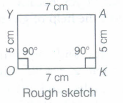
We know that, in a rectangle, opposite sides are equal and parallel and angles between two adjacent sides is 90°.
In rectangle OKAY,
OK = AY = 7 cm, KA = OY = 5 cm
and \(\angle \)OKA=\(\angle \)KOY = 90°
Steps of construction
Steps IDraw OK = 7 cm.
Step IIAt K, draw a ray KX making an \(\angle \)OKX = 90°
Step III Cut KA = 5 cm from ray KX.
Step IV With A as centre and radius 7 cm, draw an arc.
Step V With O as centre and radius 5 cm, draw another arc which intersects the arc drawn in Step IV at Y.
Step VI Join AY and OY.
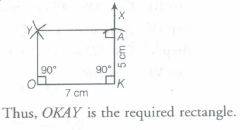
21.
\(2c{ a }^{ 2 }b,\frac { 2 }{ 3 } bc{ a }^{ 2 },3{ a }^{ 2 }bc\)
22.
We have 31944 = 2 x 2 x 2 x 3
x11x11x11
Since, the prime factors of 31944 do not appear in triples as 3 is left over.
\(\therefore\)31944 is not a perfect cube.
Obviously, 31944 \(\div\) 3 will be a perfect cube
i.e., [31944] \(\div\) 3
= [2 x 2 x 2 x 3 x 11 x 11 x11] \(\div\) 3
or 10648 = 2 x 2 x 2 x 11 x 11 x 11
\(\therefore\) 10648 is a perfect cube.
Thus, the required least number = 3.
23.
5 x 10⁻⁴
24.
\(9\over7\)
25.
6\(\frac{1}{4}\)yr
26.
Let the present age of granddaughter be x yr.
Then, the present age of grandfather =10x yr
According to the question, 10x = x + 54
\(\Rightarrow\) 10x - x = 54 [transposing x to LHS]
\(\Rightarrow\) 9x = 54 \(\Rightarrow\) x = \(\frac { 54 }{ 9 } \) or x = 6
Present age of granddaughter = x = 6 yr and present age of grandfather = 10x = 10 X 6 = 60 yr Hence, the present age of granddaughter and grandfather are 6 yr and 60 yr.
27.
(b)
28.
(a)
29.
(b)
30.
(b)
31.
(b)
32.
(b)
33.
(b)
34.
(b)
35.
(b)
36.
(b)
37.
Perimeter = 4 + 3 + 5 = 12 cm.
38.
3 x 3 = 9.
39.
The length of the rectangle on 20-25 is maximum.
40.
(7x) (-12x) = - 84x2
41.
\({10\over 1000}={4\over ?}⇒?=400\)
42.
10x2 - 18x3 + 14x2 = 2x2 (5 - 9x + 7x2).
43.
(d)
\(\frac { -2 }{ 9 } \)
44.
(c)
7
45.
46.
(c)
They are supplementary angles
47.
()
1000000
48.
()
90
49.
()
(a+c) or 12(a+c)
50.
()
1
51.
()
Let two consective multiples of 10 be x and (x + 1)
10 xx + 10 x (x + 1) = 210 \(\Rightarrow\) 10x + 10x +10 = 210
\(\Rightarrow\) 20x = 210 - 10 = 200 \(\Rightarrow\)x = 200 \(\div\) 20 = 10
So the smaller multiple is 10

8th Standard CBSE Syllabus & Materials
8th Standard CBSE
CBSE 8th Science Particulate Nature of Matter - New Model Questions Papers Study Material - QB365 Set A
NEW8th Standard CBSE
CBSE 8th Science Pressure, Winds, Stroms and Cyclones - New Model Questions Papers Study Material - QB365 Set A
NEW8th Standard CBSE
CBSE 8th Mathematics Quadrilaterals - New Model Questions Papers Study Material - QB365 Set A
NEW8th Standard CBSE
CBSE 8th Mathematics A story of Numbers - New Model Questions Papers Study Material - QB365 Set A



CBSE 8th Standard CBSE Subjects
CBSE Standards




