
 100% FREE ACCESS
8th Standard CBSE Syllabus & Materials
8th Standard CBSE
CBSE 8th Social Science Theme D - Factors of Production - New Model Questions Papers Study Material - QB365 Set A
NEW8th Standard CBSE
CBSE 8th Social Science Theme C - Universal Franchise and India's Electoral System - New Model Questions Papers Study Material - QB365 Set A
NEW8th Standard CBSE
CBSE 8th Social Science Theme B - The Rise of the Marathas - New Model Questions Papers Study Material - QB365 Set A
NEW8th Standard CBSE
CBSE 8th Social Science Theme B - Reshaping India's Political Map - New Model Questions Papers Study Material - QB365 Set A
NEW8th Standard CBSE
CBSE 8th Social Science Theme A - Natural Resources and Their Use - New Model Questions Papers Study Material - QB365 Set A
NEW8th Standard CBSE
CBSE 8th Science Keeping Time with Skies - New Model Questions Papers Study Material - QB365 Set A

Published on: 29/11/2018
Some of the important questions are covered in this question paper. The questions are created from the NCERT and HOTs questions.
Download CBSE Class 8th Standard CBSE Mathematics question papers, sample papers, important questions, and previous year solved papers in PDF format. Get free study materials, NCERT solutions, and exam preparation resources for Class 8th Standard CBSE Mathematics
Questions + Answers key
Take MCQ Mathematics Test
1.
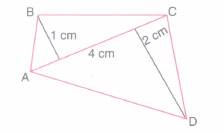
The area of the quadrilateral is
6 cm2
12 cm2
3 cm2
8 cm2
2.
The volume of a cylinder of base radius r and height h is
2\(\pi\) rh
\(\pi\)r2h
2\(\pi\)r(r+h)
\(\frac { 1 }{ 3 } \)\(\pi\)r2h
3.
If 102 = 100, then the square root of 100 is
1
10
100
1000
4.
How many nonsquare numbers lie between the pair of numbers 362 and 372?
36
37
74
72
5.
The coefficient of xy2z in -7x2y3z is
-7xy
7xy
-xy
xy.
6.
The factorisation of ax2y + bxy2 + cxyz is
xy(ax + by + cz)
axy(ax + by + cz)
bxy(ax + by + cz)
cxy(ax + by + cz),
7.
Which of the following is the co-efficient of y in -5 xyz?
-5xz
-5x
-5y
-5
8.
Which of the following is the number of faces of a solid sphere?
1
2
many
none of these
9.
A square board has an area of 121 square units. How long is each side of the board?
11 units
12 units
13 units
14 units
10.
The cube of 0.08 is
0.000512
0.0512
0.512
5.12
11.
Multiplicative inverse of a negative rational number is
0
-1
a negative rational number
a positive rational number
12.
Which of the following is not true?
\(\frac{10}{11}+\frac{11}{12}=\frac{11}{12}+\frac{10}{11}\)
\(\frac{10}{11}\times \frac{11}{12}=\frac{11}{12}\times \frac{10}{11}\)
\(\frac{10}{11}+ \frac{11}{12}=\frac{11}{12}\div \frac{10}{11}\)
\(\frac{10}{11}\div \frac{11}{12}=\frac{11}{12}\times \frac{10}{11}\)
13.
52 = 25, then square root of 25 =______.
14.
The perimeter of a circle and its diameter vary___________with each other.
15.
The large number of observations are usually organised in groups of equal width called _______.
16.
In a ______________ opposite sides are equal, opposite angles are equal and diagonals bisect one another.
17.
| Numbers | Associative for | |||
| Addition | Subtraction | Multiplication | Division | |
| Rational numbers | ___________ | ____________ | ___________ | No |
18.
Is \(\frac{-8}{9} \times (\frac{-4}{7}) =\frac{-4}{7}\times (\frac{-8}{9})?\)
19.
Write each of the following in standard form: 150,000,000,000
20.
Express 2 yr in seconds.
21.
Can we say whether the following numbers are perfect squares? How do we know? 2061
Write five numbers which you can decide by looking at their units digit that they are not square numbers.
22.
Write the additive inverse of the following \(19\over-6\)
23.
Without finding the prime factors, estimate the cube roots of the following cubes:12167
24.
Is 1008 a perfect square? If not, find the smallest multiple of 1008 which is a perfect square and then find the square root of the new number.
25.
Numbers I to 10 are written on ten separate cards such that one number on one slip. These are mixed well and one slip is chosen from the box without looking into it. What is the probability of
(i) getting a card on which 7 is written?
(ii) getting a card having two-digit number on it?
(iii) getting a number less than 5?
(iv) getting a number more than 5?
26.
Study the following frequency table and answer the questions given below.
(i) What is the class interval?
(ii) Which class has the lowest frequency?
(iii) Which class has the highest frequency?
(iv) Which two classes have the same frequency?
| Class interval (Dailv income in rupees) | Frequency (Number of workers) |
|---|---|
| 200-225 | 25 |
| 225-250 | 38 |
| 250-275 | 42 |
| 275-300 | 45 |
| 300-325 | 17 |
| 325-350 | 23 |
| 350-375 | 45 |
| 375-400 | 120 |
| Total | 365 |
(v) What is the lower limit of the class interval 300-325?
(vi) What is the upper limit of the class interval 275-300?
27.
Divide the following algebraic expressions: r(r8 - 1)\(\div\)(r3-r)
28.
Find the cube root of 614125 through estimation.
29.
Solve the following:
\((\frac{2}{3})^{-2}\times(\frac{2}{3})^{5}\)
30.
For each of the following numbers, find the smallest whole number by which it should be divided so as to get a perfect square. Also, find the square root of the square number so obtained.1620
31.
Find the values of the letters in each of the following and give reasons for the steps involved.\(\begin{matrix} \quad \quad 1\quad 2\quad A \\ +\quad 6\quad A\quad B \\ \_ \_ \_ \_ \_ \_ \_ \_ \_ \\ \quad A\quad 0\quad 9 \\ \_ \_ \_ \_ \_ \_ \_ \_ \_ \_ \end{matrix}\)
32.
Solve \(-5+{7\over10}+{3\over7}+(-3)+{5\over14}+{-4\over5}\)
33.
Regroup the terms and factorise: z - 19 + 19xy - xyz
34.
Without calculating square roots, find the number of digits in the square root of the number 36481.
35.
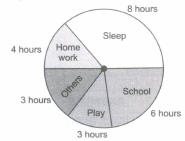
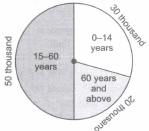
Read the following circle graphs and answer the questions given below:
(a) The time spent by a child during a day:
(i) On which activity maximum number of hours are spent?
(ii) On which two activities does he spend equal number of hours?
(iii) Find the central angles for each sector of activities
(b) Age group of people in a town:
(i) In which age group are the maximum number of people?
(ii) How many people are there is the '0-14 years' group?
(iii) Find the central angle of the sector corresponding to the age group 15-60 years'.
36.
Write the additive inverse of the following: \(\frac { -21 }{ 112 } \)
37.
Take a clock and fix its minute hand at 12.
Record the angle turned through by the minute hand from its original position and the time that has passed, in the following table:
| Time Passed (T) (in minutes) |
(T1) 15 | (T2) 15 | (T3) 45 | (T4) 60 |
|---|---|---|---|---|
| Angle turned (A) (in degree) | (A1) 90 | (A2) __ | (A3) __ | (A4) __ |
| \(T\over A\) | - | - | - | - |
What do you observe about T and A? Do they increase together? Is \(T\over A\) same every time?
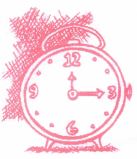
Is the angle turned through by the minute hand directly proportional to the time that has passed? Yes; From the above table, you can also see
T1 : T2 = A1 A2, because
T1 : T2 = 15 30= 1 :2
A1 : A2 = 90 180 = 1 :2
Check if T2: T3 = A2 A3 and T3 : T4 = A3 : A4
You can repeat this activity by choosing your own time interval.
1.
Area = \(\frac { 4\times (1+2) }{ 2 } \)=6 cm2
2.
(b)
\(\pi\)r2h
3.
\(\sqrt{100}=10\)
4.
2 x 36 = 72.
5.
- 7x2y3z = (- 7xy)(xy2z).
6.
ax2y + bxy2 + cxyz = xy (ax + by + cz)
7.
(a)
-5xz
8.
(a)
1
9.
(a)
11 units
10.
11.
(c)
a negative rational number
12.
(c)
\(\frac{10}{11}+ \frac{11}{12}=\frac{11}{12}\div \frac{10}{11}\)
13.
()
5
14.
()
Directly
15.
For large number of observations, groups of equal width i.e. class interval are organised.
16.
()
Parallelogram
17.
()
| Numbers | Associative for | |||
| Addition | Subtraction | Multiplication | Division | |
| Rational numbers | Yes \(e.g {-1\over2} + [{3\over7}+{-4\over3}]\\ =[{-1\over2}+{3\over7}]+({-4\over3})
\\ \Rightarrow {-1\over2}+({9-28\over21}) \\ = ({-7+6\over14}) -{4\over3} \\ \Rightarrow -
{1\over2}-{19\over21}={-1\over14}-{4\over3} \\ \Rightarrow{-59\over42}={-59\over42},\) which is true |
No \(e.g {-2\over3} -({-4\over5}-{1\over2}) \\ \neq [{-2\over3}-({-4\over5})]-{1\over2}\\ \Rightarrow{-2\over3} - ({-8-5\over10})\neq [{-10+12\over15}]-{1\over2} \\ \Rightarrow -{2\over3}+{13\over10}\neq {2\over15}-{1\over2}\\ \Rightarrow {-20+39\over30}\neq {4-15\over30}\Rightarrow {19\over30}\neq {-11\over30}\) which is not true. |
Yes e.g \({2\over3} \times({-6\over7}\times{4\over5})\\ =({2\over3}\times {-6\over7})\times {4\over5}\\ \Rightarrow {2\over3} \times ({-24\over35}) \\ {-12\over21} \times{4\over5} \\ \Rightarrow {-16\over35}={-16\over35},\) which is true. |
No which is not true |
18.
\(\frac{-8}{9} \times (\frac{-4}{7}) = \frac{32}{63}\)
\(\frac{-4}{7} \times (\frac{-8}{9})=\frac{32}{63}\)
So, \(\frac{-8}{9}\times (\frac{-4}{7})=\frac{-4}{7} \times (\frac{-8}{9})\)
19.
1.5 \(\times\) 1011
20.
6.3072 x 10⁷ s
21.
We know that, a number ends with 2, 3, 7 or 8 is neverapeIfea square.
The number 2061 ends with 1, so it may or may not be a perfect square.
But 452 = 45\(\times\)45 = 2025, 462 = 46\(\times\)46 = 2116
So, 2061 is not a perfect square
Five numbers for which we can decide by looking at their one's digit that they are not square numbers are 268, 43112, 87547, 1233 and 193.
22.
we have, \(19\over-6\) so, additive inverse of \(19\over-6\) is \(19\over6\)
23.
23
24.
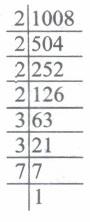
We have 1008 = 2 x 2 x 2 x 2 x 3 x 3 x 7
As the prime factor 7 has no pair.
\(\therefore\)1008 is not a perfect square.
Obviously, if 7 gets a pair, then the number will become a perfect square.
\(\therefore\)1008 x 7
= [2 x 2 x 2 x 2 x 3 x 3 x 7] x 7
or 7056 = 2 x 2 x 2 x 2 x 3 x 3 x 7 x 7
Thus, 7056 is the required multiple of 1008
which is a perfect square.
Now, \(\sqrt{7056}\) = 2 x 2 x 3 x 7 = 84
25.
Total number of outcomes = 10
(i) ∴ One card is having 7 on it
∴ Number of favourable outcome =
⇒ Probability of getting a card having 7 on it = \(1\over10\)
(ii) ∵ Only one card IS having two digit number (i.e., 10)
∴ Number of favourable outcome =
⇒ Probability of getting a card having 10
(two diizgiit number) on it = 1/10
(iii) ∴ The numbers less than 5 are I, 2, 3,
and 4
∴ Number of favourable outcomes = 4
⇒ Probability of getting a number less then \(5={4\over10}\ or\ {2\over5}\)
(iv) The numbers more than 5 are 6, 7, 8, 9 and 10.
∴ Number of favourable outcomes = 5
⇒ Probability of getting a number more than \(5={5\over10}\ or\ {1\over5}\)
26.
(i) The class interval = [Upper limit of a class] - [Lower limit of the same class] = 225 - 200 = 25
(ii) The class 300 - 325 is having the lowest frequency (which is 17).
(iii) The class 375 - 400 is having the highest frequency (which is 120).
(iv) The class intervals 275-300 and 350 - 375 have the same frequency (which is 45).
(v) The lower limit of the class interval 300 - 325 is 300.
(vi) The upper limit of the class interval 275 - 300 is 300.
27.
(r2 +1)(r4+1)
28.
Given, number is 614125.
So, groups of 614125 are
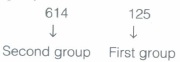
In the first group, the number 125 ends with 5. We know that, 5 comes at the unit's place of a number only when its cube ends in 5.
So, 5 will come at unit's place.
Now, in the second group, the number is 614
∵ (8)3 = 512 and (9)3=729
and 512 < 614 < 729
So, ten's place of required cube root is 8.
Hence, \(\sqrt [ 3 ]{ 614125 } \) = 85
29.
\((\frac{2}{3})^{-2}\times(\frac{2}{3})^{5}\)=\((\frac{2}{3})^{-2+5}\)=\((\frac{2}{3})^{3}=\frac{(2)^{3}}{(3)^{3}}\)
=\(\frac{2\times2\times2}{3\times3\times3}=\frac{8}{27}\)
30.
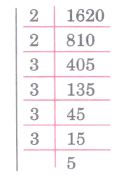
The prime factorisation of 1620 is
1620 = 2\(\times\)2\(\times\)3\(\times\)3\(\times\)3\(\times\)3\(\times\)5
By pairing the prime factors, we get
1620 =\(\underline { 2\times 2 } \)\(\times\)\(\underline { 3\times 3 } \)\(\times\)\(\underline { 3\times 3 } \)\(\times\)5
We see that the prime factor 5 has no pair. So, if we divide 1620 by 5, then we get
1620 ÷ 5 =\(\underline { 2\times 2 } \)\(\times\)\(\underline { 3\times 3 } \)\(\times\)\(\underline { 3\times 3 } \)
Now each factor has a pair. Therefore, 1620 ÷ 5 = 324 is a perfect square. Thus, the required smallest number is 5
Hence, \(\sqrt { 324 } \)= 2\(\times\)3\(\times\)3= 18
31.
\(\begin{matrix} \quad \quad 1\quad 2\quad A \\ +\quad 6\quad A\quad B \\ \_ \_ \_ \_ \_ \_ \_ \_ \_ \\ \quad A\quad 0\quad 9 \\ \_ \_ \_ \_ \_ \_ \_ \_ \_ \_ \end{matrix}\)
Here, we have two letters A and B whose values are to be found.
Studying the addition in ten's column. We have 2 + A and we get 0 from this. Therefore, A must be 8, since A will be one digit number, then the puzzle becomes
\(\begin{matrix} \quad \quad 1\quad 2\quad 8 \\ +\quad 6\quad 8\quad B \\ \_ \_ \_ \_ \_ \_ \_ \_ \_ \\ \quad 8\quad 0\quad 9 \\ \_ \_ \_ \_ \_ \_ \_ \_ \_ \_ \end{matrix}\)
Now, studying the addition in one's column. We have 8 + B and we get 9 from this. So, B must be 1.
Thus, the puzzle is solved as shown below:
\(\begin{matrix} \quad \quad 1\quad 2\quad 8 \\ +\quad 6\quad 8\quad 1 \\ \_ \_ \_ \_ \_ \_ \_ \_ \_ \\ \quad 8\quad 0\quad 9 \\ \_ \_ \_ \_ \_ \_ \_ \_ \_ \_ \end{matrix}\)
Hence, A = 8 and B = 1.
32.
\(-256\over35\)
33.
()
(xy-1)(19-z)
34.
()
3
35.
()
(i) Sleep (ii) Play and others
(iii) Sleep 120°, school 90°, home work 60°; play 45°, others 45°
36.
()
The additive inverse of\(\frac { 21 }{ 112 } \) is \(\frac { -21 }{ 112 } \)
37.
| Time Passed (T) (in minutes) |
(T1) 15 | (T2) 15 | (T3) 45 | (T4) 60 |
|---|---|---|---|---|
| Angle turned (A) (in degree) | (A1) 90 | (A2) __ | (A3) __ | (A4) __ |
| \(T\over A\) | \({15\over 90}={1\over6}\) | \({30\over 180}={1\over6}\) | \({45\over 270}={1\over6}\) | \({60\over 360}={1\over6}\) |
We observe about T and A that they increase together and is \(T\over A\) same every time.
Yes; The angle turned by the minute hand is directly proportional to the time that has passed.
On checking, we find that
T2 : T3 = A1 : A3 = 2: 3
and T3 : T4 = A3 : A4 = 3 : 4

8th Standard CBSE Syllabus & Materials
8th Standard CBSE
CBSE 8th Science Particulate Nature of Matter - New Model Questions Papers Study Material - QB365 Set A
NEW8th Standard CBSE
CBSE 8th Science Pressure, Winds, Stroms and Cyclones - New Model Questions Papers Study Material - QB365 Set A
NEW8th Standard CBSE
CBSE 8th Mathematics Quadrilaterals - New Model Questions Papers Study Material - QB365 Set A
NEW8th Standard CBSE
CBSE 8th Mathematics A story of Numbers - New Model Questions Papers Study Material - QB365 Set A



CBSE 8th Standard CBSE Subjects
CBSE Standards




