
 100% FREE ACCESS
8th Standard Syllabus & Materials
8th Standard
TN 8th Tamil இயல் 3 - கல்வி கரையில - வினைமுற்று Important Questions And Answers Study Material - QB365 Set A
NEW8th Standard
TN 8th Tamil இயல் 2 - ஈடில்லா இயற்கை - மயங்கொலிகள் Important Questions And Answers Study Material - QB365 Set A
NEW8th Standard
TN 8th Tamil இயல் 2 - ஈடில்லா இயற்கை -பட்டமரம் Important Questions And Answers Study Material - QB365 Set A
NEW8th Standard
TN 8th Tamil இயல் 2 - ஈடில்லா இயற்கை - இயற்கையை போற்றுவோம் Important Questions And Answers Study Material - QB365 Set A
NEW8th Standard
TN 8th Tamil இயல் 1 - தமிழ் இன்பம் - ஆழிக்கு இணை Important Questions And Answers Study Material - QB365 Set A
NEW8th Standard
TN 8th Tamil இயல் 2-ஈடில்லா இயற்கை - திருக்குறள் Important Questions And Answers Study Material - QB365 Set A

Published on: 04/02/2020
8th Standard Maths Creative Important Question For All Chapter
Download Tamil Nadu 8th Standard Maths question papers, model tests, one-mark questions, important questions, and public exam papers in PDF format. Free study materials and answer keys for TN State Board students.
Questions + Answers key
Take MCQ Maths Test1.
Simplify (-2x - 2y - 10) + (x +Y + 5)
2.
(x2- 4) + (x2 + 4) + 16. Simplify
3.
Simplify (pq - qr)2 + 4pq2r
4.
Factorize 6x3 - 92 + 3x
5.
Factorize - xy - ay
6.
Factorize 6 ab + 12 bc
7.
Evaluate 992 using identity
8.
Expand 9a2 - 16b2
9.
(7x - 5)2 Expand
10.
Expand (xy +yx)2
11.
Simplify (ab - q)2+ 2abc
12.
Multiply (pz - 2r) (pq - 2r)
13.
Multiply (p + 6), (q - 7).
14.
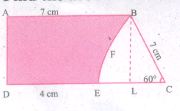
Find the area of the shaded region.
15.
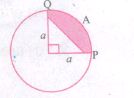
Find the area of the shaded portion.
16.
If the perimeter of a semicircle is 36 cm find its diameter.
17.
Find r1 + r2 if the sum of the areas of two circles with radii r1 and r2 is equal to the area of a circle of radius r.
18.
The cost of 2\(\frac{1}{3}\)metres of cloth is 275 \(\frac{1}{4}\). Find the cost cloth meter.
19.
Divide the sum of \(\frac{-13}{5}\) and \(\frac{12}{7}\) by the product of \(\frac{-31}{7}\) and \(\frac{-1}{2}\).
20.
Find three rational numbers between -2 and 5 by average method.
21.
What should we multiply with \(\frac{-15}{28}\)to get \(\frac{-5}{7}?\)
22.
What should we multiply with \(\frac{-1}{6}\)to get \(\frac{-23}{9}?\)
23.
Multiply \(\frac{-11}{13}\)by\(\frac{-21}{7}\)
24.
Evaluate \(\frac { -6 }{ 13 } -\frac { -7 }{ 13 } \)
25.
Subtract \(\frac{-2}{3}\)from \(\frac{5}{6}\)
26.
\(\frac { 5 }{ 9 } +\frac { -11 }{ 6 } \).
27.
Add \(\frac{31}{-4}\)and \(\frac{-5}{8}\)
28.
Factorize:9a2 -16b2
29.
Factorize:x2+xy+8x+8y
30.
Factorize :12x3y4+16x2y5-4x5y2
31.
Factorize:7(2x + 5) + 3 (2x + 5)
32.
Evaluate :
(2x+3y)(2x-3y)
33.
Evaluate:
(2x-3y)2
34.
Evaluate:
(2x+3y)2
35.
Divide 6x3y2z2 by 3x2yz
36.
Divide. -72x2yz by -12yz
37.
Divide :25x3y2 by -15x2y
38.
Divide. -15a2 bc3 by 3ab
39.
Divide:12x3y3 by 3x2y
40.
Find the product of the following
(3mn, 4np)
41.
Find the product of the following
(4a, 3a2)
42.
Find the product of the following
(2x2, 5y2)
43.
Find the product of the following.
(10x, 5y)
44.
Find the product of the following: (x,y)
45.
Is subtraction is commutative for rational numbers. Give an example,
46.
Verify addition of rational numbers is closed using \(\frac{1}{4}\) and \(\frac{2}{3}\).
47.
Simplify \(\left( \frac { -7 }{ 18 } \times \frac { 15 }{ -7 } \right) -\left( 1\times \frac { 1 }{ 4 } \right) +\left( \frac { 1 }{ 2 } \times \frac { 1 }{ 4 } \right) \)
48.
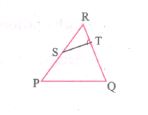
In the given figure if \(\angle \)P =\(\angle \)RTS, prove that \(\triangle \)RPQ ~\(\triangle \) RTS.
49.
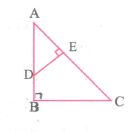
In the figure AB\(\bot \) BC and DE\(\bot \)AC prove that \(\triangle \)ABC ~\(\triangle \)AED.
50.
In the given figure if \(\angle \)A =\(\angle \)C then prove that \(\triangle \)AOB ~\(\triangle \)COD
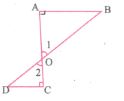
51.
In the given figure if \(\frac { AO }{ OC } =\frac { BO }{ OD } =\frac { 1 }{ 2 } \) and AB=5cm. Find the value of DC.
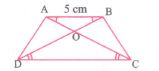
52.
Divide \(\frac{2}{3}\) by \(\frac{-7}{12}\)
53.
Is it possible to construct a quadrilateral PQRS with PQ = 5 cm, QR = 3 cm, RS = 6 cm, PS = 7 cm and PR = 10 cm. If not, why?
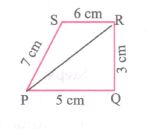
54.
In the figure, DA = DC and BA = BC. Are the triangles DBA and DBC congruent? Why?
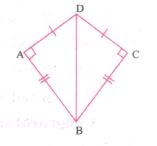
55.
Match the following by their congruence
| S.No. | A | B | |
| 1. | 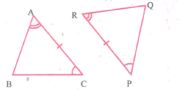 |
(i) | RHS |
| 2. | 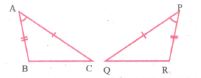 |
(ii) | SSS |
| 3. | 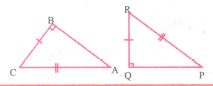 |
(iii) | SAS |
| 4. | 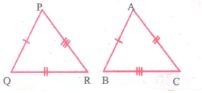 |
(iv) | ASA |
56.
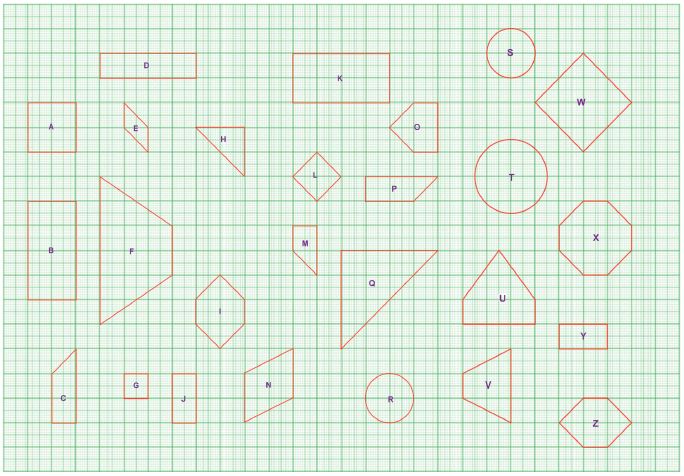
Identify the pairs of figures which are similar and congruent and write the letter pairs.
57.
Divide 1 by \(\frac{1}{2}\)
58.
Subtract \(\frac{6}{17}\) and \(\frac{7}{4}17\)
59.
Subtract \(\frac{3}{4}\) and \(\frac{7}{4}\)
60.
Add \(\frac{7}{9}\) and \(\frac{-12}{9}\)
61.
Add \(\frac{3}{5}\) and \(\frac{13}{5}\)
62.
What is the least number of planes that can enclose a solid? What is the name of the solid?
63.
Find the area of the sector whose arc length is 20 cm and radius is 7 cm
64.
Find the length of arc if the perimeter of a sector is 65 cm and radius is 20 cm.
65.
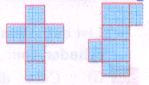
Find the area of the given nets.
66.
List out atleast three objects in each category which are in the shape of cube, cuboid, cylinder, cone and sphere.
67.
In the above example split the given mat as into two trapeziums and verify your answer
68.
All the sides of a rhombus are equal. Is it a regular polygon?
69.
If the radius of a circle is doubled, what will the area of the new circle so formed?
70.
Fill the central angle of the shaded sector (each circle is divided into equal sectors)
71.
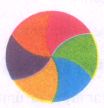
The given circular figure is divided into six equal parts. Can we call the parts as sectors? Why?
72.
A company puts a code on each different product they sell. The code is made up of 3 numbers and 2 letters. How many different codes are possible?
73.
A fast food restaurant has a meal special Rs.50 for a drink, sandwich, side item and dessert. The choices are Sandwich : Grilled chicken, AU beef patty, Vegeburger and Fill filet.
Side: Regular fries, cheese fries, potato fries
Dessert: Chocolate chip cookie or Apple pie.
Drink: Fanta, Dr. Pepper, Coke, Diet coke and sprite.
How may meal combos are possible?
74.
Factorize x2 -6x- 8
75.
Factorize x2 -7x- 8
76.
Factorize r2 - 12x + 20
77.
Divide -121p4 q2r2 \(\div\) (-11pqr)
78.
Divide (3x4 - 1875) \(\div\) by (3x2-75)
79.
Divide 76x 5y3 z3 \(\div\)19x2y2
80.
Find the length of breadth of a rectangle with area x2- 3x + 2.
81.
Simplify \(\left( \frac { 13 }{ 7 } \times \frac { 11 }{ 26 } \right) -\left( \frac { -4 }{ 3 } \times \frac { 5 }{ 6 } \right) \)
82.
What number should be subtracted from \(\frac{-5}{3}\) to get \(\frac{5}{6}\)?
83.
Simplify \(\frac { 2 }{ 5 } +\frac { 8 }{ 3 } +\frac { -11 }{ 15 } +\frac { 4 }{ 5 } +\frac { -2 }{ 3 } \)
84.
Simplify 1+\(\frac{-4}{5}\)
85.
Add and simplify in mixed fraction \(\frac{-12}{5}\)and \(\frac{43}{10}\)
86.
Factorize
4x2-4xy+y2-9z2
87.
Factorize
4a2 - 4a + 1
88.
Factorize
x2+8x+16
89.
Factorize
81a2-121b2
90.
Evaluate the following 95 x 97
91.
Evaluate the following
56X48
92.
Evaluate the following
107\(\times\)103
93.
Evaluate the following (y-7)(y+3)
94.
Evaluate the following (2x-3)(2x+5)
95.
Divide 32m2n3p2 by 4mnp
96.
Divide 16m3y by 4m2y
97.
Divide -72a4b5c8 by -9a2b2c3
98.
Divide 72xyz2 by-9xz
99.
Divide -21abc2 by 7abc
100.
Divide 24a3b3 by -8ab
101.
Divide 15m2n3 by 5m2n2
102.
Find the product of the following.
2.1 a2bc by 4ab2
103.
Find the product of the following
\(\cfrac { 3 }{ 14 } { x }^{ 2 }yby\cfrac { 7 }{ 2 } { x }^{ 4 }y\)
104.
Find the product of the following.
\(\cfrac { -8 }{ 5 } { x }^{ 2 }{ yz }^{ 2 }by-\cfrac { 3 }{ 4 } { xy }^{ 2 }z\)
105.
Find the product of the following
\({ 4x }^{ 2 }yzby\cfrac { 3 }{ 2 } { x }^{ 2 }{ yz }^{ 2 }\)
106.
Find the product of the following
3ab2c3 by 5a3b2c
107.
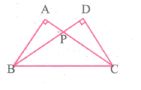
Two triangles BAC and BDC right angled at A and D respectively are drawn on the same base BC and on the same side of BC. If AC and DB intersect at P. Prove that AP x PC = DP x PB.
108.
In the figure with respect to \(\triangle \)BEP and \(\triangle \)CPD prove that BP x PD = EP x PC.
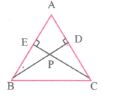
109.
D is a point on the side BC. Such that \(\angle \)ADC = \(\angle \)BAC. Prove that \(\frac { CA }{ CD } =\frac { CB }{ CA } \) or CA2 = CBXCD.
110.
Simplify \(=\frac { -12 }{ 10 } +\left( \frac { -90 }{ 15 } \right) -\left( \frac { 3 }{ 8 } \right) \)
111.
The product of two rational numbers is \(\frac{-28}{81}\). If one of the number is \(\frac{14}{27}\). find the other number.
112.
What number should be subtracted from \(\frac{7}{3}\) to get \(\frac{5}{4}?\)
113.
Add \(\frac{4}{-3}\) and \(\frac{8}{15}\)
114.
A circular arc whose radius is 12 cm makes an angle 30° at the center. Find the perimeter of the sector formed (ㅠ = 3.14)
115.
Find the length of an arc if the radius of the circle is 14 cm and area of the circle is 63 cm2.
116.
Verify Eulers formula for a triangular prism
117.
Verify Euler's formula for a pyramid.
118.
Find the length of arc whose radius is 42 cm and central angle is 600
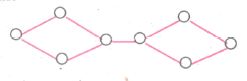
119.
Colour the graph with minimum number of colours and no two adjacent vertices should have the same colour.
120.
If m - n = 16 and m2 + n2 = 400 find mn.
121.
If (x +y) = 13 and xy = 28, find x2+y2
122.
If a + b = 25, a2+ b2 = 225 find ab
123.
If p + q = 12 and pq = 22 find p2 + q2
124.
The area of a square is 4x2- + 12xy + 9y2-. Find its side.
125.
Factorize
(x+1)2-(x-2)2
126.
Factorize
100 (x +y)2 - 81 (a + b)2
127.
Factorize
(p + q)2 - (a - b)2 + P + q - a + b
128.
Factorize
x16-y16+x8+y8
129.
Factorize
9-a6+2a3-b6
130.
Factorize
x2+2xy+y2-a2+2ab-b
131.
If 3x + 2y = 12 and xy = 6 find the value of 9x2+4y2
132.
If x+y=12 and xy=14 find x2+y2
133.
Divide
\(\cfrac { 2 }{ 3 } { a }^{ 2 }{ b }^{ 2 }{ c }^{ 2 }+\cfrac { 4 }{ 3 } { ab }^{ 2 }{ c }^{ 3 }-\cfrac { 1 }{ 5 } { ab }^{ 3 }{ { c }^{ 2 } }by\cfrac { 1 }{ 2 } abc\)
134.
Divide.6x2yz-3xy3z+8x2yz4 by 2xyz
135.
Divide 24x3y+20x2y2-4xy by 2xy
136.
Divide.9m5+12m4-6m2 by 3m2
137.
Simplify (5 -x) (3 - 2x) (4 - 3x).
138.
Simplify (3x-2)(x-1)(3x+5).
139.
Rearrange suitably and apply the properties to simplify \(\left( \frac { 6 }{ 7 } \times \frac { 2 }{ 3 } \right) +\left( \frac { 9 }{ 11 } +\frac { 2 }{ 3 } \right) +\left( \frac { 2 }{ 3 } \times \frac { 4 }{ 9 } \right) \)
140.
In the given figure if \(\frac { QT }{ PR } =\frac { QR }{ QS } \) and \(\angle \)1 = \(\angle \)2.Prove that \(\triangle \)PQS ~\(\triangle \)TQR.
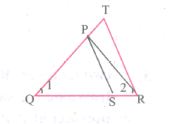
141.
Verify associative property for addition of rational numbers for \(a=\frac{5}{6}, b=\frac{-3}{4},c=\frac{4}{7}\)
142.
P and Q are points on sides AB and AC respectively of \(\triangle \)ABC. If AP = 3 cm PB = 6cm, AQ = 5 cm and QC = 10 cm, show that BC = 3 PQ.
143.
An athletic track 14 m wide consists of two straight sections 120 m long joining semicircular ends whose inner radius is 35 m. Calculate the area of the shaded region.
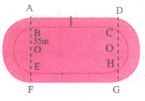
144.
Find the area of the shaded region in the figure.
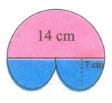
145.
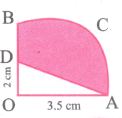
In the figure AOBCA represents a quadrant of a circle of radius 3.5cm D with center 'O' calculate the area of the shaded portion \(\left( \pi =\frac { 22 }{ 7 } \right) \)
146.
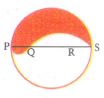
PQRS is a diameter of a circle of radius 6 cm. The lengths PQ, QR and RS are equal semi-circles drawn on PQ and QS as diameters. Find the perimeter and area of the shaded region
147.
An arc of a circle is of length 5π cm and the sector it bounds has an area of 20π cm2 Find the radius of the circle.
148.
A sector is cut from a circle of radius 21 cm. The angle of the sector is 150°. Find the length of its arc and area of the sector.
149.
Tabulate the number of faces(F), vertices (V) and edges(E) for the following polyhedron. Also find F + V - E
150.
If π = \(\frac{22}{7}\) show that the area of the unshaded part of a square of side 'a' units is approximately \(\frac{3}{7}\) a2 sq. units and that of the shaded part is approximately \(\frac47\) a2 sq. units for the given figure.

151.
Multiplicative identity is _______.
1
0
the given number itself
reciprocal of the given number
152.
Common factor of 3ab and 2pq is _________.
1
-1
a
c
153.
On dividing 57p2 qr by 114 pq we get __________.
\(\frac{1}{4}\)pr
\(\frac{3}{4}\)pr
\(\frac{1}{2}\)pr
2pr
154.
Square of (3x - 4y) is _______.
9x2-16y2
6x2-8y2
9x2+ 16y2 + 24xy
9x2 + 16y2-24xy
155.
Product of 6a2 - 7b + ab and 2ab is __________.
12a3b - 14ab2 + 10 ab
12a3b - 14ab2 + 10 a2b2
6a2b - 7b2 + 7 ab
12a2b -7ab2 + 10 ab
156.
Volume of the rectangle 1 = 2ab, b = 3ac and h = 2ac is _________.
12a2bc2
12a2bc
12a2 bc
2ab + 3ac + 2 ac
157.
A closed plane figure formed by three or more sides is called a
quadrilateral
pentagon
triangle
polygon
158.
Perimeter of a sector is
\(\frac{lr}{2}\)
\(\frac{l+r}{2}\)
l+2r
\(\pi\)+2
159.
A part of the circumference of a circle is called
circular arc
segment
sector
chord
160.
If V = 6, E = 12 then the faces of the polyhedron is
6
7
8
9
161.
In 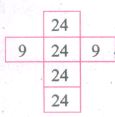 if the faces shows the area in the net, then the shape mentioned is
pyramid
Cube
cuboid
prism
162.
\(\frac { 1 }{ 2 } \times \left( \frac { 2 }{ 3 } +\frac { 6 }{ 4 } \right) =\left( \frac { 1 }{ 2 } +\frac { 2 }{ 3 } \right) +\left( \frac { 1 }{ 2 } \times \_ \_ \right) \)
\(\frac{1}{2}\)
\(\frac{2}{3}\)
\(\frac{4}{6}\)
0
163.
\(\frac{5}{6}\div\frac{6}{2}\) is
\(\frac{5}{2}\)
\(\frac{2}{5}\)
\(\frac{5}{18}\)
\(\frac{30}{12}\)
164.
(a) \(\frac { x }{ 2 } \) = 10 (i) x = 4
(b) 20 = 6x – 4 (ii) x = 1
(c) 2x – 5 = 3 – x (iii) x = 20
(d) 7x – 4 – 8x = 20 (iv) x = \(\frac { 8 }{ 3 } \)
(e) \(\frac { 4 }{ 11 } \)- x = \(\frac { -7 }{ 11 } \) (v) x = –24
(i), (ii), (iv), (iii), (v)
(iii), (iv), (i), (ii), (v)
(iii), (i), (iv), (v), (ii)
(iii), (i), (v), (iv), (ii)
165.
Common factor of 12a2b2+ 4ab2 - 32 is 4.
166.
(a+b)(a-b) = a2 - b2
167.
p2q + q2 r + r2 is a binomial
168.
Product of two negative terms is a negative term
169.
(a + b)2 = a2 + b2
170.
\(\frac { 4 }{ 3 } \times \frac { 3 }{ 11 } =\frac { 12 }{ 11 }\)
171.
\(\frac { 5 }{ 6 } -\frac { 11 }{ 12 } =\frac { -1 }{ 12 } \)
172.
Factorisation of 18 mn + 10 mnp is = ___________.
173.
The factorization of 2x + 4y is ________.
174.
On simplificaiton \(\frac{3x+3}{3}\) = ________.
175.
The area of the circle is 220 cm2. What is the area of the square inscribed in it?
176.
Find the area of the larger triangle that can be inscribed in a semi circle of radius 'r' cm.
177.
The circumference of a circle is 100 cm. Find the side of the square inscribed in the circle.
178.
The radius of a wheel is 0.25m, how many revolutions are needed to travel a distance of 11 km?
179.
If a wire is bent to the shape of a square, the area of the square is 81cm2. If it is bent to a semi-circle then find the area of the semicircle?
180.
If the difference between the circumference and radius of a circle is 37cm then find the circumference of the circle.
181.
Addition of rational numbers commutative, so a + b =_______.
182.
The additive inverse of -2 is __________.
1.
-2
2.
Given, (x² - 4) + (x² + 4) + 16
= x² - 4 + x² +4 +16
= x² + x² + 16
= 2x² + 16
3.
(a - b)² = a² - 2ab + b²
Here, a = pq and b = qr
(pq - qr)² + 4pq²r
= [(pq)² - 2pq²r + (qr)²] + 4pq²r
= (pq)² - 2pq²r + 4pq²r + (qr)²
= (pq)² + 2pq²r + (qr)²
(pq+qr)2
4.
3x(x-1)(2x-1)
5.
The first term -xy can be factorized as: (-1) × x × y and
The second term -ay can be factorized as : (-1) × a × y
The common factor for both the terms is -y
Taking out the common factor we get,
- xy - ay = -y(x + a)
6.
6b(a+2c)
7.
given, 992
= (100−1)2
= (100)2−2.100.1+(1)2
= 10000−200+1
= 99801
8.
9a2 - 16b2
= (3a)2−(4b)2
(3a+4b)(3a-4b)
9.
Using standard identity: (a + b)² = a² + 2ab + b²
Here, a = 7x and b = 5
(7x + 5)² = (7x)² + [2(7x)(5)] + 5²
49x2-70x+25
10.
4x2y2
11.
We have, (ab−c)2+2abc
[Using the identity, (x−y)2 = x2+y2−2xy]
= (ab)2 + c2− (2 × ab × c) + 2abc
= (ab)2 + c2 − 2abc + 2abc
a2b2+c2
12.
(p+6)×(q−7) = p(q−7) + 6(q−7)
p2q2+4r2-4pqr
13.
pq+6q-7p-42
14.
28.89 cm2
15.
\(\frac{a^2}{4}{\pi-2}\)
16.
Perimeter of semicircular protractor = 36 cm
πr + 2r = 36
⇒ (π+2)r = 36
⇒ \((\frac{22}{7}+2)\) = 36
⇒\(\frac{36}{7}\)r = 36
⇒ r = \(\frac{36\times 7}{36}\)
⇒ r = 7
Therefore, diameter = 2r = 2 × 7 = 14 cm
17.
= r2
18.
Rs. 32.25
19.
\(\frac{-2}{5}\)
20.
\(-\frac { 1 }{ 4 } ,\frac { 3 }{ 2 } ,\frac { 13 }{ 4 } \)
21.
\(\frac{4}{3}\)
22.
\(\frac{46}{3}\)
23.
\(\frac{33}{13}\)
24.
\(\frac{1}{13}\)
25.
\(\frac{3}{2}\)
26.
\(\frac{-17}{18}\)
27.
\(\frac{-67}{8}\)
28.
9a2-16b2 = (3a)2-(4b)2=(3a+4b)(3a-4b)
29.
x2+xy+8x+8y = x(x+y)+8(x+y)
= (x +y)(x + 8)
30.
12x3y4+16x2y5-4x5y2 = 4x2y2(3xy2+4y3-x3)
31.
7(2x + 5) + 3 (2x + 5) = (2x + 5)(7 + 3)
32.
[Using (a+b)(a-b) = a2-b2]
(2x + 3y) (2x - 3y) = (2x)2-(3y)2
= 4x2-9y2
33.
[ using (a - b)2=a2-2ab+b2]
(2x-3y)2 = (2x)2-2(2x)(3y)+(3y)2
= 4x2-12xy+9y2
34.
[using (a + b)2 = a2+2ab+b2]
(2x+3y)2 = (2x)2+2\(\times\)(2x)\(\times\)(3y)(3y)2
= 4x2+12xy+9y2
35.
\(\cfrac { { 6x }^{ 3 }{ y }^{ 2 }{ z }^{ 2 } }{ { 3x }^{ 2 }yz } =\cfrac { 6 }{ 3 } { x }^{ 3-2 }{ y }^{ 2-1 }{ z }^{ 2-1 }=2xyz\)
36.
\(\cfrac { -72{ x }^{ 2 }yz }{ -12xyz } =\cfrac { -72 }{ -12 } { x }^{ 2-1 }{ y }^{ 1-1 }{ z }^{ 1-1 }=6{ xy }^{ 0 }{ z }^{ 0 }=6x\)
37.
\(\cfrac { { 25x }^{ 3 }{ y }^{ 2 } }{ -15{ x }^{ 2 }y } =\cfrac { -25 }{ 15 } { x }^{ 3-2 }{ y }^{ 2-1 }=\cfrac { -5 }{ 3 } xy\)
38.
\(\cfrac { -15{ a }^{ 2 }{ bc }^{ 3 } }{ 3ab } =\cfrac { -15 }{ 3 } { a }^{ 2-1 }{ b }^{ 1-1 }{ c }^{ 3 }=-5a{ b }^{ 0 }{ c }^{ 3 }=-5{ ac }^{ 3 }\)
39.
\(\cfrac { 12{ x }^{ 3 }{ y }^{ 3 } }{ { 3x }^{ 2 }y } =\cfrac { 12 }{ 3 } { x }^{ 3-2 }{ y }^{ 3-1 }= 4xy ^ 2\)
40.
3mn x 4np = (3 x 4) (m x n x n x p) = 12 mn2p
41.
4a\(\times\)3a2 = (4\(\times\)3) (a\(\times\)a2) = 12a3
42.
2x2\(\times\)5y2 = (2\(\times\)5)\(\times\)(x2+y2)10x2y2
43.
10x\(\times\)5y = (10\(\times\)5) X\(\times\)Xy = 50xy
44.
x \(\times\) y = xy
45.
No, subtraction is not commutative for rational numbers.
Example: Let a = \(\frac{1}{2}\) and b = \(\frac{5}{6}\)
\(a-b=\frac { 1 }{ 2 } -\frac { 5 }{ 6 } =\frac { (1\times 3)-5 }{ 6 } =\frac { 3-5 }{ 6 } =\frac { -2 }{ 6 } =\frac { -1 }{ 3 } \quad \quad \quad ...(1)\)
\(b-a=\frac { 5 }{ 6 } -\frac { 1 }{ 6 } =\frac { 5 }{ 6 } -\frac { 3 }{ 6 } =\frac { 5-3 }{ 6 } =\frac { 2 }{ 6 } =\frac { 1 }{ 3 } \quad \quad \quad \quad \quad \quad ...(2)\)
From (1) and (2)
a - b ≠ b - a for rational numbers
46.
Let a = \(\frac{1}{4}\) and b \(\frac{2}{3}\)
\(a+b=\frac { 1 }{ 4 } +\frac { 2 }{ 3 } =\frac { (1\times 3)+(2\times 4) }{ 3\times 4 } \)
\(=\frac { 3+8 }{ 12 } =\frac { 11 }{ 12 } \) is in Q.
∴ Addition of rational numbers is closed.
47.
\(\left( \frac { -7 }{ 18 } \times \frac { 15 }{ -7 } \right) -\left( 1\times \frac { 1 }{ 4 } \right) +\left( \frac { 1 }{ 2 } \times \frac { 1 }{ 4 } \right) =\left( \frac { -7\times 15 }{ 18\times -7 } \right) \left( \frac { 1\times 1 }{ 1\times 4 } \right) +\left( \frac { 1\times 15 }{ 18\times 1 } \right) -\left( \frac { 1 }{ 4 } \right) +\left( \frac { 1 }{ 8 } \right) \)
\(\\ \\ =\frac { 5 }{ 6 } -\frac { 1 }{ 4 } +\frac { 1 }{ 8 } =\frac { (5\times 4)-(1\times 6)+(1\times 3) }{ 24 } \)
\(=\frac { 20-6+3 }{ 24 } =\frac { 14+3 }{ 24 } =\frac { 17 }{ 24 } \)
48.
In triangles \(\triangle \)RPQ and \(\triangle \) RTS, we have
\(\angle \)RPQ=\(\angle \)RTS [∵ given]
\(\angle \)PRQ =\(\angle \)TRS [∵ common]
\(\angle \)PQR =\(\angle \)RST l∵ Remaining angle]
\(\triangle \)RPQ ~ \(\triangle \)RTS [∵ By AAA similarity]
49.
In triangles \(\triangle \)ABC and \(\triangle \)AED.
\(\angle \)ABC=\(\angle \)AED = 90°
\(\angle \)BAC=\(\angle \)EAD [Each equal to A]
∴ \(\angle \)ADE=\(\angle \)ACB [∵ Remaining angles]
∴ By AAA criteria of similarity \(\triangle \)ABC ~\(\triangle \)AED.
50.
In triangles \(\triangle \)AOB and \(\triangle \)COD
\(\angle \)A =\(\angle \)C ( given)
\(\angle \)AOB =\(\angle \)COD [∵ Vertically opposite angles]
\(\angle \)ABO =\(\angle \)CDO l∵ Remaining angles of MOB and ~COD]
∴\(\triangle \)AOB ~\(\triangle \)COD [∵ AAA similarity]
∴ \(\triangle \)AOB ~\(\triangle \)COD [∵ AAA similarity]
51.
In \(\triangle \)AOB and \(\triangle \)COD, we have
\(\angle \)AOB =\(\angle \)COD [∵ Vertically opposite angles]
\(\frac { AO }{ OC } =\frac { BO }{ OD } \) [given]
So by SAS criteria of similarity we have \(\triangle \)AOB ~\(\triangle \)COD
\(\frac { AO }{ OC } =\frac { BO }{ OD } =\frac { AB }{ DC } \)
\(\frac { 1 }{ 2 } =\frac { 5 }{ DC } \) [∵ AB = 5cm]
DC = 2 x 5
DC = 10 cm.
52.
\(\frac { 2 }{ 3 } \div \frac { -7 }{ 12 } =\frac { 2 }{ 3 } \times \frac { 12 }{ -7 } =\frac { 2\times 12 }{ 3\times -7 } =\frac { 24 }{ -21 } =-1\)
53.
The lower triangle cannot be constructed as the sum of two sides 5 + 3 = 8 < 10 cm. So this quadrilateral cannot be constructed.
54.
Here AD = CD
AB = CB
DB = DB (common)
\(\triangle \)DBA \(\equiv \) \(\triangle \)DBC [∵ By SSS congruency]
Also RHS rule also bind here to say their congruency.
55.
1-(iv), 2-(iii), 3-(i), 4-(ii)
56.
Similar shapes:
(i) W and L
(ii) B and J
(iii) A and G
(iv) B and J
(v) B and Y
(vi) E and N
(vii) H and Q
(viii) R and T
(ix) S and T
Congruent shapes:
(i) Z and I
(ii) J and Y
(iii) C and P
(iv) B and K
(v) R and S
(vi) I and Z
You can find more.
57.
\(1\div \frac { 1 }{ 2 } =\frac { 1 }{ 1 } \times \frac { 2 }{ 1 } =\frac { 1\times 2 }{ 1\times 1 } =2\)
58.
\(\frac { 7 }{ 17 } -\frac { 6 }{ 17 } =\frac { 7-6 }{ 17 } =\frac { 1 }{ 17 }\)
59.
\(\frac { 7 }{ 4 } -\frac { 3 }{ 4 } =\frac { 7-3 }{ 4 } =\frac { 4 }{ 4 } =1\)
60.
\(\frac { 7 }{ 9 } +\frac { (-12) }{ 9 } =\frac { 7+(-12) }{ 9 } =\frac { -5 }{ 9 } \)
61.
\(\frac { 3 }{ 5 } +\frac { 13 }{ 5 } =\frac { 3+13 }{ 5 } =\frac { 16 }{ 5 } =3\frac { 1 }{ 5 } \)
62.
Least number of planes = 4, the solid is tetrahedron.
63.
Radius of the sector = 7 cm
Arc length of the sector = 20 cm
Area of sector = \(\frac { lr }{ 2 } =\frac { 20\times 7 }{ 2 } ={ 70cm }^{ 2 }\)
Area of the sector = 70 cm2
64.
Radius of the sector = 20 cm
Perimeter of the sector = 65 cm
l + 2r = 65
l + 2(20) = 65
l + 40 = 65
l = 65 - 40
l = 25 cm
Length of the sector = 25 cm
65.
(i) Area = 6 x Area of a square of side 6 cm
= 6 x (6 x 6) cm2
= 216 cm2
(ii) Area = Area of 2 rectangles of side (8 x 6) cm2 + Area of 2 rectangles of side (8 x 4) cm2 + Area of 2 rectangles of side (6 x4) cm2
= (8 x 6) + (8 x 4) + (6 x 4) cm2
= 48 + 32 + 24 cm2
= 104 cm2
66.
(i) Cube - dice, building blocks, jewel box.
(ii) Cuboid - books, bricks, containers.
(iii) Cylinder - candles, electric tube, water pipe.
(iv) Cone - Funnel, cap, ice cream cone
(v) Sphere - ball, beads, Lemmon.
67.
Area of the mat = Area of I trapezium + Area of II trapezium
= [ \(\frac12\)x h1 x (a1 + b1)] + [ \(\frac12\)x h2 x (a2 + b2)]
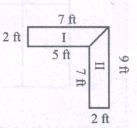
= [ \(\frac12\)x 2 x (7 + 5)] + \(\frac12\) x 2 x (9 + 7) sq. feet
= 12 + 16 = 28 sq.feet
∴ Cost per sq.feet = Rs.20
Cost for 28 sq. feet = Rs.20 x 28 = Rs.560
∴ Total cost for the entire mat = Rs.560
Both the answers are the same.
68.
For a regular polygon all sides and all the angles must be equal. But in a rhombus all the sides are equal, But all the angles are not equal.
∴ It is not a regular polygon.
69.
If r = 2 r1 ⇒ Area of the circle = πr2 = π (2r1)2 = π 4r12 = 4 πr12
70.
| Sector |  |
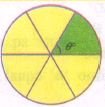 |
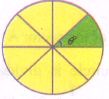 |
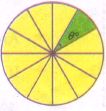 |
| Central angle \({ \theta }^{ o }=\frac { { 360 }^{ o } }{ n } \) | θo = 120o | θo = 60o | θo = 45o | θo = 30o |
71.
No, the equal parts are not sectors. Because a sector is a plane surface that is enclosed between two radii and the circular arc of the circle.
Here the boundaries are not radii.
72.
There are 5 stages, Number - 1
Number - 2
Number - 3
Letter - 1
Letter - 2
There are 10 possible numbers 0 to 9
There are 26 possible letters A to Z.
∴ We have 10 x 10 x 10 x 26 x 26 = 6,76,000 possible codes.
73.
There are 4 stages
1. Choosing a Sandwich
2. Choosing a side
3. Choosing a dessert
4. Choosing a drink
There are 4 different types of sandwich, 3 different types of side two different type of desserts and five different types of drink.
∴ The number of meal combos possible is = 4 x 3 x 2 x 5 = 120
74.
(x-2)(x-4)
75.
(x-8)(x+1)
76.
(x-2)(x-10)
77.
11 pqr
78.
(x2+25)
79.
4x3yz3
80.
Area of the rectangle = Length × Breadth
Now, find the factors of the given expression:
x² - 3x + 2 = x² - 2x - 1x + 2
= x(x - 2) - 1(x - 2)
= (x - 2)(x - 1)
Hence, the possible length and breadth of the given rectangle are (x - 2) and (x - 1).
81.
\(\frac{239}{126}\)
82.
\(\frac{-5}{2}\)
83.
\(\frac{37}{15}\)
84.
\(\frac{1}{5}\)
85.
1\(\frac{9}{10}\)
86.
4x2-4xy+y2-9z2 = (4x2-4xy+y2)-9z2
= {(2x)2-2(2x)(y)+y2}-(3z)2
= (2x-y)2-(3x)2=(2x-y+3z)(2x-y-3z)
87.
[\(\because\) using a2-2ab+b2 = (a-b)2]
4a2-4a+1 = (2a)2-2\(\times\)(2a)\(\times\)1+12
= (2a-1)2
= (2a-1)(2a-1)
88.
[\(\because\) using a2+2ab+b2 = (a+b)2]
x2+ 8x + 16 = x2+2\(\times\)x\(\times\)4+42
= (x+4)2
= (x+4)(x+4)
89.
[\(\because\) using a2-b2=(a+b)2]
81a2-121b2 = (9a)2-(11b)2
= (9a+11b)(9a-11b)
90.
95 x 97 =(100 - 5) x (l00 - 3) = {100 + (-5)} x {100 +(- 3)}
1002 + {(-5) + (-3)} x 100 + (-5)(-3)
10000 - 8 x 100 + 15= 10000 - 800 + 15 = 921
91.
56 x 48 = (50+6)X(50-2)=(50+6){50+(-2)}
502 + (6 + (-2)) x 50 + 6 x (-2)
2500 + 4 x 50 - 12 = 25000 - 200 - 12
2700 - 12 = 2688
92.
107\(\times\)103 = (100+7)\(\times\)(100+3) = 1002+(7+3)\(\times\)(100)+(7\(\times\)3)
= 10000+10\(\times\)100+21
= 1000+1000+21 = 11021
93.
[\(\because\) (x+a)(x+b)=x2(a+b)x+ab]
(y-7)(y+3)=y2+(-7+3)y+(-7)(3)
= y2-4y+(-21)=y2-4y-21
94.
[\(\because\) (x+a)(x+b)=x2+(a+b)x+ab]
(2x - 3) (2x + 5) = (2x)2 + (-3 + 5) (2x) + (-3) (5)
= 22x2+2X2x+(-15)
= 4x2+4x-15
95.
\(\cfrac { 32{ m }^{ 2 }{ n }^{ 3 }{ p }^{ 2 } }{ 4mnp } =\cfrac { 32 }{ 4 } { m }^{ 2-1 }{ n }^{ 3-1 }{ p }^{ 2-1 }={ 8m }n^{ 2 }p\)
96.
\(\cfrac { 16{ m }^{ 3 }{ y }^{ 2 } }{ { 4m }^{ 2 }y } =\cfrac { 16 }{ 4 } { m }^{ 3-2 }{ y }^{ 2-1 }=4\quad my\)
97.
\(\cfrac { -79{ a }^{ 4 }{ b }^{ 5 }{ c }^{ 8 } }{ -9{ a }^{ 2 }{ b }^{ 2 }{ c }^{ 3 } } =\cfrac { -72 }{ -9 } { a }^{ 4-2 }{ b }^{ 5-2 }{ c }^{ 8-3 }={ 8a }^{ 2 }{ b }^{ 3 }{ c }^{ 5 }\)
98.
\(\cfrac { 72xy{ z }^{ 2 } }{ -9xz } =\cfrac { -72 }{ -9 } { x }^{ 1-1 }{ y }^{ 2-1 }=-8{ x }^{ 0 }{ yz }^{ 1 }-8yz\)
99.
\(\cfrac { -21abc^{ 2 } }{ 7abc } =\cfrac { -21 }{ 7 } { a }^{ 1-1 }{ b }^{ 1-1 }{ c }^{ 2-1 }=-3{ a }^{ 0 }{ b }^{ 0 }{ c }^{ 1 }=-3{ { a }^{ 0 }{ b }^{ 0 }{ c }^{ 1 } }=-3c\)
100.
\(\cfrac { 24{ a }^{ 3 }{ b }^{ 3 } }{ -8ab } =\cfrac { 24 }{ -8 } { a }^{ 3-1 }{ b }^{ 3-1 }=-3{ a }^{ 2 }{ b }^{ 2 }\)
101.
\(\cfrac { 15{ m }^{ 2 }{ n }^{ 3 } }{ { 5m }^{ 3 }{ n }^{ 2 } } =\cfrac { 15 }{ 5 } ={ m }^{ 2-2 }{ n }^{ 3-2 }={ 3m }^{ 0 }n^{ 1 }=3n\)
102.
2.1a2bcX4ab2 = (2.1 x 4) x (a2 x a x b x b2 x c)
= 8.4 a2+1b1+2c = 8.4a3b3c
103.
\(\left( \cfrac { 3 }{ 14 } { x }^{ 2 }y \right) \left( \cfrac { 7 }{ 2 } { x }^{ 4 }y \right) =\left( \cfrac { 3 }{ 14 } \times \cfrac { 7 }{ 2 } \right) \times \left( { x }^{ 2 }\times { x }^{ 4 }\times y\times y \right) \)
= \(\cfrac { 3 }{ 4 } { x }^{ 2+4 }{ y }^{ 1+1 }=\cfrac { 3 }{ 4 } { x }^{ 6 }{ y }^{ 2 }\)
104.
\(\left( -\cfrac { 8 }{ 5 } { x }^{ 2 }{ yz }^{ 3 } \right) \times \left( -\cfrac { 3 }{ 4 } { xy }^{ 2 }z \right) =\left( -\cfrac { 8 }{ 5 } \times -\cfrac { 3 }{ 4 } \right) \times \left( { x }^{ 2 }\times x\times y\times z\times { z }^{ 2 } \right)\)
= \(\cfrac { 6 }{ 5 } { x }^{ 2+1 }{ y }^{ 3+1 }=\cfrac { 6 }{ 5 } { x }^{ 3 }{ y }^{ 2 }{ z }^{ 4 }\)
105.
\(\left( { 4x }^{ 2 }yz \right) \times \left( -\cfrac { 3 }{ 2 } { x }^{ 2 }{ yz }^{ 2 } \right) =\left( { x }^{ 2 }\times { x }^{ 2 }\times y\times y\times z\times { z }^{ 2 } \right)\)
= -6x2+2y1+1z1+2 = -6x4y2z3
106.
(3ab3c3)X(5a3b2c) =(3X5)(aXa3Xb2Xb2Xc3Xc)
= 15a1+3,b2+2,c3+1=15a4b4c4
107.
In \(\triangle \)APB and \(\triangle \)DPC
\(\angle \)A =\(\angle \)D = 90° [given]
\(\angle \)APB =\(\angle \)DPC [Vertically opposite angles]
\(\angle \)ABP =\(\angle \)DCP [Remaining angle]
∴ \(\triangle \)APB ~ \(\triangle \)DPC [AAA criteria]
\( \frac {AP }{ DP } =\frac { BP }{ PC }\) [Corresponding sides are proportional]
AP x PC = BP x DP
108.
In \(\triangle \)EPB and \(\triangle \)DPC,
\(\angle \)PEB =\(\angle \)PDC = 90° [given]
\(\angle \)EPB =\(\angle \)DPC [Vertically opposite angles]
\(\angle \)EPB =\(\angle \)PCD [∵ Remaining angles]
Thus, \(\triangle \)EPB ~ \(\triangle \)DPC [∵ By AAA criteria]
\(\frac { EP }{ DP } =\frac { PB }{ PC } \)
BP x PD = EP x PC
109.
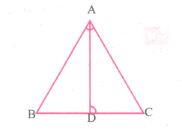
Proof:
In \(\triangle \)ABC and \(\triangle \)DAC we have,
\(\angle \)ADC =\(\angle \)BAC [ ∵ given ]
\(\angle \)L =\(\angle \)C [ ∵ common]
\(\angle \)ABC =\(\angle \)DAC [∵ Remaining angle]
\(\triangle \)ABC ~ \(\triangle \)DAC [∵ By AAA similarity]
⇒ \(\frac { AB }{ DA } =\frac { BC }{ AC } =\frac { AC }{ DC } \) [sides are proportional]
⇒ \( \frac { CB }{ CA } =\frac { CA }{ CD }\)
or CA2 = CB x CD.
110.
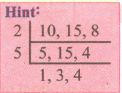
\(=\frac { (-12\times 12)+(-90\times 8)-(3\times 15) }{ 120 } \)
\(=\frac { -144+(-720)-45 }{ 120 } =\frac { -864-45 }{ 120 } \)
\(=\frac { -864+(-45) }{ 120 } =\frac { -909 }{ 120 } =\frac { -303 }{ 40 } \\ \)
111.
Let the other number be x
\(\frac { 14 }{ 27 } \times x=\frac { -28 }{ 81 } \)
\(x=\frac { -28 }{ 81 } \div \frac { 14 }{ 27 } =\frac { -28 }{ 81 } \times \frac { 27 }{ 14 } =\frac { -2 }{ 3 } \times \frac { 1 }{ 1 } =\frac { -2 }{ 3 } \)
\(\therefore\) other number \(=\frac{-2}{3}\)
112.
Let the number to be subtracted = x
\(\frac { 7 }{ 3 } -x=\frac { 5 }{ 4 } \)
\(\frac { 7 }{ 3 } -\frac { 5 }{ 4 } =x\)
\(x=\frac { (7\times 4)-(5\times 3) }{ 3\times 4 } =\frac { 28-15 }{ 12 } =\frac { 13 }{ 12 } =1\frac { 1 }{ 12 } \)
\(\frac{13}{12}\) should be subtracted
113.
\(\frac { 4 }{ -3 } +\frac { 8 }{ 15 } =\frac { -4 }{ 3 } +\frac { 8 }{ 15 } \)
LCM of 3 and 15 is 15
\(\frac { (-4\times 5)+(8\times 1) }{ 15 } \) 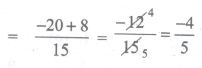
114.
Given that r = 12cm
θ = 30°
Length of the arc l = \(\frac { { \theta }^{ o } }{ { 360 }^{ o } } \times 2\pi r\)
= \(\frac { { 30 }^{ o } }{ { 360 }^{ o } } \) x 2 x 3.14 x 12
= \(\frac12\) x 2 x 3.14 x 12
l = 6.28 cm
Perimeter of.a sector = l + 2r
= 6.28 + 2 (12) cm
= 6.28 + 24 cm = 30.28 cm
Perimeter of the sector = 30.28 cm
115.
Radius of the circle = 14cm
Area of the circle = 63 cm2
Area of the circle = \(\frac { 1 }{ 2 } \)lr
\(\frac { 1 }{ 2 } \) l x r = 63
\(\frac { 1 }{ 2 } \) l x 14 = 63
l x 7 = 63
l = \(\frac{63}{7}\)
l = 9 cm
Length of the arc = 9 cm
116.
For a triangular prism
Faces = 5, Edges = 9, Vertices = 6
By Euler's formula F + V - E = 5 + 6 - 9
11 - 9 = 2
117.
A pyramid has faces = 5, Vertices = 5, Edges = 8
By Euler's formula F + V - E = 5 + 5 - 8 = 10 - 8 = 2
118.
Length of arc = \(\frac { { \theta }^{ o } }{ 360^{ o } } \times 2\pi r\) units
Given central angle θ = 600
Radius of the sector r = 42 cm
l = \(\frac { { 60 }^{ o } }{ { 360 }^{ o } } \times 2\times \frac { 22 }{ 7 } \times 42\) cm = 44 cm
∴ Length of the arc = 44 cm
119.
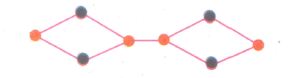
120.
72
121.
225
122.
200
123.
100
124.
(2x+3y)
125.
(x-1)2-(x-2)2={(x-1+(x-2)}{(x-1)-(x-2)}
= (2x-3)-(x-1-x+2)
= (2x-3)X1=2x-3
126.
100 (x +y)2 - 81 (a + b)2 = {10(x+y)}2-{(a(a+b)}2
= {10(x+y)+9(a+b)}{10(x+y)-9(a+b)}
= (10x + 10y+.9a- 9b)} (10x +10y - 9a- 9b)
127.
(p+q)2-(a-b)2+p+q-a+b = {(p+q)2-(a-b)2}+(p+q)-(a-b)}
= {(p+q)-(a-b)}{(p+q)-(a-b)+{(p+q)-(a-b)
={(P + q + a - b}+(p + q - a + b) + (p + q - a + b)
= (p+q -a+b)(p+q+a-b+ 1)
128.
x16-y16+x8+y8 = {(x8)2-(y8)2}+{x8+y8}
= (x8-y8)(x8+y8)+(x8+y8)
= (x8 +y8)+ (x8 - y8 + 1)
129.
9-a6+2a3-b6 = 9 - (a6 - 2a3b3 + b6),
= 32-{(a3)2-2Xa3Xb3+(b3)2}
= 32-(a3-b3)2
={3 +(a3 - b3)}{3 - (a3 - b3)}
= (3 + a3 - b3) (3 - a3 + b3)
= (a3 - b3 + 3)( - a3 + b3 + 3)
130.
x2+2xy+y2-a2+2ab-b2 =(x2+2xy+y2)-(a2-2ab+b2)
= (x+y)2-(a-b)2
= {(x+y)+(a-b)}{(x+y)-(a-b)}
= (x+y+a-b)(x+y-a+b)
131.
(3x + 2y)2 = (3xi +(2y)2 + 2 (3x) (2y)
=9x2 + 41 + 12xy
122 = 9x3 + 41 + 12 x 6
144 = 9x3+ 41 + 72
144-72 = 9x2+4y2
\(\therefore\) 9x3+4y2=72
132.
(x + y)2=x2+y2+2xy
122=x2+y2+2X14
144=x3+y2+28
x2+y2=116
133.
\(\cfrac { \frac { 2 }{ 3 } { a }^{ 2 }{ b }^{ 2 }{ c }^{ 2 }+\cfrac { 4 }{ 3 } { ab }^{ 2 }{ c }^{ 3 }-\cfrac { 1 }{ 5 } { ab }^{ 3 }{ c }^{ 2 } }{ \frac { 1 }{ 2 } abc } =\cfrac { \frac { 2 }{ 3 } { a }^{ 2 }{ b }^{ 2 }{ c }^{ 2 } }{ \frac { 1 }{ 2 } abc } +\cfrac { \frac { 4 }{ 3 } { ab }^{ 3 }{ c }^{ 3 } }{ \frac { 1 }{ 2 } abc } -\cfrac { \frac { 1 }{ 5 } a{ b }^{ 3 }{ c }^{ 3 } }{ \frac { 1 }{ 2 } abc } \)
= \(\cfrac { 2 }{ 3 } \times \cfrac { 2 }{ 1 } { a }^{ 2-1 }{ b }^{ 2-1 }{ c }^{ 2-1 }+\cfrac { 4 }{ 3 } \times \cfrac { 2 }{ 1 } { a }^{ 1-1 }{ b }^{ 2-1 }{ c }^{ 3-1 }-\cfrac { 1 }{ 5 } \times \cfrac { 2 }{ 1 } { a }^{ 1-1 }{ b }^{ 3-1 }{ c }^{ 2-1 }\)
= \(\cfrac { 4 }{ 3 } abc+\cfrac { 8 }{ 3 } { a }^{ 0 }{ bc }^{ 2 }-\cfrac { 2 }{ 5 } { a }^{ 0 }{ b }^{ 2 }c\)
= \(\cfrac { 4 }{ 3 } abc+\cfrac { 8 }{ 3 } { bc }^{ 2 }-\cfrac { 2 }{ 5 } { b }^{ 2 }c\)
134.
\(\cfrac { { 6x }^{ 4 }yz-{ 3xy }^{ 3 }+{ 8x }^{ 2 }{ yz }^{ 4 } }{ 2xyz } =\cfrac { { 6x }^{ 4 }yz }{ 2xyz } -\cfrac { 3xy^{ 2 }z }{ 2xyz } +\cfrac { { 8x }^{ 2 }{ yz }^{ 4 } }{ 2xyz } \)
= \(\cfrac { 6 }{ 2 } { x }^{ 4-1 }{ y }^{ 1-1 }{ z }^{ 1-1 }-\cfrac { 3 }{ 2 } { x }^{ 1-1 }{ y }^{ 3-1 }z^{ 1-1 }+\cfrac { 8 }{ 2 } { x }^{ 2-1 }{ y }^{ 1-1 }{ z }^{ 4-1 }\)
= \(3{ x }^{ 3 }{ y }^{ 0 }{ z }^{ 0 }-\cfrac { 3 }{ 2 } { x }^{ 0 }{ y }^{ 2 }{ z }^{ 0 }+{ 4xy }^{ 0 }{ z }^{ 3 }\)
= \({ 3x }^{ 3 }-\cfrac { 3 }{ 2 } { y }^{ 2 }-4{ xz }^{ 3 }\)
135.
\(\cfrac { { 24x }^{ 3 }y+20{ x }^{ 2 }{ y }^{ 2 }-4xy }{ 2xy } =\cfrac { 24{ x }^{ 3 }y }{ 2xy } +\cfrac { 20{ x }^{ 2 }{ y }^{ 2 } }{ 2xy } -\cfrac { 4xy }{ 2xy } \)
= \(\cfrac { 24 }{ 2 } { x }^{ 3-1 }y^{ 1-1 }+\cfrac { 20 }{ 2 } { x }^{ 2-1 }{ y }^{ 2-1 }-\cfrac { 4 }{ 2 } { x }^{ 1-1 }{ y }^{ 1-1 }\)
= 12x2y0+10xy-2x0y0=12x2+10xy-2
136.
\(\cfrac { 9{ m }^{ 5 }+12{ m }^{ 4 }-{ 6m }^{ 2 } }{ { 3m }^{ 2 } } =\cfrac { { 9m }^{ 5 } }{ { 3m }^{ 2 } } +\cfrac { { 12m }^{ 4 } }{ { 3m }^{ 2 } } -\cfrac { { 6m }^{ 2 } }{ { 3m }^{ 2 } } \)
= \(\cfrac { 9 }{ 3 } { m }^{ 5-2 }+\cfrac { 12 }{ 3 } { m }^{ 4-2 }-\cfrac { 6 }{ 2 } { m }^{ 2-2 }\)
= 3m3+4m2-2m0=3m3+4m2-2
137.
(5 -x)(3 - 2x) (4 - 3x) = {(5 -x) (3 - 2x)} x (4 - 3x) [\(\therefore\) Multiplication in association]
= {5(3-2x)-x(3-2x)}X(4-3x)
= (15 - 10x - 3x + 2x2) x (4 - 3x)
= (2x2-13x+15)(4-3x)
= 2x2X(4-3x)-13x(4-3x)+15(4-3x)
= 8x3-63-52x+39x2+60-45x
= -6x3+47x2-97x+60
138.
(3x - 2) (x - 1) (3x + 5) = {(3x -2) (x -1)} x (3x +5) [\(\therefore\) Multiplication in associative]
= {3x (x - 1) - 2 (x - 1)} x (3x + 5)
= (3x2 - 3x - 2x + 2) x(3x + 5)
= (3x2 - 5x + 2) (3x + 5)
= 3x2 x (3x + 5) - 5x (3x + 5) + 2 (3x + 5)
= 9x3 + 15x2 - 15x2 - 25x + 6x + 10
= 9x3 -19x + 10
139.
\(\left( \frac { 6 }{ 7 } \times \frac { 2 }{ 3 } \right) +\left( \frac { 9 }{ 11 } +\frac { 2 }{ 3 } \right) +\left( \frac { 2 }{ 3 } \times \frac { 4 }{ 9 } \right) =\left\{ \left( \frac { 6 }{ 7 } \times \frac { 2 }{ 3 } \right) +\left( \frac { 9 }{ 11 } +\frac { 2 }{ 3 } \right) +\left( \frac { 2 }{ 3 } \times \frac { 4 }{ 9 } \right) \right\} \) [∵ Associativity of addition]
\(=\left\{ \left( \frac { 9 }{ 11 } +\frac { 2 }{ 3 } \right) +\left( \frac { 6 }{ 7 } \times \frac { 2 }{ 3 } \right) \right\} \left\{ \frac { 2 }{ 3 } \times \frac { 4 }{ 9 } \right\} \) [∵Addition is commutative]
\(=\left\{ \frac { 9 }{ 11 } +\frac { 2 }{ 3 } \right\} +\left\{ \left( \frac { 6 }{ 7 } \times \frac { 2 }{ 3 } \right) +\left( \frac { 2 }{ 3 } \times \frac { 4 }{ 9 } \right) \right\} \)[∵ Addition is associative]
\(=\left\{ \frac { (9\times 3)+(2\times 11) }{ 33 } \right\} +\left\{ \left( \frac { 2 }{ 3 } +\frac { 6 }{ 7 } \right) +\left( \frac { 2 }{ 3 } \times \frac { 4 }{ 9 } \right) \right\} \)
\(=\frac { 27+22 }{ 33 } +\left\{ \frac { 2 }{ 3 } \times \left[ \frac { 6 }{ 7 } +\frac { 4 }{ 9 } \right] \right\} \) [∵ Multiplication associative]
\(\\ =\frac { 49 }{ 33 } +\left\{ \frac { 2 }{ 3 } \times \left[ \frac { (6\times 9)+(4\times 7) }{ 63 } \right] \right\} \) [∵ Distributive property of multiplication over addition]
\(=\frac { 49 }{ 33 } +\left\{ \frac { 2 }{ 3 } \times \left[ \frac { 54+28 }{ 63 } \right] \right\} =\frac { 49 }{ 33 } +\{ \frac { 2 }{ 3 } \times \frac { 82 }{ 63 } \} \)
\(=\frac { 49 }{ 33 } +\frac { 164 }{ 189 } =\frac { (49\times 63)+(164\times 11) }{ 2079 } =\frac { 3087+1804 }{ 2079 } \)
\(=\frac { 4891 }{ 2079 } \)
140.
\(\frac { QT }{ PR } =\frac { QR }{ QS } \\ \frac { QT }{ QR } =\frac { PR }{ QS } \) [given] ...(1)
\(\angle \)1 = \(\angle \)2
PR=PQ ...(2) [∵ Sides opposite to equal angles are equal]
From (1) and (2)
\(\frac { QT }{ QR } =\frac { PQ }{ QS } \\ \frac { PQ }{ QT } =\frac { QS }{ QR } \)
\(\angle \)PQS = \(\angle \)TQR =\(\angle \)Q
:. By SAS criteria \(\triangle \)PQS ~\(\triangle \)TQR.
141.
Given \(a=\frac{5}{6}, b=\frac{-3}{4},c=\frac{4}{7}\)
To verify (a + b) + c = a + (b + c)
Let \(a+b=\frac { 5 }{ 6 } +\frac { -3 }{ 4 } =\frac { (5\times 2)+(-3\times 3) }{ 12 } =\frac { 10+(-9) }{ 12 } \)
\(a+b=\frac { 1 }{ 12 } \)
Now \((a+B)+c=\frac { 1 }{ 12 } +\frac { 4 }{ 7 } \)
\(=\frac { (1\times 7)+(4\times 12) }{ 84 } =\frac { 7+48 }{ 84 } =\frac { 55 }{ 84 } \)
\(\therefore (a+B)+c=\frac { 55 }{ 84 } \quad \quad ...(1)\)
Now \(b+c=\frac { -3 }{ 4 } +\frac { 4 }{ 7 } \)
\(=\frac { (-3\times 7)+(4\times 4) }{ 28 } =\frac { -21+16 }{ 28 } =\frac { -5 }{ 28 } \)
\(x a+(b+c)=\frac { 5 }{ 6 } +\left( \frac { -5 }{ 28 } \right) =\frac { (5\times 14)+(-5\times 3) }{ 84 } =\frac { 70+(-15) }{ 84 } \)
\(a+(b+c)=\frac { 55 }{ 84 } \) ...(2)
From (1) and (2) we have (a + b) + c = a + (b + c) .
∴ Associative property is true for addition of rational numbers.
142.
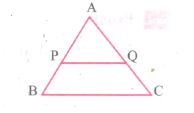
AB = AP + PB
= 3 + 6 cm = 9 cm.
AC = AQ + QC = 510 cm =15
\(\frac { AP }{AB } =\frac { 3 }{ 9 } =\frac { 1 }{ 3 } \)
\(\frac { AQ }{AC } =\frac { 5 }{15 } =\frac { 1 }{ 3 } \)
⇒\(\frac { AP }{AB } =\frac { AQ }{AC } \)
Thus in triangles APQ and ADC we have \(\frac { AP }{AB } =\frac { AQ }{AC } \) and \(\angle \)A = \(\angle \)A.
∴ By SAS criteria of similarity \(\triangle \)APQ ~\(\triangle \)ABC
⇒ \(\frac { AP }{AB } =\frac { PQ }{ BC } =\frac { AQ }{ AC } \)
⇒ \(\frac { PQ }{BC } =\frac { AQ }{ AC} \)
\(\frac { PQ }{BC } =\frac { 5 }{15 } =\frac { 1 }{ 3 } \)
\(\frac { PQ }{BC } =\frac { 1 }{ 3 } \)
⇒ BC = 3PQ
143.
OB = OC = 35 m
AB = CD= 14 m
OA = OD = (35 + 14) m
Area of the shaded region = Area of the rectangle ABCD + Area of the rectangle EFGH + 2 [ {Area of semi circles with radius 49m} - {Area of semi -circle with radius 35m} ]
= (14 x 120) + (14 x 120) + 2 [\(\frac { 1 }{ 2 } \times \frac { 22 }{ 7 } \) x 49 x 49] - 2[\(\frac { 1 }{ 2 } \times \frac { 22 }{ 7 } \) x 35 x 35]
= 1680 + 1680 + \(\frac { 22 }{ 7 } \)(492 - 352) m2
= 3360 + \(\frac { 22 }{ 7 } \) (49 + 35) (49 - 35) m2
= 3360 + \(\frac { 22 }{ 7 } \) x 8 x 14 m2 = 3360 + (44 x 84) m2
= 7056 m2
144.
Radius of the big semicircle = 14 cm
∴ Area of big semicircle = \(\frac { 1 }{ 2 } \)πr2 sq. units
= \(\frac { 1 }{ 2 } \times \frac { 22 }{ 7 } \times 14\times 14\)
= 308 cm2
Radius of small semi circles = 7cm
Area of 2 small semi circles = \(\frac { 1 }{ 2 } \times \frac { 22 }{ 7 } \times 7\times 7\)
= 154 cm2
∴ Required area = 308 + 154 cm2
= 462 cm2
145.
Area of quadrant AOBCA = \(\frac14\)πr2
= \(\frac { 1 }{ 4 } \times \frac { 22 }{ 7 } \times 3.5\times 3.5\)cm2
= \(\frac { 1 }{ 4 } \times \frac { 22 }{ 7 } \times \frac { 7 }{ 2 } \times \frac { 7 }{ 2 } \)cm2 = \(\frac { 27 }{ 8 } \)cm2
= 9.625 cm2
Area of ΔAOD = \(\frac { 1 }{ 2 } \) x b x h sq. units
= \(\frac { 1 }{ 2 } \)x 3.5 x 2 cm2
= 3.5 cm2
Area of the shaded portion = Area of the quadrant - Area of triangle
= 9.625 - 3.5 cm2
= 6.125 cm2
146.
PS = Diameter of a circle of radius 6 cm = 12 cm
PQ = QR = RS = \(\frac{12}{3}\) = 4cm
QS = QR + RS = 4 + 4 = 8 cm
∴ Perimeter of the shaded part = Arc length of semi - circle of radius 6 em + Arc length of semicircle of radius 4 cm + Arc length of semi-circle of radius 2 cm
= (π x 6) + (π x 4) + (π x 2) cm
P = 12 π cm
Area required = Area of semicircle with PS as. diameter + Area of semi circle with PQ as diameter - Area of semi-circle with QS as diameter
=\(\frac { 1 }{ 2 } \times \frac { 22 }{ 7 } \times \left( { 6 }^{ 2 }+{ 2 }^{ 2 }+{ 4 }^{ 2 } \right) =\frac { 1 }{ 2 } \times \frac { 22 }{ 7 } \times 24\)
= \(\frac { 264 }{ 7 } { cm }^{ 2 }\) = 37.71 cm2
Area required = 37.71 cm2
147.
Given arc length of the sector = 5π cm
\(\frac { { \theta }^{ o } }{ { 360 }^{ o } } \times 2\pi r=\) 5π cm .....(1)
Also area of the same sector = 20π cm2
\(\frac { { \theta }^{ o } }{ { 360 }^{ o } } \times \pi { r }^{ 2 }=20\pi { cm }^{ 2 }\).....(2)
Dividing equation (2) by equation (1), we have
\(\frac { \frac { { \theta }^{ o } }{ { 360 }^{ o } } \times \pi \times r\times r }{ \frac { { \theta }^{ o } }{ { 360 }^{ o } } \times 2\times \pi \times r } =\frac { 20\pi }{ 2\pi } \)
\(\frac { r }{ 2 } =4\)
r = 4 x 2
r = 8
Radius of the circle = 8 cm
148.
Radius of the sector = 21 cm
Length of the arc = \(\frac { { \theta }^{ o } }{ 360^{ o } } \times 2\pi r\) units = \(\frac { { 150 }^{ o } }{ { 360 }^{ o } } \) x 2 x \(\frac{22}{7}\)
l = 55 cm
Area of the sector = \(\frac { lr }{ 2 } \) sq. units
= \(\frac { 55\times 21 }{ 2 } \) cm2
= \(\frac{1155}{2}\) = 577.5 cm2
∴ Length of the arc = 55 cm
Area of the sector = 577.5 cm2
149.
| Solid | Name | F | V | E | F + V - E |
 |
Cube | 6 | 8 | 12 | 6 + 8 -12 = 14 -12 = 2 |
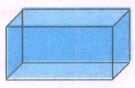 |
Cuboid | 6 | 8 | 12 | 6 + 8-12 = 14-12 = 2 |
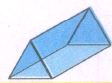 |
Triangular Prism | 5 | 6 | 9 | 5+6-9 = 11- 9 =2 |
 |
square Pyramid |
5 | 5 | 8 | 5 + 5 - 8 = 10 - 8 = 2 |
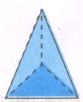 |
Triangular Pyramid | 4 | 4 | 6 | 4 + 4 - 6 = 8 - 6 = 2 |
From the table F + V - E = 2 for all the solid shapes
150.
Area of I + Area of III = Area of square - Area of two semi circles having centres as Q and S.
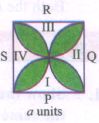
= \({ a }^{ 2 }-2\frac { 1 }{ 2 } \pi { r }^{ 2 }\)
= \({ a }^{ 2 }-\pi { r }^{ 2 }={ a }^{ 2 }-\pi { \left( \frac { a }{ 2 } \right) }^{ 2 }\)
= \({ a }^{ 2 }-\frac { 22 }{ 7 } \times \frac { { a }^{ 2 } }{ 4 } =\frac { { 14a }^{ 2 }-{ 1 }1a^{ 2 } }{ 14 } \)
= \(\frac { { 14a }^{ 2 }-{ 1 }1a^{ 2 } }{ 14 } \)
Area of I + Area of III = \(\frac { 3{ a }^{ 2 } }{ 14 } \)sq. units ...(1)
Area of II + Area of IV = Area of square - Area of 2 semicircles having centres at P and R
= \({ a }^{ 2 }-2\frac { 1 }{ 2 } \pi { r }^{ 2 }={ a }^{ 2 }-\pi { \left( \frac { a }{ 2 } \right) }^{ 2 }\)
Area of II + Area of IV = \(\frac { 3{ a }^{ 2 } }{ 14 } \) sq. units ....(2)
∴ Area of unshaded region = Area of I + Area of II + Area of III + Area of IV
= \(\frac { 3{ a }^{ 2 } }{ 14 } +\frac { 3{ a }^{ 2 } }{ 14 } \) sq. units = \(\frac { { 6a }^{ 2 } }{ 14 } \) sq. units
= \(\frac { 3{ a }^{ 2 } }{ 7 } \) sq. units
∴ Area of un shaded region = \(\frac { 3{ a }^{ 2 } }{ 7 } \) sq. units
Area of the shaded portion = Area of the square - Area of the unshaded region
= \({ a }^{ 2 }-\frac { 3{ a }^{ 2 } }{ 7 } =\frac { 3{ 7a }^{ 2 }-3{ a }^{ 2 } }{ 7 } =\frac { 4{ a }^{ 2 } }{ 7 } \) sq. units
Area of the shaded part = \(\frac { 4{ a }^{ 2 } }{ 7 } \) sq. units
151.
(a)
1
152.
(a)
1
153.
(c)
\(\frac{1}{2}\)pr
154.
(d)
9x2 + 16y2-24xy
155.
(b)
12a3b - 14ab2 + 10 a2b2
156.
(a)
12a2bc2
157.
(d)
polygon
158.
(c)
l+2r
159.
(a)
circular arc
160.
(c)
8
161.
(c)
cuboid
162.
(c)
\(\frac{4}{6}\)
163.
(c)
\(\frac{5}{18}\)
164.
(c)
(iii), (i), (iv), (v), (ii)
165.
(a)
166.
(a)
167.
(a)
168.
(b)
169.
(b)
170.
(b)
171.
(a)
172.
()
2mn(9+5p)
173.
()
2(x+2y)
174.
()
x+1
175.
()
140 cm2
176.
()
r2
177.
()
\(\frac{50\sqrt2}{\pi}\)
178.
()
7000
179.
()
77 cm2
180.
()
44
181.
()
b+a
182.
()
+2

8th Standard Syllabus & Materials
8th Standard
TN 8th Tamil இயல் 3 - கல்வி கரையில - பாடறிந்து ஒழுகுதல் Important Questions And Answers Study Material - QB365 Set A
NEW8th Standard
TN 8th Tamil இயல் 3-கல்வி கரையில - பல்துறைக் கல்வி Important Questions And Answers Study Material - QB365 Set A
NEW8th Standard
TN 8th Tamil இயல் 3-கல்வி கரையில - புத்தியைத் தீட்டு Important Questions And Answers Study Material - QB365 Set A
NEW8th Standard
TN 8th Tamil இயல் 2 - ஈடில்லா இயற்கை - தமிழர் மருத்துவம் ( நேர்காணல்) Important Questions And Answers Study Material - QB365 Set A



Tamilnadu Stateboard 8th Standard Subjects
Tamilnadu Stateboard Standards




