
 100% FREE ACCESS
8th Standard Syllabus & Materials
8th Standard
TN 8th Tamil இயல் 3 - கல்வி கரையில - வினைமுற்று Important Questions And Answers Study Material - QB365 Set A
NEW8th Standard
TN 8th Tamil இயல் 2 - ஈடில்லா இயற்கை - மயங்கொலிகள் Important Questions And Answers Study Material - QB365 Set A
NEW8th Standard
TN 8th Tamil இயல் 2 - ஈடில்லா இயற்கை -பட்டமரம் Important Questions And Answers Study Material - QB365 Set A
NEW8th Standard
TN 8th Tamil இயல் 2 - ஈடில்லா இயற்கை - இயற்கையை போற்றுவோம் Important Questions And Answers Study Material - QB365 Set A
NEW8th Standard
TN 8th Tamil இயல் 1 - தமிழ் இன்பம் - ஆழிக்கு இணை Important Questions And Answers Study Material - QB365 Set A
NEW8th Standard
TN 8th Tamil இயல் 2-ஈடில்லா இயற்கை - திருக்குறள் Important Questions And Answers Study Material - QB365 Set A

Published on: 04/02/2020
8th Standard Maths Important Questions
Download Tamil Nadu 8th Standard Maths question papers, model tests, one-mark questions, important questions, and public exam papers in PDF format. Free study materials and answer keys for TN State Board students.
Questions + Answers key
Take MCQ Maths Test1.
Simplify \(\frac { 2 }{ 5 } +\frac { 8 }{ 3 } +\frac { -11 }{ 15 } +\frac { 4 }{ 5 } +\frac { -2 }{ 3 } \)
2.
Use Ceasar Cipher table set + 4 and to try to solve the given secret sentence.
fvieo mr gshiw ger fi xvmgoc
3.
Solve 2x + 5 = 9
4.
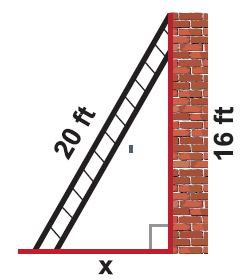
A 20- feet ladder leans against a wall at height of 16 feet from the ground. How far is the base of the ladder from the wall?
5.
Can a right triangle have sides that measure 5cm, 12cm and 13cm?
6.
When a number is decreased by 25% it becomes 120. Find the number.
7.
Factorize
4a2 - 4a + 1
8.
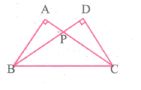
Two triangles BAC and BDC right angled at A and D respectively are drawn on the same base BC and on the same side of BC. If AC and DB intersect at P. Prove that AP x PC = DP x PB.
9.
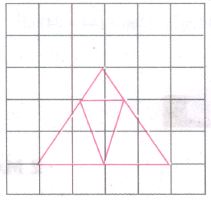
Give the net pattern for a tetrahedron.
10.
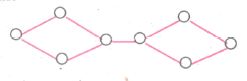
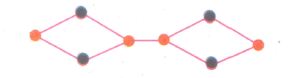
Colour the graph with minimum number of colours and no two adjacent vertices should have the same colour.
11.
Expand (x + 4)3
12.
Write the following decimal numbers as rationals.
−5.8
13.
(Illustrating SSS similarity)
Prove that ΔPQR ~ ΔPRS in the given Fig
.JPG)
14.
From the three vertices of an equilateral triangle of side 12 cm, Nishanth cuts sectors of 5 cm radius each and forms the following shape. Find the area of that shape. (π = 3.14)
15.
Using both repeated division method and repeated subtraction method and find the greatest number that divides 167 and 95, leaving 5 as reminder
16.
Find the length of the largest which piece of wood used to measure exactly the lengths 4m50cm and 6m 30cm woods.( Use repeated subtraction method)
17.
The rule of Fibonacci Sequence is F(n) = F(n–2) + F(n–1). Find the 11th to 20th Fibonacci numbers.
18.
Factorize - xy - ay
19.
(7x - 5)2 Expand
20.
What should we multiply with \(\frac{-15}{28}\)to get \(\frac{-5}{7}?\)
21.
In triangle ABC, the measure of ∠B is two-third of the measure of ∠A. The measure of ∠C is 20° more than the measure of ∠A. Find the measures of the three angles.
22.
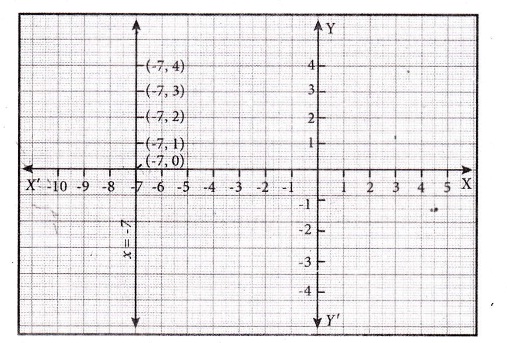
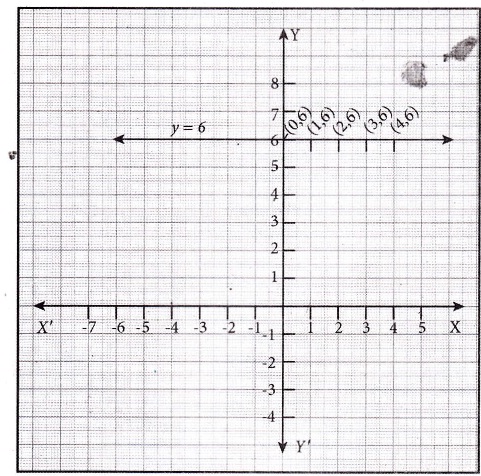
Draw the graph of the following equations
(i) x = −7 (ii) y = 6
23.
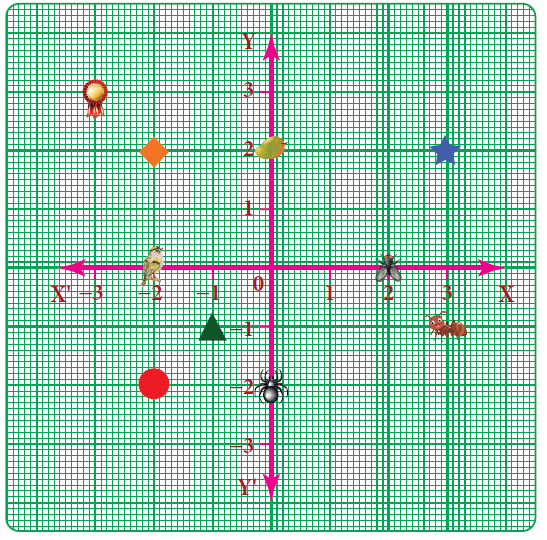
Use the graph to determine the coordinates where each figure is located
a) Star _______
b) Bird _______
c) Red Circle _______
d) Diamond _______
e) Triangle _______
f) Ant _______
g) Mango _______
h) Housefly _______
i) Medal _______
j) Spider _______
24.
I. Construct the following trapeziums with the given measures and also find their area.
1. AIMS with \(\overset { \_ \_ }{ AI } \) || \(\overset { \_ \_ }{ SM } \), AI = 6 cm, IM = 5 cm, AM = 9 cm and MS = 6.5 cm.
2. CUTE with \(\overset { \_ \_ }{ CD } \) || \(\overset { \_ \_ }{ ET } \), CU = 7 cm, ㄥUCE = 800 CE = 6 cm and TE = 5 cm..
3. ARMY with \(\overset { \_ \_ }{ AR } \) || \(\overset { \_ \_ }{ YM } \), AR = 7 cm, RM = 6.5 cm ㄥRAY = 1000 and ㄥARM = 600
4. CITY with \(\overset { \_ \_ }{ CI } \) || \(\overset { \_ \_ }{ YT } \), CI = 7 cm, IT = 5.5 cm, TY = 4 cm and YC = 6 cm.
25.
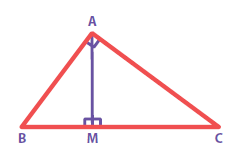
∆ ABC is a right angled triangle in which ㄥA = and AM ⊥ BC. Prove that AM = \(\frac { AB\times AC }{ BC } \). Also if AB = 30 cm and AC = 40 cm, find AM.
26.
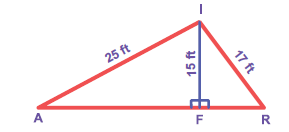
In the figure, find AR.
27.
Mayan travelled 28 km due north and then 21 km due east. What is the least distance that he could have travelled from his starting point?
28.
Find the unknown side in the following triangles.
.png)
.png)
.png)
29.
A fruit vendor bought some mangoes of which 10% were rotten. He sold 33\(\frac { 1 }{ 3 } \) % of the rest. Find the total number of mangoes bought by him initially, if he still has 240 mangoes with him.
30.
If the numerator of a fraction is increased by 50% and the denominator is decreased by 20%, then it becomes \(\frac { 3 }{ 5 } \). Find the original fraction.
31.
Evaluate:
(2x-3y)2
32.
Simplify \(\left( \frac { -7 }{ 18 } \times \frac { 15 }{ -7 } \right) -\left( 1\times \frac { 1 }{ 4 } \right) +\left( \frac { 1 }{ 2 } \times \frac { 1 }{ 4 } \right) \)
33.
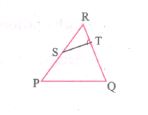
In the given figure if \(\angle \)P =\(\angle \)RTS, prove that \(\triangle \)RPQ ~\(\triangle \) RTS.
34.
3x2(x4 - 7x3+ 2) what is the highest power in the expression.
35.
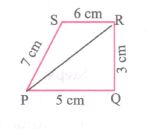
Is it possible to construct a quadrilateral PQRS with PQ = 5 cm, QR = 3 cm, RS = 6 cm, PS = 7 cm and PR = 10 cm. If not, why?
36.
Match the following by their congruence
| S.No. | A | B | |
| 1. | 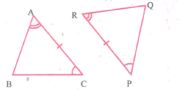 |
(i) | RHS |
| 2. | 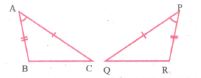 |
(ii) | SSS |
| 3. | 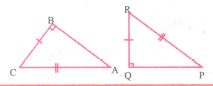 |
(iii) | SAS |
| 4. | 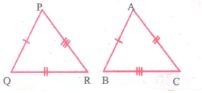 |
(iv) | ASA |
37.
Divide 1 by \(\frac{1}{2}\)
38.
Multiply \(\frac{3}{4}\) by \(\frac{5}{17}\)
39.
Can a polyhedron have 10 faces, 20 edges and 15 vertices?
40.
Can a polyhedron have for its faces = 12 edges = 16 and vertices = 6.
41.
List out atleast three objects in each category which are in the shape of cube, cuboid, cylinder, cone and sphere.
42.
Mark the following rational numbers on a number line.
\(\frac{5}{-4}\)
43.
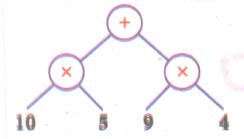
Convert the tree diagram into a numeric expression.
44.
Fill in the blanks with the correct term from the given list.
(in proportion, similar, corresponding, congruent shape, area, equal)
(i) Corresponding sides of similar triangles are _______.
(ii) Similar triangles have the same _________ but not necessarily the same size.
(iii) In similar triangles, ______ sides are opposite to equal angles.
(iv) The symbol ≡ is used to represent _______ triangles.
(v) The symbol ~ is used to represent ________ triangles
45.
Write five rational numbers which are less than –2.
46.
Identify the errors and correct them. (4n)2 − 2n +3 = 4n2− 2n + 3
47.
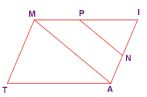
In the figure, ∠TMA ≡ ∠IAM and ∠TAM ≡ ∠IMA . P is the midpoint of MI and N is the midpoint of AI. Prove that ΔPIN~ΔATM.
48.
Shanthi has 5 chudithar sets and 4 frocks. In how many possible ways, can she wear either a chudithar or a frock?
49.
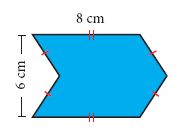
Find the area of the combined figure given which is got by joining of two parallelograms
50.
Find the area of a sector whose length of the arc is 50 mm and radius is 14 mm.
51.
There are 270 ginger chocolates, 384 milk chocolates and 588 coconut chocolates. What is the largest number of containers possible so that each container contains the same number of chocolates of each kind?
52.
The sum of the digits of a two-digit number is 8. If 18 is added to the value of the number, its digits get reversed. Find the number.
53.
Construct a trapezium DEAN in which \(\overset { \_ \_ }{ DE } \) is parallel to \(\overset { \_ \_ }{ NA } \), DE = 7 cm, EA = 6.5 cm ㄥEDN = 1000 and ㄥDEA = 700. Also find its area.
54.
The cost price of 16 boxes of strawberries is equal to the selling price of 20 boxes of strawberries. Find the gain or loss percentage.
55.
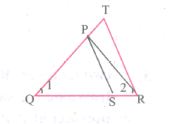
In the given figure if \(\frac { QT }{ PR } =\frac { QR }{ QS } \) and \(\angle \)1 = \(\angle \)2.Prove that \(\triangle \)PQS ~\(\triangle \)TQR.
56.
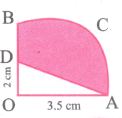
In the figure AOBCA represents a quadrant of a circle of radius 3.5cm D with center 'O' calculate the area of the shaded portion \(\left( \pi =\frac { 22 }{ 7 } \right) \)
57.
Velu pastes ‘ 4xy ’ pictures in one page of his scrap book. How many pages will he need to paste 100x2y3pictures? (x, y are positive integers).
58.
Colour a map of South India in the given figure with the fewest number of colours.
.JPG)
59.
Square of (3x - 4y) is _______.
9x2-16y2
6x2-8y2
9x2+ 16y2 + 24xy
9x2 + 16y2-24xy
60.
Product of 6a2 - 7b + ab and 2ab is __________.
12a3b - 14ab2 + 10 ab
12a3b - 14ab2 + 10 a2b2
6a2b - 7b2 + 7 ab
12a2b -7ab2 + 10 ab
61.
Volume of the rectangle 1 = 2ab, b = 3ac and h = 2ac is _________.
12a2bc2
12a2bc
12a2 bc
2ab + 3ac + 2 ac
62.
The line segment which connects any two faces are called ______.
edges
vertices
shape
faces
63.
If any two points on a circles is joined the line segment is called as
diameter
chord
radius
center
64.
Exact value of \(\pi\) is
\(\frac{22}{7}\)
3.14
\(\frac{Area}{radius}\)
\(\frac{Circumference}{Diameter}\)
65.
If V = 6, E = 12 then the faces of the polyhedron is
6
7
8
9
66.
In 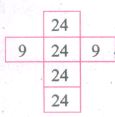 if the faces shows the area in the net, then the shape mentioned is
pyramid
Cube
cuboid
prism
67.
\(\frac { 1 }{ 2 } \times \left( \frac { 1 }{ 3 } +\frac { 1 }{ 4 } \right) =\left( \frac { 1 }{ 2 } +\frac { 1 }{ 3 } \right) +\frac { 1 }{ 4 } \)
Closure property
Associative property
Distributive property
Commutative property
68.
\(\frac { 1 }{ 2 } \times \left( \frac { 2 }{ 3 } +\frac { 6 }{ 4 } \right) =\left( \frac { 1 }{ 2 } +\frac { 2 }{ 3 } \right) +\left( \frac { 1 }{ 2 } \times \_ \_ \right) \)
\(\frac{1}{2}\)
\(\frac{2}{3}\)
\(\frac{4}{6}\)
0
69.
\(\frac{1}{2}+\frac{6}{4}\) is
\(\frac{6}{6}\)
\(\frac{6}{4}\)
\(\frac{2}{1}\)
None of these
70.
Praveen recently got the registration number for his new two-wheeler. Here, the number is given in the form of mirror-image. Encode the image and find the correct registration number of praveen’s two-wheeler.

.png)
.png)
.png)
.png)
71.
There are four groups of letters in each set. Three of these sets are a like in some way while one is different. Find the one which is different.
H K N Q
I L O R
J M P S
A D G J
72.
The product of LCM and HCF of two numbers is 24. If one of the number is 6, then the other number is ________.
6
2
4
8
73.
The exterior angle of a triangle is 120° and one of its interior opposite angle 58°, then the other opposite interior angle is________.
62°
72°
78°
68°
74.
The difference between the 18th and 17th Fibonacci number is
233
377
610
987
75.
Every _______ number of the Fibonacci sequence is a multiple of 8
2nd
4th
6th
8th
76.
Every 3rd number of the Fibonacci sequence is a multiple of _______
2
3
5
8
77.
The time taken for Rs.4400 to become Rs.4851 at 10%, compounded half yearly is _______.
6 months
1 year
1\(\frac { 1 }{ 2 } \)years
2 years
78.
The number of conversion periods, if the interest on a principal is compounded every two months is___________.
2
4
6
12
79.
The sides of a right angled triangle are in the ratio 5: 12: 13 and its perimeter is 120 units then, the sides are ______________.
25, 36, 59
10, 24, 26
36, 39, 45
20, 48, 52
80.
If the square of the hypotenuse of an isosceles right triangle is 50 cm2, the length of each side is ____________.
25 cm
5 cm
10 cm
20 cm
81.
The hypotenuse of a right angled triangle of sides 12cm and 16cm is __________.
28 cm
20 cm
24 cm
21 cm
82.
A man buys an article for Rs.150 and makes overhead expenses which are 12% of the cost price. At what price must he sell it to gain 5%?
Rs. 180
Rs. 168
Rs. 176.40
Rs. 85
83.
A fruit vendor sells fruits for Rs. 200 gaining Rs. 40. His gain percentage is
20%
22%
25%
16\(\frac { 2 }{ 3 } \)%
84.
If 48% of 48 = 64% of x , then x =
64
56
42
36
85.
Multiplicative inverse of 0 (is)
0
1
-1
does not exist
86.
The rational number (numbers) which has (have) additive inverse is (are)
7
\(\frac { -5 }{ 7 } \)
0
all of these
87.
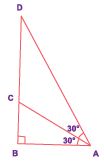
In the figure, which of the following statements is true?
AB = BD
BD < CD
AC = CD
BC = CD
88.
If ΔABC~ΔPQR in which ∠A = 53o and ∠Q = 77o, then R is
50°
50°
70°
80°
89.
A flag pole 15 m high casts a shadow of 3 m at 10 a.m. The shadow cast by a building at the same time is 18.6 m. The height of the building is
90 m
91 m
92 m
93 m
90.
If in triangles PQR and XYZ, \(\frac{PQ}{XY}=\frac{QR}{ZX}\) then they will be similar if
∠Q = ∠Y
∠P = ∠X
∠Q = ∠X
∠P ≡ ∠Z
91.
Two similar triangles will always have ________angles
acute
obtuse
right
matching
92.
How many 2 digit numbers contain the number 7?
10
18
19
20
93.
In how many ways can you answer 3 multiple choice questions, with the choices A, B, C and D?
4
3
12
64
94.
How many outcomes can you get when you toss three coins once?
6
8
3
2
95.
If the area of a square is 36x4y2t hen, its side is______
6x4y2
8x2y2
6x2y2
6x2y
96.
The missing terms in the product - 3m3n x 9(_) = ___________m4n3 are
mn2, 27
m2n, 27
m2n2, -27
mn2, -27
1.
\(\frac{37}{15}\)
2.
Let us make Ceasar Cipher table first. Here, we have to set to + 4 table. For that, we have to start letter e to set as A, f as B … likewise d as Z. Now, the + 4 Ceasar Cipher table looks like
| Plain Text | a | b | c | d | e | f | g | h | i | j | k | l | m | n | o | p | q | r | s | t | u | v | w | x | y | z |
| Cipher Text | W | X | Y | Z | A | B | C | D | E | F | G | H | I | J | K | L | M | N | O | P | Q | R | S | T | U | V |
The given plain text is
fvieo mr gshiw ger fi xvmgoc
To crack this secret code, follow the steps given below.
Step 1: Using Ceasar Cipher table, let us first match the most repeated letters. This will help us to progress faster.
fvieo mr gshiw ger fi xvmgoc

Step 2: Then, let us find remaining letters to complete the code.
.png)
Thus, the secret sentence is, BREAK IN CODES CAN BE TRICKY
3.
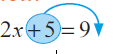
2x = 9 − 5
2x = 4
x = \(\frac { 4 }{ 2 } \)
x = 2
4.
The ladder, wall and the ground form a right triangle with the ladder as the hypotenuse. From the figure, by Pythagoras theorem,
202 = 162 + x2
⇒ 400 = 256 + x2
⇒ x2 = 400 − 256 = 144 = 122
⇒ x = 12 feet
Therefore, the base (foot) of the ladder is 12 feet away from the wall.
5.
Take a = 5, b = 12 and c = 13
Now, a2 + b2 = 52 +122 = 25 +144 = 169 = 132 = c2
By the converse of Pythagoras theorem, the triangle with given measures is a right angled triangle.
6.
Let the number be x.
x-\(\frac { 25 }{ 100 } x\) = 120
\(\frac { 100x-25x }{ 100 } \) = 120
\(\frac { 75x }{ 100 } \) = 120
x = \(\frac { 120\times 100 }{ 75 } \)
x = 160
7.
[\(\because\) using a2-2ab+b2 = (a-b)2]
4a2-4a+1 = (2a)2-2\(\times\)(2a)\(\times\)1+12
= (2a-1)2
= (2a-1)(2a-1)
8.
In \(\triangle \)APB and \(\triangle \)DPC
\(\angle \)A =\(\angle \)D = 90° [given]
\(\angle \)APB =\(\angle \)DPC [Vertically opposite angles]
\(\angle \)ABP =\(\angle \)DCP [Remaining angle]
∴ \(\triangle \)APB ~ \(\triangle \)DPC [AAA criteria]
\( \frac {AP }{ DP } =\frac { BP }{ PC }\) [Corresponding sides are proportional]
AP x PC = BP x DP
9.
10.
11.
Comparing (x + 4)3 with (a + b)3, we get a = x, b = 4
We know(a + b)3 = a3 + 3a2b + 3ab2 + b3
(x + 4)3 = (x)3 + 3(x)2 + 3(x)(4)2 + (4)3
= (x)5 + 3x2(4)+ 3(x)(16) + 64
(x+4)3 = x3 + 12x2 + 48x + 64
12.
\(-5.8=\frac { -58 }{ 10 } =\frac { -29 }{ 5 } =-5\frac { 4 }{ 5 } \)
13.
Now, \(\frac { PQ }{ PR } =\frac { 20 }{ 15 } =\frac { 4 }{ 3 } \)
\(\frac { PR }{ PS } =\frac { 15 }{ 11.25 } =\frac { 4 }{ 3 } \)
Also, \(\frac { QR }{ RS } =\frac { 12 }{ 9 } =\frac { 4 }{ 3 } \)
We find \(\frac { PQ }{ PR } =\frac { PR }{ PS } =\frac { QR }{ RS } \)
That is, their corresponding sides are proportional.
∴ By SSS Similarity, ΔPQR ~ ΔPRS
.JPG)
14.
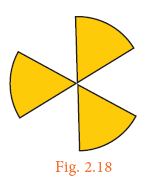
Since, the sectors are cut from an equilateral triangle, the central angle of each of them is 60°.
∴ Area of the shape formed, \(A=3\times \left( \frac { { \theta }^{ 0 } }{ { 360 }^{ 0 } } \times { \pi r }^{ 2 } \right) \)
\(=3\times \frac { { 60 }^{ 0 } }{ { 360 }^{ 0 } } \times \pi \times 5\times 5\)
\(=3\times \frac { 1 }{ 6 } \times \pi \times 5\times 5\)
= 12.5 π sq.cm
15.
18
16.
90
17.
89, 144, 233, 377, 610, 987, 1597, 2584, 4181, 6765
18.
The first term -xy can be factorized as: (-1) × x × y and
The second term -ay can be factorized as : (-1) × a × y
The common factor for both the terms is -y
Taking out the common factor we get,
- xy - ay = -y(x + a)
19.
Using standard identity: (a + b)² = a² + 2ab + b²
Here, a = 7x and b = 5
(7x + 5)² = (7x)² + [2(7x)(5)] + 5²
49x2-70x+25
20.
\(\frac{4}{3}\)
21.
Given that ∠B = 2/3 x ∠A = 2/3a & given ∠C = ∠A + 20 = a + 20
Since A, B & C are angles of a triangle, they add up to 180° (∆ property)
∠A + ∠B + ∠C = 180°
a + 2/3 a + a + 20 = 180°
(3a+2a+3a)/3 + 20 = 180°
8a/3 = 180 – 20 = 160°
\(\frac{160 \times 3}{8} = 60^o\)
\( \angle B = \frac{2}{3}\times \angle A = \frac{2}{\not 3} \times \not 60 = 40^o
\)
∠C = 80°
60°, 40°, 80°
22.
(1) x = -7
| x | -7 | -7 | -7 | -7 | -7 |
| y | 0 | 1 | 2 | 3 | 4 |
(ii) y = 6
| x | 0 | 1 | 2 | 3 | 4 |
| y | 6 | 6 | 6 | 6 | 6 |
23.
a) (3, 2)
b) (- 2, 0)
c) (- 2, - 2)
d) (- 2, 2)
e) (-1, -1)
f) (3, -1)
g) (0, 2)
h) (2, 0)
i) (- 3, 3)
j) (0, -2)
24.
Given:
AI = 6 cm,
IM = 5 cm,
AM = 9 cm,
MS = 6.5 cm.
Rough Diagram
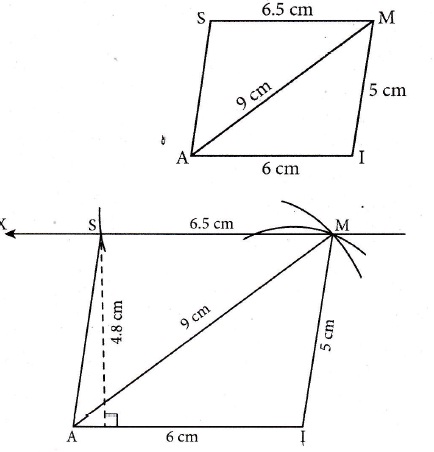
Steps:
1. Draw aline segment AI = 6 cm.
2. With A and I as centres draw arcs of radius
9 cm and 5 cm respectively and let them cut at M.
3. Join AM and IM.
4. Draw MX parallel to AI.
5. With M as centre, draw an arc of radius6.5 cm cutting MX at S.
6. |oin AS. AIMS is the required trapezium
Calculation of Area:
Area of the trapezium AIMS
\(=1 / 2 \times h \times(a+b) \)
\(=1 / 2 \times 4.8 \times(6+6.5) \)
\(=1 / 2 \times 4.8 \times 12.5=30 \mathrm{sq} . \mathrm{cm} . \)
2. Given:
CU = 7cm;
CE = 6cm; TE = 5cm.
Rough Diagram
.jpg)
Steps:
1. Draw a line segment CU = 7cm
2. Constract an angle
3. With C as centre, draw an arc of radius 6 cm cutting CX at E.
4. Draw EY parallel to CU.
5. With E as centre, draw an arc of radius 5 cm cutting EY at T.
6. Join TLI CUTE is the required trapezium.
Calculation of Area:
Area of the trapezium CUTE
\(=1 / 2 \times \mathrm{h} \times(\mathrm{a}+\mathrm{b}) \)
\(=1 / 2 \times 6 \times(5+7) \)
\(=1 / 2 \times 6 \times 12=36 \text { sq. } \mathrm{cm} . \)
3. Given:
AR = 7 cm; RM = 6.5 cm
ZRAY = 100o; ZARM = 60o
Rough Diagram
.jpg)
Steps: -
1. Draw a line segment AR 7 cm.
2. Construct an angle
3. With R as centre draw an arc of radius 6.5 cm cutting RX at M.
4. Draw MZ parallel to AR.
5. Construct an angle ZRAY = 100o A cutting MZ at Y.
6. ARMY is the required trapezium
Calculation of Area:
Area of the trapezium ARMY
\(=1 / 2 \times h \times(a+b) \)
\(=1 / 2 \times 5.6 \times(7+7) \)
\(=1 / 2 \times 5.6 \times 14=39.2 \text { sq. cm } \)
4. Given:
CI = 7 cm ; IT = 5.5 cm
TY = 4 cm ; YC = 6cm.
Rough Diagram
.jpg)
Steps:
1..Draw a line segment CI = 7 cm.
2. Mark the point A on CI such that CA = 4 cm.
3. With A and I as centres, draw arcs of radii 6 cm and S.S cm. Let them cut at T. join AT and IT.
4. With C and T as centres, draw arcs of radii 6 cm and 4 cm respectively. Let them cut at Y. Join TY and CY.
5. CITY is the required trapezium.
Calculation of Area:
Area of the trapezium CITY
\(=1 / 2 \times h \times(a+b) \)
\(=1 / 2 \times 6 \times(4+4) \)
\(=1 / 2 \times 6 \times 8=24 \text { sq. } \mathrm{cm} . \)
25.
24 cm
26.
\(\triangle\) AFI is a right angled triangle
(AI)2 = (AF)2 + (FI)2
252 = (AF)2 + 152
625 = (AF)2 + 225
(AF)2 = 625 - 225
= 400
\(\mathrm{AF}=\sqrt{400}\)
AF = 20ft
\(\triangle\) FRI is a right angled triangle.
(FI)2 + (FR)2 = (RI)2
(FR)2 + 152 = 172
(FR)2 + 225 = 289
(FR)2 = 289 - 225
= 64
\(A R=\sqrt{64}\)
= 8ft
AR = AF+FR
= 20 + 8
= 28 ft
AR = 28 ft
27.
From the figure AC is to be found.
By using Pythagoras theorem,
AC2 = AB2 + BC2 = 282 + 212 = 784 + 441 = 1225 = 352
∴ AC = 35 km
28.
(i) From the figure,
x2 = 92 + 402
= 81 + 1600
= 1681
\(x=\sqrt{1681}\)
x = 41
(ii) From the figure
342 = 302 + y2
1156 = 900 + y2
y = 1156 - 900
y2 = 256
\(y=\sqrt{256}\)
y = 16
(iii) From the figure
392 = 362 + z2
1521 = 1296 + Z2
z2 = 1521- 1296
z2 = 225
\(z=\sqrt{225}\)
z = 15
29.
Let x be the initial number of mangoes.
Nurnber of Rotten mangoes = 10%
Number of good mangoes
\(=90 \% \text { of } x=\frac{90}{100} x\)
Percentage of sold mangoes \(=33 \frac{1}{3} \%\)
Percentage of unsold mangoes \(=100-33 \frac{1}{3} \%\)
\(=66 \frac{2}{3} \%\)
\(
\frac{66 \frac{2}{3}}{100} \times \frac{90}{100} x =240
\)
\(\frac{200}{3 \times 100} \times \frac{90}{100} x =240
\)
\(\frac{2}{3} \times \frac{9}{10} \times x =240
\)
\(=\frac{240 \times 3 \times 10}{2 \times 9} =400
\)
The vendor bought 400 mangoes initially.
30.
Let the numerator be x and the denominator be y.
The original fraction = x/y
Given the numerator of a fraction is increased by 50%
\(
\therefore \mathrm{Nr} =x+50 \% \text { of } x
\)
\(=x+\frac{50}{100} x=x+\frac{1}{2} x \\
\mathrm{Nr} =\frac{3}{2} x
\)
Also given the denominator is decreased by 20 %
\(
\text { Dr } =y-20 \% \text { of } y
\)
\(=y-\frac{20}{100} y=y-\frac{1}{5} y=\frac{4}{5} y
\)
By given data
\(
\frac{\frac{3}{2} x}{\frac{4}{5} y}=\frac{3}{5} \Rightarrow \frac{3}{2} x \times \frac{5}{4 y}=\frac{3}{5}
\)
\(\frac{x}{y}=\frac{8}{25}
\)
The original fraction is 8/25
31.
[ using (a - b)2=a2-2ab+b2]
(2x-3y)2 = (2x)2-2(2x)(3y)+(3y)2
= 4x2-12xy+9y2
32.
\(\left( \frac { -7 }{ 18 } \times \frac { 15 }{ -7 } \right) -\left( 1\times \frac { 1 }{ 4 } \right) +\left( \frac { 1 }{ 2 } \times \frac { 1 }{ 4 } \right) =\left( \frac { -7\times 15 }{ 18\times -7 } \right) \left( \frac { 1\times 1 }{ 1\times 4 } \right) +\left( \frac { 1\times 15 }{ 18\times 1 } \right) -\left( \frac { 1 }{ 4 } \right) +\left( \frac { 1 }{ 8 } \right) \)
\(\\ \\ =\frac { 5 }{ 6 } -\frac { 1 }{ 4 } +\frac { 1 }{ 8 } =\frac { (5\times 4)-(1\times 6)+(1\times 3) }{ 24 } \)
\(=\frac { 20-6+3 }{ 24 } =\frac { 14+3 }{ 24 } =\frac { 17 }{ 24 } \)
33.
In triangles \(\triangle \)RPQ and \(\triangle \) RTS, we have
\(\angle \)RPQ=\(\angle \)RTS [∵ given]
\(\angle \)PRQ =\(\angle \)TRS [∵ common]
\(\angle \)PQR =\(\angle \)RST l∵ Remaining angle]
\(\triangle \)RPQ ~ \(\triangle \)RTS [∵ By AAA similarity]
34.
3x2(x4 - 7x3+ 2)
= 3x6-21x5 + 6x2
Highest power is 6 in x6
35.
The lower triangle cannot be constructed as the sum of two sides 5 + 3 = 8 < 10 cm. So this quadrilateral cannot be constructed.
36.
1-(iv), 2-(iii), 3-(i), 4-(ii)
37.
\(1\div \frac { 1 }{ 2 } =\frac { 1 }{ 1 } \times \frac { 2 }{ 1 } =\frac { 1\times 2 }{ 1\times 1 } =2\)
38.
\(\frac { 3 }{ 4 } \times \frac { 5 }{ 7 } =\frac { 3\times 5 }{ 4\times 7 } =\frac { 15 }{ 28 } \)
39.
By Euler's formula F + V - E = 10 + 15 - 20
= 25 - 20 = 5 ≠ 2
No, it cannot have F = 10, E = 20 and V = 15
40.
Verifying Euler's formula
F + V - E = 12 + 6
= 18 - 16 = 2
Yes, the polyhedron can have F = 12, E = 16 and V = 6
41.
(i) Cube - dice, building blocks, jewel box.
(ii) Cuboid - books, bricks, containers.
(iii) Cylinder - candles, electric tube, water pipe.
(iv) Cone - Funnel, cap, ice cream cone
(v) Sphere - ball, beads, Lemmon.
42.
\(\frac { 5 }{ -4 } =-\frac { 5 }{ 4 } =-1\frac { 1 }{ 4 } \)
-1 \(\frac{1}{4}\) lies between -1 and -2. The unit part between -1 and -2 is divided into four equal parts and the first part is taken.

43.
(10 x 5) + (9 x 4)
44.
(i) in proportion
(ii) shape
(iii) equal
(iv) congruent
(v) similar
45.
All integers are rational numbers.
∴ Rational numbers less than -2 are -10, -15, -20, -25,-30.
46.
(4n)2 − 2n +3 = 4n2− 2n + 3 (false)
(4n)2 − 2n +3 = 16n2− 2n + 3
47.
Given in \(\triangle\) AIM
P is the mid point of MI and
N is the mid point of AI
\(\therefore \mathrm{PN} \| \mathrm{AM}
\)
\(Now
\)
\(\angle \mathrm{TMA}=\angle \mathrm{IAM}=\angle \mathrm{PNI}
\)
\(\angle \mathrm{TAM}=\angle \mathrm{IMA}=\angle \mathrm{IPN}
\)
\(\angle \mathrm{ATM}=\angle \mathrm{MIA}=\angle \mathrm{PIN}
\)
\(
\therefore \triangle \mathrm{PIN} \sim \triangle \mathrm{ATM}
\)
Hence proved
48.
Shanthi wears a chudithar in 5 different ways.
She also wears a frock in 4 different ways.
So she wears either a chudithar or a frock in 5 + 4 different ways.
That is 9 different ways.
49.
If we make this parallelograms into a rectangle, we get the breadth and height of the rectangle 8 cm and 6 cm respectively
Area of the shaded part
= Area of the rectangle = bh
= 8 x 5 = 48 cm2
50.
Length of the arc of the sector l = 50 mm
Radius r = 14mm
Area of the sector = \(\frac { lr }{ 2 } \) sq. units
= \(\frac { 50\times 14 }{ 2 } \) mm2 = 50 x 7 mm2 = 350 mm2
Area of the sector = 350mm2
51.
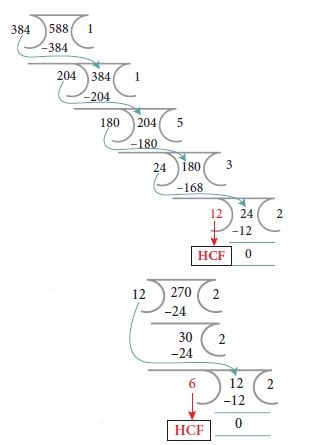
Here, we have to find HCF of 270, 384 and 588
STEP 1: First find the HCF of any two of the given numbers (follow the same step 1, 2 and 3 of the above example). Here, find HCF of (384, 588) first.
STEP 2: The HCF of the first two numbers which is 12 becomes the divisor and the third number 270 becomes the dividend.
STEP 3: Repeat this division process till the remainder becomes zero. The last divisor is the HCF. Here, 6 is the last divisor.
Hence, HCF of 270, 384 and 588 is 6. Therefore, we needs 6 containers so that each of them contains (270 ÷ 6 = 45) 45 ginger chocolates, (384 ÷ 6 = 64) 64 milk chocolates and (588 ÷ 6 = 98) 98 coconut chocolates.
52.
Let the two digit number be xy (i.e., ten’s digit is x, ones digit is y)
Its value can be expressed as 10 x + y.
Given, x + y = 8 which gives y = 8 − x
Therefore its value is 10 x + y
= 10x + 8 − x
= 9x + 8.
The new number is yx with value is 10y + x
= 10(8 − x) + x
= 80 – 9x
Given, when 18 is added to the given number (xy) gives new number (yx)
(9x + 8) + 18 = 80 – 9x
This simplifies to 9x + 9x = 80 – 8 – 18
18x = 54
x = 3 ⇒ y = 8 – 3 = 5
The two digit number is xy = 35
53.
Given:
DE = 7 cm, EA = 6.5 cm ㄥEDN = 1000 and ㄥDEA = 700 and \(\overset { \_ \_ }{ DE } \) || \(\overset { \_ \_ }{ NA} \)
.png)
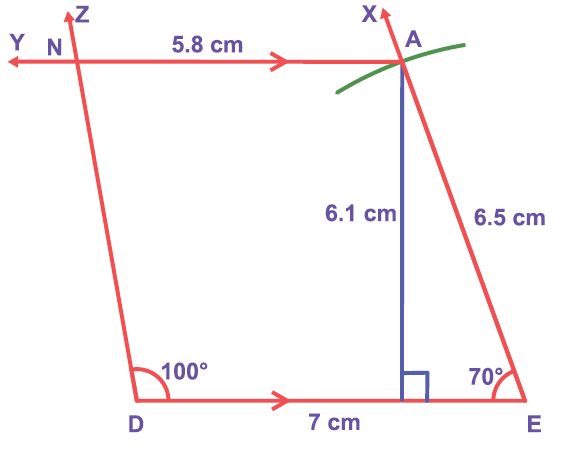
Steps:
1. Draw a line segment DE = 7cm.
2. Construct an angle ㄥDEX = 700 at E.
3. With E as centre draw an arc of radius 6.5cm cutting EX at A.
4. Draw AY parallel to DE.
5. Construct an angle ㄥEDZ = 1000 at D cutting AY at N.
6. DEAN is the required trapezium.
Calculation of area:
Area of the trapezium DEAN = \(\frac { 1 }{ 2 } \) x h x (a+b) sq. units
= \(\frac { 1 }{ 2 } \) x 6.1 x (7 + 5.8) = 39.04 sq. units
54.
Let the C.P of one strawberry box be Rs. x.
Then C.P of 20 strawberry boxes = 20 x and
S.P of 20 strawberry boxes = C.P of 16 strawberry boxes = 16 x
Thus, S.P < C.P, hence there is a loss.
Loss = C.P –S.P = 20 x − 16 x = 4 x
∴ Loss % =\(\left( \frac { Loss }{ C.P } \times 100 \right) \)%
=\(\left( \frac { 4x }{ 20x } \times 100 \right) \)%
= 20 %
55.
\(\frac { QT }{ PR } =\frac { QR }{ QS } \\ \frac { QT }{ QR } =\frac { PR }{ QS } \) [given] ...(1)
\(\angle \)1 = \(\angle \)2
PR=PQ ...(2) [∵ Sides opposite to equal angles are equal]
From (1) and (2)
\(\frac { QT }{ QR } =\frac { PQ }{ QS } \\ \frac { PQ }{ QT } =\frac { QS }{ QR } \)
\(\angle \)PQS = \(\angle \)TQR =\(\angle \)Q
:. By SAS criteria \(\triangle \)PQS ~\(\triangle \)TQR.
56.
Area of quadrant AOBCA = \(\frac14\)πr2
= \(\frac { 1 }{ 4 } \times \frac { 22 }{ 7 } \times 3.5\times 3.5\)cm2
= \(\frac { 1 }{ 4 } \times \frac { 22 }{ 7 } \times \frac { 7 }{ 2 } \times \frac { 7 }{ 2 } \)cm2 = \(\frac { 27 }{ 8 } \)cm2
= 9.625 cm2
Area of ΔAOD = \(\frac { 1 }{ 2 } \) x b x h sq. units
= \(\frac { 1 }{ 2 } \)x 3.5 x 2 cm2
= 3.5 cm2
Area of the shaded portion = Area of the quadrant - Area of triangle
= 9.625 - 3.5 cm2
= 6.125 cm2
57.
Total number of pictures = 100x2y3
Each page contains = 4xy pictures
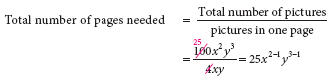
= 25xy2 pages
58.
.JPG)
This is one of the solutions. Try for more solutions
59.
(d)
9x2 + 16y2-24xy
60.
(b)
12a3b - 14ab2 + 10 a2b2
61.
(a)
12a2bc2
62.
(a)
edges
63.
(b)
chord
64.
(d)
\(\frac{Circumference}{Diameter}\)
65.
(c)
8
66.
(c)
cuboid
67.
(b)
Associative property
68.
(c)
\(\frac{4}{6}\)
69.
(c)
\(\frac{2}{1}\)
70.
(c)
71.
(d)
A D G J
72.
(c)
4
73.
(a)
62°
74.
(d)
987
75.
(d)
8th
76.
(a)
2
77.
(b)
1 year
78.
(c)
6
79.
(d)
20, 48, 52
80.
(b)
5 cm
81.
(b)
20 cm
82.
(c)
Rs. 176.40
83.
(c)
25%
84.
(d)
36
85.
(d)
does not exist
86.
(d)
all of these
87.
(c)
AC = CD
88.
(a)
50°
89.
(d)
93 m
90.
(c)
∠Q = ∠X
91.
(d)
matching
92.
(c)
19
93.
(d)
64
94.
(b)
8
95.
(d)
6x2y
96.
(d)
mn2, -27

8th Standard Syllabus & Materials
8th Standard
TN 8th Tamil இயல் 3 - கல்வி கரையில - பாடறிந்து ஒழுகுதல் Important Questions And Answers Study Material - QB365 Set A
NEW8th Standard
TN 8th Tamil இயல் 3-கல்வி கரையில - பல்துறைக் கல்வி Important Questions And Answers Study Material - QB365 Set A
NEW8th Standard
TN 8th Tamil இயல் 3-கல்வி கரையில - புத்தியைத் தீட்டு Important Questions And Answers Study Material - QB365 Set A
NEW8th Standard
TN 8th Tamil இயல் 2 - ஈடில்லா இயற்கை - தமிழர் மருத்துவம் ( நேர்காணல்) Important Questions And Answers Study Material - QB365 Set A



Tamilnadu Stateboard 8th Standard Subjects
Tamilnadu Stateboard Standards




