
 100% FREE ACCESS
8th Standard CBSE Syllabus & Materials
8th Standard CBSE
CBSE 8th Social Science Theme D - Factors of Production - New Model Questions Papers Study Material - QB365 Set A
NEW8th Standard CBSE
CBSE 8th Social Science Theme C - Universal Franchise and India's Electoral System - New Model Questions Papers Study Material - QB365 Set A
NEW8th Standard CBSE
CBSE 8th Social Science Theme B - The Rise of the Marathas - New Model Questions Papers Study Material - QB365 Set A
NEW8th Standard CBSE
CBSE 8th Social Science Theme B - Reshaping India's Political Map - New Model Questions Papers Study Material - QB365 Set A
NEW8th Standard CBSE
CBSE 8th Social Science Theme A - Natural Resources and Their Use - New Model Questions Papers Study Material - QB365 Set A
NEW8th Standard CBSE
CBSE 8th Science Keeping Time with Skies - New Model Questions Papers Study Material - QB365 Set A

Published on: 15/02/2019
Rational Numbers Important Questions
Download CBSE Class 8th Standard CBSE Mathematics question papers, sample papers, important questions, and previous year solved papers in PDF format. Get free study materials, NCERT solutions, and exam preparation resources for Class 8th Standard CBSE Mathematics
Questions + Answers key
Take MCQ Mathematics Test
1.
The reciprocal of a negative rational number is
a positive rational number
a negative rational number
0
-1.
2.
0 is not
a natural number
a whole number
an integer
a rational number.
3.
Which of the following is neither positive nor a negative rational number?
1
0
Such a rational number does not exist
None of the above
4.
Which of the following is not true?
rational numbers are closed under addition
rational numbers are closed under subtraction.
rational numbers are closed under multiplication
rational numbers are closed under division
5.
Zero (0) is
the identity for addition of rational numbers
the identity for subtraction of rational numbers
the identity for multiplication of rational numbers
the identity for division of rational numbers.
6.
\({1\over15}\times[{27\over31}+{32\over37}]=[{1\over15}\times{27\over31}]+\) ______________________
7.
| Numbers | Commutative for | |||
| Addition | Subtraction | Multiplication | Division | |
| Rational numbers | Yes | ___________ | ___________ | __________ |
8.
Let O, P and Z represent the numbers 0, 3 and -5, respectively on the number line. Points Q, Rand S are between O and P such that OQ = QR = RS = SP. What are the rational numbers represented by the points Q, Rand S? Next choose a point T between Z and O, so that ZT = TO. Which rational number does T represent?
9.
\({1\over6}\) of the class students are above average,\({1\over4}\) are average and rest are below average. If there are 48 students in all, how many students are below average in the class?
10.
The product of two rational numbers is \({-128\over75}\) If one of the numbers is \(64\over3\) find the other rational number.
11.
Using appropriate properties, find \({-2\over3}\times{3\over5}+{5\over2}-{3\over5}\times{1\over6}\)
12.
If a property holds for rational number, will it also hold for integers? For whole numbers? Which will? Which will not?
13.
Do you think the properties of commutativity and associativity made the calculations easier?
14.
Is \(\frac{1}{2}-\frac{3}{5}=\frac{3}{5}-\frac{1}{2}?\)
15.
4 + 7 =_________ Is it a whole number?
16.
The product of two rational numbers is \(\frac { -28 }{ 75 } \) if one of the numbers is \(\frac { 14 }{ 25 } \) find the other
17.
Multiply the reciprocal of \(\frac { 7 }{ 8 } \) by the reciprocal of \(\frac { -2 }{ 21 } \)
18.
Name the property used in each of the following:
\(({-2\over7})+0=0+({-2\over7})=-{2\over7}\)
19.
Find the additive inverse of \(17\over-3\)
20.
Simplify : \({7\over8}+{1\over16}-{1\over12}\)
21.
Find the multiplicative inverse of the following -1
22.
Verify that -(-x) = x, for x = \(11\over15\)
23.
Complete the following crossword puzzle using given directions.
Across:
(1) The negative of a rational number is called its ______.
(2) A number of the form where p and q are integers and q \(\neq \) 0, is called a ________.
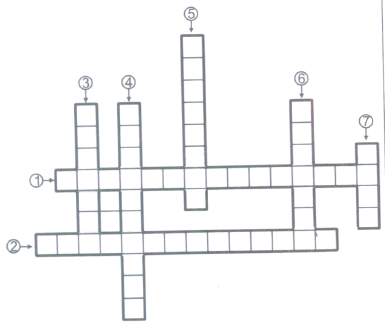
(3) The________ of a rational number and its product is 1.
(4) The multiplicative inverse of a number is also called its _____.
(5) Zero is also called the________ identity for rational numbers.
(6) If the product of two rational numbers is 1, then they are called multiplicative_______ of each other.
(7) The rational number is________ the additive identity for rational numbers.
24.
Four friends had a competition to see how far could they hop on one foot. The table given shows the distance covered by each
| Name | Distance covered (in km) |
| Seema | \({1\over25}\) |
| Nancy | \({1\over32}\) |
| Megha | \({1\over40}\) |
| Soni | \({1\over20}\) |
(a) How farther did Soni hop than Nancy?
(b) What is the total distance covered by Seema and Megha?
(c) Who walked farther Nancy or Megha?
(d) What is the benefit of competition?
25.
Use the distributivity of multiplication of rational numbers over addition to simplify:
\({2\over7}\times[{7\over16}-{21\over4}]\)
26.
Using and associativity of addition of rational numbers, express the following as a rational number.
\({5\over2}+{-3\over7}+{1\over2}+{4\over7}\)
27.
The negative of the negative of any rational number is the number itself
28.
(a + b)+ c= a + (b+ c) is called
29.
Find \(\frac { 5 }{ 22 } +\frac { 3 }{ 7 } +\left( \frac { -8 }{ 21 } \right) +\left( \frac { -6 }{ 11 } \right) \)
1.
(b)
a negative rational number
2.
(d)
a rational number.
3.
(b)
0
4.
(d)
rational numbers are closed under division
5.
(a)
the identity for addition of rational numbers
6.
()
\([{1\over15}\times{32\over37}]\)[using distributive property over addition]
7.
()
| Numbers | Commutative for | |||
| Addition | Subtraction | Multiplication | Division | |
| Rational numbers | Yes \(e.g ({2\over3}+{5\over7}={5\over7}+{2\over3}) \\ \Rightarrow {14+15\over21}={15+14\over21}\\ \Rightarrow {29\over21}={29\over21}, which \ is \ true.\) | No e.g \(({1\over2}-{3\over5}\neq {3\over5}-{1\over2}) \\ \Rightarrow {5-6\over10}\neq{6-5\over10}\\ {-1\over10}\neq{1\over10}, which \ is \ not \ true.\) | yes , e.g\(({-7\over3} \times {6\over5}={6\over5}\times{-7\over3})\\ \Rightarrow {-42\over15}={-42\over15} Which \ is \ true\) | No e.g \(({-5\over4}\div {3\over7}\neq {3\over7}\div{-5\over4}) \\ \Rightarrow {-5\over4}\times{7\over3}\neq {3\over7}\times{4\over-5} \\ \Rightarrow-{35\over12}\neq{12\over-35}, which \ is \ not \ true\) |
8.
\(Q={3\over4},R={6\over4},S={9\over4},T={-5\over2}\)
9.
Number of above average students=\({1\over6}\) of the class student
Number of average students= \({1\over4}\)of the class student
\(\therefore\) Number of below average students \(=1-[{1\over6}+{1\over4}]\) of the class student
\(=-[{2+3\over12}]=1-{5\over12}={7\over12}\)of the class student
Since, number of students in the class = 48
\(\therefore\)Number of below average students
\(={7\over12}\times48=28\)
So, Number of below average students= 28
10.
We have, product of two numbers = \({-128\over75}\)
One of the numbers is \(64\over3\)
\(\therefore\)The other number =\({-128\over75}+{64\over3}={-128\over75}\times{3\over64}={-2\over25}{}\)
11.
We have, \({-2\over3}\times{3\over5}+{5\over2}-{3\over5}\times{1\over6}={-2\over3}\times{3\over5}-{3\over5}\times{1\over6}+{5\over2}\) [by associativity]
\(={3\over5}\times{-2\over3}+{3\over5}\times{-1\over6}+{5\over2}\) [by commutativity]
\(={3\over5}\times({-2\over3}-{1\over6})+{5\over2}\)
[by distributivity, taking \({3\over5}\) as common factor]
\(={3\over5}\times({-4-1\over6})+{5\over2} \ \ \ \ [\because LCM \ of \ 3 \ and \ 6=6] \)
\(\\ ={3\over5}\times({-5\over6})+{5\over2}={3\over5}\times {-5\over6}+{5\over2}={-1\over2}+{5\over2}={-1+5\over2}\)
\(\\ ={4\over2}=2\)
12.
All properties of operations on rational numbers also hold in case of integers except the following property:
a \(\div\) b is a rational number if b \(\neq\) 0 but a \(\div\)b is not necessarily an integer in case ab \(\in\) J,
All properties of operations on rational numbers also hold in case of whole numbers except the following properties:
(i) If a and b are rational numbers, then (a - b) may or may not be a whole number,
(ii) If a and b are rational numbers, then a\(\div\)b (where b \(\neq\) 0) is not necessarily a whole number,
13.
Yes! the properties of commutativity and associativity made the calculations easier.
14.
\(\frac{1}{2}-\frac{3}{5}=\frac{5-6}{10}=\frac{-1}{10}\)
\(\frac{3}{5}-\frac{1}{2}=\frac{6-5}{10}=\frac{1}{10}\)
\(\because \frac{-1}{10} \ne \frac{1}{10}\)
\(\therefore \frac{1}{2}-\frac{3}{5} \ne \frac{3}{5}-\frac{1}{2}\)
15.
4 + 7 = 11;
Yes; it is a whole number.
16.
\(\therefore\) product of two rational numbers = \(\frac { -28 }{ 75 } \)
Any one of the ratioanl numbers = \(\frac { 14 }{ 25 } \)
\(\therefore\) the other number = \(\left[ \frac { -28 }{ 75 } \right] \div \frac { 14 }{ 25 } \)
= \(\frac { -28 }{ 75 } \times \frac { 25 }{ 14 } =\frac { -2\times 1 }{ 3\times 1 } =\frac { -2 }{ 3 } \)
Thus, the required rational number is \(\left( \frac { -2 }{ 3 } \right) \)
17.
\(\therefore\) Reciprocal of \(\frac { 7 }{ 8 } \) is \(\frac { 8 }{ 7 } \)
Reciprocal of \(\frac { -2 }{ 21 } \) is \(\frac { -21 }{ 2 } \)
\(\therefore\) \(\left[ Reciprocal\ of\frac { 7 }{ 8 } \right] \times \left[ Reciprocal\ of\left( \frac { -2 }{ 21 } \right) \right] \)
= \(\frac { 8 }{ 7 } \times \left( \frac { -21 }{ 2 } \right) =\frac { 4\times (-3) }{ 1\times 1 } =-12\)
18.
Existence of additive identity
19.
The additive Inverse of \({17\over-3}is{17\over13}\)
20.
\(41\over48\)
21.
we have, -1
\(\therefore\)The multiplicative inverse of-1 is -1
22.
We have, x =\(11\over15\)
LHS = -(-x) = -\(({11\over15})={11\over15}=X=RHS\)
S0, - (-x) = x is verified for x =\(11\over15\)
23.
(1) \(\rightarrow\) Additive Inverse
(2) \(\rightarrow\) Rational Inverse
(3) \(\rightarrow\) Product
(4) \(\rightarrow\) Reciprocal
(5) \(\rightarrow\) Additive
(6) \(\rightarrow\) Inverse
(7) \(\rightarrow\) Zero
24.
Now, we have, \({1\over25},{1\over32},{1\over40},{1\over20}\)
Now, making same denominator, we get
\({1\over25}={32\over800},{1\over32}={25\over800},{1\over40}={20\over800},{1\over20}={40\over800}\)
(a) Soni hop more than Nancy with distance
\(={40\over800}-{25\over800}={15\over800}={3\over160}Km\)
(b) Total distance covered by Seema and Megha
\(={32\over800}+{20\over800}={52\over800}={13\over200}Km\)
(c) Clearly, Nancy walked farther than Megha.
(d) By competition, we make ourself relate with the surrounding in terms of compatibility of our quality. It helps to enrich our strength.
25.
\(-{11\over8}\)
26.
\(22\over7\)
27.
(a)
28.
()
Commutative property for addition
29.
()
\(\frac { -125 }{ 462 } \)

8th Standard CBSE Syllabus & Materials
8th Standard CBSE
CBSE 8th Science Particulate Nature of Matter - New Model Questions Papers Study Material - QB365 Set A
NEW8th Standard CBSE
CBSE 8th Science Pressure, Winds, Stroms and Cyclones - New Model Questions Papers Study Material - QB365 Set A
NEW8th Standard CBSE
CBSE 8th Mathematics Quadrilaterals - New Model Questions Papers Study Material - QB365 Set A
NEW8th Standard CBSE
CBSE 8th Mathematics A story of Numbers - New Model Questions Papers Study Material - QB365 Set A



CBSE 8th Standard CBSE Subjects
CBSE Standards




