
 100% FREE ACCESS
8th Standard Syllabus & Materials
8th Standard
TN 8th Tamil இயல் 3 - கல்வி கரையில - வினைமுற்று Important Questions And Answers Study Material - QB365 Set A
NEW8th Standard
TN 8th Tamil இயல் 2 - ஈடில்லா இயற்கை - மயங்கொலிகள் Important Questions And Answers Study Material - QB365 Set A
NEW8th Standard
TN 8th Tamil இயல் 2 - ஈடில்லா இயற்கை -பட்டமரம் Important Questions And Answers Study Material - QB365 Set A
NEW8th Standard
TN 8th Tamil இயல் 2 - ஈடில்லா இயற்கை - இயற்கையை போற்றுவோம் Important Questions And Answers Study Material - QB365 Set A
NEW8th Standard
TN 8th Tamil இயல் 1 - தமிழ் இன்பம் - ஆழிக்கு இணை Important Questions And Answers Study Material - QB365 Set A
NEW8th Standard
TN 8th Tamil இயல் 2-ஈடில்லா இயற்கை - திருக்குறள் Important Questions And Answers Study Material - QB365 Set A

Published on: 19/08/2019
Download Tamil Nadu 8th Standard Maths question papers, model tests, one-mark questions, important questions, and public exam papers in PDF format. Free study materials and answer keys for TN State Board students.
Questions + Answers key
Take MCQ Maths Test1.
The sum of two rational numbers is \(\frac { 4 }{ 5 } \). If one number is \(\frac { 2 }{ 15 } \) find the other.
2.
Find the value of (3a + 4c)2 by using (a+b)2 identity.
3.
Guna has fixed a single door of 3 feet wide in his room where as Nathan has fixed a double door, each 1\(\frac{1}{2}\) feet wide in his room. From the closed state, if each of the single and double doors can open up to 1200, whose door requires a minimum area?
4.
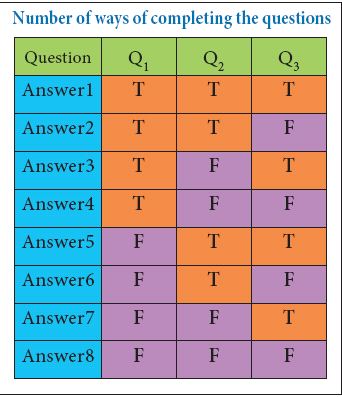
In how many ways, can the students answer 3 true or false type questions in a slip test?
5.
Find the unknowns in the following figures
.JPG)
6.
In a recipe making, every \(1\frac { 1 }{ 2 } \) cup of rice requires \(2\frac { 3 }{ 4 } \) cups of water. Express this, in the ratio of rice to water.
7.
Evaluate: \(\frac{9}{132} \times \frac{-11}{3}\)
8.
Find the rational numbers represented by each of the question marks marked on the following number lines.

9.
Write four rational numbers equivalent to
\(\frac { 8 }{ 9 } \)
10.
Can a polyhedron have 12 faces, 22 edges and 17 vertices?
11.
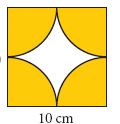
Find the area of the shaded part in the following figures. ( π = 3.14 )
12.
Multiply a monomial by a monomial
2p2q3, −9pq2
13.
Dhamu fixes a square tile of 30 cm on the floor. The tile has a sector design on it as shown in the figure. Find the area of the sector. (π = 3.14).

14.
Find the area of a sector whose length of the arc is 50 mm and radius is 14 mm.
15.
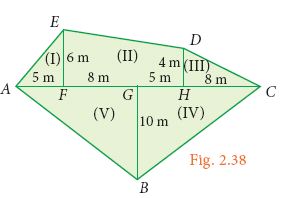
Find the area of the irregular polygon field whose measures are as given in the figure.
16.
Use graph colouring to determine the minimum number of colours that can be used. The adjacent states should not have the same colour.
Use the graph given below such that,
(i) each state is assigned a coloured vertex.
(ii) edges are used to connect the vertices of States.
.JPG)
17.
\(\frac { 1 }{ 2 } -\left( \frac { 3 }{ 4 } -\frac { 5 }{ 6 } \right) \neq \left( \frac { 1 }{ 2 } -\frac { 3 }{ 4 } \right) -\frac { 5 }{ 6 } \) illustrates that subtraction does not satisfy the ________ property for rational numbers.
commutative
closure
distributive
associative
18.
Which of the following rational numbers is the greatest?
\(\frac { -17 }{ 24 } \)
\(\frac { -13 }{ 16 } \)
\(\frac { 7 }{ -8 } \)
\(\frac { -31 }{ 32 } \)
19.
If ΔABC~ΔPQR in which ∠A = 53o and ∠Q = 77o, then R is
50°
50°
70°
80°
20.
How many 2 digit numbers contain the number 7?
10
18
19
20
21.
The product of 7p3 and (2p2)2 is
14p12
28P7
9p7
11p12
22.
The multiplicative inverse of -1 is ________.
23.
A cube has _________ faces.
24.
The standard form of \(\frac { +58 }{ -78 } \) is ______________
25.
The longest chord of a circle is __________.
26.
\(\frac{18 m^{4}(-)}{2 m^{3} n^{3}}\) ______mn5
27.

28.

29.

30.
Circumference of a semicircle
31.
Area of a circle
32.
The additive inverse of \(\frac { -11 }{ -17 } \) is \(\frac { 11 }{ 17 } \)
33.
The rational number which is its own reciprocal is –1.
34.
0 is the smallest rational number
1.
Let the other number be x
Given, \(\frac { 2 }{ 15 } +x=\frac { 4 }{ 5 } \)
\(\Rightarrow x=\frac { 4 }{ 5 } -\frac { 2 }{ 15 } =\frac { 12-2 }{ 15 } =\frac { 10 }{ 15 } \)
\(\Rightarrow x=\frac { 2 }{ 3 } \)
2.

\(\therefore\) (3a + 4c)2 = (3a)2 + 2(3a)(4c) + (4c)2 (replacing a and b values)
= 32 a2 + (2 x 3 x 4)(a x c) + 42c2
(3a + 4c)2 = 9a2 + 24ac + 16c2
3.
Guna fixed a single door of 3 feet wide.
Radius of this single door = 3 feet.
Nathan fixed a double door each of 1 1/2 feet wide.
Radius of each of this double door
\(=\frac{3}{2} \text { feet. } \)
The area required for the single door
\(=\frac{\theta}{360} \times \pi r^{2} \)
\(=\frac{120}{360} \times 3.14 \times 3 \times 3 \)
= 9.42 m2 ............(i)
The area required for the double door
\(=2 \times \frac{\theta}{360} \times \pi r^{2} \)
\(=2 \times \frac{120}{360} \times 3.14 \times \frac{3}{2} \times \frac{3}{2} \)
= 4.71 m2 ........................(ii)
From (i) and (ii), the double door requires minimum area.
4.
Assuming that the question Q1 is answered True, questions Q2 and Q3 can be answered as TT, TF, FT, and FF in 4 ways.
Similarly, assuming that the question Q2 is answered False, Q2 and Q3 can also be answered as TT, TF, FT, and FF in 4 ways.
Thus, as each question has only two options (True or False), the number of ways of answering these 3 questions in a slip test is 2 x 2 x 2 = 8 possible ways
5.
Now, from Fig \(\angle\)140o+ \(\angle\)z = \(\angle\)180o (linear pair)
⇒ \(\angle\)z = 180o −140o = 40o
Also \(\angle\)x+ \(\angle\)z= \(\angle\)70 + \(\angle\)z (exterior angle property)
⇒\(\angle\)x=70o
Also \(\angle\)z+ \(\angle\)y + 70o = 180o (angle sum property in ΔABC)
⇒ 40o + \(\angle\)y + 70o = 180o
⇒ \(\angle\)y = 180o − 110o = 70o
6.
For the recipe rice required = 1\(\frac{1}{2}\)cup
water required = 2\(\frac{3}{4}\) cups
\(\frac { rice }{ water } =\frac { 1\frac { 1 }{ 2 } }{ 2\frac { 3 }{ 4 } } \)
fraction \(=\frac { \frac { 3 }{ 2 } }{ \frac { 11 }{ 4 } } =\frac { 3 }{ 2 } \times \frac { 4 }{ 11 } \)
\(=\frac { 6 }{ 11 } \)
∴ rice : water = 6 : 11
7.
\(\frac{9}{132} \times \frac{-11}{3}=\frac{3}{12} \times \frac{-1}{1}=\frac{-1}{4} \)
8.
The rational number for the point marked on the number line is -\(\frac{2}{5}\)
9.
\(\frac { 8 }{ 9 } =\frac { 8\times 2 }{ 9\times 2 } =\frac { 16 }{ 18 } \)
\(\frac { 8 }{ 9 } =\frac { 8\times 3 }{ 9\times 3 } =\frac { 24 }{ 27 } \)
\(\frac { 8 }{ 9 } =\frac { 8\times 4 }{ 9\times 4 } =\frac { 32 }{ 36 } \)
\(\frac { 8 }{ 9 } =\frac { 8\times 5 }{ 9\times 5 } =\frac { 40 }{ 45 } \)
Four equivalent rational numbers of \(\frac { 8 }{ 9 } \) are \( \frac { 16 }{ 18 } ,\frac { 24 }{ 27 } ,\frac { 32 }{ 36 } ,\frac { 40 }{ 45 } \)
10.
By Euler's formula F + V - E = 2 for a polyhedron
Here F = 12, V = 17, E = 22
F + V - E = 12 + 17 - 22
= 29 - 22
= 7≠ 2
∴ The polyhedron cannot have 12 faces 22 edges and 17 vertices.
11.
From the figure
diameter = 10 cm
radius = 5 cm
Area of the shaded part
= Area of the square - Area of the four circular quadrant
\(
=a^{2}-\left(4 \times \frac{\theta}{360} \times \pi r^{2}\right)
\)
\(=(10 \times 10)-\left(4 \times \frac{90}{360} \times 3.14 \times 5 \times 5\right)
\)
= 100 - 78.5 = 21.5 cm2 (approximately)
12.
(2p2q3)\(\times\)(-9pq)2 = (+)(-) \(\times\) (2\(\times\)9) (p2\(\times\) p (q3\(\times\)q2)) = -18p3q5
13.
From the figure the tile is in a circular quadrant, Then the central angle is 90o
Area of the sector = \(\frac{\theta}{360} \times \pi r^{2}\)
\(=\frac{90}{360}\) x 3.14 x 30 x 30
= 706.5 cm2
14.
Length of the arc of the sector l = 50 mm
Radius r = 14mm
Area of the sector = \(\frac { lr }{ 2 } \) sq. units
= \(\frac { 50\times 14 }{ 2 } \) mm2 = 50 x 7 mm2 = 350 mm2
Area of the sector = 350mm2
15.
The given field has four triangles (I, III, IV & V) and a trapezium (II).
Area of the triangle (I) \(=\frac { 1 }{ 2 } \times b\times h=\frac { 1 }{ 2 } \times 5\times 6=15{ m }^{ 2 }\)
Area of the trapezium (II) \(=\frac { 1 }{ 2 } h(a+b)=\frac { 1 }{ 2 } \times 13\times (6+4)=65{ m }^{ 2 }\)
Area of the triangle (III) \(=\frac { 1 }{ 2 } \times b\times h=\frac { 1 }{ 2 } \times 8\times 4=\frac { 32 }{ 2 } =16{ m }^{ 2 }\)
Area of the triangle (IV) \(=\frac { 1 }{ 2 } \times b\times h=\frac { 1 }{ 2 } \times 13\times 10=65{ m }^{ 2 }\)
Area of the triangle (V) \(=\frac { 1 }{ 2 } \times b\times h=\frac { 1 }{ 2 } \times 13\times 10=65{ m }^{ 2 }\)
∴ The total area of the field = 15 + 65 + 16 + 65 + 65 = 226 m2
16.
.JPG)
.JPG)
This is one of the solutions. Try for more
17.
(d)
associative
18.
(a)
\(\frac { -17 }{ 24 } \)
19.
(a)
50°
20.
(c)
19
21.
(b)
28P7
22.
()
-1
23.
()
Six
24.
()
\(\frac { -29 }{ 39 } \)
25.
()
diameter
26.
()
\(\cfrac { 18{ m }^{ 4 }(n^{ 98 }) }{ 2m^{ (3) }{ n }^{ 3 } } =9mn^{ 5 }\)
27.
Triangular Prism
28.
Square Pyramid
29.
Cuboid
30.
(π + 2)r
31.
πr2
32.
(b)
33.
(b)
34.
(b)

8th Standard Syllabus & Materials
8th Standard
TN 8th Tamil இயல் 3 - கல்வி கரையில - பாடறிந்து ஒழுகுதல் Important Questions And Answers Study Material - QB365 Set A
NEW8th Standard
TN 8th Tamil இயல் 3-கல்வி கரையில - பல்துறைக் கல்வி Important Questions And Answers Study Material - QB365 Set A
NEW8th Standard
TN 8th Tamil இயல் 3-கல்வி கரையில - புத்தியைத் தீட்டு Important Questions And Answers Study Material - QB365 Set A
NEW8th Standard
TN 8th Tamil இயல் 2 - ஈடில்லா இயற்கை - தமிழர் மருத்துவம் ( நேர்காணல்) Important Questions And Answers Study Material - QB365 Set A



Tamilnadu Stateboard 8th Standard Subjects
Tamilnadu Stateboard Standards




