
 100% FREE ACCESS
8th Standard Syllabus & Materials
8th Standard
TN 8th Tamil இயல் 3 - கல்வி கரையில - வினைமுற்று Important Questions And Answers Study Material - QB365 Set A
NEW8th Standard
TN 8th Tamil இயல் 2 - ஈடில்லா இயற்கை - மயங்கொலிகள் Important Questions And Answers Study Material - QB365 Set A
NEW8th Standard
TN 8th Tamil இயல் 2 - ஈடில்லா இயற்கை -பட்டமரம் Important Questions And Answers Study Material - QB365 Set A
NEW8th Standard
TN 8th Tamil இயல் 2 - ஈடில்லா இயற்கை - இயற்கையை போற்றுவோம் Important Questions And Answers Study Material - QB365 Set A
NEW8th Standard
TN 8th Tamil இயல் 1 - தமிழ் இன்பம் - ஆழிக்கு இணை Important Questions And Answers Study Material - QB365 Set A
NEW8th Standard
TN 8th Tamil இயல் 2-ஈடில்லா இயற்கை - திருக்குறள் Important Questions And Answers Study Material - QB365 Set A

Published on: 01/10/2019
Term 1 Rational Numbers
Download Tamil Nadu 8th Standard Maths question papers, model tests, one-mark questions, important questions, and public exam papers in PDF format. Free study materials and answer keys for TN State Board students.
Questions + Answers key
Take MCQ Maths Test1.
Evaluate \(\frac { 6 }{ 7 } -2+\frac { -7 }{ 9 } +\frac { 19 }{ 21 } \)
2.
Simplify \(=\frac { -12 }{ 10 } +\left( \frac { -90 }{ 15 } \right) -\left( \frac { 3 }{ 8 } \right) \)
3.
Simplify \(\left( \frac { -16 }{ 5 } \times \frac { 20 }{ 8 } \right) -\left( \frac { 15 }{ 5 } \times \frac { -35 }{ 3 } \right) \)
4.
Find which rational number is greater?
\(\frac { -10 }{ 3 } ,\frac { 14 }{ -5 } \)
5.
Find which rational number is greater?
\(\frac { 5 }{ -4 } ,\frac { -11 }{ -7 } \)
6.
Write the following decimal numbers as rationals.
0.666…
7.
Write the following decimal numbers as rationals.
0.25
8.
Verify associative property for addition of rational numbers for \(a=\frac{5}{6}, b=\frac{-3}{4},c=\frac{4}{7}\)
9.
Simplify \(\left( \frac { -16 }{ 5 } \times \frac { 20 }{ 8 } \right) -\left( \frac { 15 }{ 5 } \times \frac { -35 }{ 3 } \right) \div \left( \frac { 11 }{ 16 } +\frac { 4 }{ 8 } \right) \)
10.
Simplify \(\left( \frac { -7 }{ 18 } \times \frac { 15 }{ -7 } \right) -\left( 1\times \frac { 1 }{ 4 } \right) +\left( \frac { 1 }{ 2 } \times \frac { 1 }{ 4 } \right) \)
1.
\(\frac { 6 }{ 7 } -2+\frac { -7 }{ 9 } +\frac { 19 }{ 21 } =\frac { 6 }{ 7 } -\frac { 2 }{ 1 } +\frac { -7 }{ 9 } +\frac { 19 }{ 21 } \)
\(=\frac { (6\times 9)-(2\times 63)+(-7\times 7)+(19\times 3) }{ 63 } \)
\(=\frac { 56-126+(-49)+57 }{ 63 } =\frac { 54-126-49+57 }{ 63 } \)
\(=\frac { -72-49+57 }{ 63 } =\frac { -121+57 }{ 63 } =\frac { -64 }{ 63 } =-1\frac { 1 }{ 63 } \)
2.
\(=\frac { (-12\times 12)+(-90\times 8)-(3\times 15) }{ 120 } \)
\(=\frac { -144+(-720)-45 }{ 120 } =\frac { -864-45 }{ 120 } \)
\(=\frac { -864+(-45) }{ 120 } =\frac { -909 }{ 120 } =\frac { -303 }{ 40 } \\ \)
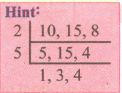
3.
\(\left( \frac { -16 }{ 5 } \times \frac { 20 }{ 8 } \right) -\left( \frac { 15 }{ 5 } \times \frac { -35 }{ 3 } \right) =\left( \frac { -2 }{ 1 } \times \frac { 4 }{ 1 } \right) -\left( \frac { 1 }{ 1 } \times \frac { -35 }{ 1 } \right) \)
= -8 - (-35) = -8 + ( + 35) = 27
4.
First, make the denominator of the rational number \(\frac { 14 }{ -5 } \) to be positive as \(\frac { -14 }{ 5 } \)
Then, make the denominators the same by finding the LCM of the denominators.
So, \(\frac { -10 }{ 3 } =\frac { -10 }{ 3 } \times \frac { 5 }{ 5 } =\frac { -50 }{ 15 } \) and \(\frac { -14 }{ 5 } =\frac { -14 }{ 5 } \times \frac { 3 }{ 3 } =\frac { -42 }{ 50 } \)
As 50 > 42, we have −50 < -42
Hence, \(\frac { -50 }{ 15 } <\frac { -42 }{ 50 } \) and so \(\frac { -42 }{ 50 } >\frac { -50 }{ 15 } \). Thus, \(\frac { -14 }{ 5 } >\frac { -10 }{ 3 } \)
5.
Now, \(\frac { 5 }{ -4 } =\frac { 5\times (-1) }{ -4\times (-1) } =\frac { -5 }{ 4 } \)
Also, \(\frac { -11 }{ -7 } =\frac { -11\times (-1) }{ -7\times (-1) } =\frac { 11 }{ 7 } \)
Here, \(\frac { 11 }{ 7 } \) is positive and \(\frac { -5 }{ 4 } \) is a negative rational number.
∴ \(\frac { 11 }{ 7 } >\frac { -5 }{ 4 } \), that is \(\frac { -11 }{ -7 } >\frac { 5 }{ -4 } \)
6.
\(0.666...=\frac { 2 }{ 3 } \)
7.
\(0.25=\frac { 25 }{ 100 } =\frac { 1 }{ 4 } \)
8.
Given \(a=\frac{5}{6}, b=\frac{-3}{4},c=\frac{4}{7}\)
To verify (a + b) + c = a + (b + c)
Let \(a+b=\frac { 5 }{ 6 } +\frac { -3 }{ 4 } =\frac { (5\times 2)+(-3\times 3) }{ 12 } =\frac { 10+(-9) }{ 12 } \)
\(a+b=\frac { 1 }{ 12 } \)
Now \((a+B)+c=\frac { 1 }{ 12 } +\frac { 4 }{ 7 } \)
\(=\frac { (1\times 7)+(4\times 12) }{ 84 } =\frac { 7+48 }{ 84 } =\frac { 55 }{ 84 } \)
\(\therefore (a+B)+c=\frac { 55 }{ 84 } \quad \quad ...(1)\)
Now \(b+c=\frac { -3 }{ 4 } +\frac { 4 }{ 7 } \)
\(=\frac { (-3\times 7)+(4\times 4) }{ 28 } =\frac { -21+16 }{ 28 } =\frac { -5 }{ 28 } \)
\(x a+(b+c)=\frac { 5 }{ 6 } +\left( \frac { -5 }{ 28 } \right) =\frac { (5\times 14)+(-5\times 3) }{ 84 } =\frac { 70+(-15) }{ 84 } \)
\(a+(b+c)=\frac { 55 }{ 84 } \) ...(2)
From (1) and (2) we have (a + b) + c = a + (b + c) .
∴ Associative property is true for addition of rational numbers.
9.
\(\left( \frac { -16 }{ 5 } \times \frac { 20 }{ 8 } \right) -\left( \frac { 15 }{ 5 } \times \frac { -35 }{ 3 } \right) \div \left( \frac { 11+(4\times 2) }{ 16 } \right) \)
\(=\left( \frac { -16 }{ 5 } \times \frac { 20 }{ 8 } \right) -\left( \frac { 15 }{ 5 } \times \frac { -35 }{ 3 } \right) \div \left( \frac { 11+8 }{ 16 } \right) \)
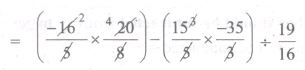
\(=-8-(-35)\times \frac { 16 }{ 19 } \)
\(=(-8)-(-35)\times \frac { 16 }{ 19 } \)
\(=-8-\left( -\frac { 560 }{ 19 } \right) =-8+\frac { 560 }{ 19 } \)
\(=\frac { (-8\times 19)+560 }{ 19 } =\frac { -152+560 }{ 19 } =\frac { 408 }{ 19 } =21\frac { 9 }{ 19 } \)
10.
\(\left( \frac { -7 }{ 18 } \times \frac { 15 }{ -7 } \right) -\left( 1\times \frac { 1 }{ 4 } \right) +\left( \frac { 1 }{ 2 } \times \frac { 1 }{ 4 } \right) =\left( \frac { -7\times 15 }{ 18\times -7 } \right) \left( \frac { 1\times 1 }{ 1\times 4 } \right) +\left( \frac { 1\times 15 }{ 18\times 1 } \right) -\left( \frac { 1 }{ 4 } \right) +\left( \frac { 1 }{ 8 } \right) \)
\(\\ \\ =\frac { 5 }{ 6 } -\frac { 1 }{ 4 } +\frac { 1 }{ 8 } =\frac { (5\times 4)-(1\times 6)+(1\times 3) }{ 24 } \)
\(=\frac { 20-6+3 }{ 24 } =\frac { 14+3 }{ 24 } =\frac { 17 }{ 24 } \)

8th Standard Syllabus & Materials
8th Standard
TN 8th Tamil இயல் 3 - கல்வி கரையில - பாடறிந்து ஒழுகுதல் Important Questions And Answers Study Material - QB365 Set A
NEW8th Standard
TN 8th Tamil இயல் 3-கல்வி கரையில - பல்துறைக் கல்வி Important Questions And Answers Study Material - QB365 Set A
NEW8th Standard
TN 8th Tamil இயல் 3-கல்வி கரையில - புத்தியைத் தீட்டு Important Questions And Answers Study Material - QB365 Set A
NEW8th Standard
TN 8th Tamil இயல் 2 - ஈடில்லா இயற்கை - தமிழர் மருத்துவம் ( நேர்காணல்) Important Questions And Answers Study Material - QB365 Set A



Tamilnadu Stateboard 8th Standard Subjects
Tamilnadu Stateboard Standards




