
 100% FREE ACCESS
8th Standard Syllabus & Materials
8th Standard
TN 8th Tamil இயல் 3 - கல்வி கரையில - வினைமுற்று Important Questions And Answers Study Material - QB365 Set A
NEW8th Standard
TN 8th Tamil இயல் 2 - ஈடில்லா இயற்கை - மயங்கொலிகள் Important Questions And Answers Study Material - QB365 Set A
NEW8th Standard
TN 8th Tamil இயல் 2 - ஈடில்லா இயற்கை -பட்டமரம் Important Questions And Answers Study Material - QB365 Set A
NEW8th Standard
TN 8th Tamil இயல் 2 - ஈடில்லா இயற்கை - இயற்கையை போற்றுவோம் Important Questions And Answers Study Material - QB365 Set A
NEW8th Standard
TN 8th Tamil இயல் 1 - தமிழ் இன்பம் - ஆழிக்கு இணை Important Questions And Answers Study Material - QB365 Set A
NEW8th Standard
TN 8th Tamil இயல் 2-ஈடில்லா இயற்கை - திருக்குறள் Important Questions And Answers Study Material - QB365 Set A

Published on: 25/09/2019
Forces and Pressure
Download Tamil Nadu 8th Standard Science question papers, model tests, one-mark questions, important questions, and public exam papers in PDF format. Free study materials and answer keys for TN State Board students.
Questions + Answers key
Take MCQ Science Test1.
If the area of contact is greater, then the ______ will be greater.
Pressure
Temperature
Friction
Force
2.
Rain drops are spherical in nature because of _________
Frictional force
Buoyant force
Surface tension
Viscous force
3.
The unit of viscosity is
Nm2
poise
kgms–1
no unit
4.
Pascal’s law is used in
hydraulic lift
brake system
pressing heavy bundles
All the above
5.
If we apply a force against the direction of motion of a body, then the body will
stop moving
move with an increased speed
move with a decreased speed
move in a different direction
6.
_________decides whether an object will sink or float
7.
A simple barometer was first constructed by _____.
8.
The property of _____ of a liquid surface enables the water droplets to move upward in plants.
9.
The pressure of a liquid column _____ with the depth of the column.
10.
Force is an action of push or pull
11.
Viscosity depends on the pressure of a liquid.
12.
Friction is the only reason for the loss of energy.
13.
Force acting on a given area is called pressure.
14.
Viscous force
15.
Irregular surface
16.
increasing area of contact
17.
Friction between the liquid layers
18.
Static friction
19.
Name some things which exert larger pressure on a smaller area?
20.
Which has greater viscosity, oil or honey? Why?
21.
Define one atmosphere.
22.
How does the friction arise between the surfaces of two bodies in relative motion?
23.
Give two examples to verify that a force changes the shape of a body.
24.
Why a camel can easily walk on sand?
25.
State Pascal’s law and mention its applications.
26.
Define friction. Give two examples of the utility of friction in day to day life.
27.
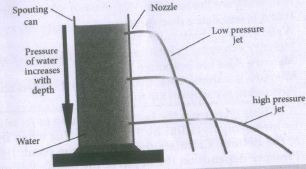
Describe an experiment to prove that the pressure in a liquid increases with depth.
28.
Give the different types of friction and explain each with an example.
29.
Why is it not advisable to take a fountain pen while travelling in an aeroplane?
1.
(c)
Friction
2.
(c)
Surface tension
3.
(b)
poise
4.
(d)
All the above
5.
(d)
move in a different direction
6.
()
Upward force
7.
()
Torricelli
8.
()
surface tension
9.
()
Increases
10.
(a)
11.
(b)
12.
(a)
13.
(b)
14.
Kg m-1S-1
15.
cause of friction
16.
increase friction
17.
viscosity
18.
objects are at rest
19.
Axe, nail, knife, injection needle, bullet.
20.
Honey. Honey flows slower than oil. So it has greater viscosity.
21.
i) The pressure exerted by the mercury column in a barometer is considered as the pressure of magnitude 'one atmosphere'.
ii) 1 atm = pressure due to 76 cm of mercury column in a barometer = 1.01 x 10⁵ Nm-2.
22.
Friction is produced due to the geometrical dissimilarities of the surface of the bodies, which are in relative motion.
23.
i) When force is exerted on raw rice, it gets grind to form rice flour
ii) When force is exerted on an inflated balloon at different angles, the shape of the balloon gets changed.
24.
i. Camel have large padded feet, which increase the area of contact with the sandy ground.
ii. This reduces the pressure and walk easily on sand.
25.
Pascal's law states that the pressure applied at any point of a liquid at rest, in a closed system will be distributed equally through all directions of the liquid.
Applications of Pascal's law:
i) In an automobile service stations, the vehicles are lifted upward using the hydraulic lift, which works as per Pascal's law.
ii) Automobile brake system works according to Pascal's law.
iii) The hydraulic press is used to make the compressed bundles of cloth or cotton so as to occupy less space.
26.
Frictional force arises when two or more bodies in contact move or tend to move, relative to each other. It acts always in the opposite direction of the moving body.
Examples:
(i) To light a matchstick.
(ii) To stitch a cloth in a sewing machine.
27.
Experiment:
i) Take a plasitc bottle
ii) Punch three holes on its side in the same direction but at different heights.
iii) Now pour some water into it and let it flow through the holes.
iv) Observe the flow of water.
Inference:
i) The water comes out from all the holes with a different force and falls on the table at points that are at variable distance from the bottle.
ii) Water from the lowest hole comes out with the greatest force and falls at a point that is at the maximum distance from the bottle.
iii) Water from the top most hole comes out with the least force and Falls at the point that is at the minimum distance from the bottle.
Result;
This activity confirms that the pressure in a liquid varies with the depth of the point of observation in it.
28.
Types of Friction:
Friction can be classifed into two basic types
I Static friction
II. Kinetic friction
I. Static friction:
The friction experienced by the bodies which are at rest is called static friction.
eg:- a knot in a thread.
II. Kinetic friction:
Friction existing during the motion of bodies is called kinetic friction
Kinetic friction can be classified into two types
(i) Sliding friction
(ii) Rolling friction
(i) Sliding friction:
When a body slides over the surface of another body, the friction acting between the surfaces in contact is called sliding friction
eg: Sliding on snow in a sled.
(ii) Rolling friction:
When a body rolls over another surface, the friction acting between the surfaces in contact is called rolling friction.
eg: Wheels in vehicles, trolleys, Suitcases.
29.
While travelling in an aeroplane atmospheric pressure decreases with increasing altitude. So pressure inside the aeroplane can also decreases. The pressure inside the fountain pen is more compared to its surrounding Due to varying pressure, the ink gets spilled. Due to ink spillage, fountain pens are not advisable to use while travelling in an aeroplane.

8th Standard Syllabus & Materials
8th Standard
TN 8th Tamil இயல் 3 - கல்வி கரையில - பாடறிந்து ஒழுகுதல் Important Questions And Answers Study Material - QB365 Set A
NEW8th Standard
TN 8th Tamil இயல் 3-கல்வி கரையில - பல்துறைக் கல்வி Important Questions And Answers Study Material - QB365 Set A
NEW8th Standard
TN 8th Tamil இயல் 3-கல்வி கரையில - புத்தியைத் தீட்டு Important Questions And Answers Study Material - QB365 Set A
NEW8th Standard
TN 8th Tamil இயல் 2 - ஈடில்லா இயற்கை - தமிழர் மருத்துவம் ( நேர்காணல்) Important Questions And Answers Study Material - QB365 Set A



Tamilnadu Stateboard 8th Standard Subjects
Tamilnadu Stateboard Standards




