
 100% FREE ACCESS
8th Standard Syllabus & Materials
8th Standard
TN 8th Tamil இயல் 3 - கல்வி கரையில - வினைமுற்று Important Questions And Answers Study Material - QB365 Set A
NEW8th Standard
TN 8th Tamil இயல் 2 - ஈடில்லா இயற்கை - மயங்கொலிகள் Important Questions And Answers Study Material - QB365 Set A
NEW8th Standard
TN 8th Tamil இயல் 2 - ஈடில்லா இயற்கை -பட்டமரம் Important Questions And Answers Study Material - QB365 Set A
NEW8th Standard
TN 8th Tamil இயல் 2 - ஈடில்லா இயற்கை - இயற்கையை போற்றுவோம் Important Questions And Answers Study Material - QB365 Set A
NEW8th Standard
TN 8th Tamil இயல் 1 - தமிழ் இன்பம் - ஆழிக்கு இணை Important Questions And Answers Study Material - QB365 Set A
NEW8th Standard
TN 8th Tamil இயல் 2-ஈடில்லா இயற்கை - திருக்குறள் Important Questions And Answers Study Material - QB365 Set A

Published on: 04/02/2020
8th Standard Science Important Questions
Download Tamil Nadu 8th Standard Science question papers, model tests, one-mark questions, important questions, and public exam papers in PDF format. Free study materials and answer keys for TN State Board students.
Questions + Answers key
Take MCQ Science Test1.
Tux paint software is used to ________.
paint
program
scan
2.
Adolescence is the period of life between _____________ years of age.
10 to 16
11 to 17
11 to 19
11 to 20
3.
External ear (pinna )is supported by
bone
cartilage
tendon
capsule
4.
In water, hydrogen and oxygen are combined in the ratio of _______by mass.
1:8
8:1
2:3
1:3
5.
Which of the following is known as azote?
Oxygen
Nitrogen
Sulpher
Carbon dioxide
6.
Which of the following a simple circuit must have?
Energy Source, Battery, Load
Energy Source, Wire, Load
Energy Source, Wire, Switch
Battery, Wire, Switch
7.
Which of the following substances will absorb more heat energy?
Solid
Liquid
Gas
All the above
8.
The unit for surface tension is _________
Nm
N-1m
N-1m-1
Nm-1
9.
Even if we tilt the barometric tube at various angles, the level of mercury will______
Not vary
increases
decreases
charge
10.
_______is the force acting perpendicularly on any given surface area of a body
Pressure
Thrust
Density
Volume
11.
Electric current (I) = ____________
Qt
t/Q
Q/t
Q/t2
12.
_______ can be used as memory or storage element in the computers.
Condutors
Insulators
Supercondutors
Semiconductors
13.
Normal temperature of the human body is between
98.4°F and 99.6°F
98.40F and 98.60F
97.4°F and 98.6°F
97.6°F and 99.60F
14.
When the angle of inclination decreases the number of images formed _________
increase
decreases
remain same
none of the above
15.
An imaginary line perpendicular to the reflecting surface is called
imaginary line
curved line
Perpendicular line
normal
16.
__________ form the perfect image of an object
Spherical mirrors
Parabolic mirrors
Plane mirrors
Cylindrical mirrors
17.
Enzymes and yeasts are called
catalysts
bio catalysts
chemical catalysts
physical catalysts
18.
The chemical reactions carried out by the passage of electricity is called.
Rusting
Thermolysis
Electrolysis
Photolysis
19.
Rusting of iron is a _________ change.
physical
chemical
physical and chemical
neutral
20.
Plasmodium belongs to _________ type of protozoan.
Ciliates
Flagellate
Pseudopods
sporozoans
21.
__________is an example for Lophotrichous
vibrio
Pseudomonas
Rhodospirillum
Corny bacterium
22.
_________is a ball-shaped bacteria.
Bacilli
Spinilla
Cocci
Vibrio
23.
The compound used for the sterilisation of drinking water is________
baking soda
washing soda
quick lime
bleaching powder.
24.
Compound obtained from living sources such as plants and animals are called
In Organic Compounds
Organic Compounds
Synthetic Compounds
Artificial Compounds
25.
The smallest particle of an element is__________
atom
molecule
Compound
element
26.
Which of the following component are used in fourth generation?
Vaccum tubes
Microprocessor
Integrated circuits
Transistor
27.
When was the first computer introduced?
1980
1947
1946
1985
28.
_______tissues for conduction of nerve impalses
Epithelial
Muscular
Nervous
Supporting
29.
_________make up organs
Cells
Tissues
Organ system
None of the above
30.
Cercospora personata causes _________
Wilt disease
Red rot of sugar cane
Blast disease
Tikka disease
31.
______ is used as a food for domestic animals
Gelidium
Ascophyllum
Laminaria & Ascophyllum
32.
______ is the earliest system of classification in plants.
Natural system of classification
Artificial system of classification
Phylogenetic system of classification
Modern system of classification
33.
Pen drive is _____device.
Output
Input
Storage
Connecting cable
34.
Which one of the following is an input device?
Speaker
Keyboard
Monitor
Printer
35.
Osmosis is the movement of water molecules from a ______.
Higher concentration to a region of lower concentration.
Lower concentration to a region of higher concentration.
Both of these
None of these
36.
_________ cells are specialised cells that can be transformed into any kind of cells.
Nerve
Stem
Heart
Bone
37.
The well-developed sporophytic plant body is seen in
Bryophytes
Pteridophytes
Gymnosperms
Angiosperms
38.
An example for colonial form of algae is
Oscillatoria
Nostac
Volvox
Chlorella
39.
______ is a prokaryotic micro organisms.
Virus
algae
fungi
bacteria
40.
Micro organisms are measured in ______.
cm
mm
micron
meter
41.
______ metal undergoes rusting.
tin
sodium
copper
iron
42.
The burning of matchstick is an example for chemical reaction based on______
Contact in physical states
electricity
light
catalyst
43.
Which one of metal possess low tensile strength?
Silver
Copper
Zinc
Aluminium
44.
Which one of the element name not derived from planet?
Plutonium
Neptunium
Uranium
Mercury
45.
The distance from the pole to the focus is called
Pole length
focal length
principal axis
None of the above
46.
The spherical mirror with a reflecting surface curved inward is called
convex mirror
concave mirror
curved mirror
None of the above
47.
Pascal’s law is used in
hydraulic lift
brake system
pressing heavy bundles
All the above
48.
Pressure exerted by a liquid is increased by
the density of the liquid
the height of the liquid column
Both (a) & (b)
None of the above
49.
Quantities other than base quantities are called as
supplementary quantities
derived quantities
professional quantities
energy quantities
50.
Luminous intensity is the intensity of ________
Laser light
UV light
visible light
IR light
51.
How is the skeleton of a bird well-suited for flying?
52.
Explain the working of thermos flask.
53.
Convert i) 90° into radian,
ii) \(\frac { \pi }{ 6 } \) into degrees.
54.
Why dams are made stronger and thicker at the bottom than at the top?
55.
Where the multiple reflection takes place.
56.
Write the chemical substances responsible for air pollution?
57.
What do you know about pasteurization?
58.
What is a compound? Give example.
59.
What is respiration?
60.
What is claviceps purpunya?
61.
What is a Computer?
62.
Define Prokaryotic cell?
63.
Write any four characters of pteridophytes.
64.
What are pathogens?
65.
Name the elements for following symbols.
a) Na b) W c) Ba d) Al e) U
66.
Define the refractive index of a medium.
67.
A bubble rises from the bottom of a pond to its surface by increasing its radius by 3 times its value when it was at the bottom. Calculate the depth of the pond. (Hint: Pressure depends on the depth of the pond. Volume is inversely related to pressure.) [Science Olympiad]
68.
What are the differences between Plane angle and solid angle?
69.
What is the use of Text Tool?
70.
What is fertilization?
71.
Differentiate axial and appendicular skeleton.
72.
State the law of conservation of mass.
73.
Write about the reaction of nitrogen with non metals.
74.
Give some uses of electroplating.
75.
Name three types of heat transfer
76.
Give the general formula for the conversion of scales of temperature?
77.
Why more number of wheels are provided for a heavy goods - carrier?
78.
Which mirror is used in solar cookers and solar water heaters?
79.
What is photolysis?
80.
Give any 2 living characters of virus.
81.
What are metalloids?
82.
What is symbol of an element?
83.
What is an Application Software?
84.
What do you mean by coenocytic mycelium?
85.
The radius of curvature of a spherical mirror is 20 cm. Find its focal length.
86.
Convert 80°C into kelvin
87.
Define Metabolism?
88.
What is cell differentiation?
89.
Write any two economic importance of fungi.
90.
What is mean by Binomial Nomenclature? give example.
91.
Which diseases can be prevented by vaccination?
92.
Write the names of any three protozoans.
93.
Why photosynthesis is a chemical reaction?
94.
What is pollution?
95.
Write three properties of metalloids.
96.
How do you feel when you touch a nail immediately after it is hammered into a wooden plank? Why?
97.
What can you suggest to your classmates to keep himself/herself clean and healthy?
98.
What is a streamlined body? How does it help in the movement of animals that fly or swim in water?
99.
It is said that sleeping beneath the tree during night is bad for health. What is the reason?
100.
What is electroscope? Explain how it works?
101.
Which one of the following statements about thermal conductivity is correct? Give reason.
a) Steel > Wood > Water
b) Steel > Water > Wood
c) Water > Steel > Wood
d) Water > Wood > Steel
102.
Explain how will you measure the current in an electric circuit using circuit diagram
103.
Explain Manometer with the diagram
104.
What are the uses of convex mirrors?
105.
Explain the biological effects of chemical reactions
106.
Write a note on techniques followed in food preservation.
107.
Explain the structure of an animal cell.
108.
Burning of fossil fuels is responsible for global warming. Justify the statement.
109.
Refractive index of water is 4/3 and the refractive index of glass is 3/2. Find the refractive index of glass with respect to the refractive index of water.
110.
Round off the number 1.868 to two decimal places.
111.
An iron ball requires 1000 J of heat to raise its temperature by 20°C. Calculate the heat capacity of the ball.
1.
(a)
paint
2.
(c)
11 to 19
3.
(b)
cartilage
4.
(a)
1:8
5.
(b)
Nitrogen
6.
(b)
Energy Source, Wire, Load
7.
(b)
Liquid
8.
(d)
Nm-1
9.
(a)
Not vary
10.
(b)
Thrust
11.
(c)
Q/t
12.
(c)
Supercondutors
13.
(b)
98.40F and 98.60F
14.
(a)
increase
15.
(d)
normal
16.
(c)
Plane mirrors
17.
(b)
bio catalysts
18.
(c)
Electrolysis
19.
(b)
chemical
20.
(d)
sporozoans
21.
(b)
Pseudomonas
22.
(c)
Cocci
23.
(d)
bleaching powder.
24.
(b)
Organic Compounds
25.
(a)
atom
26.
(b)
Microprocessor
27.
(c)
1946
28.
(c)
Nervous
29.
(b)
Tissues
30.
(d)
Tikka disease
31.
(c)
Laminaria & Ascophyllum
32.
(b)
Artificial system of classification
33.
(c)
Storage
34.
(b)
Keyboard
35.
(b)
Lower concentration to a region of higher concentration.
36.
(b)
Stem
37.
(c)
Gymnosperms
38.
(c)
Volvox
39.
(d)
bacteria
40.
(c)
micron
41.
(d)
iron
42.
(a)
Contact in physical states
43.
(c)
Zinc
44.
(d)
Mercury
45.
(b)
focal length
46.
(b)
concave mirror
47.
(d)
All the above
48.
(c)
Both (a) & (b)
49.
(b)
derived quantities
50.
(c)
visible light
51.
► A bird has streamlined body.
► Its bones are light and strong.
► They are hollow and have air spaces between them.
► The hind limbs of birds are modified as claws, which help them to walk and to perch.
► The breast bones are modified to hold massive flight muscles which help in moving wings up and down
► Birds have special flight muscles and the forelimbs are modified as wings.
► The wings and tail have long feathers which help in flying.
52.
Thermos flask:
The thermos flask is an insulating storage vessel that keeps its content hot cooler than the surroundings for longer time.
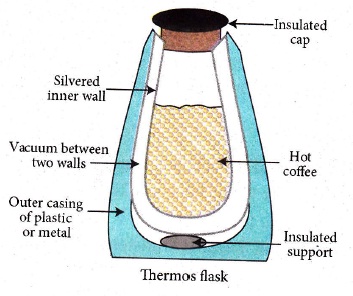
Working:
(i) A thermos flask has double wails, which are evacuated.
(ii) It is silvered on the inside.
(iii) The vacuum between the two walls prevents heat being transferred from the inside to the outside by conduction and convection.
(iv) with very little air between the walls, there is almost no transfer of heat from the inner wall to the outer wall or vice versa inner wall to the outer wall or vice versa
(v) Conduction can only occur at the points where the two walls meet, at the top of the bottle and through an insulated support at the bottom
(vi) The silvered walls reflect radiated heat buck to the liquid in the bottle.
53.
i) 90° into radian:
10 = \(\frac { \pi }{ 180 } \)
90O =\(\frac { \pi }{ 180 } \)x 90 = \(\frac { \pi }{ 2 } \)radian
ii) \(\frac { \pi }{ 6 } \) into degree
π radian = 1800
\(\frac { \pi }{ 6 } =\frac { 180 }{ 6 } \) = 300
54.
i. Due to high pressure at the bottom of the dam, the dam may be destroy or crack.
ii. So dams are made stronger and thicker at the bottom than at the top.
55.
The multiple reflections take place in showrooms and saloons
56.
Carbon dioxide, carbon monoxide, oxides of sulphur, oxides of nitrogen, chloro fluoro carbons, methane etc
57.
1. It is a process for preservation of liquid food.
2. This method was invented by Louis Pasteur in 1862.
3. Milk is heated up to 700c to kill the bacteria and it is cooled to 100c to prevent the growth of remaining bacteria.
4. Then milk is stored in sterilized bottles in cold places.
58.
(i) The molecule of a substance that contains two or more atoms of different elements combined together in a definite ratio is called as a compound.
(ii) (ex) CO2, H2O
59.
Respiration is the process in which energy is released while food is oxidised. It consists of external respiration and internal respiration.
60.
Claviceps purpunya is the hallwcinogenic fungi causes greatest damage to the frustrated youth by giving unreal, extra ordinary lightness and hovering sensations.
61.
(i) Computer is an electronic device that process the data and information according to our needs.
(ii) It follow instructions, called programs which determine the tasks the computer will perform.
62.
Prokaryotic cell lacks a distinct nucleus and membrane bound organelles
eg: bacteria.
63.
Characters of Pteridophytes:
1 Pteridophytes are the first true land plants with xylem and phloem. Hence it is called vascular cryptogams.
2 Pteridophytes exhibit alternation of generation. The diploid sporophytic phase alternates with the haploid gametophytic phase.
3 The main plant body is sporophytes, which is the dominant phase, differentiated into true root, stem and leaves.
4. Sporophytes reproduce by means of spores. Spores are produced in sporangium.
64.
Disease causing micro organisms are called pathogens.
Pathogenic organisms are of 5 types :
i) viruses
ii) fungi
iii) worms
iv) bacteria
v) protozoa
65.
| Symbol | Name | |
| a | Na | Sodium |
| b | W | Tungsten |
| c | Ba | Barium |
| d | Al | Aluminium |
| e | U | Uranium |
66.
Refractive index of the medium is the ratio of the speed of light in the air to the speed of light in that particular medium.
μ = \(\frac { Speed\ of\ light\ in\ air\ (c) }{ Speed\ of\ light\ in\ the\ medium\ (v) } \)
67.
From Boyle's law :- P α
Initial Pressure P1 = atmospheric pressure + pressure of liquid cloumn
= Hρg + Hρg
Where h 2 depth of the pond
H 2 Assume 10m of water
V1 = \(\frac { 4 }{ 3 } \pi \)r3 ; P2 = Hρg
V2 = \(\frac { 4 }{ 3 } \pi \)(3r)3 = \(\frac { 4 }{ 3 } \pi \)(27r3)
P1V1 = P2V2

h+10 =10x27
h =270-10
depth of the pond, h = 260m
68.
| Plane angle | Solid angle |
| Angle between the intersection of two straight lines or two planes. | Angle formed by three or more planes intersecting at a common point. |
| S. I unit - radian(rad) | S. I unit - steradian (sr) |
| It is Two dimensional | It is Three dimensional |
69.
70.
The fusion of Male and Female gametes (sperm, ovum) is called fertilization. In human, fertilization occurs in fallopian tubes of women's ovary.
71.
| S.No | Axial skeleton | Appendicular skeleton |
| 1 | Axial skeleton consists of bones along the axis or central line of thehuman body. |
It contains bones in the appendages of the body and structure which connect appendages to axial skeleton |
| 2 | It consists of skull, facial bones, sternum, ribs and vertebral column |
It comprises of pectoral girdle, pelvic girdle, arm bone and leg bone. |
72.
Law of conservation of mass states that during any chemical change, the total mass of the products is equal to the total mass of the reactants".
73.
Nitrogen reacts with non-metals like hydrogen, oxygen etc at high temperature to form their corresponding nitrogen compounds
\( 3 \mathrm{H}_{2}+\mathrm{N}_{2} \stackrel{\Delta}{\longrightarrow} 2 \mathrm{NH}_{3} \)
74.
Uses of electroplating:
(i) Zinc is deposited over Iron by electroplating to protect it from corrosion and rust formation. It is used in automobile industries.
(ii) Wheel rims, car parts, bath taps etc. requires a non-corrosive, non-scratchy, shiny metal. Chromium suits well but it is expensive. So they are made from a cheaper metal and a coating of chromium is deposited over it by electroplating.
75.
Three types ofheat transfer:
(i) Conduction
(ii) Convection
(iii) Radiation.
76.
\(\frac { C-10 }{ 100 } =\frac { F-32 }{ 180 } =\frac { K-273 }{ 100 } \)
77.
i. Decreases the pressure.
ii. Increase the area of contact
78.
Parabolic mirror.
79.
Chemical reactions carried out by light are called photolysis.
80.
i. They respond to heat, chemicals, and radiations.
ii. They show irritability.
81.
Elements which show the properties of metals as well as non metals are called metalloids
82.
The shortened form of the name of are element is called its symboL
83.
(i) Application software is a program or a group of programs designed for the benefit of end user to work on computer.
(ii) Examples of application program: Video player, Audio player, Word processing Software, Drawing tools etc.
84.
When aseptate without (cross wall) mycelium contains many nuclei it is called as coenocytic mycelium.
85.
Radius of curvature = 20 cm
Focal length (f) =\(\frac { Radius\quad of\quad curvat }{ 2 } \)
=\(\frac { R }{ 2 } =\frac { 20 }{ 2 } \)=10 cm
86.
K = C + 273
K = 80 + 273
K = 353 kelvin
87.
Metabolism is the sum total of the biochemical reactions involves in release and utilization of energy or energy exchange within the organisms.
88.
► Th foetus consists of multitude of cells of different shape, size and content.
► Foetal cells gradually attain change in structure and function.
► This process is known as cell differentiation.
89.
Antibiotic:
Penicillin, Neomycin, Gentamycin, Erythromycin are some antibiotics obtained from fungi which cure variable diseases.
Food:
Mushroom contains rich protein and minerals Common edible mushroom is Agaricus
90.
The naming of an organism with two words are known as Binomial nomenclature.
Eg: Mangifera indica - Binomial name of mango
Mangifera - Genus name: indica - Species name
91.
MMR Vaccine for measles, Mumps, Rubella, BCG (Bacille Calamette Guerin) vaccine for Tuberculosis
92.
i) Plasmodium
ii) Paramecium
iii) Euglena
93.
Photosynthesis is an irreversible change. In photosynthesis carbondioxide and water react in the presence of sunlight to produce a new substance called starch. Hence photosynthesis is a chemical reaction
94.
Any unwanted change in physical, chemical and biological properties of the environment is termed as pollution.
95.
i) Metalloids are all solid at room temperature.
ii) Metalloids can form alloys with other metals.
iii) The physical properties of metalloids tend to be metallic but their chemical properties tend to be non-metallic
96.
I feel hotness. When an iron nail is hammered into a wooden plank, heat is liberated due to friction.
97.
Personal hygiene habits:
(i) Shower or bath daily.
(ii) Always wash your hands before and after meals.
(iii) Keep fingernails clean and dipped.
(iv) Wash your teeth and mouth before and after each meal.
(v) Avoid touching your face, nose or mouth while preparing food.
(vi) Avoid coughing or sneezing around food and close your mouth by using hand kerchief while you cough in public places.
(vii) If you are to taste the food, use a clean spoon.
(viii) Change your clothes regularly and wash them cleanly especially undergarments.
(ix) Don't defecate in open field. Use clean toilets for defecation.
(x) If you are not well, avoid self-medication consult a doctor.
98.
Streamlined body
(i) A streamlined body is the shape of the body that reduces resistance when moving
(ii) Streamlined bodies often have a teardrop shape.
(iii) Streamline shape reduces the friction of movement to a minimum thus decreasing overall drag
(iv) Streamlined body of birds help the particles of air to move upload them quickly and come together smoothly on the other side. The air does not provide much resistance to the body so that they can fly easily in air spending less energy.
(v) Streanilined body of fishes help them to move smoothly with the flow of water. Its body shape reduces friction while moving in water. It helps in the orientation of the fish movements in a particular direction.
99.
i) During night photosynthesis does not occur. So, tree will not release oxygen and take in oxygen.
ii) Trees respire and they take in oxygen and release carbon dioxide. Due to their huge size, they take up comparatively more Oxygen than a human being. So, we will not get sufficient oxygen under a tree during night. It may cause breathing problems and suffocation. So it is bad for health.
100.
Electroscope:
An electroscope is a scientific instrument used to detect the presence of electric charge on a body.
Types:
There are two types of electroscope.
a) Pith-ball electroscope
b) Gold-leaf electroscope.
Principle:
It works on the principle that like charges repel each other.
Structure of a gold leaf electroscope:
It is made up of a glass jar. A vertical brass rod is inserted into the jar through a cork. The top of brass rod has a horizontal brass rod or a brass disc. Two gold leaves are suspended from the brass rod inside the jar.
Working -
i) If a negatively charged object is brought near the top disc of the electroscope, it causes free electrons in the electroscope to move down into the leaves, leaving the top positive. Since both the leaves have negative charge, they repel each other and move apart.
ii) If a positive object is brought near the top disc of the electroscope, the free electrons in the electroscope start to move up towards the disc. The bottom has a net positive charge. The leaves repel other and move apart.
101.
(b) Steel > Water > Wood is the correct statement
Steel has more number of free electrons than water and wood. So it is more electropositive. It has the tendency to gain electrons. So the thermal conductivity of steel is more than water and wood. Like wise, the thermal conductivity of water is more than that of wood.
Thermal conductivity of steel - 43 w/mK
Thermal conductivity of water - 0.606 w/mK.
Thermal conductivity of wood - 0.17 w/mK.
102.
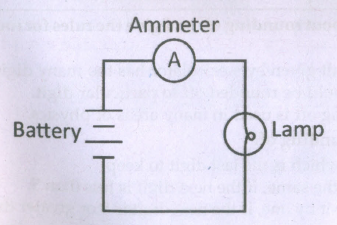
Components required:
Battery, Ammeter, Lamp (Bulb)
Procedure:
i. Connect the battery, ammeter and the lamp in series as shown in the figure.
ii. Note the ammeter reading.
iii. It is the current in the circuit.
103.
i. The level of mercury is initially at the same level.
ii. The gas present in the manometer event pressure.
iii. The mercury level moves down in one limb and rises in other limb.
iv. The mercury level moves down in one limb and rises in other limb.
v. The difference in liquid pressure is measured.
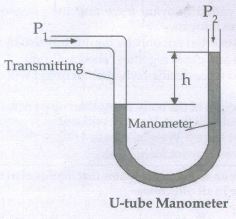
104.
i. Provide a wider field of view as they are curved outwards.
ii. Used in vehicles as rearview mirrors.
iii. Used in hallways of various buildings like hospital, hotels, schools, and stores.
iv. Mounted on a wall or ceiling where there are sharp turns.
v. Used on roads where there are sharp curves and turns.
105.
Biological effects:
a) Spoilage of food and Vegetables:
i. Food spoilage may be defined as any change that causes food unfit for human consumption.
ii. The chemical reactions catalysed by the enzymes result in the degradation of food quality.
iii. It develops bad tastes, odour, deterioration and loss of nutrients.
iv. (eg.) 1. Rotten eggs develop a bad smell due to the formation of hydrogen sulphide gas.
v. (eg.) 2. Decaying of vegetables and fruits due to microbes.
b) Rancidity of fishes and meat:
i. Fishes and meat contain high levels of polyunsaturated fatty acids.
ii. When exposed to air or light these polyunsaturated fatty acids undergo oxidation causing bad odour.
iii. This process is known as rancidity.
c) Apples and fruits turn brown when cut:
i. The cells of apples, fruits and other vegetables contain an enzyme called poly phenol oxidase or tyrosinase.
ii. This enzyme when comes in contact oxygen catalyses a biochemical reaction of plants phenolic compounds to brown pigments known as melanins.
iii. This chemical reaction is browning.
106.
A. Traditional Techniques:
i. Fermentation: Fermentation is the microbial conversion of starch and -sugar into alcohol. It makes foods more nutritious and palatable
ii. Pickling: It is of two types
1. Chemical pickling: Food is placed in an edible liquid that kills bacteria and other microorganisms, Eg; Vinegar, alcohol, vegetable oil.
2. Fermentation Pickling: Bacteria in the liquid produce organic acid as preservation agent that produces lactic acid due to the presence of Lactobacillus.
iii. Boiling: Boiling liquid food items kill all the microbes eg; Milk & water
iv. Sugaring: Sugar is used to preserve fruits in an antimicrobial syrup with fruit such as. apple, pears, peaches.
B. Modern techniques:
i. Pasteurization
1. It is a process for preservation of liquid food.
2. Milk is heated upto 700c to kill the bacteria and it is cooled to 100c to percent the growth of remaining bacteria.
3. Then Milk is stored in sterilized bottles in cold places.
107.
(i) It is the structural and functional unit of life.
(ii) Cells are often called as building blocks of life.
(iii) Cell consists of cytoplasm enclosed within them a membrane,
which contains many biomolecules, such as protein and Nucleic acids.
(iv) Cells vary in shape and size.
(v) There is a central nucleus and a living cell organelles like endoplasmic reticulum, mitochondria, Golgi bodies, centrioles, ribosome, lysosome, etc. present in an animal cell.
(vi) Each cell organelle performs a specific function
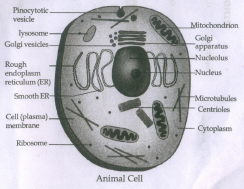
108.
Burning fossil fuels is a cause of global warming because it produces Co, and methane. These gases give the greenhouse effect. This increase the Earth's average temperature and results in the phenomenon called Global warming.
109.
wμg = \(\frac { Refractive\ index\ of\ glass }{ Refractive\ index\ of\ water } \)
\(=\frac { \frac { 3 }{ 2 } }{ \frac { 4 }{ 3 } } =\frac { 9 }{ 8 } \)=1.125
110.
We need to round off the number to two decimal places. So, the last digit to be kept is 6. Since the next digit is more than 5, we should increase the second digit by one. So, the answer is 1.87.
111.
Heat energy required Q = 1000 J
Raise in temperature T = 20oC
Heat capacity C' = ?
\(\mathrm{C}^{\prime}=\frac{\mathrm{Q}}{\Delta \mathrm{T}}=\frac{1000}{20^{\circ}}=50 \mathrm{~J} /{ }^{\circ} \mathrm{C}\)
Heat capacity of the iron ball is 50 J/oC.

8th Standard Syllabus & Materials
8th Standard
TN 8th Tamil இயல் 3 - கல்வி கரையில - பாடறிந்து ஒழுகுதல் Important Questions And Answers Study Material - QB365 Set A
NEW8th Standard
TN 8th Tamil இயல் 3-கல்வி கரையில - பல்துறைக் கல்வி Important Questions And Answers Study Material - QB365 Set A
NEW8th Standard
TN 8th Tamil இயல் 3-கல்வி கரையில - புத்தியைத் தீட்டு Important Questions And Answers Study Material - QB365 Set A
NEW8th Standard
TN 8th Tamil இயல் 2 - ஈடில்லா இயற்கை - தமிழர் மருத்துவம் ( நேர்காணல்) Important Questions And Answers Study Material - QB365 Set A



Tamilnadu Stateboard 8th Standard Subjects
Tamilnadu Stateboard Standards




