
 100% FREE ACCESS
8th Standard Syllabus & Materials
8th Standard
TN 8th Tamil இயல் 3 - கல்வி கரையில - வினைமுற்று Important Questions And Answers Study Material - QB365 Set A
NEW8th Standard
TN 8th Tamil இயல் 2 - ஈடில்லா இயற்கை - மயங்கொலிகள் Important Questions And Answers Study Material - QB365 Set A
NEW8th Standard
TN 8th Tamil இயல் 2 - ஈடில்லா இயற்கை -பட்டமரம் Important Questions And Answers Study Material - QB365 Set A
NEW8th Standard
TN 8th Tamil இயல் 2 - ஈடில்லா இயற்கை - இயற்கையை போற்றுவோம் Important Questions And Answers Study Material - QB365 Set A
NEW8th Standard
TN 8th Tamil இயல் 1 - தமிழ் இன்பம் - ஆழிக்கு இணை Important Questions And Answers Study Material - QB365 Set A
NEW8th Standard
TN 8th Tamil இயல் 2-ஈடில்லா இயற்கை - திருக்குறள் Important Questions And Answers Study Material - QB365 Set A

Published on: 30/10/2019
Term 2 Electricity
Download Tamil Nadu 8th Standard Science question papers, model tests, one-mark questions, important questions, and public exam papers in PDF format. Free study materials and answer keys for TN State Board students.
Questions + Answers key
Take MCQ Science Test1.
Fuse is
a switch
a wire with low resistance
a wire with high resistance
a protective device for breaking an electric circuit
2.
An electroscope has been charged by induction with the help of charged glassrod. The charge on the electroscope is
negative
positive
both positive and negative
None of the above
3.
Which of the following a simple circuit must have?
Energy Source, Battery, Load
Energy Source, Wire, Load
Energy Source, Wire, Switch
Battery, Wire, Switch
4.
The electrification of two different bodies on rubbing is because of the transfer of
neutrons
protons
electrons
protons and neutrons
5.
When an ebonite rod is rubbed with fur, the charge acquired by the fur is
negative
positive
partly positive and partly negative
None of these
6.
Give some uses of electroplating.
7.
What is electroplating?
8.
What is electric circuit?
9.
What is earthing?
10.
How charges are produced by friction?
11.
What is electroplating? Explain how it is done.
12.
How lightning takes place?
13.
Explain series and parallel circuit.
14.
What is electroscope? Explain how it works?
15.
Explain three ways of charge transfer.
1.
(d)
a protective device for breaking an electric circuit
2.
(c)
both positive and negative
3.
(b)
Energy Source, Wire, Load
4.
(c)
electrons
5.
(b)
positive
6.
Uses of electroplating:
(i) Zinc is deposited over Iron by electroplating to protect it from corrosion and rust formation. It is used in automobile industries.
(ii) Wheel rims, car parts, bath taps etc. requires a non-corrosive, non-scratchy, shiny metal. Chromium suits well but it is expensive. So they are made from a cheaper metal and a coating of chromium is deposited over it by electroplating.
7.
The process of depositing a layer of one metal over the surface of another metal by passing electric current is called electroplating.
8.
The path through which electrons flow from one terminal to another terminal of the source is called electric circuit.
9.
Earthing is the process of connecting the exposed metal parts of an electric circuit to the ground with the help of low resistance wire. It is a safety measure devised to prevent people from getting shocked if the insulation inside electrical devices fails.
10.
When two materials are rubbed together, some electrons are transferred from one material to the other, leaving them both with a net electric charge.
E.g. When a glass rod is rubbed with a silk cloth the free electrons in the glass rod are transferred to silk cloth. Thus, the glass rod acquires a positive charge and the silk cloth acquires a negative charges.
11.
Electroplating :
The process of depositing a layer of one metal over the surface of another metal by passing electric current is called electroplating.
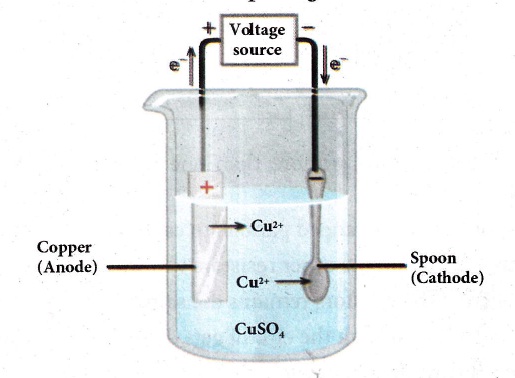
Procedure:
1. Take a glass jar and fill it with copper sulphate solution.
2. Take a copper metal plate and connect it to the positive terminal of the battery.
3. Connect an iron spoon to the negative terminal of the battery.
4. Now, dip them in the copper sulphate solution.
5. Pass electric current through the copper sulphate solution.
6. A thin layer of copper metal is deposited on the iron spoon and an equivalent amount of copper is lost by the copper plate.
12.
Lightning:
i) Lightning is an example of discharge that takes place in clouds.
ii) Lightning is produced by discharges of electricity from cloud to cloud or from cloud to ground.
iii) During thunderstorm air is moving upward rapidly and it carries small ice crystals upward. At the same time, small water drops move downward.
iv) When they collide, ice crystals become positively charged and more upward and the water drops become negatively charged and move downward.
v) So the upper part of the cloud is positively charged and the lower part of the cloud is negatively charged.
vi) When they come into contact, electrons in the water drops are attracted by the positive charges in the ice crystals.
vii) Thus electricity is generated and lightning is seen.
viii) Sometimes, the lower part of the cloud which is negatively charged comes into contact with the positive charges accumulated near the mountains, trees and even people on the earth.
ix) This discharge produces a lot of heat and sparks that results in lightning.
x) Huge quantities of electricity are discharged in lightning flashes and temperatures of over 30,000°C or more can be reached.
13.
1. A series circuit has more than one resistor but only one path through which the electrons can travel.
2. All the components in a series circus, are connected end to end.
3. If one resistor in the circuit is unscrewed, the current flow to another bulb would be interrupted.
4. current through the circuit remains same throughout the circuit.
5. The voltage gets divided across the resistors in the circuit.
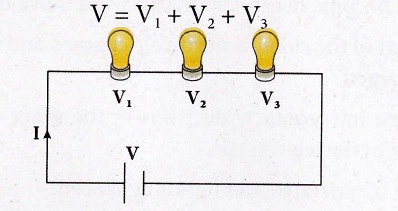
6. When three resistors are connected in series
i) I will be the current through the circuit.
ii) V1, V2, V3 will be the voltage across each resistor.
iii) The supply voltage V is the total of individual voltage drops across the resistances.
iv) V=V1+V2+V3
Parallel circuits
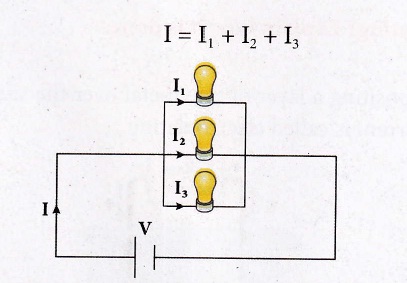
1. In a parallel circuit, there is more than one resistor and they are arranged on many paths.
2. All the components are arranged parallel to each other.
3. If one resistor burns out, the other resistors will work.
4. The voltage across the resistors remains the same.
5. The current flowing through the circuit gets divided across each resistor.
6. When three resistors are connected in parallel
i) V will be the voltage across the bulbs.
ii) I1, I2, I3 be the current across each bulb.
iii) The current I from the battery is the total of the individual current flowing through the resistance.
iv) I=I1+I2+I3
14.
Electroscope:
An electroscope is a scientific instrument used to detect the presence of electric charge on a body.
Types:
There are two types of electroscope.
a) Pith-ball electroscope
b) Gold-leaf electroscope.
Principle:
It works on the principle that like charges repel each other.
Structure of a gold leaf electroscope:
It is made up of a glass jar. A vertical brass rod is inserted into the jar through a cork. The top of brass rod has a horizontal brass rod or a brass disc. Two gold leaves are suspended from the brass rod inside the jar.
Working -
i) If a negatively charged object is brought near the top disc of the electroscope, it causes free electrons in the electroscope to move down into the leaves, leaving the top positive. Since both the leaves have negative charge, they repel each other and move apart.
ii) If a positive object is brought near the top disc of the electroscope, the free electrons in the electroscope start to move up towards the disc. The bottom has a net positive charge. The leaves repel other and move apart.
15.
Three ways of charge transfer:-
(i) Transfer by friction
(ii) Transfer by conduction
(iii) Transfer by Induction
(i) Transfer by friction:-
1. When two materials are rubbed together some electrons are transferred from one material to the other, leaving them both with a net electric charge.
2. E.g. when a glass rod is rubbed with a silk cloth, the free electrons in the glass rod are transferred to silk cloth.
3. Glass rod acquires a positive charge and the silk cloth acquires a negative charge.
(ii) Transfer by conductions :
1. Charges can be transferred to an object by bringing it in contact with a charged body. The method of transferring charges from one body to other body is called transfer by conduction.
2. E.g. when a negatively charged ebonite rod is brought near a hollow paper cylinder, negative charges in the rod are attracted by the positive charges in the cylinder.
3. When the paper cylinder is touched by the rod, some negative charges are transferred to the paper cylinder and they repel each other.
(iii) Transfer by Induction:
1. The process of charging an uncharged body by bringing a charged body near to it but without touching it is called induction.
2. E.g. when a negatively charged plastic rod is brought near a neutral rod, the near end of the neutral rod becomes positively charged and the farther end becomes negatively charged.

8th Standard Syllabus & Materials
8th Standard
TN 8th Tamil இயல் 3 - கல்வி கரையில - பாடறிந்து ஒழுகுதல் Important Questions And Answers Study Material - QB365 Set A
NEW8th Standard
TN 8th Tamil இயல் 3-கல்வி கரையில - பல்துறைக் கல்வி Important Questions And Answers Study Material - QB365 Set A
NEW8th Standard
TN 8th Tamil இயல் 3-கல்வி கரையில - புத்தியைத் தீட்டு Important Questions And Answers Study Material - QB365 Set A
NEW8th Standard
TN 8th Tamil இயல் 2 - ஈடில்லா இயற்கை - தமிழர் மருத்துவம் ( நேர்காணல்) Important Questions And Answers Study Material - QB365 Set A



Tamilnadu Stateboard 8th Standard Subjects
Tamilnadu Stateboard Standards




