
 100% FREE ACCESS
8th Standard Syllabus & Materials
8th Standard
TN 8th Tamil இயல் 3 - கல்வி கரையில - வினைமுற்று Important Questions And Answers Study Material - QB365 Set A
NEW8th Standard
TN 8th Tamil இயல் 2 - ஈடில்லா இயற்கை - மயங்கொலிகள் Important Questions And Answers Study Material - QB365 Set A
NEW8th Standard
TN 8th Tamil இயல் 2 - ஈடில்லா இயற்கை -பட்டமரம் Important Questions And Answers Study Material - QB365 Set A
NEW8th Standard
TN 8th Tamil இயல் 2 - ஈடில்லா இயற்கை - இயற்கையை போற்றுவோம் Important Questions And Answers Study Material - QB365 Set A
NEW8th Standard
TN 8th Tamil இயல் 1 - தமிழ் இன்பம் - ஆழிக்கு இணை Important Questions And Answers Study Material - QB365 Set A
NEW8th Standard
TN 8th Tamil இயல் 2-ஈடில்லா இயற்கை - திருக்குறள் Important Questions And Answers Study Material - QB365 Set A

Published on: 25/07/2019
From trade to territory
Download Tamil Nadu 8th Standard Social Science question papers, model tests, one-mark questions, important questions, and public exam papers in PDF format. Free study materials and answer keys for TN State Board students.
Questions + Answers key
Take MCQ Social Science Test
1.
The commander of the battle of adayar
Yousuf khan
Mahfuz khan
Anwar-ud-din
Chanda sahib
2.
Who was the last Peshwa of Maratha empire?
Balaji Vishwanath
Baji Rao II
Balaji Baji Rao
BajiRao
3.
The Treaty of Pondichery brought the _______ Carnatic war to an end.
First
Second
Third
None
4.
Which among the following treaty was signed after Battle of Buxar?
Treaty of Allahabad
Treaty of Carnatic
Treaty of Alinagar
Treaty of Paris
5.
The ruler of Bengal in 1757 was ________.
Shuja-ud-daulah
Siraj – ud – daulah
Mir kasim
Tipu Sultan
6.
The first indian to pass the I.C.S Exam-ination in 1863 was _________.
7.
In 1800, _________ established a college at Fort William in Calcutta.
8.
Tippu Sultan was finally defeated at the hands of _________.
9.
The main cause for the Second Carnatic war was _________.
10.
The Treaty of Alinagar was signed in _________.
11.
Artillery
12.
Civil service
13.
Treaty of Madras
14.
Treaty of Paris
15.
Treaty of Aix-La-Chapelle
16.
The battle of wandiwash came to an end by the treaty of pondicherry.
17.
The British company began to control the foreign policy of the princely states.
18.
The Police system was created by Lord Cornwallis.
19.
The outbreak of the Austrian war of succession in Europe was led to Second Carnatic War in India.
20.
After the death of Alivardi Khan, Siraj-ud-daulah ascended the throne of Bengal.
21.
Name the states signed into Subsidiary Alliance.
22.
Mention the causes for the Battle of Buxar.
23.
Write a short note on Black Hole Tragedy.
24.
What are the factors for the success of the british? Factors for the sccess of the british.
25.
Describe the policy adopted by Lord Dalhousie to expand the British empire in India.
26.
Write an essay on second Carnatic war.
27.
1. Plassy
2. Buxar
3. Purandhar
4. Arcot
5. Wandiwash
28.
Mention the states which became independent because of maratha confederacy.
1.
(b)
Mahfuz khan
2.
(b)
Baji Rao II
3.
(b)
Second
4.
(a)
Treaty of Allahabad
5.
(b)
Siraj – ud – daulah
6.
()
Satyendranath Tagore
7.
()
Lord Wellesley
8.
()
Lord Wellesly
9.
()
issue of succession
10.
()
1757
11.
English
12.
collecting revenue
13.
The First Anglo Mysore War
14.
The Third Carnatic war
15.
First Carnatic War
16.
(b)
17.
(a)
18.
(a)
19.
(b)
20.
(a)
21.
1. Hyderabad
2. Awadh
3. Indore
4. Udaipur and Jodhpur
5. Tanjore
6. Peshwa
7. Gwalior
8. Jaipur
9. Bhonsle
22.
1. Mir Jafar ascended the throne after the Battle of Plassey and failed to accept the demand of British
2. Mir Jafar the Nawab of Bengal however fell into arrears and was forced to abdicate in favour of his son in law, Mir Qasim.
3. Mir Qasim soon revolted as he was angry with the British for misusing the destakes (free duty passes).
4. However, having been defeated by the British, he fled to Awadh, where he formed a confederacy with Shuja-ud-daulah and ShahAlam.
23.
1. There was a small dungeon room in the Fort William in Calcutta, where troops of the Nawab of Bengal Siraj-ud-daulah, held 146 British Prisoners of war for one night.
2. Next day morning, when the door was opened 123 of the prisoners were found dead because of suffocation.
24.
1. The French were the most serious rivals to the English in India.
2. The English were successful in establishing their supremacy in India
3. The following were the causes for the success of the English in India.
4. The English had good financial position.
5. The Government in England rendered adequate support to the English East India Company.
6. The English had good trade facilities.
7. The English had a strong and superior naval power.
8. There was good understanding between the English Generals.
9. Development of textile was another cause.
10. There was scientific division of labour.
11. Economic prosperity and skilful diplomacy of the British.
12. The Indian merchants felt insecure.
13. The inequality and ignorance of the Indian kings.
25.
1. Lord Dalhousie was one of the chief architects of the British Empire in India. He was an imperialist. He adopted a new policy known as Doctrine of Lapse to extend British Empire
2. He made use of this precedent and declared in 1848 that if the native rulers adopted children without the prior permission of the Company, only the personal properties of the rulers would go to the adopted sons and the kingdom would go to the British paramount power.
3. It was bitterly opposed by the Indians. It was one of the root causes for the Great Revolt of 1857
26.
1. The main cause of this war was the issue of succession in Carnatic and Hyderabad.
2. Anwaruddin Khan and Chanda Sahib were the two claimants to the throne of Carnatic, whereas Nasir Jang and Muzaffar Jang were claimants to the throne of Hyderabad.
3. The French supported Chanda Sahib and Muzaffar Jang, while the British supported the other claimants with the objective of keeping their interest and influence in the entire Deccan region.
Wars: Battle of Ambur (1749)
1. Dupleix, Chanda Sahib and Muzaffar Jang formed a grand alliance and defeated and killed Anwar-ud-din Khan, the Nawab of Carnatic, on 3 August 1749 in the Battle of Ambur.
2. Chanda Sahib became the Nawab of Carnatic and rewarded the French with the grant of 80 villages around Pondicherry.
3. In the Deccan, too, the French defeated and killed Nasir Jang and made Muzaffar Jang as the Nizam. The French received the Northern Circar.
Battle of Arcot (1751):
1. Dupleix sent forces to besiege the Fort of Trichy where Muhammad Ali had taken shelter in 1751.
2. Chanda Sahib also joined the French, Robert Clive attacked Arent and defeated the French at Arni and Kaveripak.
3. Muhammad Ali was made the Nawab of Arcot under British protection.
Treaty of Pondicerry:
1. According to it, both the powers agreed not to interfere in the internal affairs of the native states.
2. They were to retain their old positions. New forts should not be built by either power.
3. The treaty made the British stronger. The French were still very powerful in Hyderabad.
4. However the predominant position of the French in the Deccan peninsula was definitely undermined in this war.
27.
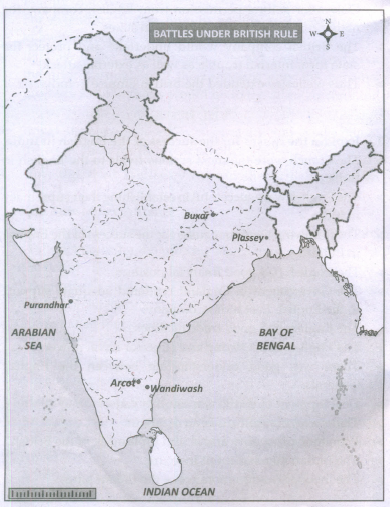
28.
i) Pune
ii) Baroda
iii) Nagpur
iv) Indore
v) Gwalior

8th Standard Syllabus & Materials
8th Standard
TN 8th Tamil இயல் 3 - கல்வி கரையில - பாடறிந்து ஒழுகுதல் Important Questions And Answers Study Material - QB365 Set A
NEW8th Standard
TN 8th Tamil இயல் 3-கல்வி கரையில - பல்துறைக் கல்வி Important Questions And Answers Study Material - QB365 Set A
NEW8th Standard
TN 8th Tamil இயல் 3-கல்வி கரையில - புத்தியைத் தீட்டு Important Questions And Answers Study Material - QB365 Set A
NEW8th Standard
TN 8th Tamil இயல் 2 - ஈடில்லா இயற்கை - தமிழர் மருத்துவம் ( நேர்காணல்) Important Questions And Answers Study Material - QB365 Set A



Tamilnadu Stateboard 8th Standard Subjects
Tamilnadu Stateboard Standards



