
 100% FREE ACCESS
8th Standard Syllabus & Materials
8th Standard
TN 8th Tamil இயல் 3 - கல்வி கரையில - வினைமுற்று Important Questions And Answers Study Material - QB365 Set A
NEW8th Standard
TN 8th Tamil இயல் 2 - ஈடில்லா இயற்கை - மயங்கொலிகள் Important Questions And Answers Study Material - QB365 Set A
NEW8th Standard
TN 8th Tamil இயல் 2 - ஈடில்லா இயற்கை -பட்டமரம் Important Questions And Answers Study Material - QB365 Set A
NEW8th Standard
TN 8th Tamil இயல் 2 - ஈடில்லா இயற்கை - இயற்கையை போற்றுவோம் Important Questions And Answers Study Material - QB365 Set A
NEW8th Standard
TN 8th Tamil இயல் 1 - தமிழ் இன்பம் - ஆழிக்கு இணை Important Questions And Answers Study Material - QB365 Set A
NEW8th Standard
TN 8th Tamil இயல் 2-ஈடில்லா இயற்கை - திருக்குறள் Important Questions And Answers Study Material - QB365 Set A

Published on: 06/08/2019
Download Tamil Nadu 8th Standard Maths question papers, model tests, one-mark questions, important questions, and public exam papers in PDF format. Free study materials and answer keys for TN State Board students.
Questions + Answers key
Take MCQ Maths Test1.
The difference between a number and its two third is 30 more than one -fifth of the number. Find the number.
2.
Show that \(\left( \frac { \frac { 7 }{ 9 } -5 }{ \frac { 4 }{ 3 } } \right) \div \frac { 3 }{ 2 } +\frac { 4 }{ 9 } -\frac { 1 }{ 3 } =-2\)
3.
Subbu spends \(\frac { 1 }{ 3 } \) of his monthly earnings on rent, \(\frac { 2 }{ 5 } \) on food and \(\frac { 1 }{ 10 } \) on monthly usuals. What fractional part of his earnings is left with him for other expenses?
4.
Use commutative and distributive properties to simplify \(\frac { 4 }{ 5 } \times \frac { -3 }{ 8 } -\frac { 3 }{ 8 } \times \frac { 1 }{ 4 } +\frac { 19 }{ 20 } \)
5.
Divide: \(\frac { -3 }{ 13 } \) by -3
6.
Verify that -(- x) is the same x for:
\(x=\frac { -31 }{ 45 } \)
7.
List five rational numbers between
–1.2 and -2.3
8.
List five rational numbers between
–2 and 0
9.
Multiply (4x2 + 9) and (3x-2)
10.
Expand (3m + 5)2
11.
Construct the following quadrilaterals with the given measurements and also find their area.
AGRI, AG = 4.5 cm, GR = 3.8 cm, ∠A = 60°, ∠G = 110° and ∠R = 90°.
12.
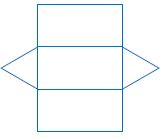
Which 3-D shapes do the following nets represent? Draw them.
13.
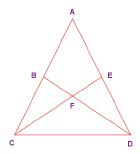
In the given figure, AC ≡ AD and ∠CBD ≡∠DEC.
Prove that \(\triangle\)BCF ≡ \(\triangle\)EDF.
14.
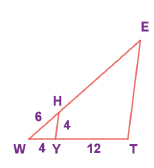
In the given figure YH||TE . Prove that ΔWHY~ΔWET and also find HE and TE.
15.
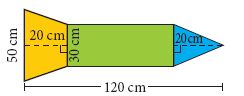
A rocket drawing has the measures as given in the figure. Find its area.
16.
An examination paper has 3 sections, each with five questions and students are instructed to answer one question from each section. In how many different ways of can the questions be answered?
17.
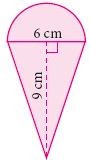
Find the area of the combined figure given, formed by joining a semicircle of diameter 6 cm with a triangle of base 6 cm and height 9 cm. ( π = 3.14 )
18.
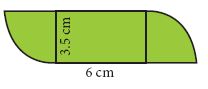
Find the perimeter and area of the combined figures given below. \(\left( \pi =\frac { 22 }{ 7 } \right) \)
19.
Find the product of (2x + 3)(2x − 4)
20.
Multiply a monomial by a monomial
2p2q3, −9pq2
21.
Multiply a monomial by a monomial
6x,4
22.
In how many ways, can the teacher choose 3 students in all, one each from 10 students in VI std, 15 students in VII std and 20 students in VIII std to go to an excursion?
23.
Dhamu fixes a square tile of 30 cm on the floor. The tile has a sector design on it as shown in the figure. Find the area of the sector. (π = 3.14).

24.
Find the area of a sector whose length of the arc is 50 mm and radius is 14 mm.
25.
Arrange the following rational numbers in ascending and descending order
\(\frac { -5 }{ 12 } ,\frac { -11 }{ 8 } ,\frac { -15 }{ 24 } ,\frac { -7 }{ -9 } ,\frac { 12 }{ 36 } \)
1.
Let the number to be find out = x
Its two third =\(\frac{2x}{3}\)
Given x - \(\frac{2}{3}\) x = \(\frac{1}{5}x+30\)
\(x-\frac { 2 }{ 3 } -\frac { 1 }{ 5 } x=30\)
\(\\ x\left( 1-\frac { 2 }{ 3 } -\frac { 1 }{ 5 } \right) =30\)
\(x\left( \frac { 15-10-3 }{ 15 } \right) =30\)
\(x\times \frac { 2 }{ 15 } =30\)
\(x=30\div \frac { 2 }{ 15 } \)
\(x=\frac { 30 }{ 1 } \times \frac { 15 }{ 2 } \)
x = 225
2.
\(LHS=\left( \frac { \frac { 7 }{ 9 } -5 }{ \frac { 4 }{ 3 } } \right) \div \frac { 3 }{ 2 } +\frac { 4 }{ 9 } -\frac { 1 }{ 3 } =\left( \frac { \frac { 7-(5\times 9) }{ 9 } }{ \frac { 4 }{ 3 } } \right) \div \frac { 3 }{ 2 } +\frac { 4 }{ 9 } -\frac { 1 }{ 3 } \)
\(=\left( \frac { \frac { 7 }{ 9 } -5 }{ \frac { 4 }{ 3 } } \right) \div \frac { 3 }{ 2 } +\frac { 4 }{ 9 } -\frac { 1 }{ 3 } =\left( \frac { \frac { -38 }{ 9 } }{ \frac { 4 }{ 3 } } \right) \div \frac { 3 }{ 2 } +\frac { 4 }{ 9 } -\frac { 1 }{ 3 } \)
\(=\left( \frac { -38 }{ 9 } \times \frac { 3 }{ 4 } \right) \div \frac { 3 }{ 2 } +\frac { 4 }{ 9 } -\frac { 1 }{ 3 } =\frac { -19 }{ 6 } \div \frac { 3 }{ 2 } +\frac { 4 }{ 9 } -\frac { 1 }{ 3 } \)
\(=\frac { -19 }{ 6 } \times \frac { 2 }{ 3 } +\frac { 4 }{ 9 } -\frac { 1 }{ 3 } =\frac { -19 }{ 9 } +\frac { 4 }{ 9 } -\frac { 1 }{ 3 } =\frac { -19+4-(1\times 3) }{ 9 } \)
\(=\frac { -15-3 }{ 9 } =\frac { -18 }{ 9 } =-2=RHS\)
3.
Total spending of subbu = \(\frac{1}{3}+\frac{2}{5}+\frac{1}{10}\)
\(=\frac { (1\times 10)+(2\times 6)+(1\times 3) }{ 30 } =\frac { 10+12+3 }{ 30 } =\frac { 25 }{ 30 } =\frac { 5 }{ 6 } \)
Let the total earning be 1.
Total spending \(=\frac{5}{6}\)
∴ fraction of money left with subbu \(=1-\frac { 5 }{ 6 } =\frac { (1\times 6)-(5\times 1) }{ 6 } =\frac { 6-5 }{ 6 } =\frac { 1 }{ 6 } \)
4.
Since multiplication is commutative.
We have \(=\left( \frac { -3 }{ 8 } \times \frac { 4 }{ 5 } \right) +\left( \frac { -3 }{ 8 } \times \frac { 1 }{ 4 } \right) +\frac { 19 }{ 20 } \)
\(\\ =\left\{ \frac { -3 }{ 8 } \times \left( \frac { 4 }{ 5 } +\frac { 1 }{ 4 } \right) \right\} +\frac { 19 }{ 20 } \)
\(=\left\{ \frac { -3 }{ 8 } \times \left( \frac { (4\times 4)+(1\times 5) }{ 20 } \right) \right\} +\frac { 19 }{ 20 } \)
\(\\ =\left\{ \frac { -3 }{ 8 } \times \left( \frac { 16+5 }{ 20 } \right) \right\} +\frac { 19 }{ 20 } =\left\{ \frac { -3 }{ 8 } \times \frac { 21 }{ 20 } \right\} +\frac { 19 }{ 20 } \)
\(=\frac { -63 }{ 160 } +\frac { 19 }{ 20 } =\frac { (-63\times 1)+(19\times 8) }{ 160 } \)
\(=\frac { -63+152 }{ 160 } =\frac { 89 }{ 160 } \)
\(\therefore \frac { -3 }{ 8 } \times \frac { 4 }{ 5 } -\frac { 3 }{ 8 } \times \frac { 1 }{ 4 } +\frac { 19 }{ 20 } =\frac { 89 }{ 160 } \)
5.
\(\frac{-3}{13} \div-3=\frac{-3}{13} \times \frac{1}{-3}=\frac{1}{13} \)
6.
\(x=\frac { -31 }{ 45 } \)
\(-x=-\left( \frac { -31 }{ 45 } \right) \)
\(-x=\frac { 31 }{ 45 } \)
\(-(-x)=\frac { 31 }{ 45 } =x\)
\(\therefore -(-x)=x\)
7.
–1.2 and -2.3
\(-1.2=\frac { -1.2\times 10 }{ 1\times 10 } =\frac { -12 }{ 10 } \)
\(-2.3=\frac { -2.3\times 10 }{ 1\times 10 } =\frac { -23 }{ 10 } \)
∴ Five rational numbers between -1.2\(\\ \\ (=\frac { -12 }{ 10 } )\) and -2.3 \((=\frac { -23 }{ 10 } )\) are \(\frac { -21 }{ 10 } ,\frac { -20 }{ 10 } ,\frac { -15 }{ 10 } ,\frac { -14 }{ 10 } ,\frac { -13 }{ 10 } \)
8.
-2 and 0
i,e. \(\frac{-2}{1}\) and \(\frac{0}{1}\)
\(\frac { -2 }{ 1 } =\frac { -2\times 10 }{ 1\times 10 } =\frac { -20 }{ 10 } \)
\(\frac { 0 }{ 1 } =\frac { 0\times 10 }{ 1\times 10 } =\frac { 0 }{ 10 } \)
∴ Five rational numbers between \(\frac{-20}{10}\) ( = -2) and \(\frac{0}{10}\)( = 0)are
\(\frac { -20 }{ 10 } ,\frac { -19 }{ 10 } ,\frac { -18 }{ 10 } ,\frac { -7 }{ 10 } ,\frac { -6 }{ 10 } ,\frac { -5 }{ 10 } ,\frac { 0 }{ 10 } (=0)\)
9.
(4x2 + 9)(3x - 2) = 12x3 - 8x2 + 27x - 18
10.
(a + b)2 = a2 + 2ab + b2
(3m+5)2 = (3m)2 + 2(3m)(5) + 52
= 32m2 + 30m + 25 = 9m2 + 30m + 25
11.
AG = 4.5 cm, GR = 3.8 cm, ∠A = 60°, ∠G = 110° and ∠R = 90°.
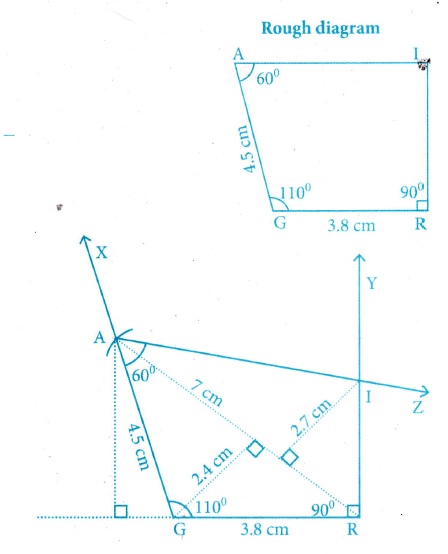
steps:
1. Draw a line segment AG = 4.5 cm
2. At G on AG made ∠AGX = 110°
3. With G as centre drawn an arc of radius 3.8 cm let it cut GX at R.
4. At R on GR made ∠GRZ = 90°
5. At A on AG made ∠GAY = 90°
6. AY and RZ meet at I.
7. AGRI is the required quadrilateral.
Calculation of Area:
Area of the quadrilateral AGRI
\( =1 / 2 \times \mathrm{d} \times\left(\mathrm{h}_{1}+\mathrm{h}_{2}\right) \text { sq. units } \)
\(=1 / 2 \times 7 \times(2.4+2.7) \)
\(=1 / 2 \times 7 \times 5.1=17.85 \text { sq. cm. }\)
12.
Triangular Prism
13.
\(\triangle\)BCF ≡ \(\triangle\)DEF
AC = AD (given)
\( \angle \mathrm{CBF} =\angle \mathrm{DEF}(\text { given }) \)
\(\angle \mathrm{BFC} =\angle \mathrm{EFD}(\text { vertically opposite angles }) \)
\(\angle \mathrm{BCF} =\angle \mathrm{EDF}(\text { Third angle }) \ldots . .(2)\)
From (1), (2)
\(\angle \mathrm{FCD}=\angle \mathrm{FDC}\)
CF = DF
\(\Delta \mathrm{BCF} \equiv \triangle \mathrm{EDF}(\mathrm{ASA})\)
Hence proved.
14.
Given in\( \triangle \mathrm{WHY} and \ \triangle \mathrm{WET}, \)
\(\angle \mathrm{W} =\angle \mathrm{W} \)
\(\angle \mathrm{WYH} =\angle \mathrm{WTE} \)
\(\angle \mathrm{WHY} =\angle \mathrm{WET} \\ \therefore \Delta \mathrm{WHY} \sim \Delta \mathrm{WET} \)
Also \(\triangle \)WHY ~ \(\triangle \)WET
∴ Corresponding sides are proportionated
\(\frac { WH }{ WE } =\frac { HY }{ ET } =\frac { WY }{ WT } \)
\(\\ \frac { 6 }{ 6+HE } =\frac { 4 }{ ET } =\frac { 4 }{ 16 }\)
\( \\ \frac { 6 }{ 6+HE } =\frac { 4 }{ 16 }\)
\( \\ 6+HE=\frac { 6 }{ 4 } \times16\)
\(\\ 6+HE=24\)
\(\\ \therefore HE=24-6\\ HE=18\)
\(\\ Again\quad \frac { 4 }{ ET } =\frac { 4 }{ 16 } \)
\(\\ ET=\frac { 4 }{ 4 } \times 16\)
\(\\ ET=16\)
15.
Area = Area of a rectangle + Area of a triangle + Area of a trapezium
For rectangle length I = 120 - 20 - 20 cm = 80 cm
Breadth b = 30 cm
For the triangle base = 30 cm
Height = 20 cm
For the trapezium height h = 20 cm
Parallel sided a = 50 cm
b = 30cm
∴ Area of the figure = (l x b) + (\(\frac12\) x base x height) + \(\frac12\) x h x (a + b) sq. units
= (80 x 30) + (\(\frac12\) x 30 x 20) + (\(\frac12\)x 20 x (50 + 30) cm2
= 2400 + 300 + 800 cm2 = 3500 cm2
Area of the figure = 3500 cm2
16.
The tree diagram for this may be
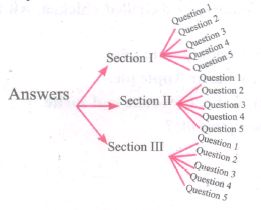
∴ Number of possible ways to select one questions from each of 3 sections is 3 x 5 = 15 ways
17.
The given figure is a combination of a semicircle and a triangle.
diameter = 6 cm
radius = 3 cm
base = 6 cm
height = 9 cm
The shaded area of the figure = Area of the semicircle + Area of the triangle
\(=\frac{1}{2} \pi \mathrm{r}^{2}+\frac{1}{2} \mathrm{bh} \)
\(=\frac{1}{2} \times 3.14 \times 3 \times 3+\frac{1}{2} \times 6 \times 9 \)
= 14.13 + 27 = 41.13 cm2
18.
From this figure
Perimeter = 2l + 2 x 6 + 2r
\(=2 \times \frac{\theta}{360} \times 2 \pi \mathrm{r}+12+2 \times 3.5 \)
\(=2 \times \frac{90}{360} \times 2 \times \frac{22}{7} \times 3.5+12+7 \)
= 11+ 12 + 7
= 30 cm
The area of shaded part
= Area of two circular quadrants + Area of the rectangle
\(=\left(2 \times \frac{\theta}{360} \times \pi r^{2}\right)+(l \times b) \)
\(=\left(2 \times \frac{90}{360} \times \frac{22}{7} \times 3.5 \times 3.5\right)+(6 \times 3.5) \)
= 19. 25 + 21
= 40.25 cm2
19.
(2x + 3) (2x - 4)
= 4x2 - 8x + 6x - 12
= 4x2 - 2x - 12
20.
(2p2q3)\(\times\)(-9pq)2 = (+)(-) \(\times\) (2\(\times\)9) (p2\(\times\) p (q3\(\times\)q2)) = -18p3q5
21.
6x \(\times\) 4= (6 \(\times\) 4)(x) = 24x
22.
The teacher is going to select one student from class VI out of 10 students in 10 ways from class VII out of 15 students in 15 ways and from class VIII out of 20 students in 20 ways.
ஃ Number of ways 3 students can be selected = 10 + 15 + 20 = 45 ways
23.
From the figure the tile is in a circular quadrant, Then the central angle is 90o
Area of the sector = \(\frac{\theta}{360} \times \pi r^{2}\)
\(=\frac{90}{360}\) x 3.14 x 30 x 30
= 706.5 cm2
24.
Length of the arc of the sector l = 50 mm
Radius r = 14mm
Area of the sector = \(\frac { lr }{ 2 } \) sq. units
= \(\frac { 50\times 14 }{ 2 } \) mm2 = 50 x 7 mm2 = 350 mm2
Area of the sector = 350mm2
25.
\(\frac { -5 }{ 12 } ,\frac { -11 }{ 8 } ,\frac { -15 }{ 24 } ,\frac { -7 }{ -9 } ,\frac { 12 }{ 36 } \)
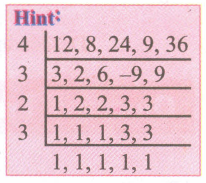
LCM of 12, 8, 24, 9, 36 is 4 x 3 x 2 x 3
= 72
\(\frac { -5 }{ 12 } =\frac { -5\times 6 }{ 12\times 6 } =\frac { -30 }{ 72 } \)
\(\frac { -11 }{ 8 } =\frac { -11\times 9 }{ 8\times 9 } =\frac { -99 }{ 72 } \)
\(\frac { -15 }{ 24 } =\frac { -15\times 3 }{ 24\times 3 } =\frac { -45 }{ 72 } \)
\(\\ \frac { -7 }{ -9 } =\frac { 7\times 9 }{ 9\times 8 } =\frac { 56 }{ 72 } \)
\(\frac { 12 }{ 36 } =\frac { 12\times 2 }{ 36\times 2 } =\frac { 24 }{ 72 } \)
Now comparing the numerators -30, -99, -45, 56, 24 we get 56 > 24 > - 30 > -45 > -99
i.e \(\frac { 56 }{ 72 } >\frac { 24 }{ 72 } >\frac { -30 }{ 72 } >\frac { -45 }{ 72 } >\frac { -99 }{ 70 } \) and so \(\\ \\ \\ \frac { -7 }{ -9 } >\frac { 12 }{ 36 } >\frac { -5 }{ 12 } >\frac { -15 }{ 24 } >\frac { -11 }{ 8 } \)
∴ Descending order: \(\frac { -7 }{ -9 } ,\frac { 12 }{ 36 } ,\frac { -5 }{ 12 } ,\frac { -15 }{ 24 } ,\frac { -11 }{ 8 } \)
Ascending order \(\frac { -11 }{ 8 } ,\frac { -15 }{ 24 } ,\frac { -5 }{ 12 } ,\frac { 12 }{ 36 } ,\frac { -7 }{ -9 } \)

8th Standard Syllabus & Materials
8th Standard
TN 8th Tamil இயல் 3 - கல்வி கரையில - பாடறிந்து ஒழுகுதல் Important Questions And Answers Study Material - QB365 Set A
NEW8th Standard
TN 8th Tamil இயல் 3-கல்வி கரையில - பல்துறைக் கல்வி Important Questions And Answers Study Material - QB365 Set A
NEW8th Standard
TN 8th Tamil இயல் 3-கல்வி கரையில - புத்தியைத் தீட்டு Important Questions And Answers Study Material - QB365 Set A
NEW8th Standard
TN 8th Tamil இயல் 2 - ஈடில்லா இயற்கை - தமிழர் மருத்துவம் ( நேர்காணல்) Important Questions And Answers Study Material - QB365 Set A



Tamilnadu Stateboard 8th Standard Subjects
Tamilnadu Stateboard Standards




