
 100% FREE ACCESS
6th Standard Syllabus & Materials
6th Standard
TN 6th Tamil பருவம் 1 - இயல் 1 - மொழி -தமிழ்த்தேன் - இன்பத்தமிழ் Sample Question Papers Study Material - QB365 Set A
NEW6th Standard
TN 6th English T1 - Supplementary - The Apple Tree and The Farmer Sample Question Papers Study Material - QB365 Set A
NEW6th Standard
TN 6th English T1 - Prose - When The Trees Walked Sample Question Papers Study Material - QB365 Set A
NEW6th Standard
TN 6th Social Science T3 - CIV - Road Safety Sample Question Papers Study Material - QB365 Set A
NEW6th Standard
TN 6th Social Science T3 - CIV - Local Bodies - Rural and Urban Sample Question Papers Study Material - QB365 Set A
NEW6th Standard
TN 6th Social Science T3 - CIV - Democracy Sample Question Papers Study Material - QB365 Set A

Published on: 16/03/2020
6th Standard Mathematics English Medium All Chapter Book Back and Creative Two Marks Questions 2020
Download Tamil Nadu 6th Standard Social Science question papers, model tests, one-mark questions, important questions, and public exam papers in PDF format. Free study materials and answer keys for TN State Board students.
Questions + Answers key
Take MCQ Social Science Test
1.
What is the meaning of "Secular?
2.
When did they complete this work?
3.
What do you know about the early man?
4.
Who is the real shadow of the cities?
5.
What do you know about the,upper parts of the national emblem?
6.
Mention the upper parts ofthe national emblem?
7.
What are the uses of natural resources?
8.
Give an example for the human resources?
9.
Place the following words in the appropriate column.
Words: Jina, Mahayana, Tirthankaras, Stupas Nirvana, Digambara, Tripitakas, Agama
| Jainism | Buddhism |
10.
Name the new animal used by the Aryans?
11.
Name the gods that the Rig Vedic Aryans worshipped?
12.
Name the four hemispheres of the Earth.
13.
What is a geoid?
14.
Write a short note on ‘Thunder and lightning’.
15.
Define Disaster
16.
Who are the representatives elected in a Village Panchayat
17.
Is there any corporation in your district? Name it.
18.
What are the types of democracy?
19.
What are called secondary occupation?
20.
Sandhai – Define.
21.
Human resources.
22.
When you are walking on the Marina beach in Chennai, which order of landform are you on?
23.
Complete the given table with the help of an atlas. Follow the example
| S.No | Mountain Ranges | Peaks | Continents | Elevation (m) |
| 1. | The Himalayas | Everest | Asia | 8,848 |
| 2. | The Rockies | |||
| 3. | The Andes | |||
| 4. | The Alps | |||
| 5. | The Eastern Ghats |
24.
What is stereotype?
25.
What is Prejudice?
26.
What are oceans?
27.
What is a continent?
28.
What are the types of diversity?
29.
Name the scholars who were born at Kancheepuram.
30.
Write a brief note on ancient cities of India.
31.
Why Indus Civilisation is called Bronze Age civilisation?
32.
How would you define archaeology?
33.
What are the sources available to know about the pre-historic period?
34.
Give an account on Western Chalukyas of Kalyani.
35.
Draw posters related to road safety
36.
Discuss about the statistics of 2017 accidents data
37.
What did Indian scientists achieve in astronomy and mathematics during the Gupta period?
38.
Compare and contrast direct democracy and representative democracy.
39.
Can you guess what happened to the Harappan?
40.
List out the various festivals celebrated in different states.
41.
Importance of invention of wheel from the ancient period to the modern period.
42.
Compare the lifestyle of Old Stone Age man with present day lifestyle.
1.
Law allows all the citizens of a country, the right to follow different faith and religious beliefs. All citizens enjoy the freedom of worship. The country does not have a religion of its own. All the religions in our country hold the same status
2.
It took a period of 2 years, 11 months, and 17 days. It was completed on 26th November 1949.
3.
1. The early man, who hunted and gathered food, later learnt to cultivate crops. When they found rivers which provided them water, settled down permanently near the rivers.
2. These permanent settlements were called villages.
4.
But the villages are the real shadows of cities
5.
The lower part has an elephant, a horse, a bull and a lion. The' Wheel of righteousness'. is placed between them. This emblem is found at the top of the government communication. Indian currency and passport
6.
The upper part has four lions facing the North, South, East and West. This is on a circular pedestal. One can only see three lions at a time.
7.
The use of any natural resource depends on the place it is available, the form in which it is available and the technology necessary to avail it
8.
People are also referred to as resources
9.
| Jainism | Buddhism |
| Jina, Tirthankaras, Digambara,Agama | Mahayana, Stupas Nirvana,Tripitakas, |
10.
(i) In the later Vedic period the Aryans tamed elephants, apart from cow, goat, sheep and horse.
11.
The sky gods like Prithvi (Earth), Agni (fire), Vayu (wind), Varona (rain), Indra (Thunder).
12.
(i) Northern hemisphere
(ii) Southern hemisphere
(iii) Eastern hemisphere
(iv) Western hemisphere
13.
(i) The Earth which is spherical, is flat at the poles and bulges at the Equator.
(ii) The Earth cannot be compared with any other geometrical shape as it has a very unique shape.
(iii) Hence, its shape is called a geoid.
14.
(i) Thunder is a series of sudden electrical discharge resulting from atmospheric conditions.
(ii) This discharge results in sudden flashes of light and trembling sound waves which are commonly known as thunder and lightning.
15.
A disaster is a serious disruption of the functioning of a society involving human and material loss.
16.
(i) Panchayat President
(ii) Ward members
(iii) Councillor
(iv) District Panchayat Ward Councillor
17.
Yes, Tirunelveli.
18.
Direct democracy and Representative democracy are the types of democracy.
19.
1. The raw materials obtained from the primary acti~ities are converted into finished products through machinery on a large scale.
2. These activities are called secondary activities.
20.
(i) In villages, once in a week or month, all things are sold in a particular place at a specific time to meet the needs of the people.
(ii) That is called "Sandhai".
21.
Human resources are groups of individuals who use nature to create more resources.
22.
Third order of land form.
23.
| S.No | Mountain Ranges | Peaks | Continents | Elevation (m) |
| 1. | The Himalayas | Everest | Asia | 8,848 |
| 2. | The Rockies | Elbert | N. America | 4,401 |
| 3. | The Andes | Aconcagna | S. America | 1,069 |
| 4. | The Alps | Mont Blanc | Europe | 806 |
| 5. | The Eastern Ghats | lindhagada | Asia (In A.P, India) | 1,690 |
24.
When prejudice gets stronger, it develops into a stereotype. stereotype is a false view or idea about something.
25.
Prejudice means to judge other people in a negative or inferior manner, without knowing much about them. It happens when people have false belief and ideas.
26.
Oceans are vast expanse of water.
27.
The vast land masses on Earth are called Continents.
28.
The types of diversity are
(i) Land forms and Lifestyle diversity
(ii) Social diversity
(iii) Religions diversity
(iv) Linguistic diversity
(v) Cultural diversity
29.
Scholars like Dharmabalar, Jothibalar, Sumathi and Bodhi Dharamar where born in Kanchi.
30.
1. Harappa
2. Mohenjo - Daro
31.
Indus, civilisation is called Bronze Age civilisation because it is a historical period characterised by the use of articles made of bronze.
32.
Archaeology is the study of pre historic humans remained materials used by pre historic humans.
33.
(i) Stone tools.
(ii) Excavated materials.
(iii) Rock paintings are the major sources of pre-history
34.
(i) The Western Chalukya empire ruled most of the western deccan, South India, between the 10th and 12th Centuries.
(ii) They were the descendants of Badami chalukyas ruled from kalyani (modern day Basavakalyan)
(iii) In 1973, Tariapa - II, a feudatory of the Rashtrakuta ruling from Bijapur region defeated Parmara of Malwa.
(iv) Tailapa - II occupied Kalyani his fimasty quickly grew into an empire under Someswara - I.
(v) Someswara - I moved the capital from Manyakheta to Kalyani.
(vi) For over a century, the western chalukyas and the chola dynasty of Thanjavur, fought many fierce battles to control the fertile region of vengi.
(vii) During the rule of Vikramaditya VI in the late 1le century vast areas between the Narmada River in the north and Kaveri River in the south came under Chalukyas control.
(viii) The Kasi Visweshvara Temple at Lakkundi, the Mallikarjuna temple at Kuruvatti, the Kalleshwara temple at Bagali and the Mahadeva Temple at Itagi represeni well known examples of the architecture of western Chaitrkyas of Kalyani.
35.
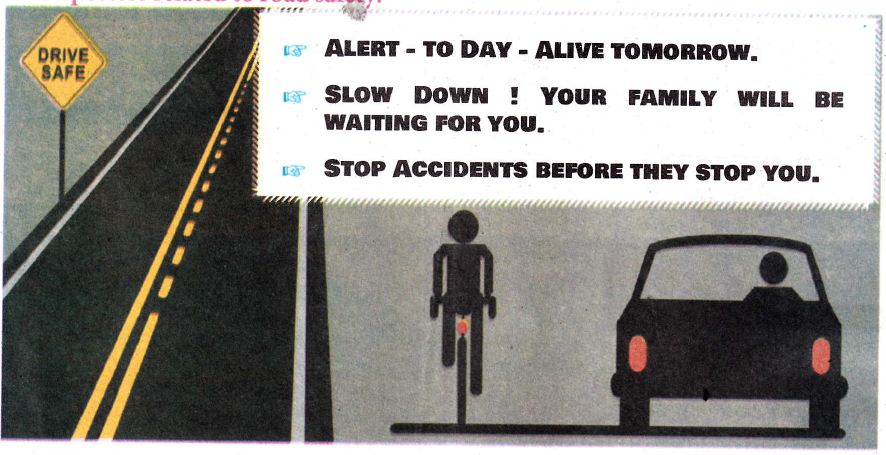
36.
(i) As per the report by the Ministry of Road Transport and Highways (MRTH) as many us 1.47 lakhs people died on Indian Roads in 4.64 lakh accidents.
(ii) Fatal road accidents victims largely constitute young people in the productive age groups. Young adults in the age group of 18-45 years accounted for 72.1% of victims.
(iii) People in working age group of 18-60 years accounted for a share of 87.2% in the total road accident fatalities.
37.
(i) Invention of zero and the consequent evolution of the decimal system were the legacy of Guptas to the modem world.
(ii) Aryabhatta, Varahamihira and Brahmagupta were. foremost astronomers and mathematicians of the time.
(iii) Aryabhatta, in his book Surya Siddhanta, explained the true causes of solar and lunar eclipses.
(iv) He was the first Indian astronomer to declare that the earth revolves around its own axis.
(v) Dhanvantriwas a famous scholar in the field of medicine. He was a specialist in Ayurveda. Charaka was a medical scientist. Susruta was the first Indian to explain the process of surgery.
38.
| S.No | DIRECT DEMOCRACY | REPRESENTATIVE DEMOCRACY |
| 1. | In a direct democracy, only the citizens can make laws. | Elected members only can make laws. |
| 2. | All changes have to be approved by the citizen. |
Council of legislative changes the laws. |
| 3. | The politicians only rule over parliamentary procedure. |
Members of parliament rule the country. |
39.
(i) By 1800 BCE, the Harappan culture had started declining.
(ii) It is assumed that the civilization met with
(a) repeated floods
(b) ecological changes
(c) invasions
(d) natural calamity
(e) climatic changes
(f) deforestation
(g) an epidemic might have disturbed the civilization.
40.
1. Andhra Pradesh - Brahmotsavam
2. Arunachal Pradesh - Losar festival
3. Assam - Bohag Bihu
4. Bihar - Chhath Puja
5. Chhattisgarh - Bastar Dussehra
6. Goa - Carnival
7. Gujarat - Janmashtami, Diwali
8. Haryana - Baisaki
9. Himachal Pradesh - Maha Sivarathiri
10. Jammu and Kashmir - Eid-Ul-Fitr and Eid-ul-Azha
11. Jharkhand - Holi
12. Karnataka - Vgadi
13. Kerala - Onam
14. Madhya Predesh - Diwali
15. Maharastra - Ganesh Chaturthi
16. Manipur - Yaoshang
17. Meghalaya - Nongkrem Dance Festival
18. Mizoram - Chapachar kut Festival
19. Nagaland - Hombill Festival
20. Odisha - Raja Parba
21. Punjab - Lohri
22. Rajasthan - Gangaur Festival
23. Sikkim - Saga Dawa
24. Tamil Nadu - Pongal
25. Telangana - Bonalu
26. Tripura - Kashi puja
27. Uttra Pradesh - Navaratri
28. Uttarkhand - Ganga Dusshera
29. West Bengal - Durga Pooja
41.
(i) The invention of wheel by human is considered to be the foremost invention,
(ii) The invention of wheel made pot making easier.
(iii) The wheel helps to man one place to another place.
(iv) It is used to transportation in trading goods.
(v) In modern days the wheel is most significance in Transport facilities.
(vi) It also used in function of machine in several factories
42.
| S.No | OLD STONE AGE LIFE STYLE | PRESENT DAY LIFE STYLE |
| 1. | The old stone Age people were went from place to place in searching food. | Present day man built houses and began to Iive in permanent place |
| 2. | They wore dresses made out of leaves, barks and skins of animals | Now a days people dresses wear made out of cotton, silk, wool and artificial rays. |
| 3. | They ate vegetables, fruits roots and meat of the animals | Present day these kind of foods are cooked and eaten by people. |
| 4. | They lived in caves. | Storeys houses are built by him. |
| 5. | They live depended in nature | We live in uses of modern technologis |

6th Standard Syllabus & Materials
6th Standard
TN 6th Social Science T3 - GEO - Understanding Disaster Sample Question Papers Study Material - QB365 Set A
NEW6th Standard
TN 6th Social Science T3 - GEO - Globe Sample Question Papers Study Material - QB365 Set A
NEW6th Standard
TN 6th Social Science T3 - GEO - Asia and Europe Sample Question Papers Study Material - QB365 Set A
NEW6th Standard
TN 6th Social Science T3 - HIS - South Indian Kingdoms Sample Question Papers Study Material - QB365 Set A



Tamilnadu Stateboard 6th Standard Subjects
Tamilnadu Stateboard Standards



