
 100% FREE ACCESS
6th Standard CBSE Syllabus & Materials
6th Standard CBSE
CBSE 6th Social Science The Value of Work - New Sample Question Papers Study Material - QB365 Set A
NEW6th Standard CBSE
CBSE 6th Social Science Family and Community - New Sample Question Papers Study Material - QB365 Set A
NEW6th Standard CBSE
CBSE 6th Social Science India's Cultural Roots - New Sample Question Papers Study Material - QB365 Set A
NEW6th Standard CBSE
CBSE 6th Social Science India,That is Bharat - New Sample Question Papers Study Material - QB365 Set A
NEW6th Standard CBSE
CBSE 6th Social Science Timeline and sources of history - New Sample Question Papers Study Material - QB365 Set A
NEW6th Standard CBSE
CBSE 6th Social Science Oceans and Continents - New Sample Question Papers Study Material - QB365 Set A

Published on: 30/07/2018
In Basic Geometrical Ideas contains important questions in CBSE 6th Standard Mathematics. It also covered with the most important questions in Basic Geometrical Ideas.
Teachers please subscribe Now and Create Unlimited 6th Standard Mathematics question papers with answer keys. For subscription, please Click Here.
Download CBSE Class 6th Standard CBSE Mathematics question papers, sample papers, important questions, and previous year solved papers in PDF format. Get free study materials, NCERT solutions, and exam preparation resources for Class 6th Standard CBSE Mathematics
Questions + Answers key
Take MCQ Mathematics Test
1.
If \(\angle A = 30°\), and B = 45°and \(\angle C = 55°\). Then find the measure of sum of \(\angle A, \angle B\) and \(\angle C\) also write their name?
2.
Write down the measures of some obtuse angles.
3.
Is the statement given in option (b), is,true for all triangles?
4.
Compare the given line segments

5.
Why is it better to use a divider than a ruler, while measuring the length of a line segment
6.
A regular polygon has all its sides and angles equal.
7.
Diagonals of a rhombus are always equal.
8.
Cone is also a polygon.
9.
In a ΔABC, \(\angle B = 90°\) and AB = BC. Then, ΔABC is right angled isosceles triangle.
10.
In figure 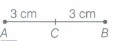 C is the mid-point of line segment \(\overline { AB } \).
11.
The number of vertices of a cuboid are _______
12.
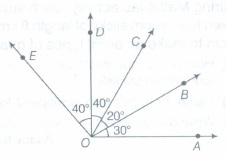
\(\angle AOE\) is a/an _____ angle.
13.
A pair of opposite sides of a rectangle are ____ and _____
14.
An angle whose measure is the sum of the measures of two right angles is ______
15.
An angle larger than a right angle but less than a straight angle is an ______ angle.
16.
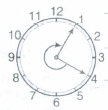
Write the revolution for each figure.
17.
Find the number of diagonals of pentagon.
18.
If each side of a triangle is 6 cm. Name the type of triangle.
19.
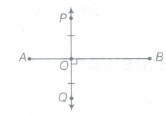
In the given figure, PQ 丄 AB and PO = OQ. Is PQ, the perpendicular bisector of line segment AB? Why or why not?
20.
State the type of angle given below.

21.
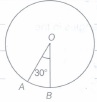
What part of one revolution is \(\angle AOB,\) (as shown in figure)?
22.
Construct two line segments AB and CO of lengths 2.5 cm and 3.2 cm. Construct another segment EF, whose length is the sum of these two segments. Measure the new length.
23.
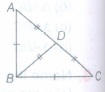
In figure, AB = BC and AD = BD = DC. Then, the number of isosceles triangles in the figure is
1
2
3
4
24.
Number of vertices in cylinder are
2
0
3
4
25.
Where will the hour hand of a clock stop, if it starts at 7 and makes \(\frac { 3 }{ 4 } \) revolution clockwise?
2
3
4
5
26.
Where will the hand of a clock stop, if it start at 5 and makes \(\frac { 1 }{ 4 } \) of a revolution clockwise?
7
8
9
10
27.
If a bicycle wheel has 48 spokes, then the angle between a pair of two consecutive spokes is
\(\left( 5\frac { 1 }{ 2 } \right) ^{ 0 }\).
\(\left( 7\frac { 1 }{ 2 } \right) ^{ 0 }\).
\(\left( \frac { 2 }{ 11 } \right) ^{ 0 }\).
\(\left( \frac { 2 }{ 15 } \right) ^{ 0 }\).
1.
\(\angle A + \angle B + \angle C = 30° + 45° + 55° = 130°\), obtuse angle.
2.
We know that, the measure of an obtuse angle is always greater than 90° but less than 180°.
So, 120°, 125°, 135°, 140° all are obtuse angles.
3.
Yes, it is true for all triangles.
4.
\(\overline{ XY } >\overline{ AB } \).
5.
When we measure the length of a line segment by ruler, there may be some errors due to its thickness and angular viewing. These errors can be removed by measuring a line segment with the help of a divider. Hence, the use of a divider is better than a ruler.
6.
(a)
7.
(b)
8.
(b)
9.
(a)
10.
(a)
11.
()
8
12.
()
obtuse
13.
()
equal , parallel
14.
()
straight angle
15.
()
Obtuse
16.
\(\frac { 3 }{ 4 } \) revolution
17.
5 diagonals
18.
Given that, each side of a triangle is 6 cm. Hence, it is an equilateral triangle.
19.
PQ is not the perpendicular bisector of line segment AB because AO \(\neq\) BO.
20.
In the given figures, we have,
\(\angle AOB\) is a an acute angle.
21.
\(\frac { 1 }{ 12 } \) part of one revolution
22.
Now, first of all, we draw AB = 2.5 cm and CD = 3.2 cm.

\(\overline{ AB } +\overline { CD } =\overline { EF } \)
Now, we have to draw a line segment
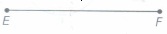
∴ \(\overline { EF } =\overline{ AB } +\overline{ CD } \) = 2.5 +3.2 = 5.7 cm
Hence, new length is 5.7 cm.
23.
(c)
3
24.
(b)
0
25.
(c)
4
26.
(b)
8
27.
(b)
\(\left( 7\frac { 1 }{ 2 } \right) ^{ 0 }\).

6th Standard CBSE Syllabus & Materials
6th Standard CBSE
CBSE 6th Social Science Locating Places on the Earth - New Sample Question Papers Study Material - QB365 Set A
NEW6th Standard CBSE
CBSE 6th Science A Journey Through States of Water - New Sample Question Papers Study Material - QB365 Set A
NEW6th Standard CBSE
CBSE 6th Science Temperature and its Measurement - New Sample Question Papers Study Material - QB365 Set A
NEW6th Standard CBSE
CBSE 6th Science Materials Around Us - New Sample Question Papers Study Material - QB365 Set A



CBSE 6th Standard CBSE Subjects
CBSE Standards




