
 100% FREE ACCESS
6th Standard CBSE Syllabus & Materials
6th Standard CBSE
CBSE 6th Social Science The Value of Work - New Sample Question Papers Study Material - QB365 Set A
NEW6th Standard CBSE
CBSE 6th Social Science Family and Community - New Sample Question Papers Study Material - QB365 Set A
NEW6th Standard CBSE
CBSE 6th Social Science India's Cultural Roots - New Sample Question Papers Study Material - QB365 Set A
NEW6th Standard CBSE
CBSE 6th Social Science India,That is Bharat - New Sample Question Papers Study Material - QB365 Set A
NEW6th Standard CBSE
CBSE 6th Social Science Timeline and sources of history - New Sample Question Papers Study Material - QB365 Set A
NEW6th Standard CBSE
CBSE 6th Social Science Oceans and Continents - New Sample Question Papers Study Material - QB365 Set A

Published on: 31/07/2018
In Body Movements contains important questions in CBSE 6th Standard Science. It also covered with the most important questions in Body Movements.
Teachers please subscribe Now and Create Unlimited 6th Standard Science question papers with answer keys. For subscription, please Click Here.
Download CBSE Class 6th Standard CBSE Science question papers, sample papers, important questions, and previous year solved papers in PDF format. Get free study materials, NCERT solutions, and exam preparation resources for Class 6th Standard CBSE Science
Questions + Answers key
Take MCQ Science Test
1.
Hinge joint is present in __________________ .
2.
Backbone is made up of____________ bones.
3.
__________ is strongest and longest bone of the body.
4.
The contraction of the ____________ pulls the bones during movement.
5.
A combination of bones and cartilages form the ____________ of the body.
6.
The human skeletal system is made up of 206 bones.
7.
Bristles are not connected with muscles.
8.
Minute movable bristles in earthworm help in gripping on the ground.
9.
The forearm has two bones.
10.
The cartilages are harder than bones.
11.
We need two muscles together to move a bone.Why?
12.
State the consequence if the backbone had only one long bone instead of many vertebrae.
13.
Skeleton is made of bones but it has some cartilage too. Do you agree?
14.
Can you imagine how does an earthworm fix parts of its body to the ground?
15.
Bones are hard structures and cannot be bent. But we can still bend our elbow, knee, etc. How is this possible?
16.
Rishi was playing football with his friends. While playing football he fell down and started crying. On seeing him crying, his friends rushed to him and found that he was unable to move his right leg. His friends took him to his house. His father immediately rushed him to a doctor. Doctor diagnosed that his leg was fractured.
(a) Can you suggest, how did doctor diagnose in Rishi's leg?
(b) What do X-rays show us?
(c) What are the values shown by Rishi's friends?
17.
In the figure given below, there are two snakes of the same size slithering on sand. Can you identify which of them would move faster and why?
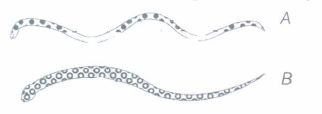
18.
Which of the following organisms does not have both muscles and skeleton for movement?
Dog
Snail
Earthworm
Human being
19.
Fixed joints are found in
lower jaw
skull
hands
hip bone
20.
Snail moves with the help of its
shell
bone
muscular foot
whole body
21.
Human skeleton comprises
skull and backbone
ribs and breast bone
shoulder and hip bone
All of the above
22.
The organ that protects the main nerve cord is
skull
backbone
breast bone
chest bone
23.
The movements of some parts/organs of the body are not under control. Can you name two such parts/organs.
24.
The number of bones differs in different parts of our hands. How many bones does middle finger have?
25.
Explain the adaptations of birds for flying in the air.
26.
Name two animals which move without bones.
27.
If there is no joints, then will it be possible to move? Explain.
1.
()
elbow
2.
()
many (33)
3.
()
Thigh bone
4.
()
muscle
5.
()
skeleton
6.
(a)
7.
(b)
8.
(a)
9.
(a)
10.
(b)
11.
A muscle can only pull, it cannot push. Thus, two muscles are required to work together to move a bone. When one muscle contracts, bone is pulled. When another muscle of the pair pulls, it brings the bone in its original position.
12.
Our vertebral column is comprised of 31 small bones. These are joined together with soft tissue in the form of cartilage discs. This arrangement makes this bony structures to have some limited movements of the body.
If there is only one long bone instead of many in the vertebral column, the organism will not be able to avail the limited movements which are necessary for the organisms for its survival.
13.
Yes, cartilages are the additional parts of the skeleton that are not as hard as the bones and which can bent. So, we can say that though most of the skeleton is made of bones but it has some cartilages too.
14.
Under earthworm's body, it has a large number of tiny bristler projecting out. The bristles are connected with muscles. The bristles help to get a good grip on the ground.
15.
Elbow and knee are not made up of a single bone rather they are made up of two or more bones which are joined to each other by a joint, i.e. hinge joint. This joint along with the muscles helps us to bend the elbow and knee.
16.
(a) The doctor has diagnosed the fracture by taking photographs of bones, i.e. X-ray images.
(b) X-rays show us the images and shapes of different bones in our body.
(c) Friendly behaviour, sense of responsibility and kind nature are the values shown by Rishi's friends.
17.
A snake form loops in its body while slithering. Each loop of the snake gives it a forward push by pressing against the ground. The snake with a larger number of loops will move much faster than the snake with lesser number of loops. Thus, the snake A will move faster than snake B as we can see that loops in snake A are more than in snake B.
18.
(c)
Earthworm
19.
(b)
skull
20.
(c)
muscular foot
21.
(d)
All of the above
22.
(b)
backbone
23.
(i) Movements in heart (ii) Movement in lungs.
24.
The number of bones in each finger is three and are called phalanges.
25.
The following adaptations are seen in the body of birds.
(i) Bones are hollow.
(ii) Forelimbs are modified into wings.
(iii) Body is streamlined.
26.
Earthworm and snail move without the bones.
27.
No, movement in the body of an animal is possible in the presence of joints only.

6th Standard CBSE Syllabus & Materials
6th Standard CBSE
CBSE 6th Social Science Locating Places on the Earth - New Sample Question Papers Study Material - QB365 Set A
NEW6th Standard CBSE
CBSE 6th Science A Journey Through States of Water - New Sample Question Papers Study Material - QB365 Set A
NEW6th Standard CBSE
CBSE 6th Science Temperature and its Measurement - New Sample Question Papers Study Material - QB365 Set A
NEW6th Standard CBSE
CBSE 6th Science Materials Around Us - New Sample Question Papers Study Material - QB365 Set A



CBSE 6th Standard CBSE Subjects
CBSE Standards




