
 100% FREE ACCESS
11th Standard CBSE Syllabus & Materials
11th Standard CBSE
CBSE 11th Economics PART-A - Presentation of Data - New Sample Question Papers Study Material - QB365 Set A
NEW11th Standard CBSE
CBSE 11th Economics PART-A - Organisation of Data - New Sample Question Papers Study Material - QB365 Set A
NEW11th Standard CBSE
CBSE 11th Economics PART-A - Collection of Data - New Sample Question Papers Study Material - QB365 Set A
NEW11th Standard CBSE
CBSE 11th Economics PART-A - Introduction to Economics and Statistics - New Sample Question Papers Study Material - QB365 Set A
NEW11th Standard CBSE
CBSE 11th Business Studies International Trade Sample Question Papers Study Material - QB365 Set A
NEW11th Standard CBSE
CBSE 11th Business Studies Evolution and Fundamentals of Business Sample Question Papers Study Material - QB365 Set A

Published on: 18/08/2026
Download CBSE Class 11th Standard CBSE Physics question papers, sample papers, important questions, and previous year solved papers in PDF format. Get free study materials, NCERT solutions, and exam preparation resources for Class 11th Standard CBSE Physics
Questions + Answers key
Take MCQ Physics Test
1.
Estimate the mean free path for a water molecule in water vapour at 373 K.The density of water is 1000 kgm-3. The density of water vapour at 1000C and 1 atm pressure is 0.6 kgm -3 The volume of a molecule multiplied by the total number gives, which is called, molecular volume. Estimate the ratio of the molecular volume to the total volume occupied by the water vapour under the above conditions of temperature and pressure and using the equation \(l=2.9 \times 10^{-7} \mathrm{~m} \approx 1500 d\)
2.
A cylinder of fixed capacity 44.8 litres contains helium gas at standard temperature and pressure. What is the amount of heat needed to raise the temperature of the gas in the cylinder by 15.0 °C? (R = 8.31 J mo1–1 K–1).
3.
(a) When a molecule (or an elastic ball) hits a ( massive) wall, it rebounds with the same speed. When a ball hits a massive bat held firmly, the same thing happens. However, when the bat is moving towards the ball, the ball rebounds with a different speed. Does the ball move faster or slower? (Ch.5 will refresh your memory on elastic collisions.)
(b) When gas in a cylinder is compressed by pushing in a piston, its temperature rises. Guess at an explanation of this in terms of kinetic theory using (a) above.
(c) What happens when a compressed gas pushes a piston out and expands. What would you observe ?
(d) Sachin Tendulkar used a heavy cricket bat while playing. Did it help him in anyway ?
4.
A vessel contains two nonreactive gases : neon (monatomic) and oxygen (diatomic). The ratio of their partial pressures is 3:2. Estimate the ratio of (i) number of molecules and (ii) mass density of neon and oxygen in the vessel. Atomic mass of Ne = 20.2 u, molecular mass of O2 = 32.0 u.
5.
Estimate the average thermal energy of a helium atom at (i) room temperature (27 °C), (ii) the temperature on the surface of the Sun (6000 K), (iii) the temperature of 10 million kelvin (the typical core temperature in the case of a star).
6.
What is the average distance between atoms (interatomic distance) in water? Use the data given in Examples : (i) The density of water is 1000 kgm-3. The density of water vapour at 1000C and 1 atm pressure is 0.6 kgm -3 .The volume of a molecule multiplied by the total number gives ,what is called, molecular volume. Estimate the ratio (or fraction) of the molecular volume to the total volume occupied by the water vapour under the above conditions of temperature and pressure.
(ii) Estimate the volume of a water molecule using the data in Example : The density of water is 1000 kgm-3. The density of water vapour at 1000C and 1 atm pressure is 0.6 kgm -3 .The volume of a molecule multiplied by the total number gives ,what is called, molecular volume. Estimate the ratio (or fraction) of the molecular volume to the total volume occupied by the water vapour under the above conditions of temperature and pressure.
7.
Estimate the volume of a water molecule using the data in Example : The density of water is 1000 kgm-3. The density of water vapour at 1000C and 1 atm pressure is 0.6 kgm -3 .The volume of a molecule multiplied by the total number gives ,what is called, molecular volume. Estimate the ratio (or fraction) of the molecular volume to the total volume occupied by the water vapour under the above conditions of temperature and pressure.
8.
The density of water is 1000 kgm-3. The density of water vapour at 1000C and 1 atm pressure is 0.6 kgm -3 .The volume of a molecule multiplied by the total number gives ,what is called, molecular volume. Estimate the ratio (or fraction) of the molecular volume to the total volume occupied by the water vapour under the above conditions of temperature and pressure.
9.
Uranium has two isotopes of masses 235 and 238 units. If both are present in Uranium hexafluoride gas which would have the larger average speed ? If atomic mass of fluorine is 19 units, estimate the percentage difference in speeds at any temperature.
10.
An oxygen cylinder of volume 30 litres has an initial gauge pressure of 15 atm and a temperature of 27 °C. After some oxygen is withdrawn from the cylinder, the gauge pressure drops to 11 atm and its temperature drops to 17 °C. Estimate the mass of oxygen taken out of the cylinder (R = 8.31 J mol–1 K–1, molecular mass of O2 = 32 u).
11.
Estimate the total number of air molecules (inclusive of oxygen, nitrogen, water vapour and other constituents) in a room of capacity 25.0 m3 at a temperature of 27 °C and 1 atm pressure.
12.
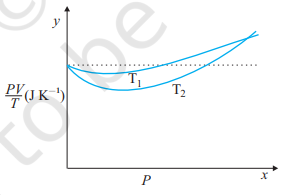
Following figure shows plot of PV/T versus P for 1.00 x 10⁻³ kg of oxygen gas at two different temperatures.
(a) What does the dotted plot signify?
(b) Which is true: T1 > T2 or T1 < T2?
(c) What is the value of PV/T where the curves meet on the y-axis?
(d) If we obtained similar plots for 1.00 x 10⁻³ kg of hydrogen, would we get the same value of PVIT at the point where the curves meet on the y-axis? If not, what mass of hydrogen yields the same value of PV If (Jor low pressure high temperature region of the plot)? (Molecular mass of H2 = 2.02 u, of O2 = 32.0 u, R = 8.31 J mot-1 K-1)
13.
Estimate the mean free path and collision frequency of a nitrogen molecule in a cylinder containing nitrogen at 2.0 atm and temperature 17oC. Take the radius of a nitrogen molecule to be roughly 1.0 Å. Compare the collision time with the time the molecule moves freely between two successive collisions (Molecular mass of N2 = 28.0 u).
14.
An air bubble of volume 1.0 cm3 rises from the bottom of a lake 40 m deep at a temperature of 12 °C. To what volume does it grow when it reaches the surface, which is at a temperature of 35 °C ?
15.
At what temperature is the root mean square speed of an atom in an argon gas cylinder equal to the rms speed of a helium gas atom at – 20 °C ? (atomic mass of Ar = 39.9 u, of He = 4.0 u).
16.
Three vessels of equal capacity have gases at the same temperature and pressure. The first vessel contains neon (monatomic), the second contains chlorine (diatomic), and the third contains uranium hexafluoride (polyatomic). Do the vessels contain equal number of respective molecules ? Is the root mean square speed of molecules the same in the three cases? If not, in which case is vrms the largest ?
17.
A flask contains argon and chlorine in the ratio of 2:1 by mass. The temperature of the mixture is 27 °C. Obtain the ratio of (i) average kinetic energy per molecule, and (ii) root mean square speed vrms of the molecules of the two gases. Atomic mass of argon = 39.9 u; Molecular mass of chlorine = 70.9 u.
18.
Estimate the fraction of molecular volume to the actual volume occupied by oxygen gas at STP. Take the diameter of an oxygen molecule to be 3 Å.
19.
Molar volume is the volume occupied by 1 mol of any (ideal) gas at standard temperature and pressure (STP : 1 atmospheric pressure, 0 °C). Show that it is 22.4 litres.
1.
The d for water vapour is same as that of air. The number density is inversely proportional to absolute temperature.
\(\text { So } n=2.7 \times 10^{25} \times \frac{273}{373}=2 \times 10^{25} \mathrm{~m}^{-3}\)
Hence, mean free path l = 4 x 10⁻⁷m
2.
Using the gas law PV = µRT, you can easily show that 1 mol of any (ideal) gas at standard temperature (273 K) and pressure (1 atm = 1.01 x 10⁵ Pa) occupies a volume of 22.4 litres. This universal volume is called molar volume. Thus the cylinder in this example contains 2 mol of helium. Further, since helium is monatomic, its predicted (and observed) molar specific heat at constant volume, Cv = (3/2) R, and molar specific heat at constant pressure, Cp = (3/2) R + R = (5/2) R. Since the volume of the cylinder is fixed, the heat required is determined by Cv . Therefore,
Heat required = no. of moles × molar specific heat × rise in temperature
= 2 x 1.5 R x 15.0 = 45 R
= 45 x 8.31 = 374 J.
3.
(a) Let the speed of the ball be u relative to the wicket behind the bat. If the bat is moving towards the ball with a speed V relative to the wicket, then the relative speed of the ball to bat is V + u towards the bat. When the ball rebounds (after hitting the massive bat) its speed, relative to bat, is V + u moving away from the bat. So relative to the wicket the speed of the rebounding ball is V + (V + u) = 2V + u, moving away from the wicket. So the ball speeds up after the collision with the bat. The rebound speed will be less than u if the bat is not massive. For a molecule this would imply an increase in temperature.
You should be able to answer (b) (c) and (d) based on the answer to (a). (Hint: Note the correspondence, piston → bat, cylinder → wicket, molecule → ball.)
4.
Partial pressure of a gas in a mixture is the pressure it would have for the same volume and temperature if it alone occupied the vessel. (The total pressure of a mixture of non-reactive gases is the sum of partial pressures due to its constituent gases.) Each gas (assumed ideal) obeys the gas law. Since V and T are common to the two gases, we have P1V = µ1 RT and P2V = µ2 RT, i.e. (P1 /P2 ) = (µ1 / µ2 ). Here 1 and 2 refer to neon and oxygen respectively. Since (P1 /P2 ) = (3/2) (given), (µ1 / µ2 ) = 3/2.
(i) By definition µ1 = (N1 /NA ) and µ2 = (N2 /NA ) where N1 and N2 are the number of molecules of 1 and 2, and NA is the Avogadro’s number. Therefore, (N1 /N2 ) = (µ1 / µ2 ) = 3/2.
(ii) We can also write µ1 = (m1 /M1 ) and µ2 = (m2 /M2 ) where m1 and m2 are the masses of 1 and 2; and M1 and M2 are their molecular masses. (Both m1 and M1 ; as well as m2 and M2 should be expressed in the same units). If ρ1 and ρ2 are the mass densities of 1 and 2 respectively, we have \( \frac{\rho_1}{\rho_2}=\frac{m_1 / V}{m_2 / V}=\frac{m_1}{m_2}=\frac{\mu_1}{\mu_2} \times\left(\frac{M_1}{M_2}\right) \)
\(=\frac{3}{2} \times \frac{20.2}{32.0}=0.947
\)
5.
(i) Given, T = 27 \(^0\)C
= ( 273.15 + 27 )
= 300.15K
Average thermal energy , E = \(\frac{3}{2}\)kBT
( where, kB = Boltzman constant
= 1.38\(\times\)10-23 JK-1 )
E = \(\frac{3}{2}\)\(\times\)1.38\(\times\)10-23\(\times\)300.15
= 6.21 \(\times\)10-21 J
(ii) At the temperatures , T = 107 K
Average thermal energy , E = \( \frac{3}{2}\)kBT
= \( \frac{3}{2}\)\(\times\)1.38\(\times\)10-23\(\times\)6000
= 1.241\(\times\)10-19 J
(iii) At temperature , T = 107K
Average thermal energy,
E = \(\frac{3}{2}\)kBT
= \(\frac{3}{2}\)\(\times\)1.38\(\times\)10-23\(\times\)107
= 2.07\(\times\)10-16 J
6.
A given mass of water in vapour state has 1.67×10³ times the volume of the same mass of water in liquid state : For a given mass of water molecules, the density is less if volume is large. So the volume of the vapour is 1000/0.6 = 1/(6 × 10 -4 ) times larger. If densities of bulk water and water molecules are same, then the fraction of molecular volume to the total volume in liquid state is 1. As volume in vapour state has increased, the fractional volume is less by the same amount, i.e. 6×10⁻⁴ .
This is also the increase in the amount of volume available for each molecule of water. When volume increases by 103 times the radius increases by V1/3 or 10 times, i.e., 10 × 2 Å = 20 Å. So the average distance is 2 × 20 = 40 Å.
7.
In the liquid (or solid) phase, the molecules of water are quite closely packed. The density of water molecule may therefore, be regarded as roughly equal to the density of bulk water = 1000 kg m–3. To estimate the volume of a water molecule, we need to know the mass of a single water molecule. We know that 1 mole of water has a mass approximately equal to
(2 + 16)g = 18 g = 0.018 kg.
Since 1 mole contains about 6 × 10²³ molecules (Avogadro’s number), the mass of a molecule of water is (0.018)/(6 × 1023) kg = 3 × 10–26 kg.
Therefore, a rough estimate of the volume of a water molecule is as follows :
Volume of a water molecule = (3 × 10–26 kg)/ (1000 kg m–3)
= 3 × 10–29 m3 = (4/3) π (Radius)3
Hence, Radius ≈ 2 ×10⁻¹⁰ m = 2 Å
8.
For a given mass of water molecules, the density is less if volume is large. So the volume of the vapour is 1000/0.6 = 1/(6 × 10 -4 ) times larger. If densities of bulk water and water molecules are same, then the fraction of molecular volume to the total volume in liquid state is 1. As volume in vapour state has increased, the fractional volume is less by the same amount, i.e. 6×10⁻⁴ .
9.
At a fixed temperature the average energy = ½ m
v349 / v352 = ( 352/ 349)1/2 = 1.0044
Hence difference = \(\frac{\Delta V}{V}=0.44 \%\)
[ 235Uis the isotope needed for nuclear fission. To separate it from the more abundant isotope 238U, the mixture is surrounded by a porous cylinder. The porous cylinder must be thick and narrow, so that the molecule wanders through individually, colliding with the walls of the long pore. The faster molecule will leak out more than the slower one and so there is more of the lighter molecule (enrichment) outside the porous cylinder The method is not very efficient and has to be repeated several times for sufficient enrichment.
10.
Volume of oxygen, V1 = 30 litres = 30 x 10–3 m3
Gauge pressure, P1 = 15 atm = 15 x 1.013 × 105 Pa
Temperature, T1 = 27°C = 300 K
Universal gas constant, R = 8.314 J mole–1 K–1
Let the initial number of moles of oxygen gas in the cylinder be n1.
The gas equation is given as:
\(P_{1} V_{1}=\eta_{1} R T_{1}\)
\(\therefore n_{1}=P_{1} \frac{V_{1}}{R} T_{1}\)
\(=\frac{15.195 \times 10^{5} \times 30 \times 10^{-3}}{(8.314) \times 300}=18.276\)
Where,
m1 = Initial mass of oxygen
M = Molecular mass of oxygen = 32 g
∴ m1 = n1M = 18.276 x 32 = 584.84 g
After some oxygen is withdrawn from the cylinder, the pressure and temperature reduces.
Volume, V2 = 30 litres = 30 x 10–3 m3
Gauge pressure, P2 = 11 atm = 11 x 1.013 x 105 Pa
Temperature, T2 = 17°C = 290 K
Let n2 be the number of moles of oxygen left in the cylinder.
The gas equation is given as:
P2V2 = n2RT2
\(\therefore n_{2}=\frac{P_{2} V_{2}}{R T_{2}}\)
\(=\frac{11.143 \times 10^{5} \times 30 \times 10^{-3}}{8.314} \times 290=13.86\)
\(\text { But } n_{2}=\frac{m_{2}}{M}\)
Where,
m2 is the mass of oxygen remaining in the cylinder
∴ m2 = n2M = 13.86 x 32 = 453.1 g
The mass of oxygen taken out of the cylinder is given by the relation:
Initial mass of oxygen in the cylinder – Final mass of oxygen in the cylinder
= m1 – m2
= 584.84 g – 453.1 g
= 131.74 g
= 0.131 kg
Therefore, 0.131 kg of oxygen is taken out of the cylinder.
11.
Here volume of room V = 25.0 m3 , temperature, T = 270C = 300 K and
Pressure, P = 1 atm = 1.01 x 10⁵ pa
According to gas equation,
PV = \(\mu \)RT = \(\mu \)NA.KB T
Hence, total number of air molecules in the volume of given gas,
N=\(\mu \). NA = \(\frac { PV }{ { k }_{ B }T } \)
\(\therefore N=\frac { 1.01\times { 10 }^{ 5 }\times 25.0 }{ (1.38\times { 10 }^{ -23 })\times 300 } =6.1\times { 10 }^{ 26 }\)
12.
(a) The dotted plot corresponds to 'ideal' gas behaviour as it is parallel to P-axis and it tells that value of PV /T remains same even when P is changed
(b) The upper position of PV /T shows that its value is lesser for T1, thus T1> T2. This is because the curve at T1 is more close to dotted plot than the curve at T2. Since the behaviour of a real gas approaches the perfect gas behaviour, as the tempera lure is increased
(c) Where the two curves meet, the value of PV / T on y-axis is equal to \(\mu \)R Since ideal gas
equation for \(\mu \) moles is PV = \(\mu \)RT
\(where,\ \mu =\frac { 1.00\times 10^{ -3 }kg }{ 32\times 10^{ -3 }kg } =\frac { 1 }{ 32 } \)
\(\therefore \ value\ of\frac { PV }{ T } \mu R=\frac { 1 }{ 32 } \times 8.31\quad { JK }^{ -1 }\)
(d) If we obtained similar plots for 1.00 x 10⁻³ kg of hydrogen, we will not get the same value of \(\frac { PV }{ T } \) at the point, where the curves meet on the y-axis. This is because molecular mass of hydrogen is different from that of oxygen.
For the same value of \(\frac { PV }{ T } \) mass of hydrogen required is obtained from
\(\frac { PV }{ T } nR=\frac { m }{ 2.02 } \times 8.31=0.26\)
\(\\ m=\frac { 2.02\times 0.26 }{ 8.31 } gram=6.32\times { 10 }^{ -2 }gram\)
13.
Let n the number of molecular per unit vollume of the gas.pV = NkT, where N = number of molecules in volume of the gas
\(n=\frac { N }{ V } =\frac { P }{ kT } \)
Here,
\(p=2\times 1.01\times { 10 }^{ 5 }N/m^{ 2 },k=1.38\times 10^{ -23 }j/K\)
\(\\ T=273\times 17=290K\)
\(\\ \ \therefore \ n=\frac { 2\times 1.01\times { 10 }^{ 5 } }{ (1.38\times { 10 }^{ -23 })\times (290) } \)
\(\\ =5.05\times { 10 }^{ 25 } molecule/m^{ 3 }\)
Mean free path
\(\lambda =\frac { 1 }{ 4\pi \sqrt { 2 } { r }^{ 2 }n } \)
Here,
\(r=1.0\mathring { A=1.0\times { 10 }^{ -19 }m }\)
\( \\ \therefore \lambda =\frac { 1 }{ 4\pi \sqrt { 2 } (1.0\times { 10 }^{ -10 })\times 5.05\times { 10 }^{ 25 } } \)
\( \lambda =1.11\times { 10 }^{ -7 }m\)
Now , \({ v }_{ rms }=\sqrt { \frac { 3RT }{ M } } =\sqrt { \frac { 3\times 8.31\times 290 }{ 28\times { 10 }^{ -3 } } } =508.14m/s\)
\(\therefore \) collision frequency,
\(f=\frac { { v }_{ rms } }{ \lambda } =\frac { 508.14 }{ 1.11\times { 10 }^{ -7 } } \)
\(=4.58\times 10^{ 9 }\)collissions/s
14.
\({ V }_{ 1 }=1\ { cm }^{ 3 }=1\times { 10 }^{ -6 }{ m }^{ 3 },\)
\(\\ { T }_{ 1 }={ 12 }^{ \circ }=273+35=308K\)
\(\\ { P }_{ 1 }=1\ atm\ +{ h }_{ 1 }pg\)
\(=1.01\times { 10 }^{ 5 }+40\times { 10 }^{ 3 }\times 9.8\ =493000\ Pa\)
Initially, when air bubble is at 40 m deep, Then,
Firstly, when air bubble reaches at the surface, then
\( { T }_{ 2 }={ 35 }^{ \circ }C=273+35\ =308K\)
\({ P }_{ 2 }=1\ atm=1.01\times { 10 }^{ 5 }\ Pa,{ V }_{ 2 }=?\)
\(As\ we\ know,\ \frac { { P }_{ 1 }{ V }_{ 1 } }{ { T }_{ 1 } } =\frac { { P }_{ 2 }{ V }_{ 2 } }{ { T }_{ 2 } } \Rightarrow { V }_{ 2 }=\frac { { P }_{ 1 }{ V }_{ 1 }{ T }_{ 2 } }{ { T }_{ 1 }{ P }_{ 2 } } \)
Final volume
\(\\ { V }_{ 2 }=\frac { \left( 493000 \right) \times \left( 1\times { 10 }^{ -6 } \right) \times 308 }{ 285\times 1.01\times { 10 }^{ 5 } } \)
\(\\ =5.275\times { 10 }^{ -6 }{ m }^{ 2 }\)
15.
let C and C' be the rms velocity of argon and a helium gas atoms at temperature TK and T'K respectively.
Here, M = 39.9 M '= 4.0, T = ?.
T' = -20 + 273 = 253 K
Now, v = \(\sqrt { \frac { 3RT }{ M } }\)
= \(\sqrt { \frac { 3RT }{ 39.9 } }\) and v' = \(\sqrt { \frac { 3R{ T }^{ ' } }{ { M }^{ ' } } }\)
= \(\sqrt { \frac { 3R\times 253 }{ 4 } }\)
Since, v = v',
\(\therefore\) \(\sqrt { \frac { 3R{ T } }{ 39.9 } }\) =\(\sqrt { \frac { 3R\times 253 }{ 4 } }\)
or T = \(\frac { 39.9\times 253 }{ 4 } \)
= 2523.7 K
16.
As three vessels are identical i.e., they have same volume now at constant pressure, temperature and volume the three vessels will contain equal number of molecules (by Avogadro’s law) and is equal to Avogadro's number, NA = 6.023 x 10²³
\(\because { V }_{ rms }=\sqrt { \frac { 3{ k }_{ B }T }{ m } } \Rightarrow { V }_{ rms }\propto \frac { 1 }{ \sqrt { m } }\)
where, m is mass of single gas molecule as neon has the smallest mass, so rms speed will be greatest in case of neon.
17.
The important point to remember is that the average kinetic energy (per molecule) of any (ideal) gas (be it monatomic like argon, diatomic like chlorine or polyatomic) is always equal to (3/2) kB T. It depends only on temperature, and is independent of the nature of the gas.
(i) Since argon and chlorine both have the same temperature in the flask, the ratio of average kinetic energy (per molecule) of the two gases is 1:1.
(ii) Now ½ m vrms2 = average kinetic energy per molecule = (3/2) ) kB T where m is the mass of a molecule of the gas. Therefore,
\( \frac{(v^2_rms)_{Ar}}{(v_rms)cl_2}\) = \( \frac{(m)cl}{(m)_{Ar}}\) =\(\frac{M_{cl}}{M_{Ar}}\) = \(\frac{70.9}{39.9}\) = 1.777
where M denotes the molecular mass of the gas. (For argon, a molecule is just an atom of argon.) Taking square root of both sides,
\(\frac{(v_{rms})_{Ar}}{(v_{rms})_cl_2}\) = 1.333
You should note that the composition of the mixture by mass is quite irrelevant to the above calculation. Any other proportion by mass of argon and chlorine would give the same answers to (i) and (ii), provided the temperature remains unaltered.
18.
Given, d = \(3\overset { o }{ A }.\)
r = \(\frac{d}{2}\)
= 1.5 \(\times\) 10-10 m
= 1.5 \(\times\) 10-8 cm
Molecular volume, V =\( \frac{4}{3}\) \(\pi\) r3N
= \(\frac{4}{3}\) \(\times\)3.14\(\times\)(1.5\(\times\)10-8)3\(\times\)6.023\(\times\)1023
= 8.52 cc
Actual volume occupied by 1 mole of oxygen at STP,
V' = 22400 cc
\(\therefore\) \( \frac{V}{V'} \) = \(\frac{8.52}{22400}\)
= 3.8 \(\times\)10-4
19.
As for one mole of ideal gas, pV =\(\mu\)RT
pV = RT
V = \(\frac{RT}{p}\)
Putting , R = 8.31 Jmol-1K-1, T = 273 K
p = 1 atm = 1.013 \(\times \)105 N -m-2
v = \(\frac{8.31\times273}{1.013\times10^5}\)
= 0.0224 m3
= 22.4 L [ \(\therefore\) 1 m3 = 103L ]

11th Standard CBSE Syllabus & Materials
11th Standard CBSE
CBSE 11th Business Studies Forms of Business Organisation Sample Question Papers Study Material - QB365 Set A
NEW11th Standard CBSE
CBSE 11th Business Studies Business, Trade and Commerce Sample Question Papers Study Material - QB365 Set A
NEW11th Standard CBSE
CBSE 11th Physics Waves Sample Question Papers Study Material - QB365 Set A



NCERT Books

Syllabus

Exam Pattern

Sample Question Papers

Previous year Question Papers

Important Notes

MCQ Practice test

NCERT Exemplers

Case study Questions

Image Based Questions

Passage based Questions

HOT Questions

Value Based Questions

Model Questions Papers
NCERT ( Book Back ) Questions

Assertion and Reason
Important Questions And Answers

CBSE 11th Standard CBSE Subjects
CBSE Standards







