
 100% FREE ACCESS
11th Standard CBSE Syllabus & Materials
11th Standard CBSE
CBSE 11th Economics PART-A - Presentation of Data - New Sample Question Papers Study Material - QB365 Set A
NEW11th Standard CBSE
CBSE 11th Economics PART-A - Organisation of Data - New Sample Question Papers Study Material - QB365 Set A
NEW11th Standard CBSE
CBSE 11th Economics PART-A - Collection of Data - New Sample Question Papers Study Material - QB365 Set A
NEW11th Standard CBSE
CBSE 11th Economics PART-A - Introduction to Economics and Statistics - New Sample Question Papers Study Material - QB365 Set A
NEW11th Standard CBSE
CBSE 11th Business Studies International Trade Sample Question Papers Study Material - QB365 Set A
NEW11th Standard CBSE
CBSE 11th Business Studies Evolution and Fundamentals of Business Sample Question Papers Study Material - QB365 Set A

Published on: 18/08/2026
Download CBSE Class 11th Standard CBSE Physics question papers, sample papers, important questions, and previous year solved papers in PDF format. Get free study materials, NCERT solutions, and exam preparation resources for Class 11th Standard CBSE Physics
Questions + Answers key
Take MCQ Physics Test
1.
For the travelling harmonic wave y(x, t) = 2.0 cos 2π (10t – 0.0080 x + 0.35) where x and y are in cm and t in s. Calculate the phase difference between oscillatory motion of two points separated by a distance of
(a) 4 m
(b) 0.5 m
(c) λ/2
(d) 3λ/4
2.
The transverse displacement of a string (clamped at its two ends) is given by \(y(x,t)=0.06 sin \frac{2\pi}{3} x cos (120 \pi t)\) where x, yare in m and t in s. The length of the string is 1.5 m and its mass is 3 x 10⁻² kg.
Answer the following :
(a) Does the function represent a travelling wave or a stationary wave?
(b) Interpret the wave as a superposition of two waves travelling in opposite directions. What is the wavelength, frequency, and speed of each wave ?
(c) Determine the tension in the string
3.
For the wave described in Exercise y(x, t) = 3.0 sin (36 t + 0.018 x + π/4), plot the displacement (y) versus (t) graphs for x = 0, 2 and 4 cm. What are the shape of these graphs? In which aspects does the oscillatory motion in travelling wave differ from one point to another: amplitude, frequency or phase?
4.
Explain why (or how):
(a) in a sound wave, a displacement node is a pressure antinode and vice versa,
(b) bats can ascertain distances, directions, nature, and sizes of the obstacles without any “eyes”,
(c) a violin note and sitar note may have the same frequency, yet we can distinguish between the two notes,
(d) solids can support both longitudinal and transverse waves, but only longitudinal waves can propagate in gases, and
(e) the shape of a pulse gets distorted during propagation in a dispersive medium.
5.
Use the formula, \(v=\sqrt { \frac { \Upsilon p }{ \rho } } \) to explain why the speed of sound in air
(a) is independent of pressure,
(b) increases with temperature,
(c) increases with humidity.
6.
A pipe, 30.0 cm long, is open at both ends. Which harmonic mode of the pipe resonates a 1.1 kHz source? Will resonance with the same source be observed if one end of the pipe is closed ? Take the speed of sound in air as 330 m s–1.
7.
A wave travelling along a string is described by, y(x, t) = 0.005 sin (80.0 x – 3.0 t), in which the numerical constants are in SI units (0.005 m, 80.0 rad m–1, and 3.0 rad s–1). Calculate (a) the amplitude, (b) the wavelength, and (c) the period and frequency of the wave. Also, calculate the displacement y of the wave at a distance x = 30.0 cm and time t = 20 s ?
8.
Given below are some examples of wave motion. State in each case if the wave motion is transverse, longitudinal or a combination of both:
(a) Motion of a kink in a longitudinal spring produced by displacing one end of the spring sideways.
(b) Waves produced in a cylinder containing a liquid by moving its piston back and forth.
(c) Waves produced by a motorboat sailing in water.
(d) Ultrasonic waves in air produced by a vibrating quartz crystal.
9.
Estimate the speed of sound in air at STP. The mass of 1 mole of air is 29.0\(\times \)10-3 kg.
10.
A steel wire 0.72 m long has a mass of 5.0 ×10⁻³ kg. If the wire is under a tension of 60 N, what is the speed of transverse waves on the wire ?
11.
A bat emits ultrasonic sound of frequency 1000 kHz in air. If the sound meets a water surface, what is the wavelength of (a) the reflected sound, (b) the transmitted sound? Speed of sound in air is 340 m s–1 and in water 1486 m s–1 .
12.
A wire stretched between two rigid supports vibrates in its fundamental mode with a frequency of 45 Hz. The mass of the wire is 3.5 × 10⁻² kg and its linear mass density is 4.0 × 10⁻² kg m–1. What is (a) the speed of a transverse wave on the string, and (b) the tension in the string?
13.
Two sitar strings A and B playing the note ‘Dha’ are slightly out of tune and produce beats of frequency 5 Hz. The tension of the string B is slightly increased and the beat frequency is found to decrease to 3 Hz. What is the original frequency of B if the frequency of A is 427 Hz ?
14.
You have learnt that a travelling wave in one dimension is represented by a function y = f (x, t) where x and t must appear in the combination x – v t or x + v t, i.e. y = f (x ± v t). Is the converse true? Examine if the following functions for y can possibly represent a travelling wave :
(i) (x - vt) 2
(ii) log [(x + vt)/x0]
(iii) 1/(x + vt)
15.
A steel wire has a length of 12.0 m and a mass of 2.10 kg. What should be the tension in the wire so that speed of a transverse wave on the wire equals the speed of sound in dry air at 20 °C = 343m s–1 .
16.
(i) For the wave on a string described by \(Y=0.06\sin { 2\pi /3x } \cos { \left( 120\pi t \right) } \) do do all the points on the string oscillate with the same (a) frequency, (b) phase, (c) amplitude? Explain your answers. (ii) What is the amplitude of a point 0.375 m away from one end?
17.
A metre-long tube open at one end, with a movable piston at the other end, shows resonance with a fixed frequency source (a tuning fork of frequency 340 Hz) when the tube length is 25.5 cm or 79.3 cm. Estimate the speed of sound in air at the temperature of the experiment. The edge effects may be neglected.
18.
Two sitar strings A and B playing the note ‘Ga’ are slightly out of tune and produce beats of frequency 6 Hz. The tension in the string A is slightly reduced and the beat frequency is found to reduce to 3 Hz. If the original frequency of A is 324 Hz, what is the frequency of B?
19.
A hospital uses an ultrasonic scanner to locate tumours in a tissue. What is the wavelength of sound in the tissue in which the speed of sound is 1.7 km s–1 ? The operating frequency of the scanner is 4.2 MHz
20.
A string of mass 2.50 kg is under a tension of 200 N. The length of the stretched string is 20.0 m. If the transverse jerk is struck at one end of the string, how long does the disturbance take to reach the other end?
21.
A steel rod 100 cm long is clamped at its middle. The fundamental frequency of longitudinal vibrations of the rod are given to be 2.53 kHz. What is the speed of sound in steel?
22.
Given below are some functions of x and t to represent the displacement (transverse or longitudinal) of an elastic wave. State which of these represent (i) a travelling wave, (ii) a stationary wave or (iii) none at all:
(a) y = 2 cos (3x) sin (10t)
(b) \(y=2 \sqrt{x-vt}\)
(c) y = 3 sin (5x – 0.5t) + 4 cos (5x – 0.5t)
(d) y = cos x sin t + cos 2x sin 2t
23.
A transverse harmonic wave on a string is described by y(x, t) = 3.0 sin (36 t + 0.018 x + π/4) where x and y are in cm and t in s. The positive direction of x is from left to right.
(a) Is this a travelling wave or a stationary wave ? If it is travelling, what are the speed and direction of its propagation ?
(b) What are its amplitude and frequency ?
(c) What is the initial phase at the origin ?
(d) What is the least distance between two successive crests in the wave ?
24.
A pipe 20 cm long is closed at one end. Which harmonic mode of the pipe is resonantly excited by a 430 Hz source ? Will the same source be in resonance with the pipe if both ends are open? (speed of sound in air is 340 m s–1).
25.
A stone dropped from the top of a tower of height 300 m splashes into the water of a pond near the base of the tower. When is the splash heard at the top given that the speed of sound in air is 340 m s–1 ? (g = 9.8 m s–2)
1.
Equation for a travelling harmonic wave is given as:
y (x, t) = 2.0 cos 2π (10t – 0.0080x + 0.35)
= 2.0 cos (20πt – 0.016πx + 0.70 π)
Where,
Propagation constant, k = 0.0160 π
Amplitude, a = 2 cm
Angular frequency, ω = 20 π rad/s
Phase difference is given by the relation:
\(\phi=k x=2 \frac{\pi}{\lambda}\)
(a) For x = 4 m = 400 cm
Φ = 0.016 π x 400 = 6.4 π rad
(b) For 0.5 m = 50 cm
Φ = 0.016 π x 50 = 0.8 π ra
(c) For\( x=\frac{\lambda}{2}\)
\(\phi=2 \frac{\phi}{\lambda} \times \frac{\lambda}{2}=\pi r a d\)
(d) For \(x=\frac{3 \lambda}{4}\)
\(\phi=2 \frac{\pi}{\lambda} \times 3 \frac{\lambda}{4}=1.5 \pi r a d\)
2.
The given equation is \(y(x,t)=0.06 sin \frac{2\pi}{3} x cos (120 \pi t)\) --- (1)
(i) As the equation involves harmonic functions of x and t separately, it represents a stationary wave.
(ii) We know that when a wave pulse
\(y_{1}=r sin \frac{2\pi}{\lambda}(vt-x)\)
travelling along + direction of x-axis is superimposed by the reflected wave
\(y_{2}= -r sin \frac{2\pi}{\lambda}(vt+x)\)
travelling in opposite direction, a stationary wave
\(y=y_{1}+y_{2} = -2r sin(\frac{2\pi}{\lambda})x cos \frac{2\pi}{\lambda}\)vt is formed. --- (2)
Comparing eqns. (1) and (2), we find that
\(\frac{2\pi}{\lambda}=\frac{2\pi}{3} \Rightarrow \lambda =3m\)
Also, \(\frac{2\pi}{\lambda}v=120 \pi\) or \(v=60 \lambda = 60\times 3=180 ms^{-1}\)
Frequency, \(v=\frac{v}{\lambda}=\frac{180}{3}=60 Hz\)
Note that both the waves have same wavelength, same frequency and same speed.
(iii) Velocity of transverse waves is
\(v=\sqrt{\frac{T}{m}}\) or \(v^{2}=\frac{T}{m}\)
T=mv2, where \(m=\frac{3\times 10^{-2}}{1.5}=2 \times 10^{-2} kg/m\)
T=\((180)^{2}\times 2 \times 10^{-2}\)
= 648 N.
3.
The transverse harmonic wave is
y (x, t) = 3.0 sin\((36t+0.018x+\frac{\pi}{4})\)
For x = 0,
y(0,t) = \(3 sin (36t+0+\frac{\pi}{4}) = 3 sin (36t+ \frac{\pi}{4})\) --- (1)
Here \(\omega = \frac{2\pi}{T}=36 \Rightarrow T=\frac{2\pi}{36}\)
To plot a (y) versus (t) graph, different values of y corresponding to the values of t may be tabulated as under (by making use of eqn. (1)).
| t | 0 | \(T \over 8\) | \(2T \over 8\) | \(3T \over 8\) | \(4T \over 8\) | \(5T \over 8\) | \(6T \over 8\) | \(7T \over 8\) | T |
| y | \(\frac{3}{\sqrt{2}}\) | 3 | \(\frac{3}{\sqrt{2}}\) | 0 | \(-\frac{3}{\sqrt{2}}\) | -3 | \(-\frac{3}{\sqrt{2}}\) | 0 | \(\frac{3}{\sqrt{2}}\) |
Using the values of t and y (as in the table), a graph is plotted as under The graph obtained is sinusoidal.
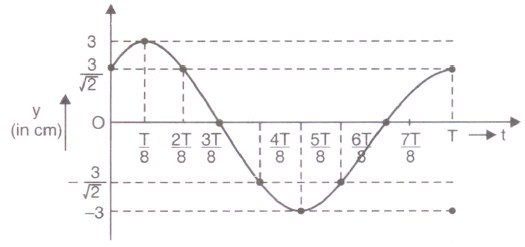
Similar graphs are obtained for x = 2 cm and x = 4 cm. The oscillatorymotion in the travelling wave only differs in respect of phase. Amplitude and frequency of oscillatory motion remains the same in all the cases.
4.
(i) Node It is a point where the amplitude of oscillation is zero, i.e. displacement is minimum. As pressure is inversely related with displacement, i.e. when displacement will be minimum, the pressure will be maximum.
Antinode At this point displacement is maximum, i.e. amplitude of oscillation will be maximum and hence, the pressure will be minimal as it is inversely related.
(ii) Bats emit ultrasonic waves of large frequencies. These waves will be reflected by the obstacles in their path. The reflected rays received by the bat will give an idea about the obstacle, i.e. distance, direction, size and nature.
(iii) As overtones produced and relatives strengths of notes are different in two notes of violin and sitar. Although frequencies are same, we will distinguish by their strengths.
(iv) The reason behind is that solids have both the elasticity of volume as well as shape, whereas gases have only the volume elasticity.
(v) As in the dispersive medium wavelengths are different, hence the velocities, therefore, the shape of the pulse gets distorted.
5.
(i) Effect of pressure
\(\text{v speed of sound in a gas}=\sqrt { \frac { \Upsilon p }{ \rho } } \)
\(\text{ p=pressure,} \rho = \text{density,} \frac { M }{ V } \Rightarrow V=\sqrt { \frac { \Upsilon pV }{ M } } \)
When T is constant, pV = constant \(\Rightarrow \) v = constant
Hence, velocity of sound is independent of the change in pressure of the gas provided temperature remains constant
(ii) Formula for Velocity, \(v=\sqrt { \frac { \Upsilon p }{ \rho } } \)
According to standard gas equation,
\(pV=RT\Rightarrow \rho =\frac { RT }{ V } \Rightarrow v=\sqrt { \frac { \Upsilon \times RT }{ pV } } =\sqrt { \frac { \Upsilon RT }{ M } } \)
Where M = pV = molecule weight of the gas
\(\Rightarrow v\infty \sqrt { T } \)
Hence, v increases with temperature.
(iii) Due to pressure of water vapours in air density changes. Hence, velocity of sound changes with humidity.
Let \(\rho _{ m }\) = density of moist \( \rho _{ d }\) = density of dry air
vm = velocity of sound in moist air
vd = velocity of sound in dry air
\( v_{ m }\ =\ \sqrt { \frac { \Upsilon p }{ \rho _{ m } } } .v_{ d }=\sqrt { \frac { \Upsilon p }{ \rho _{ d } } } \)
\(\\ \frac { v_{ m } }{ v_{ d } } =\sqrt { \frac { \rho _{ d } }{ \rho _{ m } } } as\rho _{ d }>p_{ m }\Rightarrow v_{ m }>v_{ d }\)
6.
The first harmonic frequency is given by
\(v_1=\frac{v}{\lambda_1}=\frac{v}{2 L} \) (open pipe)
where L is the length of the pipe. The frequency of its nth harmonic is:
\(v_n=\frac{n v}{2 L} \text {, for } n=1,2,3, \ldots\)(open pipe)
First few modes of an open pipe are shown in Fig.
For \(L=30.0 \mathrm{~cm}, V=330 \mathrm{~m} \mathrm{~s}^{-1}\),
\(v_{\mathrm{n}}=\frac{n 330\left(\mathrm{~m} \mathrm{~s}^{-1}\right)}{0.6(\mathrm{~m})}=550 \mathrm{n} \mathrm{s}^{-1}\)
Clearly, a source of frequency 1.1 kHz will resonate at v2 , i.e. the second harmonic.
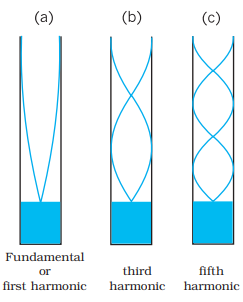
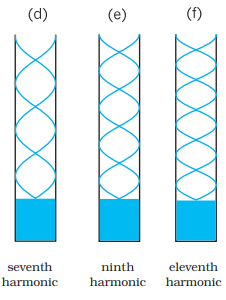
Now if one end of the pipe is closed (Fig.), it follows from Eq. that the fundamental frequency is
\(v_t=\frac{v}{\lambda_1}=\frac{v}{4 L}\)(pipe closed at one end)
and only the odd numbered harmonics are present :
\(v_3=\frac{3 v}{4 L}, v_5=\frac{5 v}{4 L}\) and so on.
For L = 30 cm and v = 330 m s–1, the fundamental frequency of the pipe closed at one end is 275 Hz and the source frequency corresponds to its fourth harmonic. Since this harmonic is not a possible mode, no resonance will be observed with the source, the moment one end is closed
7.
On comparing this displacement equation with Eq. y (x, t) = a sin (kx – ωt), we find
(a) the amplitude of the wave is 0.005 m = 5 mm.
(b) the angular wave number k and angular frequency ω are k = 80.0 m–1 and ω = 3.0 s–1
We, then, relate the wavelength λ to k through Eq. , λ = 2π/k
\(\lambda =\frac { 2\pi }{ k } =\frac { 2\pi }{ 80 m^{-1} }\)
= 7.85 cm
(c) Now, we relate T to ω by the relation T = 2π/ω
\( =\frac { 2\pi }{ 3.0 m^{-1} }\)= 2.09 s
and frequency, v = 1/T = 0.48 Hz
The displacement y at x = 30.0 cm and time t = 20 s is given by
y = (0.005 m) sin (80.0 × 0.3 – 3.0 × 20)
= (0.005 m) sin (–36 + 12π)
= (0.005 m) sin (1.699)
= (0.005 m) sin (970 ) ≃ 5 mm
8.
(a) Transverse and longitudinal
(b) Longitudinal
(c) Transverse and longitudinal
(d) Longitudinal
9.
We know that 1 mole of any gas occupies 22.4 litres at STP.
Therefore, density of air at STP is: ρo = (mass of one mole of air)/ (volume of one mole of air at STP)
\(\\ =\frac { 29.0\times { 10 }^{ -3 }kg }{ 22.4\times { 10 }^{ -3 } } \) = 1.29 kg m–3
According to Newton’s formula for the speed of sound in a medium, we get for the speed of sound in air at STP,
v = \(\left[ \frac { 1.01\times 10^{ 5 }{ Nm }^{ -2 } }{ 1.29kgm^{ -3 } } \right] ^{ { 1 }/{ 2 } }\) = 280 m s–1
10.
Mass per unit length of the wire,
\(\mu =\frac{5.0 \times 10^{-3} \mathrm{~kg}}{0.72 \mathrm{~m}} \)
\(=6.9 \times 10^{-3} \mathrm{~kg} \mathrm{~m}^{-1}\)
Tension, T=60 N
The speed of wave on the wire is given by
\(v=\sqrt{\frac{T}{\mu}}=\sqrt{\frac{60 \mathrm{~N}}{6.9 \times 10^{-3} \mathrm{~kg} \mathrm{~m}^{-1}}}=93 \mathrm{~m} \mathrm{~s}^{-1}\)
11.
Give, v = 1000 kHz =106 Hz
va = 340 m/s, vw = 1486 m/s
Wavelength of reflected sound, \({ \lambda }_{ a }=v\frac { { v }_{ a } }{ v } \)
\(=\frac { 340 }{ { 10 }^{ 6 } } =3.4\times { 10 }^{ -4 }m\)
Wavelength of transmitted sound,
\({ \lambda }_{ w }=\frac { { v }_{ s } }{ v } =\frac { 1486 }{ { 10 }^{ 6 } } =1486\times { 10 }^{ -6 }\)
\({ \lambda }_{ w }=1.486\times { 10 }^{ -3 }m\)
12.
(i) Here, given v = 45 Hz, M = 3.5 x 10⁻²kg
\(\mu =\frac { Mass }{ Length } =4.0\times { 10 }^{ -2 }{ kgm }^{ -1 }\)
\( l=\frac { M }{ \mu } =\frac { 3.5\times { 10 }^{ -2 } }{ 4\times { 10 }^{ -2 } } =\frac { 7 }{ 8 } m l=\frac { \lambda }{ 2 } =\frac { 7 }{ 8 } \)
\( \Rightarrow \lambda =\frac { 7 }{ 4 } m=1.75m\)
\(\\ Speed,\ v=v\times \lambda \ =45\times 1.75\ =78.75m/s \)
(ii) \(As\ v=\sqrt { \frac { T }{ \mu } } \Rightarrow T={ v }^{ 2 }\times \mu \)
\(\Rightarrow T=\left( 78.75 \right) ^{ 2 }\times 4\times { 10 }^{ -2 }\)
\( \Rightarrow T=248.06\ N\)
13.
Increase in the tension of a string increases its frequency. If the original frequency of B (νB ) were greater than that of A (νA ), further increase in νB should have resulted in an increase in the beat frequency. But the beat frequency is found to decrease. This shows that νB < νA . Since νA – νB = 5 Hz, and νA = 427 Hz, we get νB = 422 Hz.
14.
Conceptual question based on fundamentals of characteristics of travelling wave.
The converse is not true means if the function can be represented in the form y = f( x \(\pm \) vt ), it does not necessarily express a travelling wave. As the essential condition for a travelling wave is that the vibrating particle must have finite displacement value for all x and t.
(i) For x = 0
If t \(\rightarrow \)0, then (x - vt)2\(\rightarrow \)0 which is finite, hence, it is a wave as it passes the two tests.
(ii) log \(\left( \frac { x+vt }{ x_{ 0 } } \right)\)
l\( \\ At\ x=0\ and\ t=0,\)
\( f(x,t)=log\left( \frac { 0+0 }{ x_{ 0 } } \right) \)
= log 0 \(\rightarrow\) not defined
Hence, it is not a wave.
(iii) \(\frac { 1 }{ x+vt } \)
\( \\ For\ x=0,\ t=0,\ f(x)\rightarrow \infty\)
Though the function is of (x\(\pm\) vt) type still at x = 0, it is infinite, hence, it is not a wave.
15.
Given, l = 12.0m, M = 2\(\sqrt { \frac { T }{ \mu } } \).10kg, T = ?, v = 343m/s
\(\mu \) = mass per unit length
= \(\frac { M }{ l } =\frac { 2.10 }{ 12 } =0.175 \ kgm^{ -1 }\)
Also we know that, v = \(\sqrt { \frac { T }{ \mu } } \)
\(\Rightarrow T=v^{ 2 }\mu =(343)^{ 2 }\times (0.175)\)
\(\Rightarrow T=2.06\times 10^{ 4 }N\)
16.
(i) All the points except the nodes on the string have the same frequency and phase but not the same amplitude.
(ii) Given, \(Y=0.06\sin { \frac { 2\pi }{ 3 } } x\cos { \left( 120\pi \right) } \)
Putting x = 0.375 m
Amplitude, \(Y=0.06\sin { \frac { 2\pi }{ 3 } } \times \left( 0.375 \right) \)
\(=0.06\sin { \frac { \pi }{ 4 } } =\frac { 0.06 }{ \sqrt { 2 } } =0.042\ m\)
17.
As, there is piston at one end, it behaves as a closed organ pipe. Hence, it will produce odd harmonics only.
Hence, resonant frequencies will be first and third harmonics.
In the fundamental mode,\(\frac { \lambda }{ 4 } =25.5\ cm\)
\(\Rightarrow \lambda =4\times 25.5\ =102\ cm=1.02\ m\)
Speed of sound in air
\(v=V\lambda =340\times \left( 1.02 \right) =346.8m/s\)
18.
Frequency of string A, fA=324Hz
Frequency of string B=fB
Beat’s frequency, n=6Hz
Beat's Frequency is given as:
n=∣fA−fB∣
6=∣324−fB∣
fB=330Hz or 318Hz
Frequency decreases with a decrease in the tension in a string. This is because frequency is directly proportional to the square root of tension. It is given as:
f ∝ \(\sqrt{T}\)
Hence, the beat frequency cannot be 330 Hz
∴ fB=318Hz
19.
Speed of sound in the tissue, v = 1.7 km/s =1.7 × 10³m/s
Operating frequency of the scanner, ν = 4.2
MHz = 4.2 × 10⁶Hz
The wavelength of sound in the tissue is given as:
λ=v/ν
\(=\frac{1.7×10^{34}}{2×10^{26}}\)
=4.1 × 10⁻⁴m
20.
\(\mathrm{M}=2.50 \mathrm{~kg} \)
\( \mathrm{~T}=200 \mathrm{~N} \)
\( \mathrm{l}=20.0 \mathrm{~m}\)
Mass per unit length, \(\mu=\mathrm{M} / 1=2.50 / 20=0.125 \mathrm{Kg} \mathrm{m}^{-1}\)
The velocity (v) of the transverse wave in the string is given by the relation:
\( \mathrm{v}=\sqrt{\mathrm{T} / \mu} \)
\( =\sqrt{200 / 0.125}=\sqrt{1600}=40 \mathrm{~m} / \mathrm{s}\)
\(\therefore\) Time taken by the disturbance to reach the other end,
\(\mathrm{t}=1 / \mathrm{v}=20 / 40=0.5 \mathrm{~s}\)
21.
Here, L = 100 cm = 1m, v = 2.53 k Hz = \(2.53 \times 10^{3}\)Hz.
When the rod is clamped at the middle, then in the fundamental mode of vibration of the rod, a node is formed at the middle and antinode is formed at each end.
Therefore, as is clear from Fig.
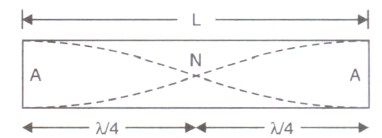
\(L=\frac{\lambda}{4}+\frac{\lambda}{4}=\frac{\lambda}{2}\)
λ = 2L = 2m
As \(\upsilon \)- = vλ
∴ \(\upsilon = 2.53 \times 10^{3} \times 2\)
= \(5.06 \times 10^{3} ms^{-1}\)
22.
(a) It represents a stationary wave.
(b) It does not represent either a travelling wave or a stationary wave.
(c) It is a representation for the travelling wave.
(d) It is a superposition of two stationary wave.
23.
Given equation is y(x,t) = 3.0sin(36t + 0.018x + \(\pi /4\)) Comparing with standard equation
y(x,t) = \(asin(\omega t+kx+\phi )\)
(i) The given equation represents a transverse harmonic wave travelling from right to left (i.e., along negative X-axis). It is not stationary wave
By comparing, we get \(\omega \) = 36rad/s, k = 0.018/cm
Speed of wave, v = \(\frac { \omega }{ k } =\frac { 36 }{ 0.018 } 2000cm/s\)
(ii) By comparing amplitude, a = 3cm
\(\Rightarrow 2\pi v=36\)
\(\Rightarrow v=\frac { 36 }{ 2\pi } =5.73Hz\)
(iii) Initial Phase, \(\phi =\frac { \pi }{ 4 } \)
(iv) \(\omega =36,\ k=\frac { 2\pi }{ \lambda } =0.018\)
\(\Rightarrow \lambda =\ least\ distance=\frac { 2\pi }{ \lambda } =\frac { 2\pi }{ 0.018 } cm\)
\(=\ 349.1\ cm\)
24.
Given L = 20 cm = 0.2 m, vn = 430 Hz, v = 340 m/s
It will behave as closed organ pipe
\( { v }_{ n }=\left( 2n-1 \right) \frac { v }{ 4L } ,\ where\ n=1,2,3....\)
\( \Rightarrow 430=\left( 2n-1 \right) \frac { v }{ 4L } =\left( 2n-1 \right) \times \frac { 340 }{ 4\times 0.2 } \)
\(\Rightarrow \ \left( 2n-1 \right) =\frac { 430\times \left( 0.8 \right) }{ 340 } \Rightarrow 2n=\frac { \left( 430 \right) \left( 0.8 \right) }{ 340 } +1\)
\( \Rightarrow n=\frac { 43\times 4 }{ 340 } +\frac { 1 }{ 2 } =\frac { 2\times 172+340 }{ 340\times 2 } =\frac { 684 }{ 680 } =1.006\)
Hence, it will be the 1st normal mode or harmonic mode of vibration.
In a pipe open at both ends,\({ v }_{ n }=n\times \frac { v }{ 2l } =\frac { n\times 340 }{ 2\times 0.2 } =430\)
\(\Rightarrow n=\frac { 430\times 2\times 0.2 }{ 340 } =\frac { 43\times 2\times 2 }{ 340 } =0.5\)
As n is not integer, hence, open organ pipe cannot be in resonance with the source.
25.
Given, h = 300m, g = 9.8m/s2 , v = 340ms-1
t1 = time taken by stone to strike the water surface
\(t_{ 1 }=\sqrt { \frac { 2h }{ g } } =\sqrt { \frac { 300 }{ 49 } } =7.82s\left( as\quad h=0+\frac { 1 }{ 2 } gt^{ 2 }_{ 1 } \right) \)
t2 = time taken by the splash's sound to reach top of the tower
\(t_{ 2 }=\frac { h }{ v } =\frac { 300 }{ 340 } =0.882\quad \left[ v=\frac { h }{ t_{ 2 } } \right] \)
Total time, t = time to hear splash of sound
= t1 + t2 =7.82 + 0.882
= 8.702

11th Standard CBSE Syllabus & Materials
11th Standard CBSE
CBSE 11th Business Studies Forms of Business Organisation Sample Question Papers Study Material - QB365 Set A
NEW11th Standard CBSE
CBSE 11th Business Studies Business, Trade and Commerce Sample Question Papers Study Material - QB365 Set A
NEW11th Standard CBSE
CBSE 11th Physics Kinetic Theory Sample Question Papers Study Material - QB365 Set A



NCERT Books

Syllabus

Exam Pattern

Sample Question Papers

Previous year Question Papers

Important Notes

MCQ Practice test

NCERT Exemplers

Case study Questions

Image Based Questions

Passage based Questions

HOT Questions

Value Based Questions

Model Questions Papers
NCERT ( Book Back ) Questions

Assertion and Reason
Important Questions And Answers

CBSE 11th Standard CBSE Subjects
CBSE Standards







