
 100% FREE ACCESS
6th Standard CBSE Syllabus & Materials
6th Standard CBSE
CBSE 6th Social Science The Value of Work - New Sample Question Papers Study Material - QB365 Set A
NEW6th Standard CBSE
CBSE 6th Social Science Family and Community - New Sample Question Papers Study Material - QB365 Set A
NEW6th Standard CBSE
CBSE 6th Social Science India's Cultural Roots - New Sample Question Papers Study Material - QB365 Set A
NEW6th Standard CBSE
CBSE 6th Social Science India,That is Bharat - New Sample Question Papers Study Material - QB365 Set A
NEW6th Standard CBSE
CBSE 6th Social Science Timeline and sources of history - New Sample Question Papers Study Material - QB365 Set A
NEW6th Standard CBSE
CBSE 6th Social Science Oceans and Continents - New Sample Question Papers Study Material - QB365 Set A

Published on: 21/09/2019
Basic Geometrical Ideas
Download CBSE Class 6th Standard CBSE Mathematics question papers, sample papers, important questions, and previous year solved papers in PDF format. Get free study materials, NCERT solutions, and exam preparation resources for Class 6th Standard CBSE Mathematics
Questions + Answers key
Take MCQ Mathematics Test
1.
Where else do you see parallel lines? Try to find ten examples.
2.
In the given figure, name the points, which are
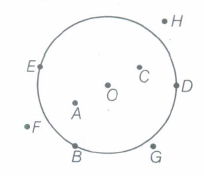
(a) in its exterior.
(b) in its interior.
(c) on the circle.
3.
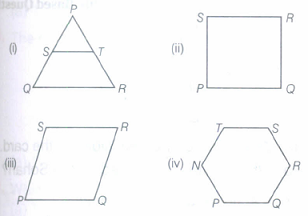
Identify parallel line segments in each of the figure given below.
4.
What is common in the following figures (i) and (ii)?
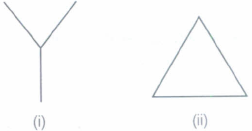
Is figure (i) is a triangle? If not,why?
5.
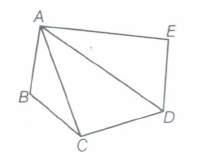
Name the vertices and the line segments in the given figure.
6.
What is the minimum number of points of intersection of three lines in a plane?
7.
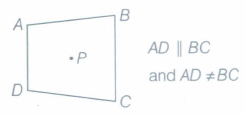
Draw a quadrilateral in which two sides are parallel, but not equal and also plot a point P inside it.
8.
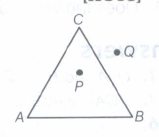
Draw a rough sketch of a \(\triangle ABC\). Mark a point P in its interior and a point Q in its exterior. Is the point A in its exterior or in its interior?
9.
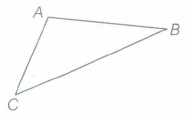
In the following figure, name the angles.
10.
Draw a diagram of a polygon with minimum number of sides.
11.
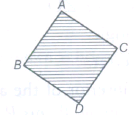
Draw any polygon and shade its interior.
12.
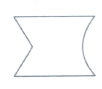
Draw rough diagram to illustrate the following:Closed curve.
13.
Draw a polygon with four line segments and write its
(i) vertices
(ii) sides
(iii) diagonals
14.
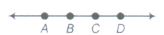
Name the line given in all possible (twelve) ways, choosing only two letters at a time from the four given letters.
15.
(a) Name the rays given in this picture.
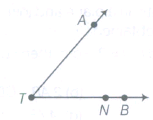
(b) Is 'T' a starting point of each of these rays?
1.
(i) Opposite edges of a scale
(ii) Opposite edges of a blackboard
(iii) Opposite edges of an envelope
(iv) Opposite edges of a rectangle
(v) Opposite edges of a page of any book
(vi) Rail lines on a railway track
(vii) Opposite edges of a file
(viii) Opposite edges of a carbon paper
(ix) Opposite edges of a rhombus
(x) Opposite edges of a page of a newspaper
2.
(a) The points, which are in the exterior are F, G and H.
(b) Interior points are A,O and C.
(c) The points, which lie on the circle are B, D and E.
3.
Parallel lines in the above figures are
(i) ST and QR.
(ii) PQ and SR, SP and QR.
(iii) PQ and SR, QR and SP.
(iv) PQ and TS, QR and TN, SR and NP.
4.
In the given figures (i) and (ii), both have three line segments. Figure (i) is not a triangle, because it is not a closed curve.
5.
The vertices of the figure are A. B, C,D, E and the line segments are \(\bar {AB},\bar {BC},\bar {CD},\bar {DE},\bar {EA},\bar {AC},\bar {AD}\).
6.
Zero
7.
8.
(i) A triangle is a three sided polygon. A rough sketch of a \(\triangle ABC\) is given.
(ii) From the figure, point P is inside the \(\triangle ABC\) and point Q is outside the \(\triangle ABC\). The point A is neither in the exterior nor in the interior of \(\triangle ABC\) because point A is the vertex of \(\triangle ABC\) ,so it lies on the \(\triangle ABC\).
9.
\(\angle CAB,\angle ACB,\angle CBA,\ or \angle A,\angle B,\angle C\)
10.

11.
ABCD is a polygon, where interior is shaded as given below:
12.
The curve given below is a closed curve, since its ends are joined:
13.
(i) Vertices of given polygon are A, B, C and D.
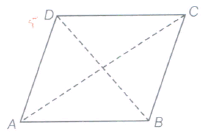
(ii) Sides are AB, BC, CD and AD.
(iii) Diagonals are AC and BD.
14.
We know that, a line is a line segment which can extend indefinitely in both directions. Name oflines in all possible ways are as follow:
(i) By taking A, all possible ways are \(\overleftrightarrow { AB } ,\overleftrightarrow { AC } and\overleftrightarrow { AD } \).
(ii) By taking B, all possible ways are \(\overleftrightarrow { BC } ,\overleftrightarrow { BD } and\overleftrightarrow {BA } \).
(iii) By taking C, all possible ways are \(\overleftrightarrow { CD } ,\overleftrightarrow { CA } and\overleftrightarrow {CB } \).
(iv) By taking D, all possible ways are \(\overleftrightarrow { DA } ,\overleftrightarrow { DB } and\overleftrightarrow {DC } \).
15.
We know that, a ray is a part of a line which starts at one point and goes endlessly in a direction.
(a) In the given figure, there are four rays namely \(\vec {TA}\), \(\vec {TN}\), \(\vec {NB}\) and \(\vec {TB}\).
(b) No, T is not a starting point of each of these rays. T is a starting point of \(\vec {TA}\), \(\vec {TB}\) and \(\vec {TN}\) only but not of \(\vec {NB}\).

6th Standard CBSE Syllabus & Materials
6th Standard CBSE
CBSE 6th Social Science Locating Places on the Earth - New Sample Question Papers Study Material - QB365 Set A
NEW6th Standard CBSE
CBSE 6th Science A Journey Through States of Water - New Sample Question Papers Study Material - QB365 Set A
NEW6th Standard CBSE
CBSE 6th Science Temperature and its Measurement - New Sample Question Papers Study Material - QB365 Set A
NEW6th Standard CBSE
CBSE 6th Science Materials Around Us - New Sample Question Papers Study Material - QB365 Set A



CBSE 6th Standard CBSE Subjects
CBSE Standards




