
 100% FREE ACCESS
6th Standard CBSE Syllabus & Materials
6th Standard CBSE
CBSE 6th Social Science The Value of Work - New Sample Question Papers Study Material - QB365 Set A
NEW6th Standard CBSE
CBSE 6th Social Science Family and Community - New Sample Question Papers Study Material - QB365 Set A
NEW6th Standard CBSE
CBSE 6th Social Science India's Cultural Roots - New Sample Question Papers Study Material - QB365 Set A
NEW6th Standard CBSE
CBSE 6th Social Science India,That is Bharat - New Sample Question Papers Study Material - QB365 Set A
NEW6th Standard CBSE
CBSE 6th Social Science Timeline and sources of history - New Sample Question Papers Study Material - QB365 Set A
NEW6th Standard CBSE
CBSE 6th Social Science Oceans and Continents - New Sample Question Papers Study Material - QB365 Set A

Published on: 11/12/2019
Integers
Download CBSE Class 6th Standard CBSE Mathematics question papers, sample papers, important questions, and previous year solved papers in PDF format. Get free study materials, NCERT solutions, and exam preparation resources for Class 6th Standard CBSE Mathematics
Questions + Answers key
Take MCQ Mathematics Test
1.
Represent the following numbers as integers with appropriate signs. Withdrawal of rupees seven hundreds.
2.
Write the opposite of each of the following:
Profit of Rs 50
3.
Write the opposite of each of the following:
Deposit of Rs 1000
4.
Compare the following pairs of numbers using > or <.
\(5\ \Box\ -5\)
5.
Write all the integers between -15 and -5.
6.
Write all the integers between the following numbers.
3 and 11
7.
Write the following numbers (integers) in increasing order with inequality '<'.
-100,100, -3, 0, 5,-1
8.
Write the following numbers (integers) in decreasing order with using inequality sign' >' .
0, -5,10,6, -3, 9
9.
By using '+' or '-' sign indicate the following
Decreasing a weight of 15 kg.
10.
Write the succeeding number of the following.
| Number | Successor |
|---|---|
| 10 | |
| 8 | |
| -5 | |
| -3 | |
| 0 |
11.
Going up and down
In Mohan's house there are stairs for going up to the terrace and for going down to the godown.
Let us consider the number of stairs going up to the terrace as positive integer, the number of stairs going down to the godown as negative integer, and the number representing ground level as zero.
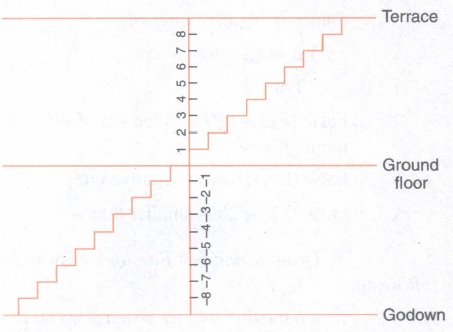
Do the following exercise and write down the answer as integer:
(a) Go 6 steps up from the ground floor.
(b) Go 4 steps down from the ground floor.
(c) Go 5 steps up from the ground floor and then go 3 steps up further from there.
(d) Go 6 steps down from the ground floor and then go down further 2 steps from there.
(e) Go down 5 steps from the ground floor and then move up 12·steps from there.
(f) Go 8 steps down from the ground floor and then go up 5 steps from there.
(g) Go 7 steps up from the ground floor and then 10 steps down from there.
Ameena wrote them as follows:
(a)+6
(b)-4
(c) (+ 5) + (+ 3) = + 8
(d) (-6) + (-2) =-4
(e)(-5)+(+12)=+7
(f)(-8) +(+5)=-3
(g) (+ 7) + (-10) = 17
She has made some mistakes. Can you check her answers and correct those that are wrong?
12.
Write the opposite of each of the following.
(a) Decrease in size
(b) Failure
(c) Profit of Rs10
(d) 1000 AD
(e) Rise in water level
(f) 60 km South
(g) 10m above the danger mark of river Ganga.
(h) 20 m below the danger mark of the river Brahmaputra.
(i) Winning by a margin of 2000 votes.
(j) Depositing Rs 100 in the Bank account.
(k) 20°C rise in temperature.
13.
Temperature of a place at 7 : 00 am was 6°C. Temperature increased by 4°C in first hour and decreased by 1°C in the second hour. What was the temperature at 9 : 00 am?
14.
Adjacent figure is a vertical number line, representing integers. Observe it and locate the following points.
(a) If point D is + 8, then which point is -8?
(b) Is point G, a negative integer or a positive integer?
(c) Write integers for points B and E.
(d) Which point marked on this number line has the least value?
(e) Arrange all the points in decreasing order of value?

15.
The succeeding number of the number - 1 is.
-1
1
0
-11
16.
The succeeding number of the number 0 is
-1
0
1
11
17.
Which of the following shows the maximum rise in temperature?
0°C to 10°C
-4°C to 8°C
-15°C to -8°C
-70C to 0°C
18.
The predecessor of the integer -1 is
0
0
-2
1
19.
Every integer less than 0 has the sign
+
-
\(\times\)
÷
1.
Withdrawal of rupees seven hundreds can be written as - Rs 700, because withdrawal is represented with - sign.
2.
The opposite of each, is loss of Rs 50
3.
The opposite of each, is withdraw of Rs 1000
4.
According to the ordering of the integers,
We know that, 5 is to right of - 5. So, \(5\ \boxed {>} -5\)
5.
Integers between -15 and -5 are -14, -13:-12, -11, -10, - 9, - 8, - 7, - 6.
6.
4,5,6,7,8,9,10
7.
-100 < -3 < -1 < 0 < 5 < 100
8.
10>9>6>O>-3>-5
9.
-15kg
10.
We know that, one more than given number gives a successor. So, the succeeding numbers of given numbers are given as below:
| Number | Successor |
|---|---|
| 10 | 10 + 1 = 11 |
| 8 | 8 + 1 = 9 |
| -5 | -5 + 1 = -4 |
| -3 | -3 + 1 = -2 |
| 0 | 0 + 1 = 1 |
11.
(a) correct
(b)correct
(c)correct
(d)Incorrect; the correct is (- 6) + (- 2) = - 8
(e)correct
(f)correct
(g)ncorrect; the correct is (+ 7) + (- 10) = - 3
12.
(a) Increase in size
(b) Success
(c) loss of Rs 10
(d) 1000 BC
(e) Fall in water level
(f) 60 km North
(g) 10 m below the danger mark of the river Ganga.
(h) 20 m above the danger mark of the river Brahmaputra.
(i) Losing by a margin of 2000 votes.
(j) Withdrawing Rs 100 from the Bank account.
(k) 20° C fall in temperature.
13.
Temperature at 7 : 00 am = + 6° C
It is given that, temperature increased by 4°C in first hour.
So, temperature at 8 : 00 am = +6°C + 4°C = 10°C
Temperature decreased in second hour by 1°C.
So, the temperature at 9 : 00 am = 10°C - 1°C = 9°C
14.
(a) Now, from the figure, it is clear that +8 is on point D, then forgetting - 8, we should move below to O. After moving 8 steps below 0, we reach at point F So, point F represents - 8.
(b) We know that, points lie above zero are positive integers and lie below zero are negative integers. Here, we see that point G lies below zero. So, G is a negative integer.
(c) On the given number line, point B lies above zero and point E lies below zero. So, it is clear that point B is a positive integer and point E is a negative integer. Now, counting from 0, the distance of B = +4 units, because it is on right of zero and counting from 0, the distance of E = -10 units because it is on left of zero.
∴ Integer B = + 4 and integer E = -10
(d) Here, we see that the distance of point E is far from 0 and below from 0 and we know that on vertical number line below from 0 the value of integers are negative. Hence, point E has the least value.
(e) We know that, on a number line the number decreases as we move to left. Here, vertical number line is given to us, so the number decreases as we move to down. So, decreasing order of values of all points is given here. D, C, B, A, O, H, G, F, E
15.
(c)
0
16.
(c)
1
17.
0°C to 10°C = +10° C -4° C to 8° C = +12°C (max.)
-15°C to -8°C = +7°C -7°C to 0°C = +7°C
18.
The predecessor of -1 = -1 - 1 = -2
\(\therefore\) The required predecessor is -2.
19.
We know that, all the negative integers are less than zero and they have '-' sign.

6th Standard CBSE Syllabus & Materials
6th Standard CBSE
CBSE 6th Social Science Locating Places on the Earth - New Sample Question Papers Study Material - QB365 Set A
NEW6th Standard CBSE
CBSE 6th Science A Journey Through States of Water - New Sample Question Papers Study Material - QB365 Set A
NEW6th Standard CBSE
CBSE 6th Science Temperature and its Measurement - New Sample Question Papers Study Material - QB365 Set A
NEW6th Standard CBSE
CBSE 6th Science Materials Around Us - New Sample Question Papers Study Material - QB365 Set A



CBSE 6th Standard CBSE Subjects
CBSE Standards




