
 100% FREE ACCESS
6th Standard CBSE Syllabus & Materials
6th Standard CBSE
CBSE 6th Social Science The Value of Work - New Sample Question Papers Study Material - QB365 Set A
NEW6th Standard CBSE
CBSE 6th Social Science Family and Community - New Sample Question Papers Study Material - QB365 Set A
NEW6th Standard CBSE
CBSE 6th Social Science India's Cultural Roots - New Sample Question Papers Study Material - QB365 Set A
NEW6th Standard CBSE
CBSE 6th Social Science India,That is Bharat - New Sample Question Papers Study Material - QB365 Set A
NEW6th Standard CBSE
CBSE 6th Social Science Timeline and sources of history - New Sample Question Papers Study Material - QB365 Set A
NEW6th Standard CBSE
CBSE 6th Social Science Oceans and Continents - New Sample Question Papers Study Material - QB365 Set A

Published on: 21/11/2019
Knowing our Numbers
Download CBSE Class 6th Standard CBSE Mathematics question papers, sample papers, important questions, and previous year solved papers in PDF format. Get free study materials, NCERT solutions, and exam preparation resources for Class 6th Standard CBSE Mathematics
Questions + Answers key
Take MCQ Mathematics Test
1.
Arrange the following numbers in ascending order and write the smallest number
3763214,18340217,984671,3790423,18431056
2.
Use the given digits without repetition and make the greatest and smallest 4-digit numbers. 5, 4, 0, 3.
3.
Use the given digits without repetition and make the greatest and smallest 4-digit numbers. 1, 7, 6, 2.
4.
Arrange the numbers 819, 5240, 890, 6249 in descending order.
5.
Arrange the numbers 847, 9754, 8320, 571 in ascending order
6.
From the digits 3, 0 and 4, make five numbers each with 6-digits. Use commas.
7.
Arrange the following numbers in ascending order.
(a) 847, 9754, 8320, 571
(b) 9801, 25751, 36501, 38802
8.
Think of five situations, where compare three or more quantities.
9.
Make the greatest and the smallest 4-digit numbers using any four different digits with conditions given below:
Digit 7 is always at one place
10.
Make the greatest and the smallest 4-digit numbers by using anyone digit twice. 8, 5, 1.
11.
Name five large cities in India. Find their population. Also, find the distance (in km) between each pair of these cities.
12.
You have the digits 4, 5, 6, 0, 7 and 8. Using them, make five numbers each with 6-digits.
(a) Put commas for easy reading.
(b) Arrange them in ascending and descending orders.
13.
Read and expand the numbers wherever there are blanks.
| Number | Number name | Expansion |
| 20000 | Twenty thousands | 2 \(\times\)10,000 |
| 26000 | Twenty six thousands | 2 \(\times\)10,000+6 \(\times\)1,000 |
| 38400 | Thirty eight thousands four hundreds | 3\(\times\)10,000+8 \(\times\)1,000+4\(\times\)100 |
| 65740 |
Sixty five thousands seven hundreds forty |
6\(\times\)10,000+5\(\times\)1,000+7\(\times\) 100+4\(\times\) 10 |
| 89324 | Eighty nine thousands three hundreds twenty four | 8\(\times\)10,000+9\(\times\)1,000+3\(\times\) 100+2\(\times\) 10+4\(\times\)1 |
| 50000 | ||
| 41000 | ||
| 47300 | ||
| 57630 | ||
| 29485 | ||
| 29085 | ||
| 20085 | ||
| 20005 |
14.
Make the smallest 4-digit number by using anyone digit of 7, 0, 6 twice.
6007
6070
6700
None of these
15.
Using the digits 3, 5, 7, 0 without repetition the greatest 4-digit number that can be made is
7530
7503
7350
7305
16.
Using the digits 1, 5, 7, 2 without repetition, the greatest 4-digit number that can be made is
7521
7512
7215
7251
17.
The greatest of the numbers 123, 27,650, 2342, 40000 is
40000
2342
27
650.
18.
Which of the following is true?
1 million = 1000000
1 lakh = 10000
1crore=100000000
19.
Do you know what is India's population today? Try to find this too.
20.
What would be the number of grains in a sackfull of wheat? A 5-digit number, a 6-digit number or more?
21.
Do you know the number of people in your state? How many digits would that number have?
22.
Which is the smallest number?
23.
What is the greatest number, you can get?
1.
984671
2.
Here, descending order of the given digits is 5,4, 3, 0.
∴ Greatest number = 5430
and ascending order of the given digits is 0,3,4, 5.
But 0345 is a three-digit number. So, we have to interchange the place of 3 and 0 i.e 3045.
∴ Smallest number = 3045.
3.
Here, descending order of the given digits is 7, 6, 2, 1
∴ Greatest number = 7621
and ascending order of the given digits is 1,2,6, 7.
∴ Smallest number = 1267.
4.
Given, numbers are 819, 5240, 890 and 6249.
To convert numbers into descending order, we arrange numbers greatest to the smallest.
Now, descending order is 6249 > 5240> 890> 819.
5.
Given, numbers are 847, 9754, 8320 and 571.
To convert numbers into ascending numbers, we arrange numbers smallest to the greatest.
Now, ascending order is 571 < 847 < 8320 < 9754.
6.
Given digits are 3, 0 and 4.
We can make many numbers by using these digits, five of them are as follows:
(i) 330443 (ii) 343404 (iii) 344430 (iv) 434043 (v) 344034
Using commas, these numbers can be rewritten as :
(i) 3,30,443 (ii) 3,43,404 (iii) 3,44,430 (iv) 4,34,043 (v) 3,44,034
7.
(a) We have, 847, 9754, 8320, 571
Ascending order of given numbers is as follows:
571 < 847 < 8320 < 9754
(b) We have, 9801, 25751, 36501, 38802
Ascending order of given numbers is as follows:
9801 < 25751 < 36501 < 38802
8.
Five more situations may be
(i) Prices of 4 different kinds of branded shoes are Rs.4225, Rs.3835, Rs. 2620 and Rs. 2230, respectively.
(ii) The weight of 4 students of Class VI are 33 kg, 38 kg, 35 kg and 37 kg, respectively.
(iii) Marks obtained by 4 students in Mathematics out of 100 are 87, 88, 90 and 78, respectively.
(iv) The tution fee paid by 4 students of different classes are Rs. 170, Rs. 190, Rs. 150 and Rs. 200, respectively.
(v) The runs scored by 4 players A, B, C and D in an innings are 75, 60, 25 and 82, respectively.
9.
Digits in ascending order are 0,1,2,3,4,5,6,7,8,9 and digits in descending order are 9,8,7,6,5,4,3,2,1, 0. Also, we know that 0 can never be taken at the leftmost place.
Keeping the digit 7 at ones place, we can fill other places tens, hundreds and thousands by remaining numbers.
Greatest number
| 9 | 8 | 6 | 7 |
-[Keeping the greatest digits i.e. 9, 8 and 6 at thousands, hundreds and tens place]
Smallest number
| 1 | 0 | 2 | 7 |
[Keeping the smallest digits i.e. 0, 1, 2 at hundreds, thousands and tens place. If keep 0 at thousands place, then number will be equal to 3-digit number]
10.
Given digits are 8, 5 and 1.
Here, descending order of the given digits is 8, 8, 5, 1. [∴ greatest digit 8 is taken twice]
∴ Greatest 4-digit number = 8851
and ascending order of the given digits is 1, 1, 5, 8. [∴ smallest digit 1 is taken twice]
∴ Smallest 4-digit number = 1158.
11.
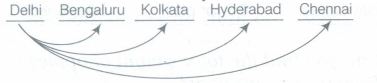
The names of five large cities in India are Delhi, Bengaluru, Kolkata, Hyderabad and Chennai.
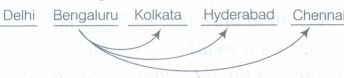
Process of making the pair of cities are given below:
We have, Delhi, Bengaluru, Kolkata, Hyderabad and Chennai
First, we take Delhi as base city
So,
Now, we take Bengaluru as base city.
Now, we take Kolkata as base city.
So,

Now, we take Hyderabad as base city.
So,

Their respective population can be taken from a book of general awareness. However, the distance (in kilometres) between each pair of these cities is given below:
| Cities in pair | Distance between two cities (in km) |
| Delhi - Bengaluru | 2019 |
| Delhi - Kolkata | 1442 |
| Delhi - Hyderabad | 1453 |
| Delhi - Chennai | 2157 |
| Bengaluru - Kolkata | 1883 |
| Bengaluru - Hyderabad | 566 |
| Bengaluru- Chennai | 334 |
| Kolkata - Hyderabad | 1516 |
| Kolkata - Chennai | 1678 |
| Hyderabad - Chennai | 704 |
These are the national distances between the cities.
12.
Given digits are 4, 5, 6, 0, 7 and 8.
We can make many numbers by using these digits, five of them are as follows:
876540, 867540, 876450, 876045 and 867405
(a) After putting commas, numbers are as follows:
(i) 8,76,540 (ii) 8,67,540
(iii) 8,76,450 (iv) 8,76,045
(v) 8,67,405
(b) Ascending order of numbers is as follows:
867405 < 867540 < 876045 < 876450 < 876540
Descending order of numbers is as follows:
876540 > 876450 > 876045 > 867540 > 867405.
13.
The remaining blanks are shown as below with appropriate number, name and expansion:
| Number | Number name | Expansion |
| 50000 | Fifty thousands | 5 \(\times\) 10,000 |
| 41000 | Forty one thousands | 4 \(\times\) 10,000 + 1 \(\times\) 1,000 |
| 47300 | Forty seven thousands three hundreds | 4\(\times\)10,000 + 7 \(\times\) 1,000 + 3 \(\times\) 100 |
| 57630 | Fifty seven thousands six hundreds thirty | 5 \(\times\) 10,000 + 7 \(\times\) 1,000 + 6 \(\times\) 100 + 3\(\times\)10 |
| 29485 | Twenty nine thousands four hundreds eighty five | 2 \(\times\)10,000 + 9\(\times\) 1,000 + 4 \(\times\) 100 + 8 \(\times\) 10 + 5 \(\times\) 1 |
| 29085 | Twenty nine thousands eighty five | 2 \(\times\) 10,000 + 9 \(\times\) 1,000 +8 \(\times\)10+ 5 \(\times\) 1 |
| 20085 | Twenty thousands eighty five | 2\(\times\)10,000 + 8 \(\times\) 10 + 5 \(\times\) 1 |
| 20005 | Twenty thousands five | 2 \(\times\) 10,000 + 5 \(\times\) 1 |
14.
(a)
6007
15.
(a)
7530
16.
(a)
7521
17.
(a)
40000
18.
(a)
1 million = 1000000
19.
()
Today India's population is 1200 million.
20.
()
The number of grains in a sack full of wheat will be a still more digit number.
21.
()
Yes! my state is U.P. The number of people in my state is 20,00,00,000 approximately. This number has 9-digits.
22.
()
The smallest number is 3578.
23.
()
The greatest number we can get is 8753.

6th Standard CBSE Syllabus & Materials
6th Standard CBSE
CBSE 6th Social Science Locating Places on the Earth - New Sample Question Papers Study Material - QB365 Set A
NEW6th Standard CBSE
CBSE 6th Science A Journey Through States of Water - New Sample Question Papers Study Material - QB365 Set A
NEW6th Standard CBSE
CBSE 6th Science Temperature and its Measurement - New Sample Question Papers Study Material - QB365 Set A
NEW6th Standard CBSE
CBSE 6th Science Materials Around Us - New Sample Question Papers Study Material - QB365 Set A



CBSE 6th Standard CBSE Subjects
CBSE Standards




