
 100% FREE ACCESS
6th Standard CBSE Syllabus & Materials
6th Standard CBSE
CBSE 6th Social Science The Value of Work - New Sample Question Papers Study Material - QB365 Set A
NEW6th Standard CBSE
CBSE 6th Social Science Family and Community - New Sample Question Papers Study Material - QB365 Set A
NEW6th Standard CBSE
CBSE 6th Social Science India's Cultural Roots - New Sample Question Papers Study Material - QB365 Set A
NEW6th Standard CBSE
CBSE 6th Social Science India,That is Bharat - New Sample Question Papers Study Material - QB365 Set A
NEW6th Standard CBSE
CBSE 6th Social Science Timeline and sources of history - New Sample Question Papers Study Material - QB365 Set A
NEW6th Standard CBSE
CBSE 6th Social Science Oceans and Continents - New Sample Question Papers Study Material - QB365 Set A

Published on: 11/12/2019
Understanding Elementary Shapes
Download CBSE Class 6th Standard CBSE Mathematics question papers, sample papers, important questions, and previous year solved papers in PDF format. Get free study materials, NCERT solutions, and exam preparation resources for Class 6th Standard CBSE Mathematics
Questions + Answers key
Take MCQ Mathematics Test
1.
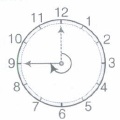
What fraction of a clockwise revolution does the hour hand of a clock turn through, when it oes from 12 to 9
2.
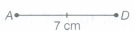
Draw a line segment \(\overline{ AD } \), which is the sum of line segments \(\overline { AB } \) and \(\overline{ CD } \) (as shown in figure).

3.
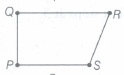
Name the line segments and also compare them.
4.
Compare the given line segments

5.
If B is the mid-point of \(\overline{ AC } \) and C is the mid-point of \(\overline{ BD } \), where A, B, C and D lie on a straight line, say why AB = CD?
6.
You have two set-squares in your instrument box. One is 30°-60°-90° set square, the other is 45°- 45°-90° set square.
You and your friend can jointly do this.
(a) Both of you will have a pair of 30°-60°- 90° set squares. Place them as shown in the figure. Can you. name the quadrilateral described? What is the measure of each of its angles? The quadrilateral is a rectangle. One more obvious property of the rectangle you can see is that opposite sides are of equal length. What other properties can you find?
.JPG)
(b) If you use a pair of 45°-45°-90° set squares, you get another quadrilateral this time.
It is a square.
.JPG)
Are you able to see that all the sides are of equal length? What can you say about the angles and the diagonals? Try to find a few more properties of the square.
(c) If you place the pair of 30°-60°-90° set squares in a different position, you get a parallelogram. Do you notice that the opposite sides are parallel? Are the opposite sides equal? Are the diagonals equal?
.JPG)
(d) If you use four 30°-60°-90° set squares you get a rhombus.
(e) If you use several set-squares you can build a shape like the one given here. Here is a quadrilateral in which two sides are parallel.
.JPG)
It is a trapezium.
Here is an outline-summary of your possible findings. Complete it.
| Quadrilateral | Opposite sides | All sides equal | Opposite angles equal | Diagonals | ||
| Parallel | Equal | Equal | perpendicular | |||
| Parallelogram | Yes | Yes | No | Yes | No | No |
| Rectangle | No | |||||
| Square | Yes | |||||
| Rhombus | Yes | |||||
| Trapezium | ||||||
7.
Draw a rough sketch of pentagon and all its diagonals.
8.
Construct two line segments AB and CO of lengths 2.5 cm and 3.2 cm. Construct another segment EF, whose length is the sum of these two segments. Measure the new length.
9.
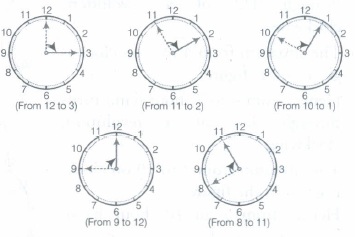
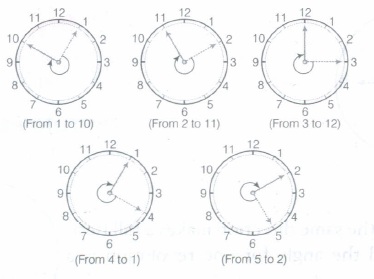
Draw five other situations of one-fourth, half and three-fourth revolution on a clock.
10.
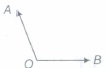
State the type of angle given below.
11.
Using the information given, name the right angles in each part of figure.
AC 丄 BD 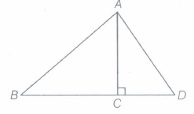
12.
Is it possible for the same, line segment to have two different lengths?
13.
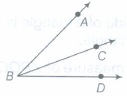
Will the measure of \(\angle ABC\) and \(\angle CBD\) make the measure of \(\angle ABD\) in figure.
14.
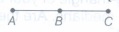
Will the lengths of line segment AB and line segment BC make the length of line segment AC in figure?
15.
The measure of a reflex angle is
180o
<180o
>180o
<90o
16.
How many right angles do you make if you start facing south and turn clockwise to east?
1
2
3
4
17.
What part of a revolution have you turned through if you stand facing north and turn clockwise to face east?
\(\frac{1}{4}\)
\(\frac{1}{2}\)
\(\frac{3}{4}\)
none of these
18.
Through what angle does the hour hand of a clock turn through, when it goes from 2 to 11?
270°
90°
360°
180°
19.
Through what angle measure does the hour hand of a clock turn through, when it goes from 12 to 9?
270°
180°
360°
90°
1.
The situation from 12 to 9 on clock is given in the figure.
Hence, from 12 to 9, hour hand turns through \(\frac { 3 }{ 4 } \) of a revolution, clockwise.
2.
\(\overline { AD } =\overline { AB } +\overline { CD } \) \(\overline { AD } \) = 4 + 3 = 7 cm
3.
\(\overline { PQ } ,\overline { QR } ,\overline { RS } ,\overline { SP } \) and \(\overline { QR } >\overline { PS } ,\overline { SR } >\overline { PQ } \).
4.
\(\overline{ AB } <\overline { PQ } \).
5.
Given, B is the mid-point of \(\overline{ AC } \)
∴ AB = BC .....(i)
and C is the mid-point of \(\overline{ BD } \).
∴ BC = CD .......(ii)
i.e.,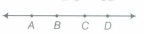
Now, on adding Eqs. (i) and (ii), we get
AB + BC = BC + CD
∴ AB = CD
6.
(a) (i) diagonals are equal
(ii) diagonals bisect each other
(iii) each angle is a right angle
(b) (i) The lengths of all the sides of a square are equal. Its each angle is a right angle.
(ii) Its diagonals bisect each other
(iii) Its diagonals bisect each other perpendicularly
(c) (i) Yes, its opposite sides are parallel
(ii) Yes, its opposite sides are equal
(iii) No, its diagonals are not equal
| Quadrilateral | Opposite sides | All sides equal | Opposite angles equal | Diagonals | ||
| Parallel | Equal | Equal | perpendicular | |||
| Parallelogram | Yes | Yes | No | Yes | No | No |
| Rectangle | yes | Yes | No | Yes | Yes | No |
| Square | Yes | Yes | Yes | Yes | Yes | Yes |
| Rhombus | Yes | Yes | Yes | Yes | No | Yes |
| Trapezium | Yes | No | No | No | No | No |
7.
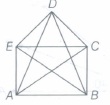
8.
Now, first of all, we draw AB = 2.5 cm and CD = 3.2 cm.

\(\overline{ AB } +\overline { CD } =\overline { EF } \)
Now, we have to draw a line segment
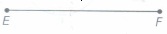
∴ \(\overline { EF } =\overline{ AB } +\overline{ CD } \) = 2.5 +3.2 = 5.7 cm
Hence, new length is 5.7 cm.
9.
(i) One-fourth revolution For one-fourth revolution, the clock hand moves in many individual routes. Some of these situations on a clock are as follows:
(ii) Half revolution For half revolution, the clock hand moves in many individual routes. Some of these situations on a clock are as follows:
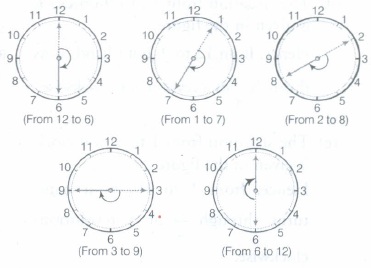
(iii) Three-fourth revolution For three-fourth revolution, the clock hand moves in many individual routes. Some of these situations on a clock are as follows:
10.
In the given figures, we have,
\(\angle AOB\) is an obtuse angle.
11.
\(\angle ACD = \angle ACB = 90°\)
12.
No, a line segment cannot have two different lengths.
13.
Here, \(\angle ABD = \angle ABC + \angle CBD\)
Hence, the measure of \(\angle ABC\) and \(\angle CBD\) makes the measure of \(\angle ABD.\)
14.
Here, \(\overline { AB } +\overline { BC } =\overline { AC } \)
Hence, the length of line segment \(\overline{ AB } \) and \(\overline{ BC } \) make the length of line segment \(\overline{ AC } \).
15.
(c)
>180o
16.
(c)
3
17.
18.
19.

6th Standard CBSE Syllabus & Materials
6th Standard CBSE
CBSE 6th Social Science Locating Places on the Earth - New Sample Question Papers Study Material - QB365 Set A
NEW6th Standard CBSE
CBSE 6th Science A Journey Through States of Water - New Sample Question Papers Study Material - QB365 Set A
NEW6th Standard CBSE
CBSE 6th Science Temperature and its Measurement - New Sample Question Papers Study Material - QB365 Set A
NEW6th Standard CBSE
CBSE 6th Science Materials Around Us - New Sample Question Papers Study Material - QB365 Set A



CBSE 6th Standard CBSE Subjects
CBSE Standards




